Static Electricity Machines · Volume 4
The Cased Machine and the Trade
The medical influence machine as a clinic object — its dry cabinet, Leyden jars, electrodes, and insulated platform — the American makers who sold it, and how static therapy earned a seat, for a while, in respectable medicine.
Contents
4.1 About this volume
The three volumes before this one describe a physical principle and a physiology. Vol 1 — Machines and How They Make Charge traced the generator from the hand-cranked frictional globe to the counter-rotating discs of the Wimshurst influence machine; Vol 2 — Franklinization and the Static Treatments followed the charge onto the body as breeze, bath, spark, and Morton wave; and Vol 3 — Legitimate Use, Overhype, and the X-Ray Second Life drew the line between the real, modest effects and the cure-all claims, and told how the powerful Wimshurst became an early X-ray source after 1896.
This volume is about none of those arguments directly. It is about the object as a piece of clinic furniture — the cased, glazed, motor-driven static machine that a physician actually bought, installed, and stood beside — and about the trade that built and sold it: the New York and Chicago instrument houses, their catalogues and prices, and the professional world that briefly made owning one a mark of a modern, scientific practice. The physics is settled elsewhere in the dive and is not re-derived here; where a number or a date matters it is cited, and where the record is thin it is flagged as such.
4.2 The machine as a clinic object
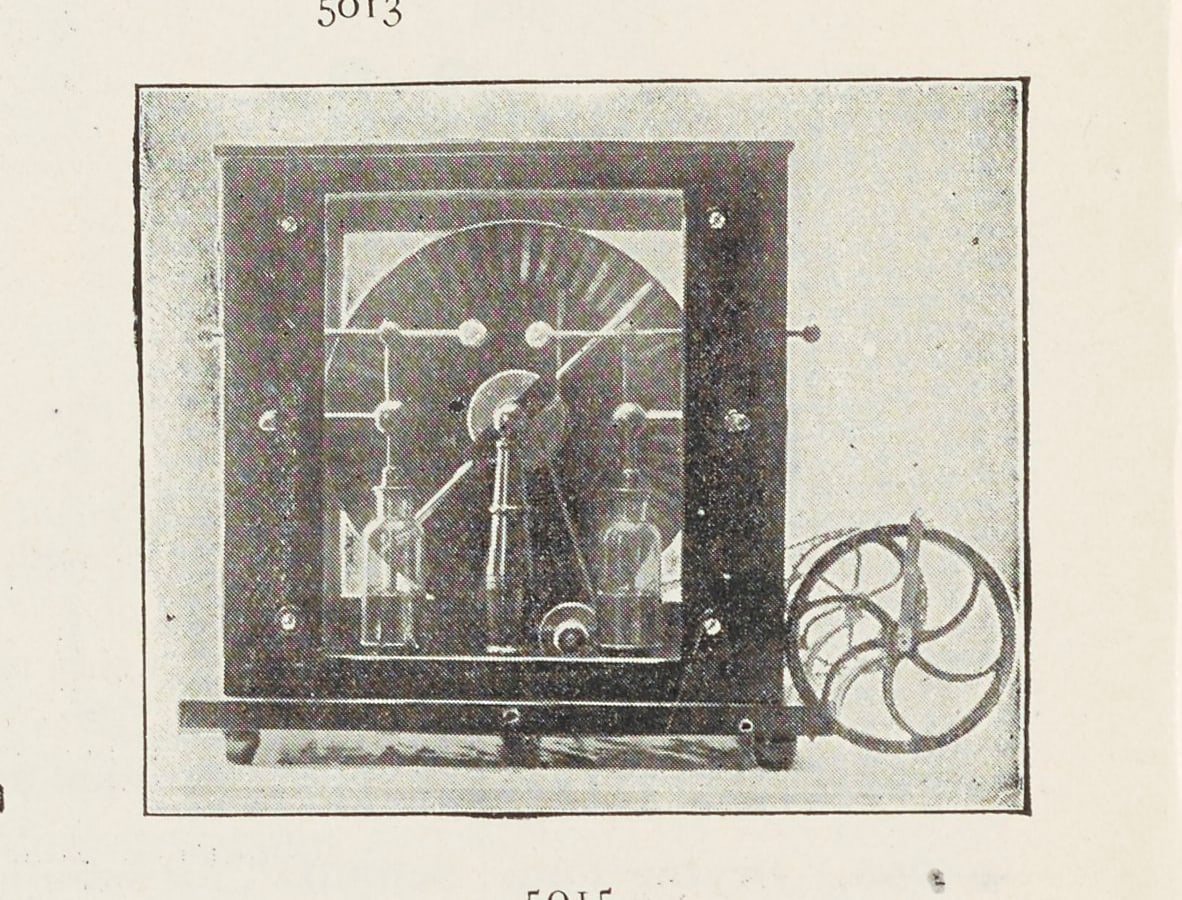
The influence machine of Vol 1 is, in the abstract, a pair of varnished glass plates and some foil. The medical machine was something else: a substantial cabinet, waist- to shoulder-high, built to survive daily use in a consulting room and to work in the one condition that ruins electrostatics — damp air.
That last point shaped the whole design. An influence machine loses its charge the instant humidity lets it leak across the glass, so the medical versions enclosed their revolving plates inside a glazed wooden case, most often mahogany or oak, sealed well enough to keep a dry microclimate around the working parts. Operators kept the interior dry with a desiccant — dishes of calcium chloride set under the glass cover — and were warned to protect the machine from dust and damp, which otherwise crippled its output ⟨verify — the calcium-chloride detail is repeated in period operating guidance but was not pinned here to a single primary page⟩. A machine that would not “excite” on a wet morning was a familiar complaint, and the cabinet was the trade’s answer to it.
Drive came two ways. Smaller instruments were hand-cranked; the larger office and hospital machines were belt-driven by a small electric motor (or, earlier, a water motor), freeing the physician’s hands and giving the steady rotation the treatments wanted. The number of plates was the machine’s headline specification. In a 1908 Journal of the American Medical Association survey of the apparatus, William Benham Snow recorded that the three machine types then on the market — the Holtz, the Toepler-Holtz, and the Wimshurst — produced current “of practically the same quality” but differing in potential, and recommended a Holtz machine of eight to sixteen revolving plates for medical purposes. Plate counts climbed from there: the Chicago maker Frank S. Betz offered a 24-plate Toepler-Holtz among the more elaborate instruments, the kind of machine built as much for the X-ray work of Vol 3 as for therapy.
On top of the cabinet sat the working output: paired Leyden jars — foil-lined glass condensers — that stored the charge, and discharging arms ending in brass balls whose gap the operator widened or narrowed to set the discharge. From terminal posts on the machine, insulated wires ran to whatever the treatment required: a hand electrode, a point electrode, or the metal chain that connected the machine to the patient’s platform. The machine, in other words, was a bench-top high-voltage supply with a small vocabulary of standard fittings — and the fittings, not the physics, were what the catalogues sold.
4.3 The patient’s side: platform, jars, and electrodes
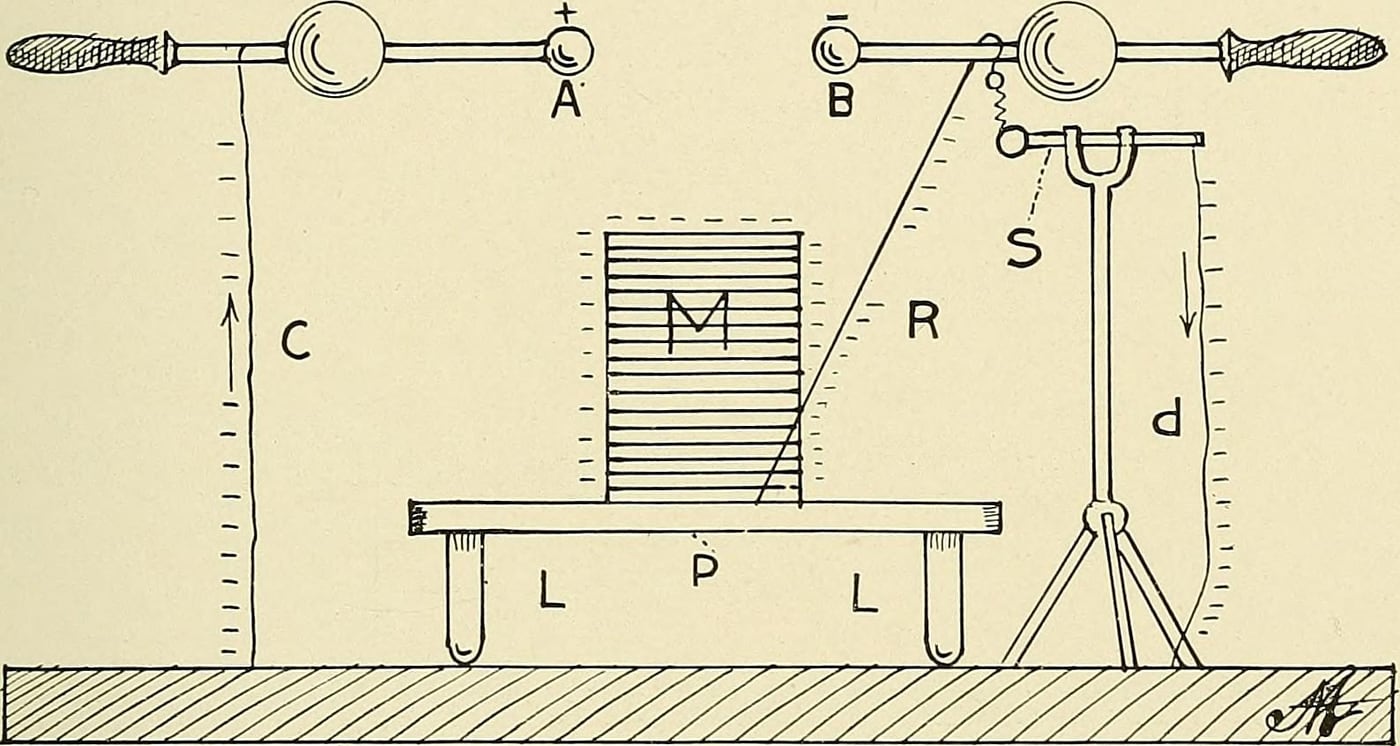
Across the room from the cabinet stood the second half of the apparatus, and it was disarmingly simple. For the static bath — the commonest mode — the patient sat in an ordinary wooden chair mounted on a platform insulated from the floor by four glass legs about a foot high, connected by chain to one terminal of the running machine. The platform raised the seated patient to the machine’s high potential; nothing was “injected,” and with the body isolated the current that flowed was minute. The sensation was a faint prickling and a bristling of the hair, sometimes the smell of ozone — the whole of it a high-voltage, very-low-current phenomenon whose real and modest physiology is Vol 2’s subject.
The other modes were set by swapping the electrode at the operator’s end. A blunt point electrode brought near the skin threw the static breeze (or effluve), a stream of charged air; a ball or knob electrode drew visible sparks from the patient for sharper counter-irritation; and the Morton wave current — the induced, wave-like discharge named for the New York physician William James Morton — was, in Snow’s judgment, “the modality of most importance in static therapeutics.” A single cabinet, a single platform, and a tray of interchangeable electrodes thus delivered the entire static repertoire. That interchangeability is why the object photographs so much like the violet-ray cased set of the Quack wing: a base unit and a fan of applicators, chosen from a booklet against a list of complaints.
4.4 The trade: makers and catalogues
The static machine reached the American physician through the same instrument houses that supplied his faradic and galvanic “medical batteries,” and often on the same catalogue pages — a point that matters, because the trade did not sort its wares by our later categories of “legitimate” and “quack.” It sold electricity, in whatever form a doctor would buy.
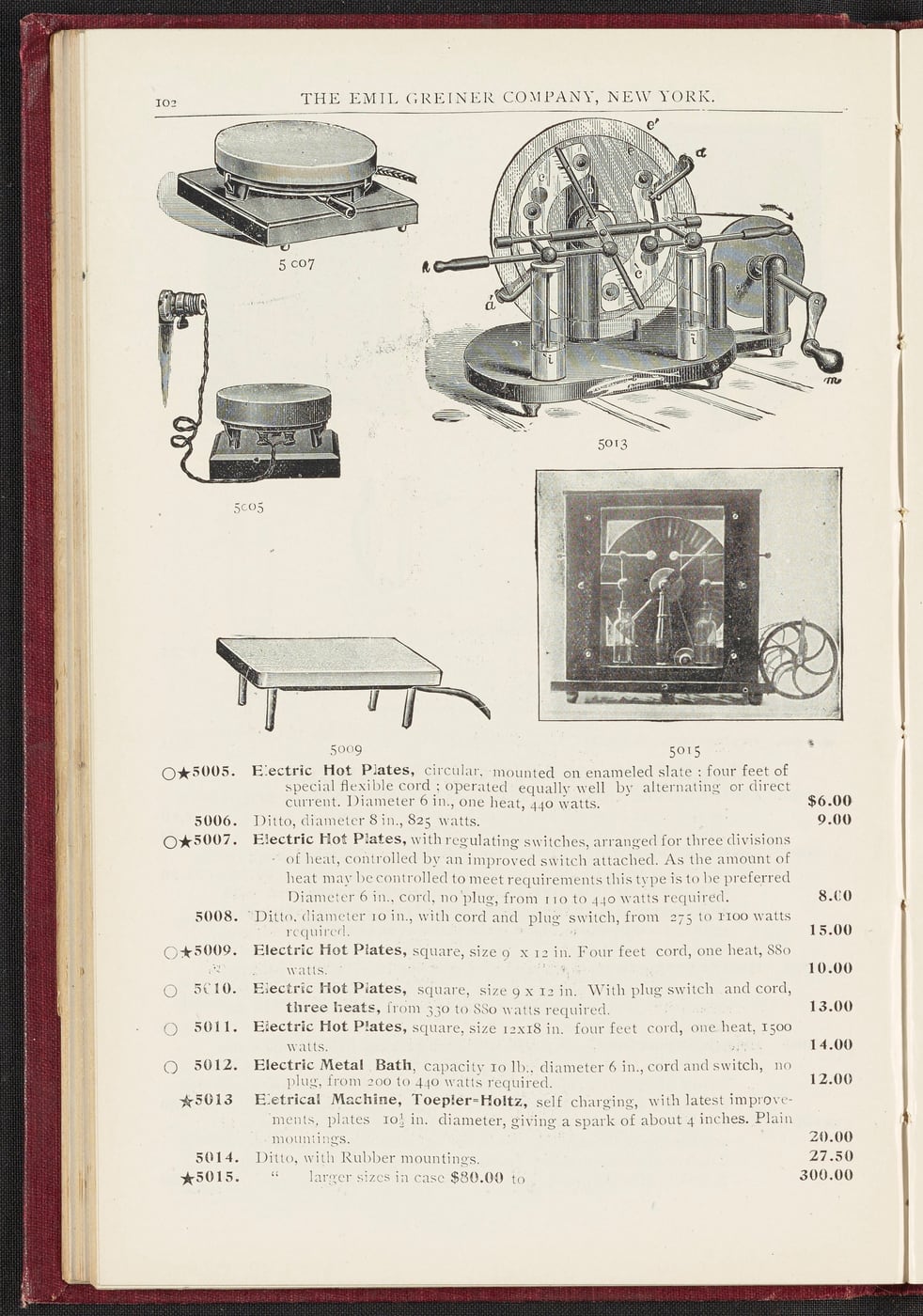
In New York, Waite & Bartlett was among the best-documented houses; its 1895–96 catalogue offered static machines alongside physicians’ wall-cabinet batteries priced in the range of about $200 to $260, available in oak or mahogany, and a remarkable roster of roughly one hundred electrode attachments shaped for different parts of the body ⟨verify — the price band, the wood options, and the ~100-electrode figure come from a secondary study of the medical-battery trade and should be confirmed against the original catalogue⟩. Also in New York, the Kny-Scheerer Company issued large illustrated catalogues running to many editions (the twentieth edition appeared in 1915) that carried electrotherapy and X-ray apparatus side by side. In Chicago, Frank S. Betz & Company built the multi-plate Toepler-Holtz machines noted above and a full electromedical line, and firms such as McIntosh rounded out the Midwestern trade. European makers — the Paris workshop of Ducretet among them — supplied the elaborate influence machines that the American houses in some cases imported or imitated.
Two features of the trade are worth naming. First, the cased machine was a considerable purchase — a piece of capital equipment on the order of a good wall-cabinet battery, not a trinket — which is exactly why makers finished them as furniture and why a surviving specimen tends to be handsome. Second, the physician bought not a machine but a system: cabinet, motor, platform, jars, and a graded set of electrodes, ordered as a fitted outfit. The persuasion lived partly in that completeness. An outfit that filled a corner of the consulting room, humming and sparking on demand, looked like modern medicine.
4.5 Where static therapy sat in medicine
For a genuine stretch of years, that appearance was backed by a real professional standing. Electrotherapy in the 1890s and 1900s was not a fringe pursuit but an organized specialty with its own society, journals, textbooks, and hospital departments — and the static machine sat inside that respectability, not outside it.
The organizing body was the American Electro-Therapeutic Association, constituted in New York in early 1891 (its constitution and by-laws adopted 22 January 1891; some accounts date the founding to 1890), with the Philadelphia physician G. Betton Massey as its first president and the stated object of “the cultivation and promotion of knowledge in whatever relates to the application of electricity in medicine and surgery.” It held annual meetings — the first in Philadelphia in September 1891 — whose programs ran to dozens of clinical papers; at the 1898 Buffalo meeting Nikola Tesla himself presented on high-frequency oscillators for therapeutic use, a reminder of how porous the boundary already was between the static, the faradic, and the coming high-frequency currents.
The specialty also produced substantial textbooks that treated the static machine as standard clinical equipment. Samuel Howard Monell’s A Manual of Static Electricity in X-Ray and Therapeutic Uses (1897) is the representative title — a working handbook that placed the influence machine at the center of both the therapy and the new radiography. What such books claimed for the treatments was, at its soberest, narrow: static electricity was held “valuable in the treatment of certain general and functional nervous disorders, especially neurasthenia,” and as a counter-irritant and general tonic. Those are exactly the diffuse, subjective, suggestion-friendly complaints for which an impressive ritual performs best, and Vol 3 weighs how much of the reported benefit was real. Here the point is only the placement: for two decades the cased static machine was ordinary furniture in a recognized branch of medicine, bought from mainstream instrument makers and written up in mainstream texts.
4.6 The porous edges of the trade
The static machine never stood alone on the shelf. The same physician, from the same catalogue and often in the same room, kept the two other workhorse outfits of the period: the faradic and galvanic “medical battery,” treated in the sibling dive Faradic and Galvanic Machines, and — increasingly after 1900 — the high-frequency apparatus of the High Frequency Currents dive, the d’Arsonval and Oudin coils that would supersede the static machine for many uses. A well-appointed “electrotherapeutic” practice ran all three, and the trade cheerfully sold them as a suite.
That same continuity ran outward into frank quackery, and pretending otherwise would falsify the object. The high-voltage, low-current spark that a physician drew from a platformed patient with a cased Holtz machine is first cousin to the spark a door-to-door salesman sold in a velvet box as a violet-ray wand (Quack-Devices → Violet Ray Wands); the “vitality restored by electricity” promise that filled the static machine’s booklets is the same promise stitched into the galvanic electropathic belts (Quack-Devices → Electropathic Belts). The instrument houses supplied the respectable end of a spectrum whose disreputable end shared its physics, its vocabulary, and sometimes its customers. The cased machine’s dignity was real, but it was a matter of degree, not of kind.
4.7 Why the cased machine faded
The trade in cased static machines did not end in a scandal or a court order — it was quietly displaced. Two forces did the work. The first was the arrival, after 1889, of high-frequency currents, which produced deep, comfortable tissue warmth the static spark never could and which physicians found both more agreeable and more plausibly “physiological”; by the 1910s the d’Arsonval and diathermy apparatus of the later dives were taking over the electrotherapy room. The second was the machine’s own X-ray second life (Vol 3): after 1896 the most powerful influence machines found urgent work as high-voltage radiographic sources, which for a decade kept the biggest Holtz and Toepler-Holtz cabinets in production even as their therapeutic use waned — until the induction coil, and then the transformer and Coolidge tube, made the electrostatic X-ray supply obsolete too.
What survived the influence machine was not its therapy but its lesson, absorbed into legitimate physical medicine: that current can be applied to the body in graded, standardized ways for real if limited effect. The cured-everything static bath left the clinic; the disciplined stimulation of nerve and muscle stayed, in the faradic and high-frequency descendants. The handsome mahogany cabinet became what it is today — a museum object and a collector’s puzzle, a high-voltage antique to be identified, dated, and displayed with care.
4.8 Where this volume hands off
This volume has kept the static machine on the consulting-room floor: the dry cabinet and its motor, the jars and electrodes, the platform, the makers who sold the outfit, and the professional world that made owning one respectable before high-frequency and X-ray work moved on. The final volume, Vol 5 — Collecting Static Machines, takes the same object into the present as a collector’s problem: how to identify and date a Wimshurst, Holtz, or Toepler-Holtz machine, how to read the condition of glass discs, foil sectors, Leyden jars, and drive mechanism, how to weigh provenance — and, above all, how to display a genuine high-voltage antique safely. Read Vol 5 before restoring or running one.
Sources
- Static Electricity: Its Physical Properties, Modalities, Physiologic Effects and Therapeutic Indications — William Benham Snow, JAMA, 1908, vol. 50(16):1241–1244; the three market machine types (Holtz, Toepler-Holtz, Wimshurst) of “practically the same quality” differing in potential, the recommendation of an 8–16-plate Holtz for medical use, and the Morton wave current as “the modality of most importance in static therapeutics.”
- The American Electro-Therapeutic Association and related notices — period record of the Association organized in New York (constitution adopted 22 January 1891), G. Betton Massey first president, its stated object, first annual meeting (Philadelphia, September 1891), and the 1898 Buffalo meeting at which Tesla presented on high-frequency oscillators.
- Manual of Static Electricity in X-Ray and Therapeutic Uses — S. H. (Samuel Howard) Monell, 1897 (this Internet Archive copy 1900); the representative specialty textbook placing the cased influence machine at the center of static therapy and early radiography.
- The Medical Battery in the United States (1870–1920): Electrotherapy at Home and in the Clinic — study of the electromedical trade; the Waite & Bartlett 1895–96 catalogue, wall-cabinet batteries at ~$200–$260 in oak or mahogany, and roughly one hundred shaped electrode attachments (figures flagged for confirmation against the original catalogue).
- Kny-Scheerer Company — College of Physicians of Philadelphia; the New York instrument house’s illustrated trade catalogues (20th edition, 1915) carrying electrotherapy and X-ray apparatus together.
- Electrostatic Machines — A. C. M. de Queiroz; large medical electrostatic (influence) machines around 1900 as the most elaborate ever built, used for both electrotherapy and radiography, hand- or motor-driven and kept protected from dust and damp; Holtz, Toepler-Holtz, Wimshurst, and Bonetti types.
- Recent Applications of Electricity: III. Static Electricity — George Parker, The Hospital, 1902; and General Considerations — Static Electricity, A. C. Norman, The Hospital, 1913 — period clinical accounts of the insulated platform (four glass legs ~1 ft high), Leyden-jar storage, breeze, spark, and bath, and the standing of static therapy for “functional nervous disorders, especially neurasthenia.”
- Electrostatic Modes of Application, Therapeutics and the Uses of the Roentgen Ray — Buffalo Medical Journal, 1904; period pairing of static-application modes with X-ray use, illustrating the machine’s dual clinical role.
- Museo Galileo — Electrotherapy (electro-medicine) — museum overview of electrotherapy’s rise from the mid-18th century, the Leyden jar and insulated supports, and the medical profession’s mixed reception.
Comments (0)