Static Electricity Machines · Volume 5
Collecting the Static Machine
How to tell a Wimshurst from a Holtz or a Toepler, how to date and grade a surviving influence machine by its discs, sectors, Leyden jars, and drive, and why a high-voltage antique is displayed with care even though it never touches the mains.
Contents
5.1 About this volume
The end of this dive is the object on the shelf: a cast-iron frame carrying two glass or ebonite discs, a crossing pair of brush-tipped bars, two Leyden jars, and a set of brass balls on adjustable arms. Four earlier volumes explained what such a machine is — how frictional and influence generators build charge (Vol 1 — The Machines and the Charge), what the static treatments actually did to skin and nerve (Vol 2 — Franklinization and the Static Treatments), where the genuine medicine ended and the “cures everything” marketing began, and the machine’s consequential second life as an X-ray source (Vol 3 — Legitimate Use, Overhype, and the X-ray Second Life), and how the cased medical machine sat in the clinic and the trade (Vol 4 — The Cased Medical Machine and the Trade). This closing volume is for the person who now owns one, or is about to: how to identify and date it, how to grade its condition honestly, and why a hand-cranked antique that never plugs into a wall still deserves a careful, hands-off posture.
Static machines survive well and turn up often, because most were built not for clinics but for schoolrooms — small demonstration models that outlasted the therapeutic fashion entirely. They are frequently mislabelled by sellers, who reach for “Wimshurst” the way they reach for “Edwardian,” so the first skill a collector needs is telling one machine from another.
5.2 Telling the three machines apart
Three names cover almost everything a collector will meet: Holtz, Toepler (usually as “Toepler-Holtz”), and Wimshurst. They are distinguished by their discs, not their decoration.
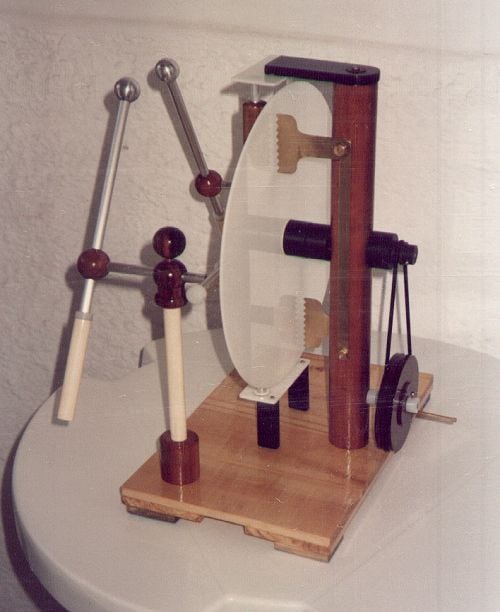
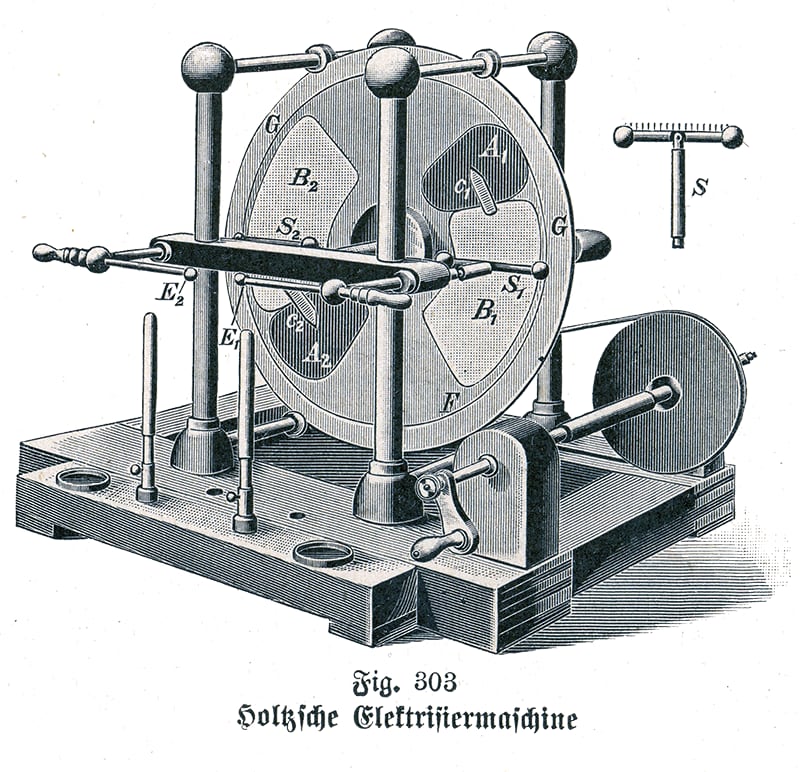
Holtz (from 1865). Wilhelm Holtz’s original machine of 1865 used a single large rotating disc turning in front of a slightly larger fixed disc. The fixed disc carries paper “inductor” armatures at two opposite windows; the rotating disc itself is plain glass with no metal sectors — the defining feature. A genuine first-form Holtz is therefore visually spare: one moving disc, two paper-armed windows, point collectors reaching to the back of the disc. It is powerful (period accounts claim sparks up to three-quarters of the disc diameter) but temperamental, sensitive to damp, and generally needs an initial charge to start. Holtz built a second form in 1867 using two counter-rotating discs, blurring the later distinction from Wimshurst; a single-disc, sectorless machine is the safest thing to positively call “Holtz.”
Toepler-Holtz (1865 onward). August Toepler’s contribution, also from the mid-1860s, was to put metal sectors on the disc. The common laboratory “Toepler-Holtz” hybrid that resulted looks like a Wimshurst at a glance — sectored discs, comb collectors — but the sector and brush geometry differs. The disc arrangement itself is a poor test, because the label is used loosely across the sources: some machines sold as “Toepler-Holtz” drive two discs on a common shaft in the same direction, others counter-rotate like a Wimshurst, and many Voss-type machines of the family use one fixed plate and one rotating plate rather than two turning discs at all. The reliable Wimshurst tells are elsewhere: the crossed diagonal neutralizer bars with their trailing brushes, a pair of matched sectored discs turning in opposite directions, and true self-excitation (it builds up from no priming charge). Judge by those, not by rotation direction alone.
Wimshurst (developed c. 1880–1883). James Wimshurst (1832–1903), an English marine surveyor, produced the design that displaced all the others: two discs that contra-rotate, each carrying foil sectors, with two crossed neutraliser bars whose brushes wipe the sectors, charge combs feeding a pair of Leyden jars, and a spark gap between brass balls. Its virtues are the ones a collector can see in operation — it self-excites (no external charge needed), is far less bothered by humidity, and, crucially for its medical afterlife, holds a fixed polarity that does not flip as it runs, which is exactly what an X-ray tube wants. A History of Science Museum, Oxford specimen is characterised as easily reaching a potential difference of 50,000–60,000 volts at very low current — the “tens of kV” figure the field quotes, and one worth treating as an order-of-magnitude claim rather than a meter reading.
5.3 Reading and dating a Wimshurst
Assume the seller’s label is wrong and read the machine itself. A few features place most specimens within roughly 1885–1930.
Discs and sectors. Wimshurst discs are glass or ebonite (hard vulcanised rubber), roughly 20 cm across and up on the ubiquitous classroom models — the Greenslade collection records both a ~20 cm table machine and a larger demonstration example with 16-inch (~40 cm) plates — and far larger again on medical and X-ray machines. The foil sectors are the counting feature: surviving demonstration machines are described with 24, 30, or 36 sectors per disc, and the number, spacing, and shape of the sectors, plus whether both discs match, are the first things to record. Original sectors are thin foil (often copper) glued flat; crude, oversized, or mismatched sectors are a restoration tell.
Base, frame, and drive. A cast-iron base with turned pillars, a large hand crank, and crossed leather drive belts running over pulleys is the standard build; the belts crossing is what makes the discs turn opposite ways. Brass Leyden jars’ mounts, brass discharge balls on insulating (often ebonite or glass) pillars, and the neutraliser bars complete the frame.
Marks and makers. A maker’s plate or a cast mark narrows the date sharply. German machines frequently carry a “D.R.G.M.” mark — Deutsches Reichs-Gebrauchsmuster, a registered-utility-model stamp used only from 1891 to about 1945 — which brackets the piece to that window at a glance. Named makers a collector meets include Max Kohl of Chemnitz (whose c. 1900 catalogue priced these machines at roughly 105–180 Marks by plate size), L. E. Knott of Boston, the Chicago Laboratory Supply Company, and C. H. Stoelting; American versions sold for about $40 around 1916. Later and more decorative examples include Heinrich Wommelsdorf’s “Womella” influence machines and the mail-order sets of the Electro Importing Company, both active in the early 1900s, and Art-Deco-era German machines branded Voltana. Many good machines, however, bear no mark at all — a great deal of classroom apparatus was anonymous — so absence of a plate is not evidence of a fake.
5.4 Condition assessment
Grade the machine in the order that its faults cost you money and function.
The discs. This is where value lives and dies. Glass discs chip and crack but are otherwise stable. Ebonite discs are the problem material: with age and exposure to humid or salty air the rubber degrades, liberating sulphur compounds that darken the surface to a brown, slightly greasy bloom and corrode the foil sectors sitting on it. A badly degraded ebonite disc can go partly conductive at the surface — fatal to the machine’s action — and can warp past the point of true running. Warped, delaminating, or heavily browned discs are often beyond honest restoration and are the single most common reason a “working” machine does not work.
The sectors. Expect losses. Sectors lift at the edges, oxidise, and go missing; a machine with several absent or replaced sectors is common and not disqualifying, but note originality, because re-foiling with modern aluminium tape is the usual repair and changes the object’s status from original to restored.
Leyden jars and combs. The paired Leyden jars are frequently cracked, replaced, or simply gone — many surviving frames retain only the jar mounts. The charge combs and neutraliser brushes are delicate and often bent, corroded, or missing. None of this is unusual; all of it is worth recording, because a complete, matched, original jar-and-comb set is far scarcer than the frame that holds it.
The drive. Original leather belts perish and stretch; a period machine almost always has replacement belting, and that is expected rather than a flaw. Check the crank, axle, and bearings for wear and for the wobble that throws a disc out of true.
A useful rule of thumb: a complete machine with sound discs, its original Leyden jars, matched sectors, and an untouched frame is worth far more than the sum of a warped-disc frame plus a box of loose parts. Completeness and originality, not mere working order, set the value.
5.5 Provenance and the clinical pedigree
Provenance turns a classroom curiosity into a document, and static machines occasionally carry an extraordinary one. The Oxford Wimshurst noted above was purchased in 1898 by an Oxford undergraduate, E. G. Spencer-Churchill, who first used it to make X-ray shadowgraphs of his friends’ hands for amusement, then took it to the South African (Boer) War of 1899–1902, where the Royal Army Medical Corps used it — paired with a Jackson-type X-ray tube — to locate bullets, shrapnel, and fractures in wounded soldiers. That is the whole arc of these machines in one object: parlour spark, then real battlefield radiography, the “second life” that Vol 3 treats in full.
Few machines come with a story like that, but any paper helps: an original maker’s catalogue page, a school or hospital inventory number, an instruction card, or a dated bill of sale ties the object to the moment Vol 4 describes. Photograph the sectors and the maker’s mark, count the sectors, and record where the machine came from; that record is the difference between “an old spark machine” and a dated, attributed instrument.
5.6 Safe display of a high-voltage antique
The safety story here is different from that of the mains-powered quack devices — and a collector should understand the difference rather than assume it. A static machine has no cord and no transformer; it draws power only from the hand that cranks it, so it carries none of the perished-mains-cord and shock-through-degraded-wiring hazards that make a violet-ray wand (see the Violet Ray Wands dive in the Quack wing) or a cased faradic set (see the Faradic and Galvanic Machines dive) genuinely dangerous to power up. Displayed cold and un-cranked, an influence machine is among the safer antiques on the shelf.
It is not, however, harmless when turned. The point of the machine is to build tens of kilovolts, and its Leyden jars are designed to store that charge; the current is very small, but the shock from a charged jar or a drawn spark is real, startling, and can cause a reflexive jerk near fragile glass and iron. So the sober posture is the same one the rest of this collection recommends: display, don’t demonstrate, unless you know exactly what you are doing — and if a machine is ever cranked, the elementary courtesy the machine demands is to treat its Leyden jars as charged and to short them to the frame before touching the terminals. This volume gives no operating procedure; the point is only that a stored high-voltage charge deserves respect.
The conservation cautions are as important as the electrical ones, and mostly concern the discs. Keep the machine dry and out of direct sun and away from salt air: humidity both spoils performance and accelerates the ebonite degradation described above, and sunlight yellows and embrittles both ebonite and any varnish. Do not sand, solvent-clean, or abrade an ebonite disc — its surface chemistry is exactly what is failing, and aggressive cleaning makes it worse; conservators warn that even some varnishes react with ageing ebonite and turn it conductive. Handle the discs by their edges, store the machine where a knocked crank cannot swing a disc into a pillar, and let a working restoration — new belts, re-foiled sectors, replacement jars — be an explicit, recorded choice rather than a default, because every such repair moves the object from original toward reproduction.
5.7 Where this volume hands off
This is the last volume of the Static Electricity Machines dive. From here the Electrotherapy Devices collection moves down the current: the steady galvanic and pulsed faradic “medical batteries” of the Faradic and Galvanic Machines dive, the d’Arsonval and Oudin apparatus of the High Frequency Currents dive — whose coil is the same one the Violet Ray Wands dive treats as a drugstore cure-all — the deep-heating machines of the Diathermy Machines dive, and the sober origin story of the Early Electroconvulsive Therapy dive. Each ends, as this one has, on the object a collector holds and how to read it honestly: what it is, what it truly did, and what the age of “electricity cures everything” only claimed it did.
Sources
- Wimshurst machine — History of Science Museum, Oxford — early-1880s development by James Wimshurst; two insulated glass discs contra-rotated by pulley wheels, tin-foil sectors, comb collectors, Leyden-jar capacitors; the 50,000–60,000-volt figure; and the 1898-purchased specimen’s Boer War / Royal Army Medical Corps X-ray provenance (Spencer-Churchill, Jackson-type tube).
- The Holtz Electrostatic Influence Machine — A. C. M. de Queiroz (COPPE/UFRJ) — Holtz’s 1865 single-disc first machine and 1867 two-disc second machine; the defining absence of metal sectors on the Holtz rotating disc; humidity sensitivity and the need for external excitation.
- Restoration of a Wimshurst machine with ebonite disks — A. C. M. de Queiroz — ebonite degradation (brown sulphur bloom, corroded sectors, surface turning conductive), warped/worn original discs, missing collectors/brushes and Leyden jars, perished belts; and the caution that varnishing ageing ebonite can make it conductive.
- Wimshurst Machine — Kenyon College, Greenslade Collection of Historical Scientific Apparatus — Wimshurst (1832–1903) and the contra-rotating design; glass or ebonite plates ~16–20 cm; foil sectors; makers (Max Kohl, L. E. Knott, Chicago Laboratory Supply, C. H. Stoelting), German prices of ~105–180 Marks c. 1900 and the ~$40 US price c. 1916; the “no pole change” property suiting X-ray use; and plate sizes from ~20 cm on a table machine to 16 inches (~40 cm) on a larger demonstration example.
- Töpler-Holtz machine — Electricity–Magnetism reference and Toepler-Holtz Machine — Kenyon Greenslade Collection — Toepler’s mid-1860s addition of metal sectors; the sources disagree on the disc arrangement (same-shaft co-rotating vs. counter-rotating vs. fixed-plus-rotating plates), so rotation direction is treated here as an unreliable test and the crossed neutralizers, matched contra-rotating discs, and self-excitation are used to identify a Wimshurst instead.
- Holtz-type influence machine — Smithsonian Institution / NMAH and Wimshurst-type influence machine — NMAH — museum object records anchoring the single-disc Holtz versus double-disc Wimshurst distinction.
- Edwardian Period Wimshurst Machine — Selling Antiques (dealer listing) — a representative surviving specimen: cast-iron base, two contra-rotating ebonite discs with 24 metal sectors, glass Leyden jars on brass plates, brass discharge nodes; unmarked, dated c. 1910; comparison makers Wommelsdorf (“Womella”) and the Electro Importing Company; the 1880–1883 development window.
- DRGM registered marks (1891–1945) — porcelainmarksandmore.com — the Deutsches Reichs-Gebrauchsmuster utility-model mark and its 1891–1945 date range, used here as a dating cue for German influence machines.
Comments (0)