Static Electricity Machines · Volume 2
Franklinization: The Breeze, the Bath, and the Spark
How physicians actually applied the static machine to a patient — the insulated bath, the electric breeze, sparks drawn from the spine, and the Morton wave — and the honest, superficial physiology beneath a century of overclaim.
Contents
2.1 About this volume
Vol 1 — Making the Charge established the machine: the frictional globes and cylinders of the eighteenth century and the influence machines — Holtz, Toepler, Voss, and above all the Wimshurst — that separated charge by induction and stored it in Leyden jars, building tens of kilovolts of potential at a vanishingly small current. This volume takes that potential off the machine and applies it to a person. It is the clinical volume: what a physician between roughly the 1850s and the First World War actually did with a static machine at the bedside, under the umbrella term Franklinization.
There were, in practice, only a handful of ways to couple a static machine to a patient, and each is taken in turn below: raising the whole body to high potential on an insulated platform (the static bath), streaming charge silently off a pointed electrode onto the skin (the breeze or effluve), drawing visible sparks from the body, and the induced-current variant that came to be called the Morton wave. The distinction that governs everything here is the one from Vol 1 — high voltage, tiny current. That combination is exactly what makes these treatments dramatic to experience and, for almost every disease they were sold to cure, physiologically trivial. The genuine effects are real but shallow: skin sensation, a startle, subjective warmth, ozone, and mild counter-irritation. The deep and systemic cures were advertising, and this volume sets the two apart plainly.
2.2 Franklinization: the name and the honest man behind it
The therapy is named for Benjamin Franklin, and the naming is quietly ironic, because Franklin himself was among the first to conclude it did not work as advertised. In the mid-1750s Franklin was asked to treat paralytics with electricity — passing Leyden-jar shocks through affected limbs. In a much-cited letter written to John Pringle in 1757, he gave a scrupulously honest account: patients often showed a temporary return of warmth and motion immediately after a treatment, but the improvement faded, the patients grew discouraged and stopped coming, and he could not say the electricity had produced any lasting cure (American Philosophical Society; Electric bath, Wikipedia). Franklin suspected that whatever benefit appeared owed as much to the patient’s exertion and expectation as to the sparks — a placebo insight two centuries early. That a whole nineteenth-century therapy took his name is a good measure of how much more confident its later promoters were than its careful originator.
After Franklin the practice drifted for decades toward showmen and empirics, then was pulled back toward respectable medicine by Golding Bird, who ran the “electrifying room” at Guy’s Hospital in London from about 1836, treated defined conditions rather than everything, and published his cases in Guy’s Hospital Reports (Electric bath, Wikipedia; HandWiki). By the late nineteenth century static treatment had a place in serious neurology: at the Salpêtrière in Paris, an electrotherapy service was organized under Romain Vigouroux from about 1875, and Jean-Martin Charcot — with Babinski and, for a time, the young Freud — used static baths, sparks, and faradization in the diagnosis and management of what were then called hysterical or functional disorders (OUPblog). It is worth registering that Freud later wrote flatly that any good results from such treatment “were entirely the result of suggestion” — Franklin’s own doubt, returning at the other end of the century.
2.3 Charging the patient: the static bath
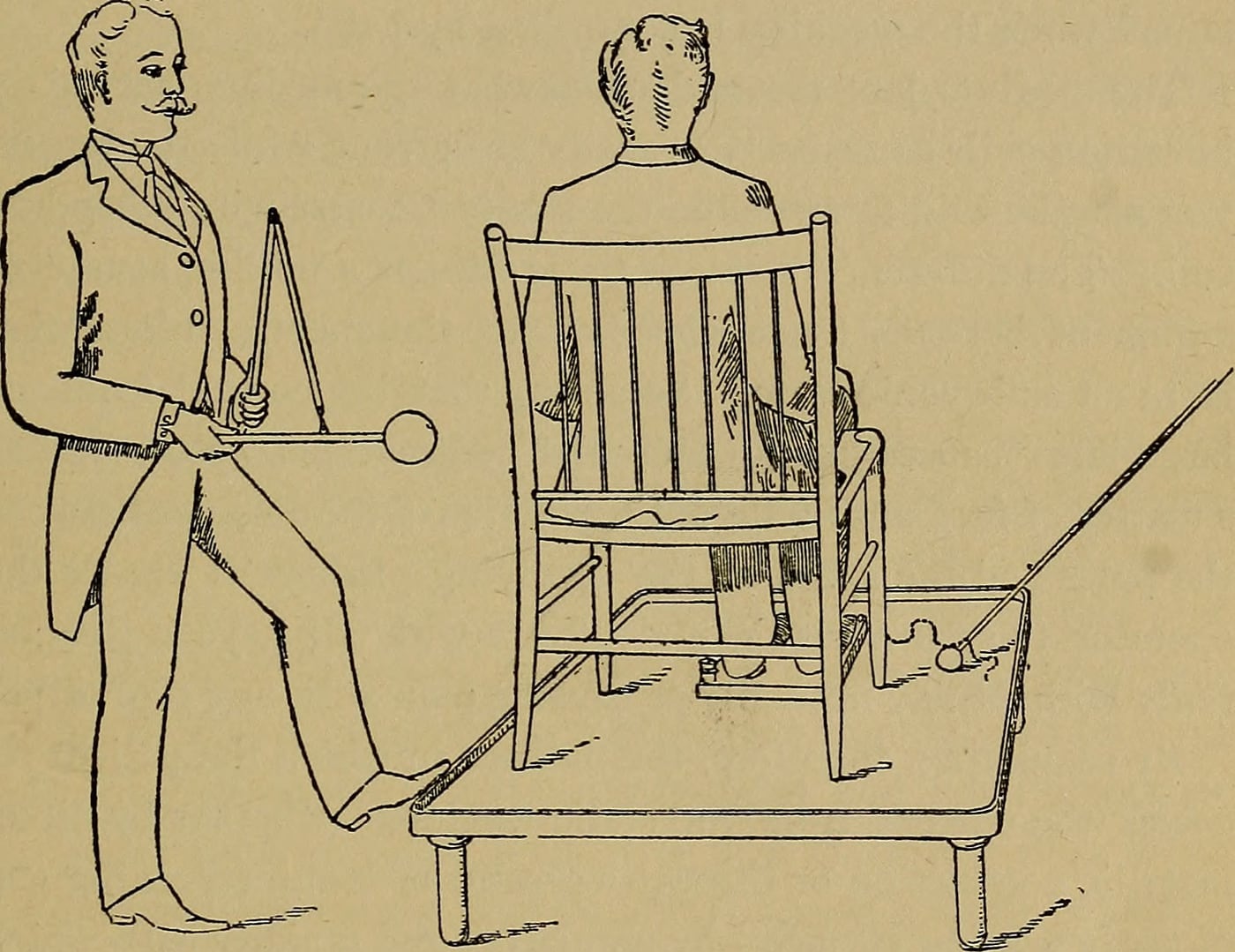
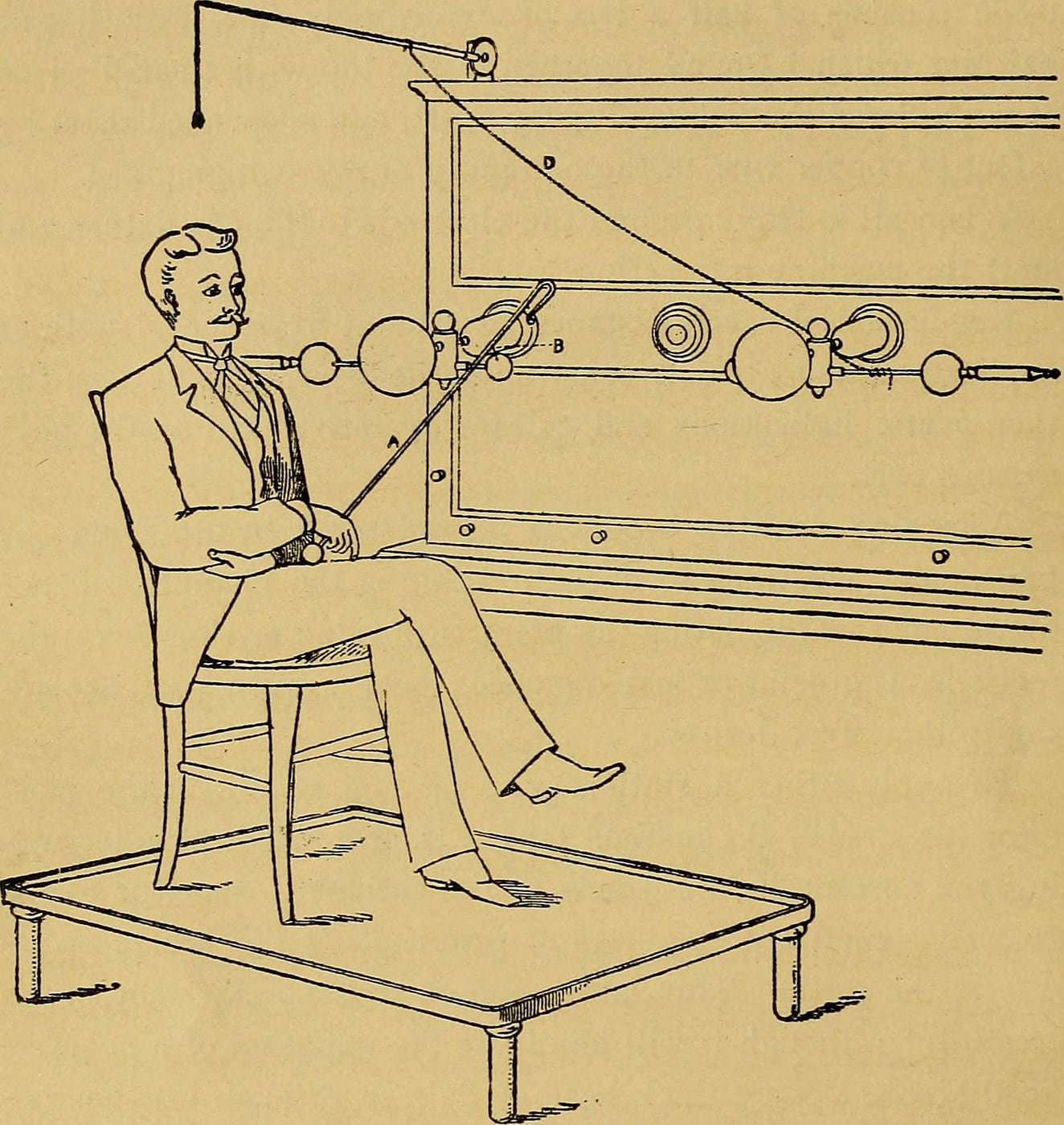
The foundational technique was to make the patient part of the charged conductor. The patient sat on a wooden stool or couch mounted on a platform standing on glass legs or other insulators, connected by a chain or rod to the prime conductor of the machine (Electric bath, Wikipedia). Turning the machine raised the whole insulated body to a high steady potential relative to the earthed room — figures on the order of 30–50 kV are cited for the bath, though this is a secondary-source range and period practice varied ⟨verify⟩.
Because the current available was so small, this was not a shock; it was painless. What the patient felt and an observer saw were the surface signs of a body at high potential: the hair standing on end, a subjective warmth and mild sweating, and — in a darkened room — a faint luminous corona at the hair and fingertips as charge leaked from the body’s sharpest points into the air (Electric bath, Wikipedia; HandWiki). Period clinicians also reported a quickened pulse and the impression of stimulated circulation; these observations are genuine as observations, but they describe a mild, transient autonomic response to a novel and slightly alarming procedure, not a therapeutic action on any disease.
2.4 The electric breeze (effluve)
The most distinctive of the static treatments needed no contact at all. A pointed or multi-pointed metal electrode — a “crown” or brush of needles, often earthed through a chain — was held a short distance from the skin of a charged patient (or brought near an earthed patient from a charged electrode). At a sharp point the field concentrates enough to ionize the surrounding air; the resulting silent discharge drives a stream of charged air molecules across the gap, and the patient feels exactly what a cool wind feels like playing on the skin. This is the static breeze, also called the effluve — described in period sources as a sensation “as if a wind or breeze were playing upon the part,” produced by “a silent discharge of electricity passing from the patient through the intervening air to the electrode and thence to earth” (Electric bath, Wikipedia).
The breeze is a corona discharge, and it is the honest physical cousin of a device in the neighbouring Quack wing: the glowing glass wand of the Violet Ray Wands dive delivers essentially the same thing — a superficial spray of ionized air and tiny sparks — from a high-frequency handset rather than a static machine. Both leave the same calling cards: a prickle, a faint warmth, and the sharp chlorine-pool smell of ozone, produced when the discharge splits atmospheric oxygen. The breeze was applied over painful joints, the face, or the scalp, and inhaled from an ionized-air stream as a form of “ozone therapy” (HandWiki). Ozone is genuinely produced; it is also a respiratory irritant at any concentration strong enough to notice, which is the recurring pattern of this whole field — a real physical by-product mistaken for a tonic.
2.5 Sparks drawn from the body
Where the breeze was gentle, the spark was pointed and brief. With the patient charged on the platform, the operator brought a rounded, earthed metal electrode toward a chosen area — commonly along the spine or over a specific muscle group — and let a visible spark jump the last gap (HandWiki). Each spark is a small, sudden discharge of the accumulated charge (a Leyden-jar condenser in the circuit sharpened it), felt as a distinct sting and a localized startle.
Physiologically this is counter-irritation: a sharp cutaneous stimulus that produces a reflex flush, a momentary muscular startle, and the familiar phenomenon by which one brisk surface sensation distracts from a deeper ache. It is a real, if minor, effect — the same principle behind a mustard plaster or a slap of liniment — and nothing more. It is worth distinguishing the static spark from the sustained, rhythmically interrupted current of the faradic coil, which can actually drive a motor nerve into repeated twitch or tetanus; that is a different physiology and the subject of the Faradic and Galvanic Machines dive. The static spark startles a muscle; it does not exercise one.
2.6 The Morton wave
The most technically interesting static modality is associated with the American electrotherapist William James Morton (1845–1920) — son of the William T. G. Morton connected with the first surgical use of ether anaesthesia, and himself an authority in electrotherapeutics and an early figure in American radiology (William J. Morton, Wikipedia). Morton’s contribution was a mechanical arrangement for drawing an interrupted, induced current from the static machine — the “static induced current” or, as it was known, the Morton current or Morton wave. Rather than applying steady high potential or single sparks, the apparatus took the rapid, oscillatory discharge of the machine’s Leyden jars through a coil and delivered a train of pulses to the patient — a waveform sitting somewhere between static electricity and the high-frequency currents that were arriving in the same years.
That in-between character is the point. Morton’s static induction was, in effect, an early bridge toward high-frequency electrotherapy, and period authors treated “Morton wave current” and “static modalities” as close relatives — a 1920 Royal Society of Medicine demonstration was devoted to obtaining both from a single coil (Batten, Proc R Soc Med 1920). The precise electrical specification of the Morton wave — its pulse rate and peak potential — is not something the sources pin to a single reliable figure, and it should be treated qualitatively as a high-voltage, low-current interrupted discharge ⟨verify⟩. Morton’s machine also had a second and more consequential use, entirely apart from therapy: as a high-potential source it could excite an X-ray tube, which is where the static machine’s real medical importance lay after 1896 — the story taken up in Vol 3. His later life, including a 1912 mail-fraud conviction over a mining scheme, is a caution against reading his authority as unqualified.
2.7 What the current really did: the physiology
Assemble the honest list and it is short, and it follows directly from high voltage, tiny current. On the skin: a prickle, a reflex reddening, subjective warmth, and — where sparks or a breeze are used — a mild counter-irritant effect and a whiff of ozone. On muscle: a startle to a spark, not a controlled contraction. On the circulation and autonomic system: a modest, transient rise in pulse and a sense of stimulation, consistent with the mild arousal of an unusual procedure. On the mind: the considerable effect of an impressive, sensory-rich ritual — the crackling machine, the standing hair, the visible glow — which is exactly the suggestion that Franklin suspected and Freud later named.
What does not happen is any of the deep work the treatment was sold for. The current is far too small to stimulate or repair a paralysed nerve, dissolve a deposit in a joint, or reach an internal organ; the energy stays at the body surface, where the field concentrates. The genuine physiological account is therefore continuous with the honest account of the Violet Ray Wands and High Frequency Currents dives: superficial stimulation and counter-irritation are real; systemic cure is not. The one durable clinical descendant of surface electrical stimulation — the reflex and neuromuscular effects put to controlled use — belongs to the faradic and galvanic tradition, not to static electricity, which faded from practice as those and the high-frequency currents matured.
2.8 What was advertised, and the debunk
Against that modest reality, static electrotherapy was marketed, especially in its popular and clinic-commercial forms, as a treatment for rheumatism and gout, paralysis, sciatica and neuralgia, “nervous exhaustion” and neurasthenia, insomnia, constipation, and a long tail of chronic complaints. The claim rested on a category error that runs through this entire wing: mistaking high potential for therapeutic power. Tens of kilovolts sounds overwhelming, and the standing hair and visible corona make it look overwhelming, but the deliverable energy is set by the current — which here is minute — and by where that energy goes, which is the skin surface. A dramatic voltage with almost no current behind it can startle and tingle a body without doing measurable work inside it.
Where symptoms genuinely eased, the honest explanations are the ones the best practitioners themselves reached for: counter-irritation (a real, shallow analgesic distraction), the placebo and suggestive weight of an elaborate procedure (Franklin’s fading paralytics; Freud’s “entirely the result of suggestion”), and the natural remission of self-limiting or functional complaints. That is not nothing — counter-irritation and suggestion are real clinical phenomena — but it is a world away from curing paralysis or “restoring vitality.” Static therapy is best understood as an honest core of trivial effects wrapped in an extravagant promise, and it declined in the early twentieth century not because it was banned but because it was superseded: the faradic and galvanic currents did the real neuromuscular work, high-frequency and diathermy apparatus did the real heating, and — as the next volume tells — the powerful influence machine found a far more consequential job driving an X-ray tube. Apparatus for the static bath was reportedly still offered for sale as late as 1908 (Electric bath, Wikipedia), a lingering afterlife rather than a living practice.
2.9 Where this volume hands off
We have taken the machine of Vol 1 and put it to the body — bath, breeze, spark, and Morton wave — and drawn the line between the shallow physiology that was real and the deep cures that were not. Vol 3 — Legitimate Use and the X-Ray Second Life picks up the two threads left dangling here: the sober question of where static electrotherapy sat between genuine counter-irritation and cure-for-everything overreach, and the machine’s dramatic reinvention after 1896, when a powerful Wimshurst became a high-voltage source for Röntgen-ray work — the one use of these machines that changed medicine for good, and the context for Wimshurst’s 1898 Fellowship of the Royal Society. From there the dive turns to the cased medical machine as a clinic object and trade (Vol 4) and to identifying, dating, and safely displaying a surviving high-voltage antique (Vol 5).
Sources
- Electric bath (electrotherapy) — Wikipedia — supported the insulated-platform static bath, the ~30–50 kV figure, the Franklinization naming and Franklin’s 1757 letter, Golding Bird at Guy’s Hospital from 1836, the static breeze as a silent point-discharge “wind,” sparks drawn from the spine, ozone inhalation, and apparatus still on sale in 1908.
- Electric bath (electrotherapy) — HandWiki — corroborated the frictional-machine/induction charging, the physiological signs (warmth, sweat, raised pulse, standing hair, luminous corona), the spark-from-spine technique, and the breeze-as-ozone-therapy detail.
- William J. Morton — Wikipedia — supported Morton’s dates (1845–1920), his “static induced current”/“Morton current,” his standing in electrotherapeutics and early radiology, the William T. G. Morton (ether) family link, and the 1912 mail-fraud conviction.
- Batten, “A Simple Means of obtaining ‘Morton Wave Current’ and ‘Static Modalities’ from a Coil,” Proc R Soc Med 13 (Electro-Ther. Sect.), 1920 — PubMed — established that “Morton wave current” and “static modalities” were period clinical terms obtainable from a coil; confirms the category without a firm electrical specification.
- “Cured with sparks: a history of electrotherapy for functional neurological symptoms” — OUPblog, 2015 — supported Charcot, Babinski, and Freud’s use of static baths, sparks, and faradization, and Freud’s later “entirely the result of suggestion” verdict.
- “Fishy Science, Part 2: Ben Franklin and Electrical Medicine” — American Philosophical Society — supported Franklin’s own cautious, largely negative assessment of electrical treatment for paralysis and his early suspicion of suggestion/placebo.
- Period clinical texts consulted for framing (page-image scans; used qualitatively): Preston King, “The Uses of Static Electricity as an Aid to Recovery,” Bristol Medico-Chirurgical Journal 24 (1906) — PMC5046483; George Parker, “Recent Applications of Electricity: III. Static Electricity,” The Hospital (1902) — PMC5208725; “The Physiological Effects of the Franklinic Current,” Southern Medical Record (1893) — PMC9154943. Each names the breeze/effluve, static bath, sparks, and Morton wave as the standard modalities.
- Cross-references (named in prose, not duplicated): the Faradic and Galvanic Machines and High Frequency Currents dives (Electrotherapy Devices), and the Violet Ray Wands dive (Quack Devices) — for the neuromuscular, high-frequency, and corona-discharge physiology adjacent to static therapy.
Comments (0)