Static Electricity Machines · Volume 3
The Honest Ledger and the X-Ray Second Life
What static-electric treatment could genuinely do versus what it was sold to cure — and the consequential second career the powerful Wimshurst found after 1895, when the same machine that had shocked patients for their nerves became a high-voltage source for the newly discovered Röntgen ray.
Contents
3.1 About this volume
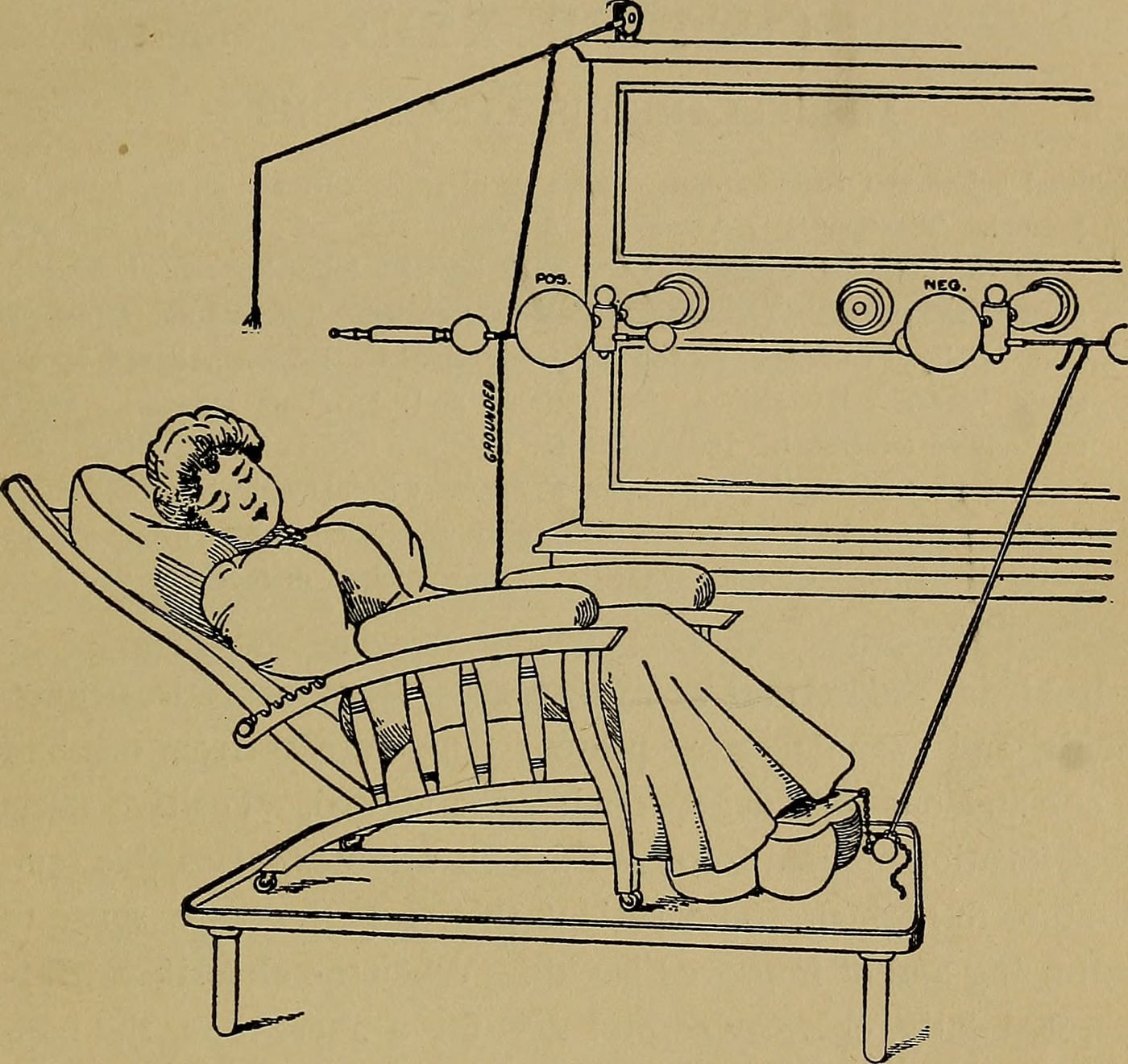
The two volumes before this one built the object and its treatments. Vol 1 — The Machines That Make the Charge traced the apparatus from hand-turned frictional globes to the influence machines of Holtz, Toepler and Voss and, above all, the Wimshurst; Vol 2 — Franklinization and the Static Treatments walked the current from the Leyden jar onto the skin — the static breeze, the insulated bath, the drawn spark, the Morton wave. This volume does the harder thing: it weighs those treatments. It separates the genuine, narrow physiology of high-voltage/low-current static therapy from the sweeping cures the same machines were advertised to work, and then it follows the most consequential turn in the whole story — the moment, at the very end of 1895, when a powerful static machine stopped being primarily a therapy device and became a high-voltage source for the newly discovered X-ray.
That second career is not a footnote. It is the reason a piece of Victorian electrotherapeutic furniture matters to the history of real medicine, and it is why its most famous maker was elected to the Royal Society in 1898. Throughout, where a date, a voltage, or a priority claim is contested, this volume hedges rather than inventing precision — this field’s figures were routinely exaggerated by the people selling the machines.
3.2 The honest ledger: what the current really did
Begin with the physics, because it disciplines everything else. A static-electric treatment is very high potential at vanishingly small current: a Wimshurst of the size a clinic owned could hold tens of kilovolts — figures of roughly 50,000 to 60,000 volts are routinely cited for a good table machine — yet the current that actually crossed into a patient was measured in microamperes. High voltage is what makes a spark leap and a person’s hair stand on end; low current is what keeps that same spark from being a serious shock. Everything static therapy could honestly claim followed from that pairing.
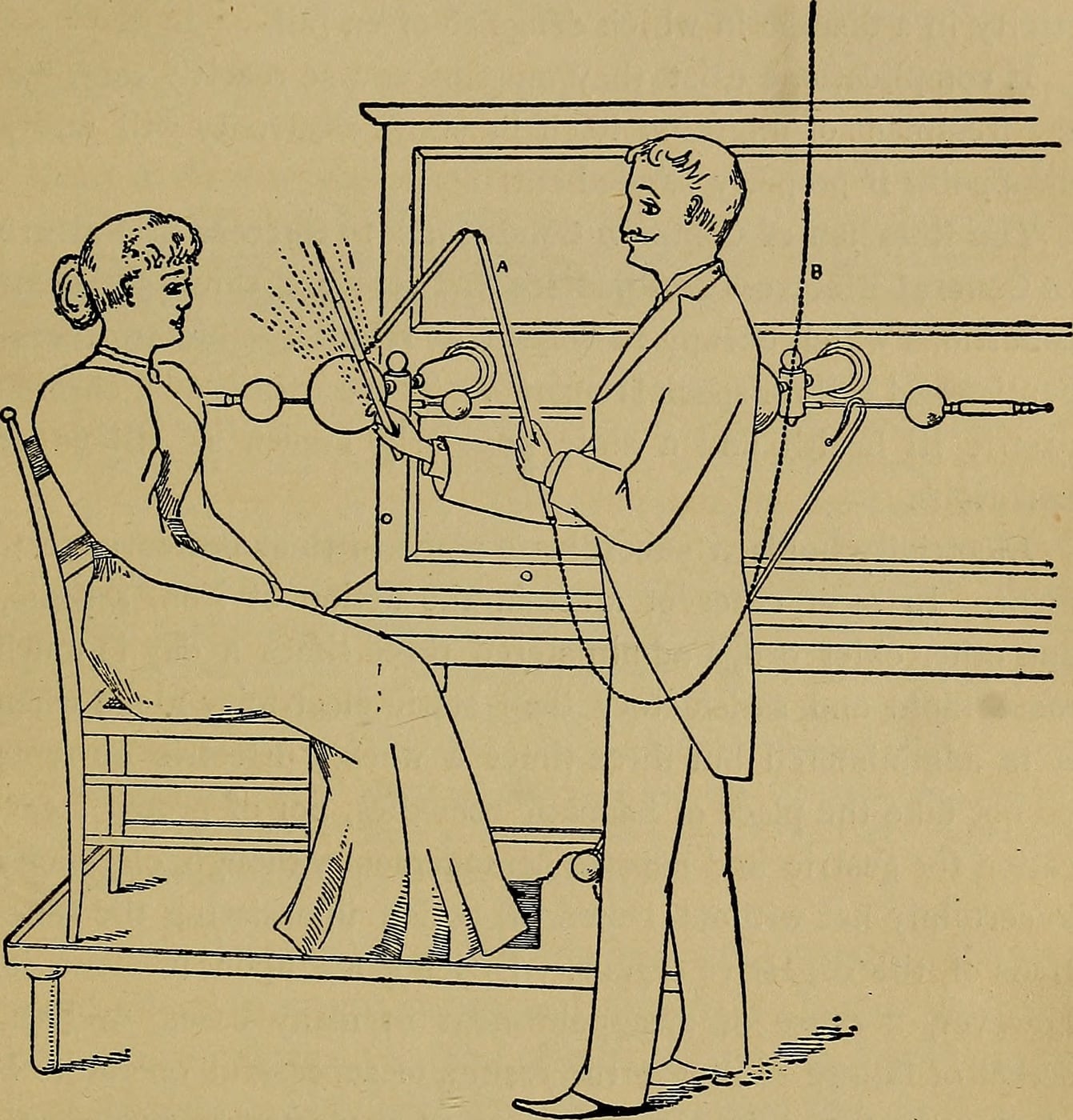
What the current genuinely produced was superficial and local. The “electric breeze” or effluve — charge streaming from a pointed electrode held near the skin — is felt as a cool prickling draught, and it ozonises the air around it, which is why these treatments carried the same sharp smell as the violet-ray parlour handset. A drawn spark delivers a brief, sharp sting and a visible muscle startle — a reflex twitch, not a sustained contraction. The static bath raised the whole insulated patient to high potential so that charge drained quietly from the body’s extremities. In modern terms these are counter-irritant effects: a strong, harmless surface sensation that can distract from pain, redden the skin, and — through relaxation, expectation and the sheer theatre of the apparatus — make a patient feel attended to. That last mechanism is not nothing; a substantial part of what static therapy “did” was what is now called a placebo response, and period-honest clinicians occasionally said as much.
There was also a legitimate diagnostic seed here, easy to miss under the marketing. The nineteenth century’s electrotherapists were, in effect, the first people systematically mapping the body’s electrical response — which surfaces sting, which muscles twitch, how nerve and skin answer a controlled electrical stimulus. That programme was carried much further by the faradic and galvanic school (see the sibling dive, Faradic and Galvanic Machines, and Duchenne’s mapping of which currents make which muscles contract), but the static men were part of the same enterprise. The honest ledger of static electricity, then, reads: real counter-irritation, real skin and reflex effects, a real if crude contribution to electrophysiology — and no reach into the depths of the body at all.
3.3 The overclaim: paralysis, “nervous disease,” and the age of cure-all
Against that modest ledger stood an enormous bill of claims. Static machines were sold and prescribed for paralysis, neuralgia, sciatica, rheumatism, “nervous exhaustion” and neurasthenia, hysteria, insomnia, constipation, and a long tail of chronic complaints — the same catalogue of vaguely-defined, waxing-and-waning conditions on which every electrical cure-all of the era was floated. The promise rested on a category error that ran right through late-Victorian medicine: the intuition that because nerves carried something “electrical,” pouring electricity into the body must restore its vitality. In an age when, by around 1900, electrical apparatus of some kind sat in a large share of city physicians’ offices, the machine’s mere presence lent the claim authority.
The paralysis claim is the clearest place to see the gap. A drawn spark can make a paralysed limb twitch — the startle reflex is real — and to a patient and a hopeful clinician that flicker looked like returning function. But a momentary reflex is not re-innervation; the current never reached, still less repaired, the damaged nerve or cord. Where recovery followed, it was the underlying condition running its course, not the sparks. The “nervous disease” claims are subtler to debunk precisely because their targets — fatigue, low mood, diffuse aches, “nervousness” — are exactly the complaints most responsive to attention, ritual and suggestion, so a static session genuinely made many sufferers feel better without touching any disease process. That is the recurring trap of this whole field: a real sensation, honestly produced, misread as a real cure.
It is worth being plain that the line between the clinic and the carnival was porous, not clean. The same high-voltage physics that a hospital dignified as Franklinization was, a generation later, the sales pitch of the drugstore violet-ray wand (see the Quack-wing dive Violet Ray Wands) and cousin to the “vitality” promises of the galvanic electropathic belts. Static therapy was the more respectable relative — administered by a physician, backed by an imposing machine — but it was selling much the same borrowed authority of “electricity heals.” The sober verdict, then and now, is that as a treatment the static machine earned its keep only as a counter-irritant and a theatre of care; the cures were oversold.
3.4 The second life: the Wimshurst as an X-ray source
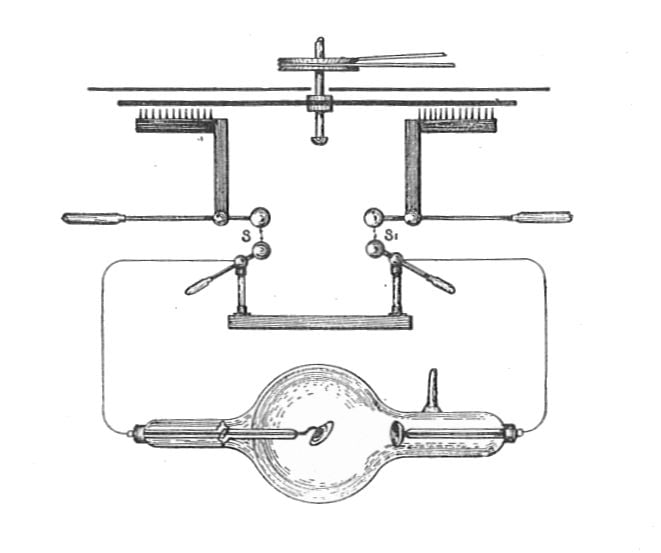
The machine’s redemption came from outside therapy altogether. In late 1895 Wilhelm Conrad Röntgen, working in Würzburg, discovered a penetrating new radiation he called the X-ray; his paper Über eine neue Art von Strahlen was communicated on 28 December 1895, and the news swept the world within weeks of the new year. Producing X-rays required driving a Crookes-type vacuum tube at very high potential so that cathode electrons struck the anode hard enough to throw off the rays. That is precisely what a powerful influence machine already did for a living: it made tens of kilovolts on demand. Almost overnight, the same Wimshurst that had been raising patients on insulated platforms was repurposed to excite Röntgen-ray tubes.
This was a real medical use, and it is the one that has lasted. Within the first year, physicians and physicists were routinely using static machines as the high-tension supply for early radiography — imaging fractures, locating foreign bodies, and photographing the living skeleton. The transition is embodied almost too neatly in one man: William James Morton (1845–1920), a New York electrotherapist who had published on “statical electrotherapeutics” and lent his name to a static wave current in the 1880s, rushed The X-Ray, or Photography of the Invisible and Its Value in Surgery into print in September 1896 — the first X-ray textbook published in the United States — barely nine months after Röntgen’s announcement. The Franklinization enthusiast and the X-ray pioneer were the same person, using, in large part, the same class of machine.
The clearest surviving object lesson is a Wimshurst-powered X-ray set held by the History of Science Museum, Oxford: a twin-plate machine and Jackson-type tube, made by London instrument houses in 1898 and owned by Edward George Spencer-Churchill, who first used it to image friends’ limbs “for fun” and then took it to South Africa, where the Royal Army Medical Corps used such apparatus during the Boer War (1899–1902) to locate bullets, shrapnel and fractures in wounded soldiers. That is genuine, consequential medicine — surgical diagnosis on a battlefield — done with a machine whose therapeutic claims had been largely hollow.
Two honest caveats keep this from becoming a triumphal story. First, the static machine was quickly outclassed for X-ray work by the induction (Ruhmkorff) coil and, later, the transformer: influence machines could reach high voltage but delivered too little current for short exposures, failed mechanically, and — because their charge is carried on varnished glass — grew erratic or useless in humid weather, working best in dry climates. Within a decade they were the fallback, not the first choice. Second, powering an unshielded tube exposed early operators to radiation whose danger was not yet understood; the X-ray’s own reckoning with injury lies outside this dive, but it belongs on the ledger. The Wimshurst’s second life was real and important, and also brief and imperfect.
3.5 1898: a Fellowship, and a machine that had changed its meaning
James Wimshurst (13 April 1832 – 3 January 1903), a ship surveyor for the Board of Trade who built and refined his machines as an unpaid enthusiast and never patented the design, was elected a Fellow of the Royal Society in 1898 (the election is dated to 9 June 1898). By then his influence machine had become a standard fixture of physics laboratories and a working instrument of the new radiography; the Fellowship is commonly read as recognition that his generators had proven scientifically and medically consequential, though the surviving citation should be treated with care — it is easy to over-tidy a story in hindsight, and the precise official wording is not something this volume can quote. What can be said plainly is the shape of it: a self-taught engineer’s charge-doubling machine, devised for the physics bench and the clinic’s static-therapy room, ended up honoured in the same decade it found a use no one had imagined when it was built. The therapy that first justified the machine has not aged well; the by-product use — as a high-voltage source for imaging the living body — helped earn its maker a place in the Royal Society.
3.6 Where this volume hands off
This volume closed the therapeutic account and opened the X-ray one. Vol 4 — The Cased Medical Machine and the Trade turns from what the machine did to what it was as a clinic object — the electrodes, Leyden jars, stand and drive of the cased medical influence machine, the makers who sold them, and how static therapy sat alongside the faradic, galvanic and high-frequency currents of the sibling dives (Faradic and Galvanic Machines and High Frequency Currents). Vol 5 — Collecting Static Machines then takes the surviving apparatus to the collector’s bench: identifying and dating a Wimshurst, Holtz or Toepler, reading its glass discs, foil sectors, Leyden jars and drive, and displaying a very-high-voltage antique safely.
Sources
- James Wimshurst — Wikipedia — Wimshurst’s dates (b. 13 April 1832, Poplar; d. 3 January 1903); the statement that in 1896 his multiple-disc machines (up to eight discs) “found a new use as Roentgen ray generators for radiography and electrotherapy”; the 1898 FRS election. Used as a lead, cross-checked against the sources below.
- List of Fellows of the Royal Society elected in 1898 — Wikipedia — confirms Wimshurst among the 1898 cohort (election dated 9 June 1898); basis for hedging the exact citation wording.
- How James Wimshurst Achieved Electrostatic Immortality — IEEE Spectrum — the ~50,000–60,000 V output of a tabletop machine; the early-1880s development finalised by 1883; descent from Holtz and Toepler; machines used to excite Crookes tubes and generate X-rays for medical imaging in the early 20th century; the 1898 Fellowship.
- James Wimshurst — Linda Hall Library, Scientist of the Day — Wimshurst experimenting with X-rays in the late 1890s on realising his generators could excite Röntgen’s vacuum tubes; portable machines used by the Royal Army Medical Corps in the Boer War; higher voltage/spark-length figures (used cautiously, as an upper bound).
- Wimshurst twin-plate electrostatic machine and X-ray material — History of Science Museum, Oxford — the concrete object: an 1898 Wimshurst + Jackson-type tube set (Harvey & Peak; Newton & Co.), Spencer-Churchill’s imaging of limbs, and RAMC use in South Africa (Boer War, 1899–1902) to locate bullets, shrapnel and fractures.
- Wimshurst Static Machine (ca. 1890–1920) — ORAU Museum of Radiation and Radioactivity — the Wimshurst as an inexpensive, simple high-voltage source for X-ray tubes in the decade after Röntgen; its limitations versus the induction coil (lower current, mechanical failure, erratic output, degradation in humidity / preference for dry climates); the Leyden-jar/spark-gap operation.
- Wimshurst Machine — History of Science Museum, Oxford — the ~50–60 kV capability of an influence machine and its popularity as a reliable high-voltage laboratory source used in early X-ray experiments.
- William James Morton (1845–1920), author of America’s first X-ray textbook — R. F. Mould, Nowotwory J. Oncol. — Morton’s 1881 work on “statical electrotherapeutics… by Franklinism,” the “Morton current” (static machine + Leyden jars + electrodes), and his September 1896 X-ray textbook — the person who embodies the static-therapy-to-X-ray transition.
- “Static Electricity” in medicine, George Parker, M.D. — The Hospital, 22 Nov 1902 (PMC5208725) — a contemporary clinical account of static-electric application; cited for period framing of the treatments (breeze, spark, bath) though its full text was available only as page scans.
Comments (0)