Static Electricity Machines · Volume 1
The Machines That Made the Charge
From the hand-turned glass globe to the twin-disc Wimshurst: how the electrostatic generators of medical electricity were built, and how they wrung tens of kilovolts from nothing but friction and induction.
Contents
1.1 About this volume
Before there was a therapy there was a machine, and for the better part of a century that machine was the most dramatic object in the physician’s rooms: a hand-cranked apparatus of glass and brass that filled the air with a smell of ozone and threw a spark you could hear across the room. This is the establishing volume of a five-part deep dive into the static-electricity side of medical electricity — the “Franklinization” wing of the trade — and its job is narrow and physical. It describes the generators themselves: what they were made of, how they separated charge, how the design evolved from crude frictional machines you rubbed by hand into the elegant self-amplifying influence machines that reached tens of kilovolts, and above all the twin-disc Wimshurst that became the standard clinic instrument.
It deliberately stops short of the treatments. What a physician actually did with all that potential — the “static breeze,” the insulated “static bath,” the Morton wave, the sparks drawn from a patient’s skin, and the honest physiology of high-voltage/low-current stimulation versus the cures that were advertised — is the whole subject of Vol 2 — The Static Treatments. The tangled question of what was legitimate and what was oversold, and the machines’ remarkable second life after 1896 as high-voltage sources for the new X-rays, belongs to Vol 3 — Legitimate Use and the X-ray Second Life. The cased clinic instrument and its trade is Vol 4 — The Cased Medical Machine, and the collector’s questions of dating, condition, and safe display are Vol 5 — Collecting Static Machines.
One framing belongs here at the front. The boundary between this sober apparatus and outright quackery is porous, and it is porous at the level of the hardware itself: the same physics of high potential and small charge that a hospital respected as a serious generator was, a generation later, packaged as the cure-all handsets of the Quack wing. Where those retail descendants appear — the Violet Ray Wands and the galvanic Electropathic Belts — this dive cross-links them by name rather than pretending the line is clean. But the static machine came first, and it was, for a time, real physics in real clinics.
1.2 Two ways to make a charge
Every generator in this volume does one thing: it separates positive from negative charge and piles each up until the potential difference between them is enormous. There are only two ways to do it mechanically, and the history of the apparatus is the history of moving from the first to the second.
The older way is friction. Rub two dissimilar insulators together — glass against a leather or silk pad, in the classic case — and electrons are dragged from one to the other by the triboelectric effect, leaving the glass positively charged and the pad negative. Every turn of the crank rubs fresh surface against the pad and scrapes off a fixed dose of charge; the machine’s output is set by how hard and how fast you rub. Frictional machines are simple and they work, but they are inefficient, they wear, and they suffer badly in damp air, where the charge leaks away across moist glass as fast as friction lays it down.
The newer way is electrostatic induction, or “influence.” Here friction is almost eliminated. A small starting charge — even the trace a machine retains from its last use — induces an opposite charge in a nearby conductor without touching it; that induced charge is then harvested, carried away, and used in turn to induce still more. The machine feeds on its own output. Given a dry day and a tiny seed charge, an influence machine bootstraps itself from almost nothing to full potential in a few turns, and it does so without the drag and wear of a rubbing pad. The distinction — friction versus influence — is the single most important structural fact about these generators, and it is why a good influence machine so completely displaced the frictional ones for medical work by the 1880s.
1.3 The frictional era: globes, cylinders, and plates
The first generators were spheres of glass spun by hand. Around 1706 the English experimenter Francis Hauksbee built a machine that rotated a glass globe rapidly against a cloth or the bare hand, producing a glow and a charge, and for the first half of the eighteenth century the glass-globe machine was the standard instrument of the new science of electricity. Experimenters soon substituted a glass cylinder for the globe, and about 1746 plate-glass machines appeared, credited in period accounts to Jan Ingenhousz among others. In 1768 the instrument-maker Jesse Ramsden produced a refined plate machine that became widely copied — a glass disc turned between leather pads, with combs to collect the charge — and the plate form persisted for decades.
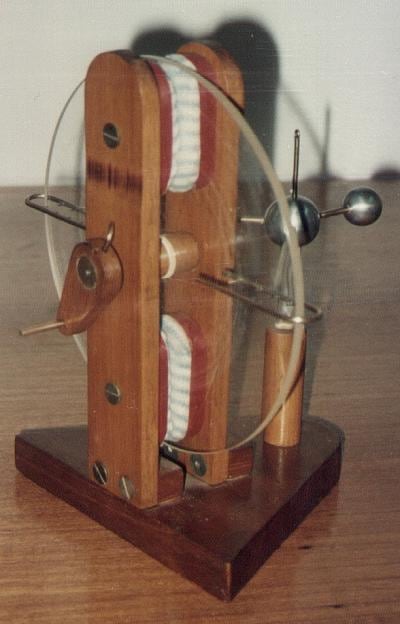
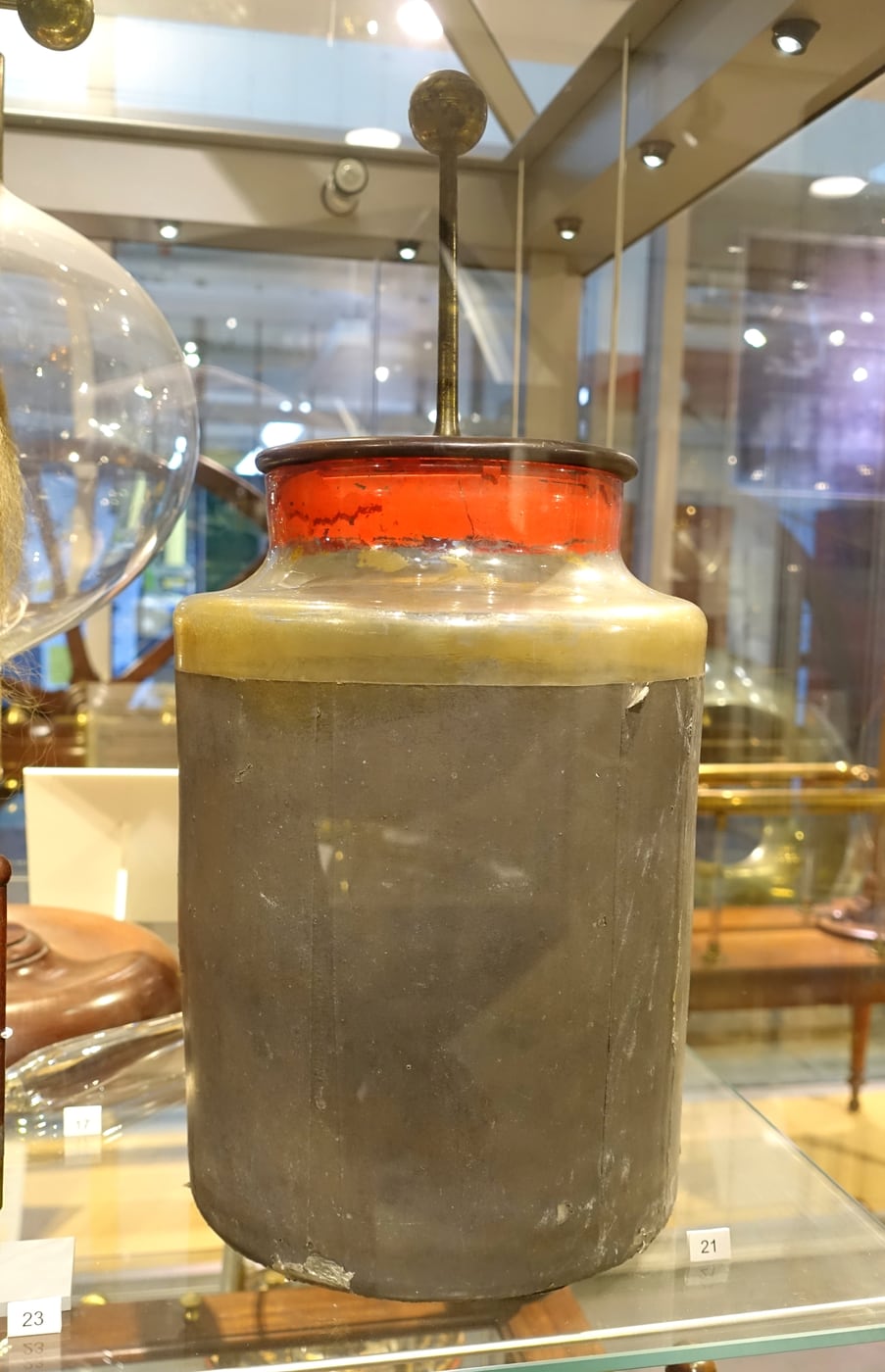
The frictional machine was also, from very early on, a medical machine. Electricity was applied to patients almost as soon as it could be reliably generated: the 1740s and 1750s saw a wave of “electrical” treatment across Europe, and Benjamin Franklin himself experimented with applying static charge to patients with paralysis — the episode that later lent the whole practice the name Franklinization. In 1787 the London instrument-maker Edward Nairne built an electrostatic generator explicitly for medical use, arranged so that either positive or negative electricity could be drawn off for treatment. These machines stored their charge in the era’s one indispensable accessory, the Leyden jar — a glass jar lined inside and out with foil, the first practical capacitor, invented independently around 1745–46 at Leiden and in Pomerania — which let a slow trickle of frictional charge be accumulated and then dumped all at once as a stinging spark. The therapeutic use of that spark is Vol 2’s story; here it is enough to note that the medical static machine is nearly as old as the science itself, and that for its first century and a half it was a frictional machine.
1.4 The influence machine arrives
The influence machine was a nineteenth-century idea. Its principle — building charge by induction rather than friction — was demonstrated in symmetrical form by Giuseppe Belli in 1831, and a high-power patented version was produced by the telegraph engineer C. F. Varley in 1860. But the machines that mattered for medicine came from the German-speaking physics laboratories in a remarkable cluster around 1865.
Wilhelm Holtz, working in Berlin, built what is usually called the first practical influence machine in 1865, refining it in a second form in 1867. The Holtz machine used a fixed glass plate pierced with windows and paper “armatures,” and a second plate rotating close in front of it; on a dry day it was a powerful generator, but it was temperamental — it could be reluctant to start, and it had an unnerving habit of spontaneously reversing its polarity mid-run. In the same year, 1865, August Toepler produced an influence machine of his own using metal sectors carried on the rotating plate — a design feature that pointed directly at what came later. Through the 1870s the two lineages were combined and tinkered with by others, and in 1880 the Berlin instrument-maker J. Robert Voss marketed a machine that he claimed united the principles of Holtz and Toepler. This is the crowded field — Holtz, Toepler, Voss, and their many imitators — that the young English engineer James Wimshurst inherited, and improved past all of them.
1.5 The Wimshurst and its geometry
James Wimshurst (1832–1903) was a consulting engineer to the Board of Trade, a shipwright and surveyor by profession who built electrical machines in his home workshop as a serious avocation. He developed his machine across the early 1880s — the sources place the work between about 1880 and 1883, with the mature design reported to the scientific community by 1883 — and it was so obviously better than what came before that it simply became the influence machine, a form still built essentially unchanged today. Wimshurst did not invent the influence machine; he took the flawed Holtz–Toepler–Voss lineage and removed its two great defects. His machine started reliably, and it did not flip its polarity. He published his design freely and, characteristically, never patented it.
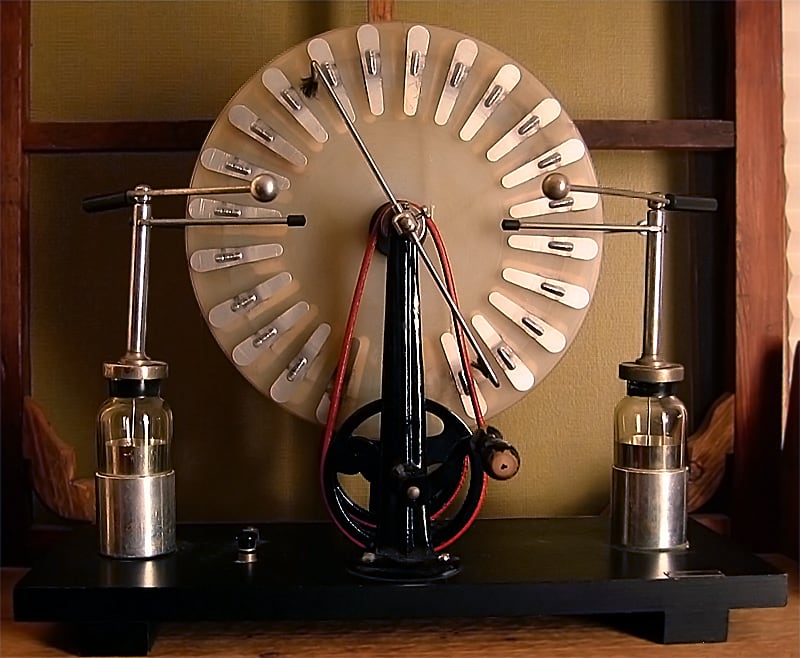
The Wimshurst’s cleverness is entirely geometric. It uses two glass discs — traditionally varnished or shellacked for insulation and moisture resistance — mounted on the same axis and driven by a crossed belt so that they counter-rotate, spinning in opposite directions. Around the rim of each disc is glued a ring of metal foil sectors, evenly spaced. Set diagonally across the face of each disc is a neutralizing bar — a conductor with a small brush at each end, the two bars crossed like an X, one for the front disc and one for the rear. As the discs turn, each brush momentarily connects a sector to the sector diametrically opposite it on the same disc, and it is this connection, working against the charge already sitting on the other, counter-rotating disc, that makes the machine self-amplify: a sector carrying a little charge induces an opposite charge in the sector facing it across the gap, the neutralizing bar redistributes it, and the effect compounds turn after turn from a vanishingly small seed. Because the geometry fixes which side becomes positive and which negative, the polarity cannot wander — the flaw that plagued the Holtz machine is engineered out.
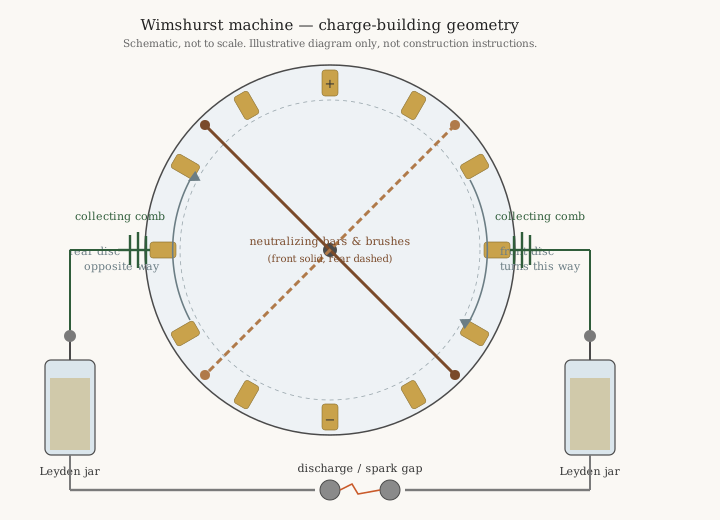
Two collecting combs — metal bars carrying a row of points, one at each side of the discs where the fully charged sectors pass — draw off the accumulated charge without touching the glass, one comb harvesting positive and the other negative. Each comb feeds a Leyden jar: the classic Wimshurst carries a pair of them, one per polarity, mounted in the base or flanking the frame, which store the charge and sharpen the discharge into a fat, bright spark rather than a feeble hiss. The two output terminals end in brass balls with an adjustable spark gap between them; open the gap wider and the machine simply charges to a higher potential before it lets go. It is a completely self-contained charge pump, driven by nothing but a hand crank, and on a dry day it is genuinely impressive to stand near.
1.6 High potential, negligible current
The number most often quoted for a Wimshurst is voltage, and it is a genuinely large one: a good tabletop machine can reach on the order of 50,000 to 60,000 volts before the gap breaks down, and the spark it throws is roughly a third of the disc’s diameter in length. Those figures come from reputable secondary and museum sources rather than a calibrated maker’s measurement, and the exact potential of any given machine depends on disc size, humidity, and gap setting — so they are best read as the right order of magnitude rather than a precise rating. Larger and multi-disc machines went higher still.
The number that matters just as much is the one the marketing never mentioned: the current is minuscule. A Wimshurst delivers only a few tens of microamperes — millionths of an ampere — of continuous output. This is the defining electrical signature of every machine in this volume, frictional or influence alike: very high potential at vanishingly small current. It is exactly the opposite of the low-voltage, high-current chemical batteries that drove the galvanic and faradic apparatus of the neighbouring Faradic and Galvanic Machines dive, and the difference dictates everything the two families could and could not do to the body.
It is worth being plain about what that signature means, because it is the physical ground on which Vol 2 will separate the real from the sold. Tens of kilovolts sounds lethal and looks alarming, but with the charge reservoir so small, the energy available in a static discharge is modest and the current that can flow through tissue is tightly limited. The honest physiological effects are therefore superficial: the prickle of a spark at the skin, a startle contraction, the faint smell of ozone where the discharge tears at the air, a sensation of a “breeze” from a pointed electrode. They are real, and they are shallow. The claims that this apparatus could reach into the body to cure paralysis, dissolve disease, or restore lost vigour do not follow from the physics at all — a high voltage across a high resistance simply does not push enough charge through living tissue to do the deep work that was advertised. That is the argument Vol 2 makes in full; this volume only lays the electrical facts it rests on.
1.7 Where this volume hands off
You now have the generator on the bench: how it is built, how friction gave way to induction, and how the twin-disc Wimshurst wrung tens of kilovolts at a few microamperes from a hand crank. The next question is the one the whole trade turned on — what a physician did with all that potential, and how much of it was real. That is Vol 2 — The Static Treatments, which follows the charge out of the Leyden jars and onto the patient: the static breeze and effluve, the insulated static bath, the Morton wave, and the sparks drawn from the body, weighed honestly against the marketing. From there the dive turns to the legitimate uses and the machines’ consequential afterlife as X-ray sources (Vol 3), the cased clinic instrument and its makers (Vol 4), and the collector’s craft of identifying, dating, and safely displaying a high-voltage antique (Vol 5).
Sources
- Wimshurst machine — Wikipedia — development between 1880 and 1883; Wimshurst’s dates (1832–1903); the two counter-rotating discs with metal sectors, crossed neutralizer bars, collecting combs and Leyden jars; the “few tens of microamperes” and one-third-of-disc-diameter spark; and the key point that it improved on Holtz (1865, 1867), Toepler (1865) and Voss (1880) by removing their inefficiency and polarity-reversal defect.
- Electrostatic generator — Wikipedia — the frictional-versus-influence distinction; Hauksbee’s glass-globe machine (c. 1706), cylinder and plate-glass machines (Ingenhousz, c. 1746), Ramsden’s 1768 plate machine, Nairne’s 1787 medical generator; Belli (1831) and Varley (1860) as early influence machines; the Holtz/Toepler/Voss/Wimshurst sequence.
- How James Wimshurst Achieved Electrostatic Immortality — IEEE Spectrum — Wimshurst’s life and career, his 1898 election to the Royal Society, the ~50,000–60,000 volt tabletop figure, and the note that the high voltage made these machines useful for exciting Crookes tubes to generate X-rays in the early 20th century (developed further in Vol 3).
- Wimshurst Machine (1880) — National MagLab / Magnet Academy — corroborates the early-1880s date and the counter-rotating discs, brushes, and spark gap; notably makes no voltage claim, which is why the 50–60 kV figure is treated here as indicative rather than exact.
- The Static Method in X-Ray Work / Manual of Static Electricity in X-Ray and Therapeutic Uses (PMC) — period medical-electrical source confirming that static influence machines, including the Wimshurst, were the chief high-voltage apparatus for early American X-ray work after Röntgen’s 1895–96 discovery; the basis of the “second life” flagged for Vol 3.
- History of Science Museum, Oxford — Wimshurst machine — museum specimen used for the physical description of a classic twin-disc machine (lead figure).
- The Bakken Museum — the museum devoted to medical electricity; general reference for the frictional-medical-machine and Leyden-jar context and for period Franklinization apparatus.
Comments (0)