High Frequency Currents · Volume 1
The Shock That Stopped Hurting
How Jacques-Arsène d'Arsonval, Paul Oudin, Nikola Tesla, and Frederick Finch Strong turned a physiological curiosity — that fast enough electricity ceases to convulse the body — into a whole branch of medicine, and the glass electrode that would later be sold as the 'violet ray.'
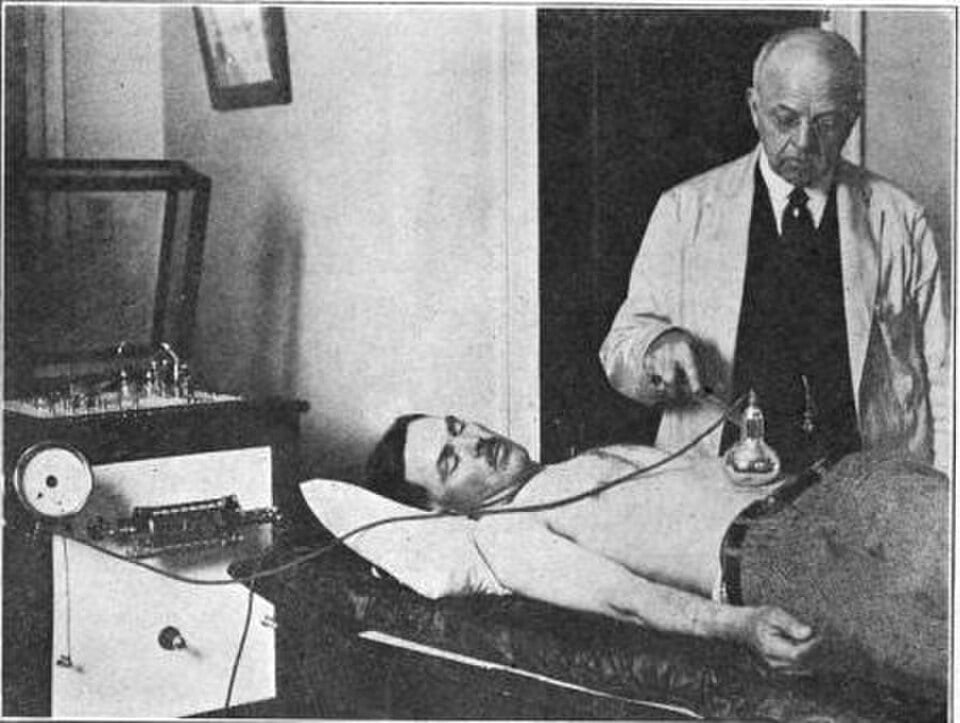
Contents
1.1 About this volume
For most of the nineteenth century, “medical electricity” meant a jolt. The galvanic and faradic machines of the day — catalogued in this wing’s Faradic and Galvanic Machines dive — worked by making a patient’s muscles twitch or tetanize, and the sensation was the point. Guillaume Duchenne de Boulogne built a whole diagnostic art on it. But there was always a hard ceiling on how much current a body would tolerate: push too far and you had pain, cramp, and danger. Electricity, in the popular and clinical imagination alike, was something that hurt.
This volume is about the men who discovered, in the last decade of that century, that the hurt was a function of frequency — and that if you made the current oscillate fast enough, it stopped convulsing the body altogether while continuing to pass through it. That single physiological fact opened the door to high-frequency electrotherapy, to diathermy, and — by a less honorable route — to the drugstore “violet ray.” It is the establishing chapter of a five-part dive; its job is to introduce the four people who made the discovery and the apparatus, and to fix the dates and priorities as firmly as a contested record allows.
The later volumes carry the rest. How the current is generated and what it actually does to tissue is Vol 2 — Spark, Coil, and Heat; how the apparatus was used in the clinic, and how the method came to bear the name “d’Arsonvalization” — a term d’Arsonval himself used from the 1890s and often, but unverifiably, said to have been endorsed by a 1913 French electrotherapeutic congress — is Vol 3 — d’Arsonvalization in the Clinic; the hinge from hospital instrument to cure-all wand is Vol 4 — The Same Coil, Sold Twice; and identifying, dating, and safely displaying a surviving unit is Vol 5 — Collecting High-Frequency Apparatus. Throughout, one boundary stays deliberately porous: the same coil a hospital called a “d’Arsonval apparatus” was peddled door-to-door as a “violet ray,” and the retail version has its own sober account in the Quack wing’s Violet Ray Wands dive. This dive is the engineering original of which that is the marketing copy.
1.2 The shock that stopped hurting
The ordinary electrical shock is a story about nerves and muscle. A current crossing the body depolarizes motor nerves; the nerves fire; the muscles contract. Slow interruptions produce single twitches, faster ones a sustained, painful tetanus — the effect Duchenne exploited on purpose. The body, in effect, is an antenna tuned to biology’s own timescale: the millisecond over which a nerve membrane charges and fires. Feed it current that switches direction on that timescale, and every reversal is a fresh command to contract.
The insight of the 1890s was that a nerve cannot keep up indefinitely. If the current alternates faster than the membrane can respond — reversing thousands of times a second — no single reversal lasts long enough to drive the nerve to threshold. The stimulus averages out below the trigger point. The current still flows, and it still deposits energy as heat, but the violent muscular response simply disappears. This is not a marketing claim; it is the well-understood physiology of why a high-frequency current can pass through tissue that a low-frequency one of the same amperage could not survive.
1.3 d’Arsonval and the threshold
The man who established it was Jacques-Arsène d’Arsonval (1851–1940), a French physician, physiologist, and biophysicist who worked in Claude Bernard’s shadow and made the physiology of electricity his life’s subject. Beginning in 1889, d’Arsonval set out to map how alternating currents of rising frequency affected the body, and reported his findings to the Société de Biologie in Paris. He found that once the frequency climbed past roughly 5,000 hertz, the muscular contractions and the pain that defined an ordinary shock ceased to appear. By 1891 he was reporting that above about 10,000 hertz he could obtain no physiological effect at all beyond a sensation of warmth — the current was passing through him and doing, apparently, nothing but gently heating the tissue.
The threshold usually quoted for this dive — “above roughly 5,000 to 10,000 hertz” — is therefore a real range, not a rhetorical hedge: d’Arsonval’s own numbers span it, the lower figure marking where contractions fade and the upper where they are gone. The precise value depends on waveform, electrode, and the tissue in question, and period authors cite it loosely; treat any single sharp figure with suspicion. What is not in doubt is the phenomenon itself, which every modern account of high-frequency stimulation confirms.
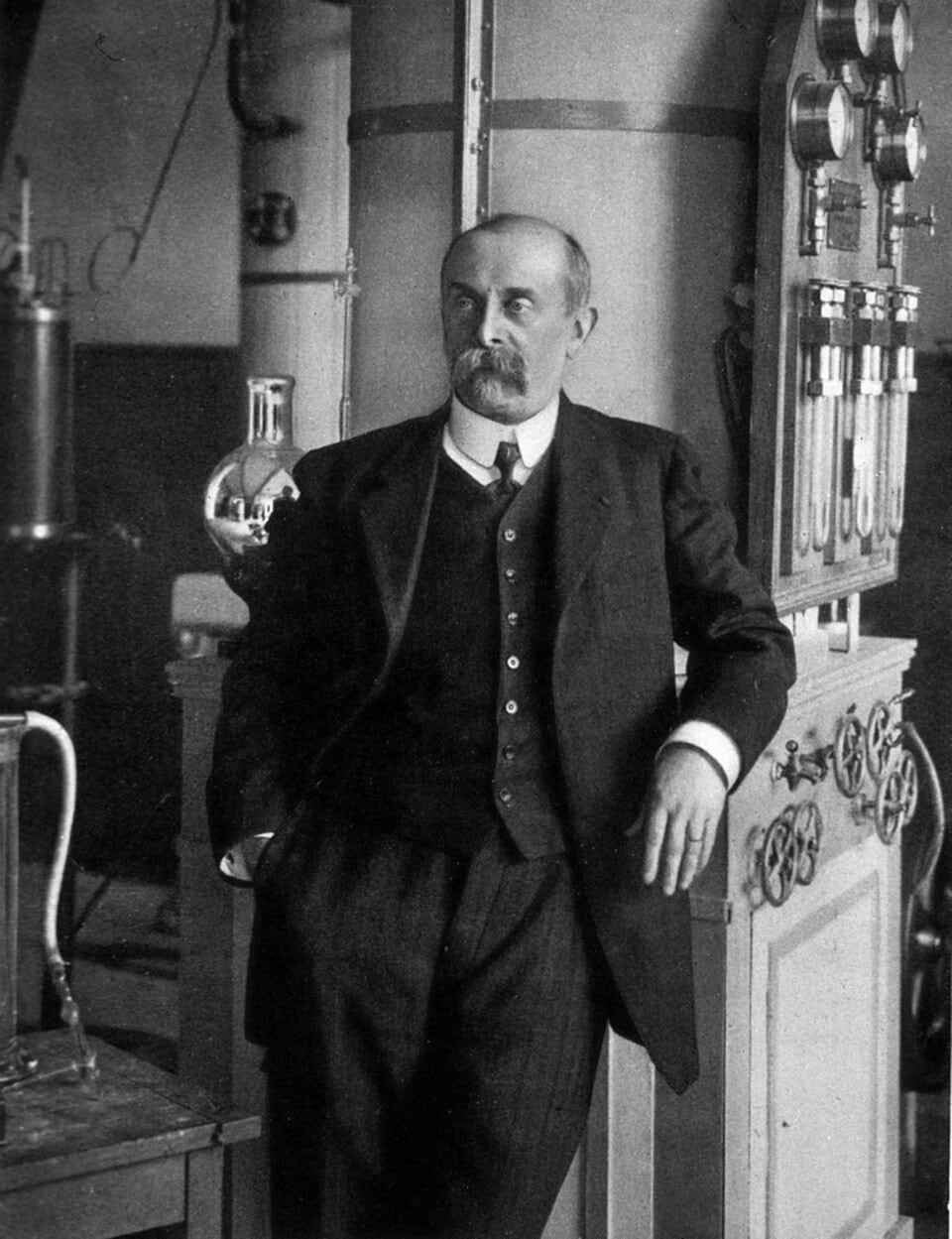
d’Arsonval pressed the finding into therapy quickly. By 1892 he was applying high-frequency currents to diseases of the skin and mucous membranes, and a paper he submitted to the Académie de Médecine that year met enough skepticism that it was reportedly close to rejection — a useful reminder that the discovery was not obvious to his contemporaries. In 1894–1895 he is recorded as treating on the order of seventy-five patients with the new currents. His most theatrical demonstrations came from passing large currents through his own body: accounts describe him tolerating several amperes at high frequency and feeling only heat — a figure of about 3 amperes around 1891 is repeated in the secondary literature, and while the exact number is hard to pin to a primary source, the qualitative claim (large current, no convulsion, only warmth) is central and well attested. That warmth is the seed of everything downstream: it is the first sighting of the deep-heating effect that becomes diathermy.
The clinical elaboration of all this — the autoconduction cage in which a patient sat inside a giant solenoid, the autocondensation couch on which the patient became one plate of a capacitor, and the naming of “d’Arsonvalization” (a word d’Arsonval used from the 1890s, and which a 1913 French electrotherapeutic congress is often but unverifiably said to have endorsed) — belongs to Vol 3, and this volume leaves it there.
1.4 Tesla’s parallel path
Running alongside d’Arsonval, and largely independent of him, was Nikola Tesla (1856–1943), whose interest in high-frequency currents was that of an electrical engineer rather than a physician. On 20 May 1891 Tesla delivered his celebrated lecture “Experiments with Alternate Currents of Very High Frequency” before the American Institute of Electrical Engineers at Columbia College in New York, in which he demonstrated the resonant air-core transformer — the Tesla coil — and, memorably, passed high-frequency current through his own body to light lamps held in his hands without harm. Tesla’s motivation was lighting and power transmission, not treatment, but his public demonstrations broadcast the same startling fact d’Arsonval had found in the laboratory: that fast alternating current is strangely gentle on the flesh it passes through.
The relationship between the two men’s work is one of convergence, not derivation. d’Arsonval supplied the physiology and the medical intent; Tesla supplied the resonant-coil engineering that could generate these currents at high potential efficiently. The apparatus that filled hospital electrotherapy departments for the next forty years was, in circuit terms, a Tesla-type resonant coil put to a physician’s purpose — which is exactly why the boundary between “serious apparatus” and “showman’s spark” was porous from the very start.
1.5 Oudin and the resonator
The bridge between the two was built by Paul Marie Oudin (1851–1923), a French physician of Épinal who collaborated with d’Arsonval. In 1893 Oudin modified the d’Arsonval circuit by adding a second, large “resonator” coil — many turns of fine wire tapped onto the smaller d’Arsonval coil — so that resonance could step the potential far higher than d’Arsonval’s own arrangement reached. The result, the Oudin coil or Oudin resonator, is closely related to the Tesla coil; the chief difference is that Oudin’s is wired as an autotransformer (a single tapped winding), and later usage came to call the single-terminal “unipolar” form Oudin’s and the two-terminal “bipolar” form Tesla’s.
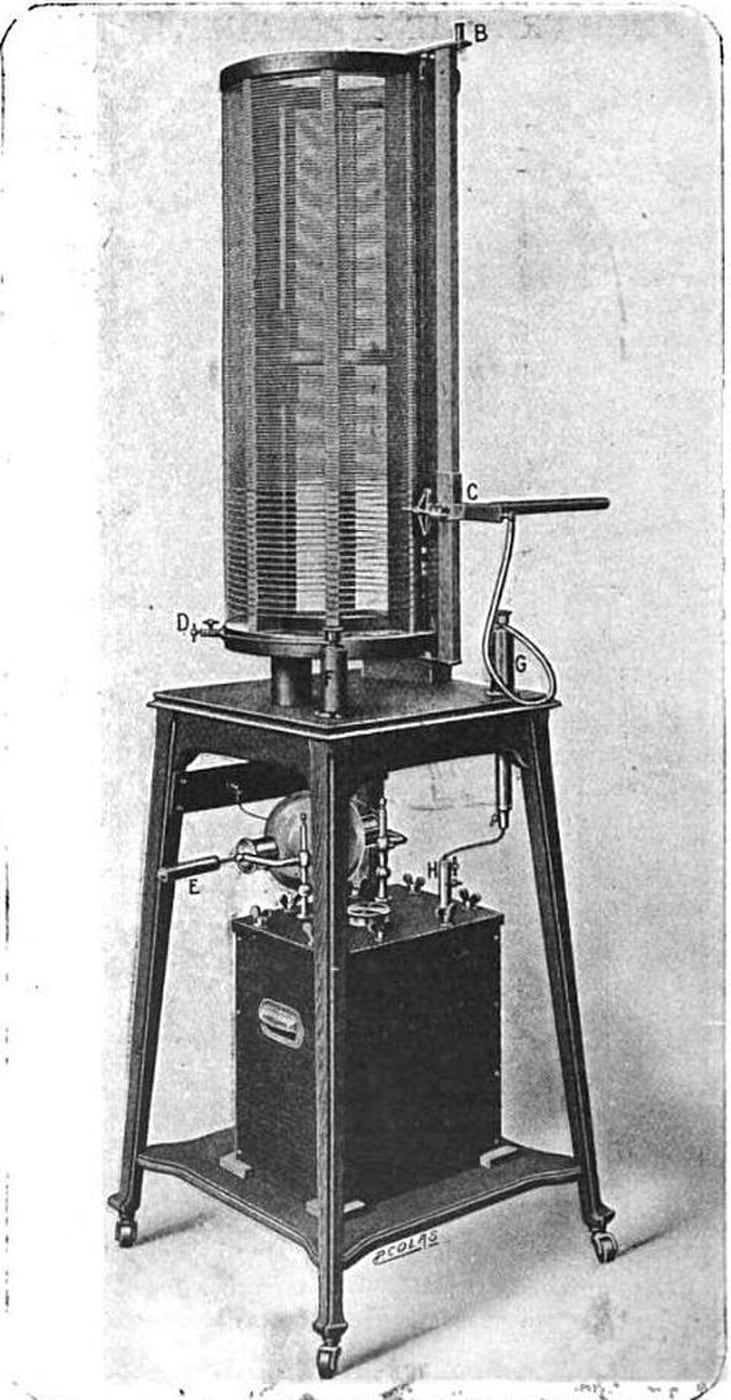
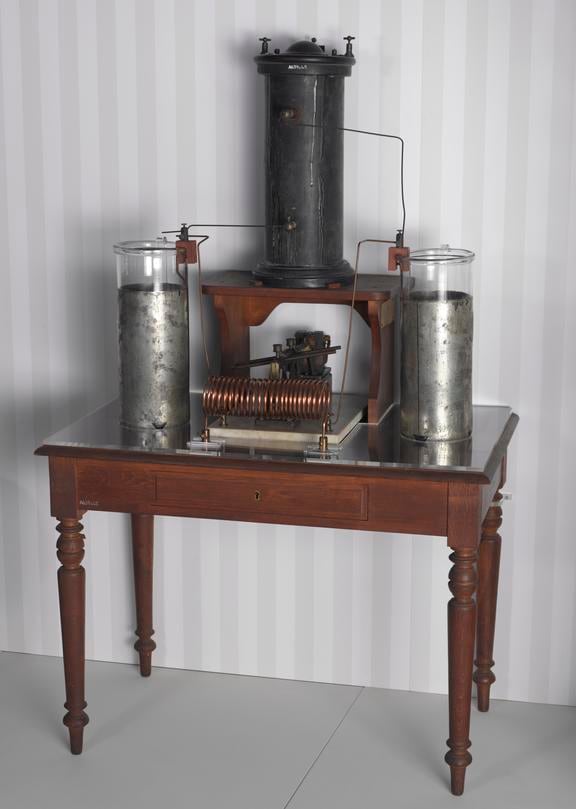
Where d’Arsonval’s own apparatus was characterized as relatively low voltage and high current, the Oudin resonator delivered high voltage at low current — the configuration that made it possible to draw long, fine sparks and to drive a glowing glass electrode. Period and museum figures for these machines vary wildly and were often exaggerated by sellers: one museum account of the d’Arsonval apparatus cites potentials on the order of tens of kilovolts, while medical Oudin coils are described reaching anywhere from tens of thousands of volts to a claimed million, at frequencies quoted from around 200 kilohertz into the low megahertz. These numbers are genuinely uncertain and are the proper business of Vol 2, which takes the circuit apart; this volume records only the qualitative and well-founded distinction — d’Arsonval low-voltage/high-current, Oudin (like Tesla) high-voltage/low-current — and flags the rest for verification.
1.6 Strong and the glass electrode
The last of the four is the one whose invention escaped the clinic entirely. Frederick Finch Strong was an American physician, a lecturer on electricity at Tufts College in the Boston area and an early enthusiast of high-frequency therapeutics. In the mid-to-late 1890s — the date is given variously, most often around 1896–1897 — Strong took a partially evacuated glass tube (accounts describe it as a modified Geissler tube), sealed one end into an insulating handle, and used it as an electrode on a high-frequency coil. Inside the evacuated glass, the high-frequency field ionized the thin residual gas so the tube filled with a soft glow, and its surface delivered a fine, diffuse spark to the skin. Strong developed the electrode in a range of shapes with the aviator-engineer Earle L. Ovington, and commercial production followed around 1903 through the Electro-Radiation Company. Strong set down his conclusions in his 1908 textbook High-Frequency Currents.
That glowing glass electrode is the physical seed of the entire “violet ray” industry. In Strong’s hands it was a genuine, if modest, dermatological and counter-irritant instrument used by a physician who understood what it did. Within twenty years the identical object — a low-pressure gas discharge glowing violet inside a handheld glass bulb — was being sold across drugstore counters as a household cure for baldness, deafness, and nearly everything else. The colour, it must be said plainly, is a gas-discharge glow, not ultraviolet light, and it carries no special therapeutic virtue; that correction is the load-bearing argument of the Violet Ray Wands dive, and Vol 4 of this dive traces exactly how the hospital instrument became the wand.
1.7 What was real, and what was not
It is worth being precise, at the outset of the dive, about which parts of this founding story survive scrutiny. The core physiological finding is real and permanent: high-frequency alternating current does pass through the body without exciting the violent muscular contraction of low-frequency shock, because the nerve membrane cannot follow the reversals. So is the secondary observation that the current deposits energy as heat in the tissue it crosses — the effect that matures, honestly, into physiotherapy diathermy. These are not nineteenth-century overstatements; they are textbook electrophysiology.
What was not real was almost everything the currents were subsequently claimed to cure. That “electricity cures everything” was the marketing air of the age, and high-frequency apparatus was swept up in it: the same gentle warmth and harmless spark that were genuinely useful for a narrow set of skin and circulatory complaints were advertised, within a decade, against rheumatism, “nervous debility,” tuberculosis, and cancer. The gap between a verified physical effect (warmth, a surface spark, a whiff of ozone) and an unverified therapeutic one (systemic cure) is the recurring subject of this whole wing, and it runs directly through the porous border with the Violet Ray Wands and Electropathic Belts dives. d’Arsonval, Oudin, Tesla, and Strong discovered something true. The salesmen who followed them discovered something profitable, and the two are not the same discovery.
1.8 Where this volume hands off
You now have the founding cast and the founding fact: from 1889, d’Arsonval showed that current above roughly 5,000–10,000 Hz stops convulsing the body; Tesla, from his 1891 Columbia lecture, supplied the resonant-coil engineering; Oudin, in 1893, added the resonator that reached high potentials; and Strong, in the later 1890s, sealed the glow into a glass electrode. The next question is mechanical: how a spark gap, a capacitor, and a resonant coil actually generate these damped high-frequency oscillations, and what — precisely — the current does to tissue when it arrives. That is Vol 2 — Spark, Coil, and Heat, which takes the machine apart, sorts the d’Arsonval, Tesla, and Oudin circuit types, and treats the contested period voltages and currents with the scrutiny they need.
Sources
- d’Arsonval high frequency electrotherapy machine — Science Museum Group Collection (co142057) — a surviving cased d’Arsonval apparatus (Paris, c. 1890–1910) with control cabinet, condenser, and Oudin resonator; confirms the physical make-up of the hospital instrument and the “110 volts” mains label; used for the lead figure and the apparatus description.
- Biological Effects of Electromagnetic Radiation — Engineering and Technology History Wiki (ETHW/IEEE) — supports d’Arsonval’s 1889 start, the >5,000 Hz threshold for loss of muscular contraction, the 1891 “no physiological effect above ~10 kHz” report, and his development of high-frequency generators for clinical use.
- Oudin coil — Wikipedia (lead + technical section, cross-checked) — Oudin (1851–1923) modifying d’Arsonval’s circuit in 1893 with a resonator autotransformer coil; the d’Arsonval (low-voltage/high-current) vs. Oudin/Tesla (high-voltage/low-current) distinction; the unipolar-Oudin / bipolar-Tesla usage; and the contested voltage/frequency figures (tens of kV to ~1 MV; ~200 kHz–5 MHz) flagged here as ⟨verify⟩.
- Paul Marie Oudin — Wikipedia — biographical dates for Oudin (Épinal, 1851–1923) and his collaboration with d’Arsonval on high-frequency electrotherapy.
- High Frequency — Cosmetics and Skin — Frederick Finch Strong’s vacuum (glass) electrode from a modified Geissler tube in the 1890s, his work with Earle L. Ovington, and commercial production from 1903 by the Electro-Radiation Company; used for the Strong electrode account.
- Tesla, quacks and violet rays — Wellcome Collection — Tesla’s 20 May 1891 Columbia lecture and Tesla coil; the collaboration framing between Tesla, d’Arsonval, and Oudin; and the descent of the medical high-frequency device into the “violet ray” trade.
- Full text of High-Frequency Currents (1908) by Frederick Finch Strong — Internet Archive — Strong’s own 1908 textbook, confirming his authorship, his position as an American high-frequency pioneer, and the period vocabulary of the field.
- Duchenne / faradic background — Faradic and Galvanic Machines dive — for the low-frequency, muscle-convulsing electrotherapy against which the high-frequency discovery is defined (cross-reference within this wing).
Comments (0)