High Frequency Currents · Volume 4
The Hinge to Quackery
How the identical high-frequency coil a hospital called a d'Arsonval apparatus became the drugstore 'violet ray' wand, sold for baldness, deafness, and nearly everything else — the sober engineering account of which the Violet Ray Wands dive is the retail version.
Contents
4.1 About this volume
The three volumes before this one built up a serious physical medicine. Vol 1 — d’Arsonval, Oudin, Tesla, and the Birth of High-Frequency Medicine established the founding discovery; Vol 2 — How It Is Generated and What It Does to Tissue traced the current from spark gap to tissue and identified deep heating as the one genuinely load-bearing effect; and Vol 3 — d’Arsonvalization in the Clinic described how physicians actually used the resonator apparatus and how the method came to bear the name “d’Arsonvalization” — a word d’Arsonval used from the 1890s, and which a 1913 French electrotherapeutic congress is often but unverifiably said to have endorsed. Every one of those volumes is about apparatus doing something real, if modest, inside a hospital or a physician’s office.
This volume is about the moment that same apparatus walked out the door. Between roughly the mid-1890s and the mid-1910s, the identical high-frequency coil that a clinic called a “d’Arsonval apparatus” — a step-up resonant coil driving a vacuum glass electrode — was miniaturized, put in a fitted case, given the name “violet ray,” and sold across a drugstore counter for baldness, deafness, “female disorders,” and nearly everything else. The physics did not change on the way to the shelf. Only the marketing did.
That is the hinge, and this dive is the sober engineering account of it. The retail version of this story — the household handset, its velvet-lined electrode fan, the extravagant claims, and the FDA reckoning that ended the trade — is told in full in the Violet Ray Wands dive in the Quack Devices wing, which this volume cross-links rather than duplicates. The job here is narrower and more clinical: to show, as an engineer would, that the two objects are the same object, and to name exactly which properties survived the trip from clinic to counter (a few, and trivial) and which the salesmen invented (nearly all the important ones).
4.2 One coil, two counters
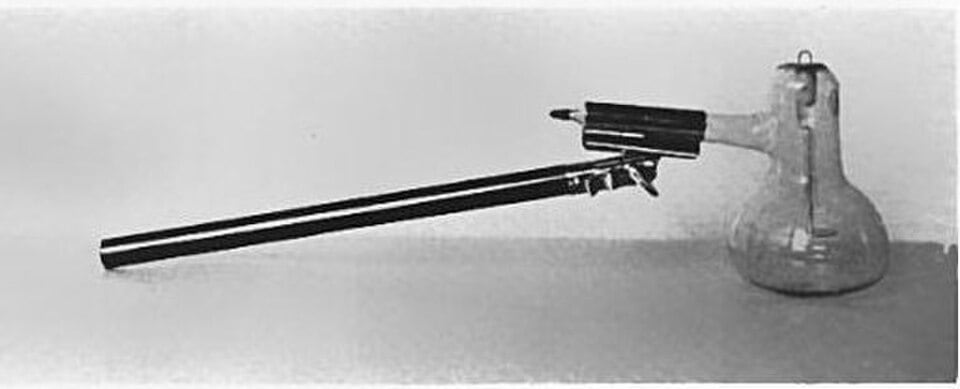
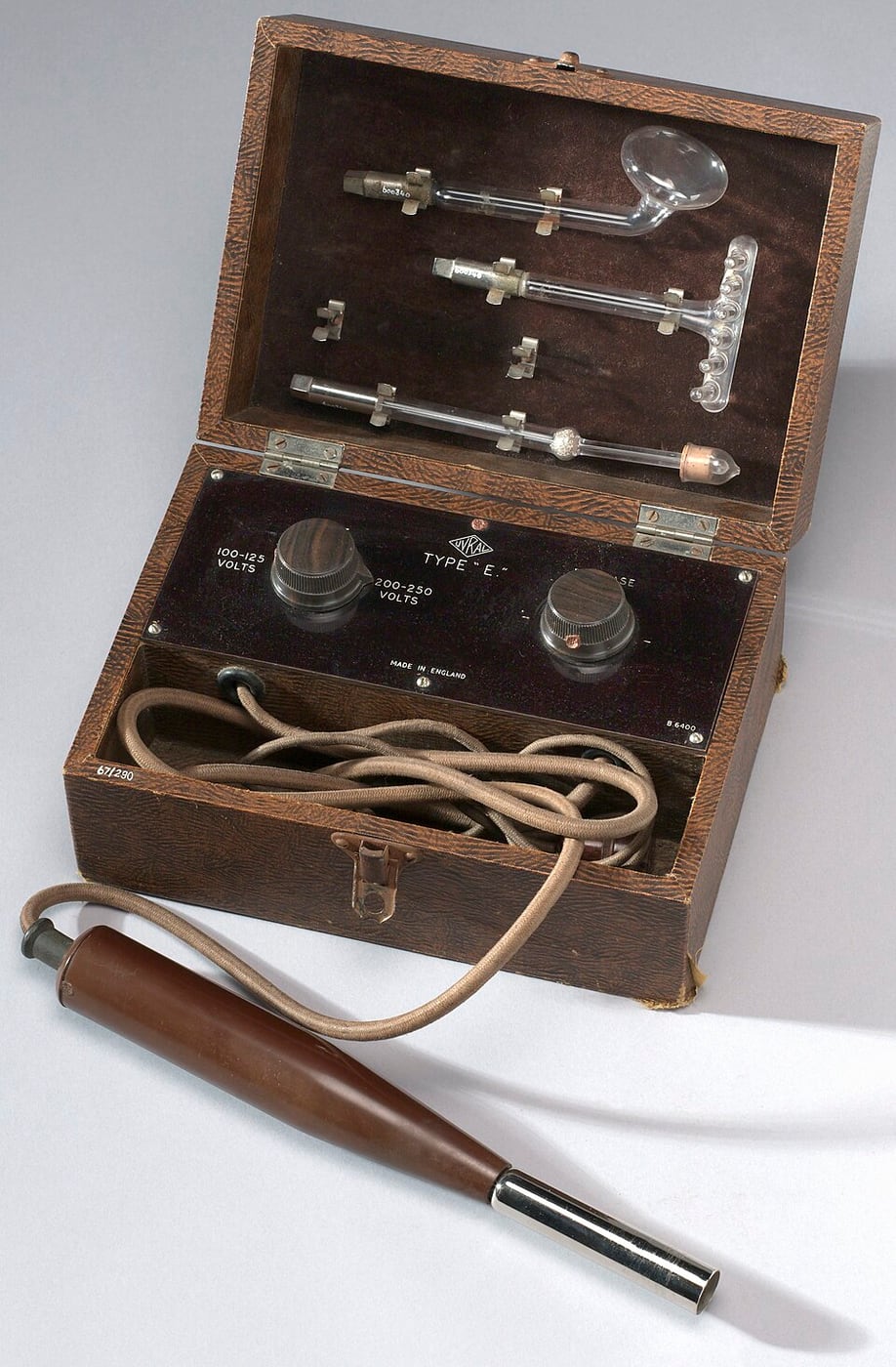
Set a hospital d’Arsonval–Oudin unit of about 1910 beside a Renulife “health generator” of about 1920 and the family resemblance is not a resemblance at all — it is descent. Both contain a spark gap or interrupter, a capacitor, and a step-up resonant coil of the Oudin/Tesla family. Both deliver a high-voltage, high-frequency, very-low-current output. Both terminate in a partially evacuated glass electrode that glows and sprays a fine, ozone-scented spark against the skin. The clinic unit is a larger cabinet with a resonator coil, a rack of electrodes, and a physician deciding the dose; the drugstore unit is the same circuit shrunk to fit one hand. The engineering distance between them is a matter of scale and packaging, not of principle.
Period authorities themselves classified the clinic machines into three types — d’Arsonval (comparatively low voltage, high current), Tesla (high voltage, low current), and the Oudin resonator (an adaptation of d’Arsonval giving high voltage, low current) — a taxonomy set out in Vol 2. The household violet ray is unambiguously the third of these: a small Oudin-type resonator. What the manufacturer sold as a novel invention was, electrically, the least powerful and most cosmetic corner of an existing medical apparatus.
The output figures usually quoted for the household version — on the order of 1 to 2 kilovolts with the spark gap discharging at roughly 4 to 10 kilohertz — come from museum secondary descriptions rather than a maker’s calibrated spec sheet, and are best treated as indicative rather than exact. Two different rates hide inside those numbers, and they must not be run together (as Vol 2 warns): the 4–10 kHz is the spark’s discharge, or repetition, rate — how many times a second the gap fires — while the current that actually flows in each burst rings at the far higher natural frequency of the resonant coil, hundreds of kilohertz into the low megahertz, the same ~200 kHz–MHz oscillation quoted for these Oudin-type coils in Vols 1, 2, and 5. It is that fast oscillation, well above d’Arsonval’s own no-tetanus threshold of roughly 5,000–10,000 Hz, that makes the current safe — not the slow spark rate, which sits right at that threshold and would convulse muscle if it were the frequency reaching the tissue. What matters is the shape of the numbers: kilovolts of potential, a true high-frequency oscillation, and a current so small that the shock never becomes the tetanic, painful jolt of house mains. That combination is the whole reason the device was safe enough to hand to a customer — and it is a property of high-frequency current itself, discovered by d’Arsonval, not an invention of any wand-maker.
4.3 The engineering that made the migration possible
The migration from clinic to counter was made possible by a single physiological fact, and it is worth restating precisely because the entire retail trade rested on it. From 1889 the French physician and physicist Jacques-Arsène d’Arsonval (1851–1940) studied what alternating current of rising frequency does to living tissue, and reported — in a note usually cited as “Action physiologique des courants alternatifs” in the Comptes rendus des séances de la Société de biologie around 1891 — that above a threshold of roughly 5,000 Hz (sources variously cite figures up to about 10,000 Hz, so the number should be read as an order of magnitude rather than a hard edge) the current stops causing the violent muscle contraction and pain of an ordinary shock. What remains at those frequencies is warmth and a superficial surface effect.
That finding is the founding permission slip for the whole field, and it cuts two ways. In the clinic it opened the door to controlled deep heating — the line that runs straight to diathermy (see the Diathermy Machines dive, Dive 4 of this wing). On the drugstore shelf it did something more mundane but commercially decisive: it made a high-voltage device that a layperson could safely press against their own skin. A wand delivering a couple of kilovolts of high-frequency current — the coil ringing at hundreds of kilohertz, far above the nerve’s follow-limit — stings, prickles, and warms, but it does not seize the muscles or stop the heart. The safety that let the object leave the hospital was purchased entirely by d’Arsonval’s physiology, not by any clever engineering in the handset.
The other enabling piece was the electrode. In parallel with the French clinical work — and with Nikola Tesla’s high-frequency experiments of 1891, which the popular literature often oversimplifies into “d’Arsonval and Oudin merely modified Tesla’s coil” (the resonant-coil hardware was indeed shared ancestry, but d’Arsonval’s physiological discovery was his own and slightly predates the medical adoption of Tesla’s circuit) — the American physician Frederick Finch Strong developed the vacuum glass electrode around 1896, adapting, in his own account, a modified Geissler tube. Where European clinicians had guided the current into the body through metal electrodes, Strong’s sealed glass bulb, evacuated to roughly 1/500th of atmospheric pressure, glowed a soft violet when the field ionized its residual gas. That glow — pretty, harmless, and easy to demonstrate — is what the object was eventually named for.
4.4 From the clinic bench to the drugstore shelf
The commercialization happened in stages, and the dates are reasonably well documented. Strong’s apparatus and electrodes entered commercial production through the Electro-Radiation Company of Boston in 1903; battery-operated models followed around 1906, which mattered because it freed the device from the constraints of a clinic’s wiring. The first inexpensive hand-held units appeared in drug stores around 1916, and the household boom followed the spread of domestic mains wiring itself — a violet ray needed a wall socket, and it sold hardest exactly where and when American homes were getting them.
The maker landscape that grew up around the object was crowded and international. The best-documented American name is Renulife, of Detroit — the historian’s account credits its founding to James Henry Eastman around 1917 — but it was one of many. Wikipedia’s roster of principal U.S. producers adds Fitzgerald, Fisher, Star Electric, and Master (the firm whose 1951 misbranding case would eventually end the American trade). One trade history reports that some twelve companies manufactured the devices across the United States, Canada, Germany, France, Spain, and England — a figure that comes from a single secondary source and should be treated as an order-of-magnitude claim rather than a verified census. No single company defined the object: it was a whole industry of near-identical velvet-lined boxes, each descended from the same clinic apparatus.
The sales channels were everything the era offered at once — drugstore counters, department stores, mail order, catalog houses, and door-to-door canvassers — and, tellingly, the same manufacturers pitched the machines to physicians and to households in the same breath. A device “designed to be used in medical settings and at home by the consumer” is a device whose makers understood perfectly that the two markets held the identical hardware. The Violet Ray Wands dive catalogs the makers, models, and cased sets in full; the point here is only that the retail industry was the clinic apparatus sold sideways.
4.5 The name that did the work
If one thing can be said to have carried the object across the boundary, it is its name. The clinic called the treatment d’Arsonvalization — a physician’s word, tied to a named discovery (and, by tradition rather than any primary record, to a 1913 electrotherapeutic congress). The counter called the object a violet ray — and the phrase, reportedly first used in The Dental Brief in 1913, is a small masterpiece of misdirection.
“Violet ray” invites the buyer to imagine a beam of therapeutic ultraviolet light, which in the 1910s and 1920s was a genuine and celebrated medical treatment for rickets and skin tuberculosis. It is nothing of the kind. The violet the customer saw was a low-pressure gas discharge inside the sealed electrode — the same physics as a neon sign, tuned to a different color — carrying only visible light and a negligible incidental trace of ultraviolet. There was no therapeutic ray. The whole retail proposition depended on letting a buyer hear “violet ray,” think of ultraviolet phototherapy, and borrow its prestige, and the marketing rarely had to claim ultraviolet outright because the name and the color did the implying. This is the load-bearing correction of the entire Violet Ray Wands dive; it is restated here only to show that the word, not the apparatus, is where the deception was engineered.
The promotion could be strikingly ordinary or strikingly strange. Manufacturers pitched the wand as a household “health generator” to be owned and self-administered. And the American clairvoyant Edgar Cayce lent it an entire subculture: of the more than 14,000 readings he is recorded to have given, he mentioned the violet ray machine in almost 900 of them — a measure of how thoroughly the object had escaped the clinic and entered the folk medicine of its era.
4.6 What survived the trip, and what did not
The engineer’s summary is short. Cross the boundary from clinic to counter and the physics is conserved — every genuine effect the wand had, the clinic apparatus had first — while the claims inflate without limit.
What survived, honestly, is a small list: a superficial, high-frequency spark that produces a mild counter-irritant tingling of the skin; local warmth; the smell of ozone from the spark tearing apart and recombining oxygen in the air; and a low, cosmetic violet glow. These are real, and they are exactly what Vol 2 attributes to surface application of high-frequency current. A stripped-down, honestly labeled version of that spark retained a genuine, narrow place in dermatology and dentistry for superficial skin and gum work — the honest descendant that survives today as the high-frequency dental electrosurgery unit.
What did not survive scrutiny is everything the object was actually sold for. Household violet-ray instruction booklets recommended the wand for an alphabet of complaints — rheumatism and neuritis, baldness and dandruff, deafness, insomnia and “nervous debility,” gout, “weak lungs,” impotence and “lost vitality,” prostate and “female” disorders, and, at the disreputable edge, cancer. None of it followed from the physics. A device delivering a couple of kilovolts of high-frequency current — the coil ringing at hundreds of kilohertz — through an electrode held to the skin, deposits a trivial, superficial amount of energy in the outermost tissue and reaches no organ, cures no infection, and regrows no hair. Organized medicine reached that verdict early: it is commonly cited that in 1917 the Journal of the American Medical Association dismissed the apparatus as incapable of treating the “practically every ailment known to mankind” its sellers claimed, attributing whatever benefit patients reported to suggestion — the placebo of an impressive, glowing, faintly painful ritual. The full regulatory reckoning, which ran through the 1938 Food, Drug, and Cosmetic Act to the 1951 misbranding action against Master Appliances that ended U.S. manufacture, belongs to the Violet Ray Wands dive and is not re-derived here.
The gap between the vivid sensation and the empty therapy is the whole story of the migration. The clinic sold a modest, bounded effect and named it after the man who discovered it; the counter sold the same effect, renamed it after its prettiest byproduct, and attached the entire catalog of human ailment to it.
4.7 The porous boundary
It would be neat to say there is a clean line between the “real” d’Arsonval apparatus and the “fake” violet ray, and there is not — which is precisely why this wing and the Quack Devices wing are deliberately cross-linked rather than walled off. The same coil, the same electrodes, and the same ozone-scented spark sat on both sides of the boundary; what differed was who wielded it, how it was dosed, and what was claimed. A physician performing autoconduction (the patient inside a large solenoid cage) or autocondensation (the patient as a capacitor plate) — the characteristic d’Arsonval treatment modes described in Vol 3 — was using serious apparatus within a bounded, if often overoptimistic, therapeutic frame. A canvasser selling the same physics door-to-door as a cure for deafness was not. The hardware could not tell the difference.
The porousness runs beyond the violet ray. The broader electrotherapy trade is full of instruments that were simultaneously legitimate tools and cure-all props: the galvanic current of a real “medical battery” was also the current of the wearable electropathic belt sold for lost “vital force” (see the Electropathic Belts dive in Quack Devices), and the faradic coil that re-educated a paralyzed muscle was also the fairground shock box. The lesson the high-frequency case teaches most sharply is that fraud in this field rarely required fake apparatus. It required real apparatus, a suggestive name, and a claim the physics could not support.
4.8 Where this volume hands off
This volume has followed the object across the hinge — from the clinic’s d’Arsonval apparatus to the drugstore’s violet ray — and shown that the crossing changed the marketing and left the physics untouched. The final volume, Vol 5 — Collecting High-Frequency Apparatus, returns all of these machines to the present as collector’s objects: how to identify and date a hospital d’Arsonval/Oudin unit, a resonator coil, a spark gap, an autoconduction solenoid cage, and the sets of vacuum electrodes that were the “violet ray” tubes — and, most importantly, how to safely display a high-voltage antique whose insulation is a century old. For the retail side of the story in full — the household handset, its makers and models, the extravagant claims, and the regulatory reckoning that ended the trade — turn to the Violet Ray Wands dive in the Quack Devices wing, of which this volume is the sober engineering counterpart.
Sources
- High Frequency — Cosmetics and Skin — the detailed history of the vacuum electrode and its commercialization: Frederick Finch Strong’s 1896 vacuum electrode (from a modified Geissler tube), commercial production via the Electro-Radiation Company of Boston in 1903, battery-operated models by 1906, the ~1/500th-atmosphere “violet vacuum,” “The Dental Brief” coining “violet ray” in 1913, cheap hand-held drugstore units by 1916, and the reported figure of roughly twelve manufacturers across the US, Canada, Germany, France, Spain, and England (treated here as an order-of-magnitude claim).
- What Was the Violet Ray Machine? — IEEE Spectrum — the Tesla-coil ancestry, d’Arsonval and Oudin refining the circuit for medical use, Oudin’s 1893 prototype, Strong’s ~1897 U.S. version, the indicative output figures (1–2 kV, with a 4–10 kHz spark discharge rate — distinct from the far higher RF oscillation frequency of the resonant coil), Renulife of Detroit (James Henry Eastman, 1917), Edgar Cayce’s ~900 mentions across 14,000 readings, the 1917 JAMA dismissal, and the 1951 Master Appliances misbranding ruling.
- Jacques-Arsène d’Arsonval — Wikipedia — d’Arsonval’s dates (1851–1940), his high-frequency work from 1889, the finding that currents above ~5,000 Hz do not cause muscle contraction or the pain of shock, “d’Arsonvalization,” and the spark-excited resonant circuit (~0.5–2 MHz) that led toward diathermy.
- Arsène d’Arsonval — Encyclopedia.com — the 1891 physiological note (“Action physiologique des courants alternatifs,” Société de biologie proceedings) reporting that high-frequency current produced no sensory or motor response and only heat; used to fix the founding-threshold claim and hedge the 5,000–10,000 Hz range.
- Tesla, quacks and violet rays — Wellcome Collection — the migration of high-frequency apparatus to the household “violet ray,” the appeal to physicians making house calls (plugging into a lamp socket, working on AC or DC), the marketing aimed at affluent buyers, and the long list of conditions claimed; plus the 1951 court finding and FDA seizures.
- Violet ray — Wikipedia — the “disruptive discharge coil with an interrupter … high voltage, high frequency, low current” description, the principal U.S. makers (Renulife, Fitzgerald, Fisher, Star Electric, Master), Edgar Cayce’s ~900 readings, and the 1951 Marion, Indiana action against Master that ended U.S. manufacture.
- RenuLife Violet Ray Health Generator — University of Rochester Medical Center, History of Medicine — a surviving Model R’s specifics and the “the glow is ionized gas, not ultraviolet” correction, supporting the indicative output figures and the debunking of the ultraviolet implication.
- High frequency (‘violet ray’) apparatus — Science Museum Group Collection — representative museum object records of the apparatus, and the collection’s own framing of the vacuum electrode (“commonly known as the ‘Violet Ray’”) as one development of the d’Arsonval / Oudin / Tesla high-frequency research.
Comments (0)