High Frequency Currents · Volume 5
Collecting the High-Frequency Apparatus
How to identify and date a hospital d'Arsonval or Oudin unit, its resonator coil, spark gap, autoconduction cage, and set of glass electrodes — and why the only sound way to keep a surviving high-voltage antique is to display it cold.
The end of this dive is the object on the bench. Four volumes have followed the high-frequency current from d’Arsonval’s 1889 discovery (Vol 1 — d’Arsonval, Oudin, Tesla, and the Birth of High-Frequency Medicine), through how a spark gap and resonant coil actually heat tissue (Vol 2 — How It Is Generated and What It Does to Tissue), into the clinic as d’Arsonvalization (Vol 3 — d’Arsonvalization in the Clinic), and across the porous line into the drugstore “violet ray” (Vol 4 — Same Physics, Different Marketing). This closing volume is for the person who now owns a piece of that apparatus, or is about to: how to tell a hospital d’Arsonval cabinet from a Tesla or Oudin variant, how to date a resonator coil or a cage, what the glass electrodes are, and — the load-bearing part — why a surviving high-frequency unit is an unsafe antique mains appliance best kept switched off.
Contents
5.1 About this volume
The hospital high-frequency apparatus survives in far smaller numbers than its drugstore cousin, and it is a very different object to hold. Where a violet-ray wand is a pocket handset in a velvet case, a clinical d’Arsonval installation was furniture: an iron-and-marble control cabinet on castors, an oak desk, a motor, a bank of condensers, and a resonator coil standing proud on top. The best-documented survivors are in the great medical collections — Sir Henry Wellcome’s Museum Collection, now within the Science Museum Group; the Wellcome Collection itself; and the Bakken Museum in Minneapolis, the only museum devoted to medical electricity. This volume assumes you have read the rest of the dive and refers back rather than repeats: the physics of the resonant tank is Vol 2’s, the clinical modes are Vol 3’s, and the retail afterlife is Vol 4’s and the Quack Devices dive on Violet Ray Wands. Here we catalogue the objects, date them, and make the safety case.
5.2 What survives: the family of objects
A collector meets the high-frequency world as five kinds of object, each of which turns up separately as often as it does together.
The cabinet unit. The full clinical installation. The Science Museum Group’s example by Établissements Gaiffe-Gallot et Pilon of Paris (c. 1890–1920) is representative: a control cabinet of iron and marble on castors, an oak desk with drawer, a wooden condenser drawer with brass fittings, an iron motor on an oak base with a marble-plated switch, and — the distinctive crown — an Oudin resonator transformer (their No. 10330, rated 110 volts, weighing 25.5 kg). The catalogue notes it was “probably an early version later modified for use with mains current,” which is itself a dating clue worth remembering.
The resonator coil. Often detached and sold alone. These are the tall, open, air-cored spirals of heavy copper wire on a wooden frame that give the apparatus its unmistakable look. The Science Museum Group holds one by Adolphe Gaiffe of Paris (c. 1900–1920): a mahogany frame with circular end rings, rods linking them, and thick copper wire coiled around the rods, 445 mm tall — described as a compact adaptation of the d’Arsonval cage meant for treating a patient’s arm rather than the whole body.
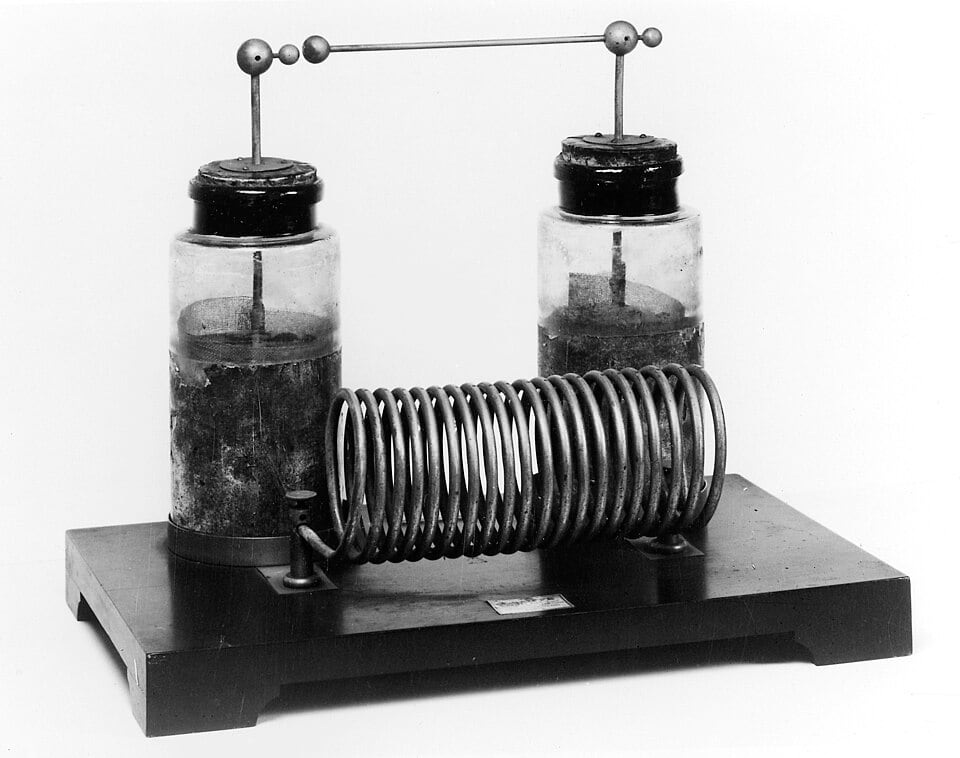
The spark gap and condenser. The oscillation source. Before vacuum tubes, every one of these machines made its high-frequency current by charging Leyden-jar or plate condensers and discharging them across a spark gap into the resonant coil — the damped-oscillation circuit of Vol 2. H. W. Cox’s London apparatus (below) survives precisely as “single coil and Leyden jars, with discharging rods.” Loose tungsten or brass spark-gap assemblies and glass Leyden jars are common orphan finds.
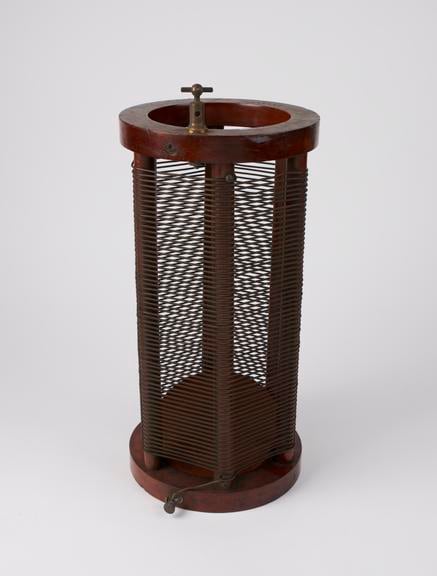
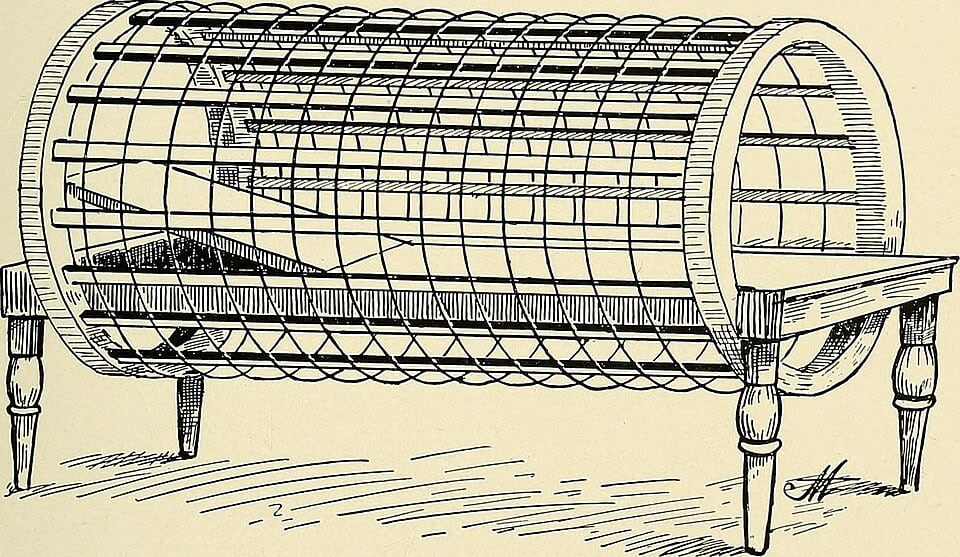
The autoconduction cage. The largest and rarest survivor: a person-sized solenoid the patient sat inside. The Science Museum Group’s cage by Richard Heller of Paris (c. 1890–1910) is an octagonal oak frame with iron fittings, 1,812 mm tall, 845 mm in diameter, weighing 105 kg — used by Dr J.-A. Rivière. As Vol 3 describes, the patient was insulated from all contact with the current-carrying wire and felt, in the catalogue’s words, “nothing, except a slightly warm sensation”; a hand-held coil with a bulb socket lit up as a demonstration of the induced field. Few of these were made and fewer kept; a genuine cage is a museum object, not an auction lot.
The electrode set. The glass vacuum electrodes — the same objects the retail trade branded “violet ray” tubes. Treated in its own section below.
5.3 Identifying the three machine types
Period authors sorted high-frequency apparatus into three families, and the distinction is the single most useful thing a collector can learn, because makers mixed and relabelled freely. Sinclair Tousey’s High Frequency Currents lays them out plainly. The d’Arsonval type is the low-voltage, high-current machine: a solenoid of heavy wire fed from Leyden jars, meant for whole-body “constitutional” treatment, and — in Tousey’s period figures — passing “a current of from 100 to 500, or sometimes 1000 or more, milliamperes” through the patient during autoconduction or autocondensation. The Oudin type adds Paul Oudin’s 1893 resonator coil tapped onto the d’Arsonval circuit, converting that high current into high voltage at low current for localised, sparking, glass-electrode work. The Tesla type reaches the same high-voltage/low-current end by a fine-wire secondary wound over the d’Arsonval solenoid. Those period current figures are best read as indicative rather than exact — treat them as ⟨verify⟩, since they come from a working clinician’s manual, not a measured specification. Modern secondary descriptions put a resonator’s output in the range of roughly 100 kHz to 1 MHz at tens of kilovolts, but these are characterisations, not maker’s ratings.
In practice the machines you find are almost always d’Arsonval-with-Oudin-resonator hybrids, exactly as the Gaiffe-Gallot et Pilon cabinet is; a pure Tesla or pure d’Arsonval installation is the exception. The tell is the resonator: a tall open air spiral means the machine could produce the high-voltage glass-electrode effects, whatever the maker’s plate calls it.
5.4 Dating a unit by maker and construction
Read the maker’s plate and the construction before you trust any seller’s date. The French school is oldest and best-provenanced: E. Ducretet of Paris built a d’Arsonval apparatus with Oudin resonator dated firmly to 1899 (Wellcome Collection); Gaiffe (later Gaiffe-Gallot et Pilon) and Richard Heller, both of Paris, span roughly 1890–1920. British makers such as H. W. Cox of Chancery Lane, London (his d’Arsonval-type apparatus of wood, vulcanite, brass, and glass dates c. 1900–1910) follow. The American makers arrive slightly later and are the ones a US collector meets most: the Wappler Electric Co. of Long Island, New York (a cabinet d’Arsonval generator with accessories dated 1920), Frank S. Betz & Co., the Davis Electric Company, and the McIntosh Electrical Corporation of Chicago, whose d’Arsonval-with-Oudin machines run into about 1930.
The construction itself brackets the era. Spark-gap excitation — Leyden jars, a visible spark gap, a resonator coil — dates a machine to roughly the 1890s–1920s; the shift to enclosed vacuum-tube oscillators belongs to the diathermy generation that follows (see the Diathermy Machines dive). Marble control panels, exposed brass and vulcanite, and open air-wound coils are early; enamelled steel cabinets and mains cords retrofitted onto a battery-or-motor original (as the Science Museum’s Gaiffe cabinet was) mark the transitional 1910s–20s. Cross-check any claimed model against the maker cities above rather than a romantic auction description; the objects were widely copied and the same “d’Arsonval type” label was applied on both sides of the Atlantic.
5.5 The electrode sets and the violet-ray overlap
Here the sober hospital apparatus and the drugstore cure-all become physically the same object, and a collector must hold both facts at once. The glass vacuum electrodes used with a clinical Oudin or Tesla output — partially evacuated sealed glass tubes that glow when the high-frequency field ionises the trace gas inside — are the identical family of objects branded “violet ray” tubes in the retail trade. Frederick Finch Strong’s development of the vacuum glass electrode around the turn of the century (c. 1896–1907; see Vol 1) served both worlds. A physician’s set and a Renulife home set share the same surface, cavity, and point shapes; the Quack Devices dive on Violet Ray Wands catalogues that fan of electrodes in full, and there is no need to duplicate it here.
What differs is the generator, not the glass. A drugstore wand hides a small coil in a Bakelite handle; a clinical unit drove its electrodes from the room-sized cabinet described above. So a bag of glass electrodes tells you almost nothing about which world it came from — only the machine does. This is the same porous boundary the whole dive turns on: identical physics, different furniture and different claims. Judge condition of the glass exactly as the Violet Ray dive advises — a sound electrode strikes a strong violet glow, a leaker glows dim, reddish, or washed-out because the discharge colour tracks the internal pressure, and a gassy tube cannot practically be re-evacuated at home.
5.6 Condition and the high-voltage-antique problem
State it flatly, as the Violet Ray dive does: a surviving high-frequency unit is an unsafe antique mains appliance, and the default sensible treatment is to display it, not operate it. The clinical machines make the case even more sharply than the handsets, because they were built to push far more energy.
- Real high voltage, real current. A resonator delivers its output in the tens of kilovolts, and the d’Arsonval side passed hundreds of milliamperes through the patient by design (Tousey’s 100–1,000 mA figures). Any machine “modified for use with mains current” — as the Science Museum’s cabinet was — couples that output to line voltage through wiring a century past its rating.
- Perished insulation. Cloth-and-rubber cordage of this age goes brittle and crumbles; early installations have no protective earth; vulcanite and shellac-varnished coils crack and carbonise. Assume every winding, capacitor, and lead is degraded and every insulator suspect.
- Possible asbestos. Some early Bakelite and insulating-board formulations were reinforced with asbestos fibre. Whether a given panel or handle contains any is not knowable by eye and should be verified, not assumed — and the correct posture is precaution: do not sand, drill, cut, or abrade an old moulded part, because intact material is low-risk and it is damage that releases fibre.
- Ozone. The spark ozonises the surrounding air — a genuine output of the device and a respiratory irritant; running one in a closed room is its own small hazard.
For all these reasons this volume gives no operating, restoration, or wiring instructions, and nothing about applying an electrode to a person — the historical whole-body cure-all claims were unfounded (see Vol 4) and the apparatus is unsafe. Bringing a clinical unit to life is expert-only high-voltage work, on a bench, through current-limiting gear; the community norm is to check a coil only at reduced input and to sense any high-frequency output without contact, never by energising it and touching it. Described here as principle, not procedure: a safe check is a low-power, hands-off, specialist affair, and everyone else should leave the plug in the drawer.
5.7 Display and provenance
Displayed cold, a high-frequency installation is a magnificent object — arguably the most impressive apparatus in the whole electrotherapy field, which is precisely why it impressed patients. Set the cabinet with its resonator standing, the condenser drawer and spark gap visible, and the electrode set laid out beside it; keep it out of direct sun (to spare varnish, vulcanite, and any velvet) and dry (to spare the coils and iron). If you want the violet glow for a photograph, produce it the modern, safe way — a small modern Tesla or plasma source lighting a spare electrode by proximity — rather than energising the antique.
Provenance turns a curiosity into a document. A maker’s plate (Ducretet, Gaiffe, Heller, Cox, Wappler, Betz, McIntosh), a resonator’s serial number, a physician’s name in the accession record (the Heller cage carries Dr Rivière’s use; the Ducretet unit its 1899 date), a surviving operating manual, or a clinic inventory ties the object to the exact clinical moment Vol 3 describes. Photograph every component with its plate and any number, and record where it came from: that record is the difference between “an old electrical machine” and a dated, attributed instrument of early high-frequency medicine.
5.8 Where this volume hands off
This is the last volume of the High Frequency Currents dive. The story does not stop here, though — it matures. The one genuine physiological finding this whole apparatus produced, the deep, safe heating of tissue without violent muscle contraction (Vol 2), is exactly what became legitimate physical medicine: the Diathermy Machines dive follows the spark-gap resonator into the vacuum-tube era and the shortwave physiotherapy unit, one of the few devices in this collection with an uncontested clinical place. In the other direction, the same glass electrodes and the same coil, stripped of clinical modesty and put in a velvet box, are the Quack Devices dive on Violet Ray Wands — the retail version of everything described here. And the deeper roots run back through the Faradic and Galvanic Machines and Static Electricity Machines dives, where medical electricity begins. Each ends, as this one has, on the object a collector holds and how to read it honestly.
Sources
- D’Arsonval high frequency electrotherapy machine by Gaiffe-Gallot et Pilon — Science Museum Group Collection (co142057) — the full clinical cabinet unit: iron-and-marble control cabinet on castors, oak desk, condenser drawer, motor and switch, and Oudin resonator No. 10330 (110 V, 25.5 kg); noted as “probably an early version later modified for use with mains current,” c. 1890–1920.
- High frequency resonator coil by Adolphe Gaiffe — Science Museum Group Collection (co141152) — the detached resonator: mahogany frame, ring ends, heavy copper wire, 445 mm, described as a compact adaptation of the d’Arsonval cage for treating a patient’s arm; Paris, c. 1900–1920.
- D’Arsonval cage for electrotherapeutic auto-conduction by Richard Heller — Science Museum Group Collection (co136587) — the autoconduction solenoid: octagonal oak frame with iron fittings, 1,812 mm × 845 mm, 105 kg, Paris c. 1890–1910, used by Dr J.-A. Rivière; the “nothing but a slightly warm sensation” and demonstration-bulb detail.
- d’Arsonval type high frequency apparatus by H. W. Cox, London — Science Museum Group Collection (co135617) — a British spark-gap unit: single coil and Leyden jars with discharging rods, wood/vulcanite/brass/glass, Chancery Lane, c. 1900–1910 — supports the spark-gap-and-Leyden-jar construction and dating.
- d’Arsonval high frequency apparatus with an Oudin resonator by E. Ducretet, Paris, 1899 — Wellcome Collection — a firmly dated 1899 French example, anchoring the earliest end of the dating range.
- d’Arsonval type high frequency generator with accessories by the Wappler Electric Co. — Science Museum Group Collection (co137068) — an American cabinet generator (Long Island, NY, 1920), for the US maker landscape and later dating.
- Sinclair Tousey, “High Frequency Currents: Oudin, Tesla, d’Arsonval, Piffard, Violet Rays, Auto-Conduction, Auto-Condensation” — Electrotherapy Museum — the period distinction between d’Arsonval (heavy solenoid, high current), Oudin (resonator, high voltage), and Tesla (fine-wire secondary) apparatus; the spark-gap/condenser/resonator components; and the period current figures (100–500, sometimes 1,000+ mA; autocondensation couch 100–500 mA), treated here as indicative ⟨verify⟩.
- Oudin coil — Wikipedia — leads only: Oudin’s 1893 modification of the d’Arsonval circuit into an autotransformer resonator, and the modern output characterisation (roughly 100 kHz–1 MHz, tens of kV); used only for orientation, not as a maker’s rating.
- Alternating Current gallery — Collect Medical Antiques — collector-side survey of makers (Wappler, Betz, Davis, McIntosh) and object types (cages, chairs, cabinets, portable and hand-held units), and the frank observation that the apparatus’s imposing look was itself part of the effect.
- The Bakken Museum — the museum devoted to medical electricity; general reference for surviving high-frequency and autoconduction apparatus.
Comments (0)