High Frequency Currents · Volume 3
d'Arsonvalization in the Clinic
How the hospital high-frequency apparatus was actually used on patients — the autoconduction solenoid cage and the autocondensation couch, the resonator coil and spark gap behind them, and the question of how the method got d'Arsonval's name.
Contents
3.1 About this volume
The first two volumes of this dive established the people and the physics. Vol 1 — d’Arsonval, Oudin, Tesla, and the Birth of High-Frequency Medicine introduced Jacques-Arsène d’Arsonval’s founding observation and the resonator that Paul Oudin added to it; Vol 2 — How It Is Generated and What It Does to Tissue followed the current from spark gap and capacitor through the resonant tank to the tissue, and drew the machine-type distinctions (d’Arsonval, Tesla, Oudin). This volume is the clinical one. Its subject is narrow: not the coil but the treatment — how a physician of roughly 1895–1920 sat a patient down with a hospital d’Arsonval/Oudin apparatus and did something that was meant to be therapy.
Two treatment modes define the era and give the volume its spine: autoconduction, in which the patient sits inside a large solenoid cage and current is induced in the body without any electrode touching it, and autocondensation, in which the patient’s own body forms one plate of a capacitor. Both were d’Arsonval’s, both were taken up widely, and one of them — autocondensation — leads directly to diathermy. The volume closes on a naming question the sources leave genuinely unsettled: the claim, repeated in the brief for this dive and in various secondary accounts, that a 1913 French electrotherapeutic congress formally adopted the word d’Arsonvalization. As will be seen, the word was already in everyday use two decades earlier, and the specific 1913 vote is hard to pin to a primary record — so this volume states what can be shown and flags what cannot. The deep debunking of the retail wand belongs to Vol 4 — The Hinge to Quackery; the collector’s questions to Vol 5 — Collecting High-Frequency Apparatus.
3.2 The apparatus on the clinic bench
The hospital high-frequency outfit of the period was not a single instrument but a chain of them. Mains or a battery drove a step-up induction coil; that charged a bank of Leyden-jar capacitors; the capacitors discharged across a spark gap, which chopped the stored charge into a train of damped oscillations; and those oscillations rang in a resonant tank circuit of capacitance and inductance. From that tank the physician tapped the output. The three named “currents” of the day — Tesla’s, d’Arsonval’s, and Oudin’s — were three ways of tapping and tuning the same basic apparatus, and by about 1900 all three were in wide clinical use across Europe and America, each with its own body of practice (Oudin coil — Wikipedia). The electrical differences between them are Vol 2’s subject; what matters at the bench is that d’Arsonval’s arrangement delivered a low-voltage, high-current output well suited to passing current through the whole body, while Oudin’s resonator coil — a second, many-turn winding tapped onto the d’Arsonval circuit and adjusted to resonance — raised the potential enormously (period figures for Oudin-type coils run to tens of kilovolts) at correspondingly low current, suited to a single-terminal electrode drawing sparks at one spot (Oudin coil — Wikipedia).
The physiological license for all of it came from d’Arsonval’s founding result. From 1889 he studied the effects of alternating current on the body and found that above roughly 5,000 Hz — period authors often quote a 5,000–10,000 Hz threshold — the current no longer produced the tetanic muscle contraction and pain of an ordinary shock (Jacques-Arsène d’Arsonval — Wikipedia). His therapeutic currents were spark-excited oscillations in the range of about 0.5–2 MHz (Wikipedia). The demonstration that made the point vivid was one d’Arsonval performed on himself: around 1891 he passed a current reported at some 3 amperes through his own body and felt nothing but warmth (D’Arsonval current — Medical dictionary). Three amperes at mains frequency would be lethal; at high frequency it merely warmed him. That single fact — high current made safe by high frequency — is what a clinic’s whole high-frequency practice was built to exploit, and it is why d’Arsonval could contemplate treatments that put the patient, rather than a small electrode, in the circuit.
3.3 Autoconduction: the patient in the solenoid cage
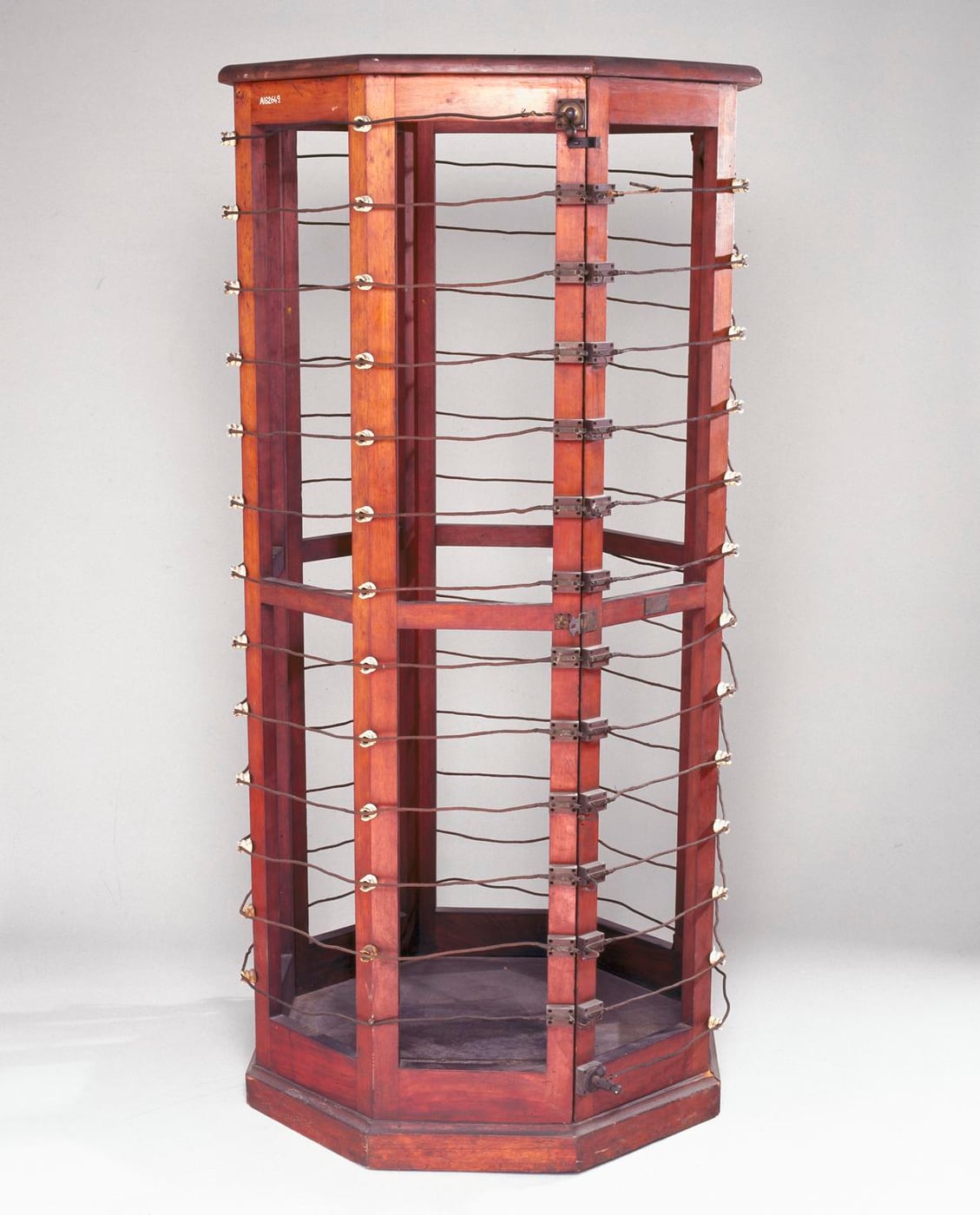
Autoconduction is the most photogenic thing in this dive, and among the most misunderstood. The patient sat inside a large solenoid — a human-sized coil of a few widely-spaced turns — and the high-frequency current ran in the winding, not through the patient by any wire. The changing magnetic field of the coil induced a current in the tissues of the body sitting within it. d’Arsonval called this “autoconduction,” though as later commentators noted the mechanism is really electromagnetic induction: the body is the secondary of an air-cored transformer (ETHW — Biological Effects of Electromagnetic Radiation). Because nothing touched the patient and the induced current was high-frequency, there was no shock and no muscular seizure — only, in the period description, a “slightly warm sensation” (Science Museum Group — D’Arsonval cage for autoconduction).
A surviving example makes the object concrete. The Science Museum’s D’Arsonval cage, built by Richard Heller of Paris and dated c.1890–1910, is an octagonal frame of oak with iron fittings, standing about 1,812 mm high and 845 mm in diameter and weighing some 105 kg — a piece of furniture, not a hand instrument. It carries a nice bit of clinical theatre: a hand-held coil fitted with a light-bulb socket, so that when the cage was energized and the seated patient held the coil, the bulb lit — proof, to a patient who felt almost nothing, that a real and powerful current was flowing (Science Museum Group). That the museum records the cage as “used by Dr J.-A. Rivière” is a reminder that these were working instruments in named practices, not curiosities.
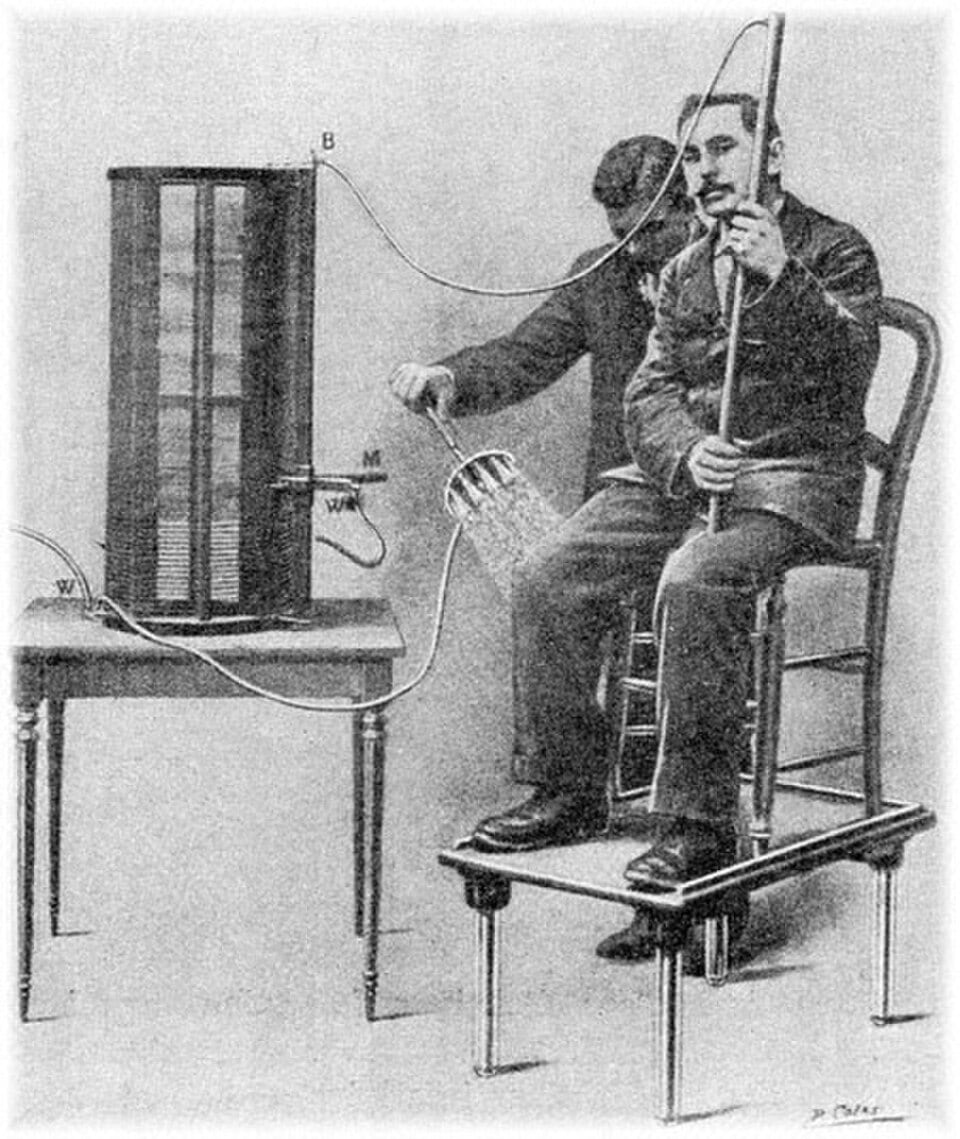
What autoconduction was for is where sober history and period enthusiasm diverge. d’Arsonval’s own trials were modest in scale: across 1894–1895 he is reported to have treated some 75 patients by seating them in the great solenoid for 15–20 minutes a day (arXiv — Essential Facts on the History of Hyperthermia). The claimed effects, recited across the period literature, were systemic and generous: raised general metabolism and body temperature, increased oxidation and haemoglobin, more active glands and secretions, freer elimination, a lowering of blood pressure where it was high, and a soothing action on the nervous system (ETHW). The blood-pressure claim was demonstrated to American audiences with the cage itself — a 1909 Buffalo paper is titled, plainly, “The Effect of High Frequency Currents upon Blood Pressure. Demonstration of the D’Arsonval Cage” (Buffalo Medical Journal, 1909, via PMC). A genuine, transient effect on blood pressure is among the more plausible of these; the rest run well ahead of what a few minutes of mild induced heating could support, and are best read as the optimistic house style of turn-of-the-century electrotherapeutics.
3.4 Autocondensation: the patient as a capacitor plate
The second mode is the one that mattered for the future of medicine. In autocondensation the patient’s body was made one plate of a capacitor: the patient lay or sat on a large conducting couch or plate connected to one terminal of the high-frequency apparatus, with an insulating layer between body and metal, so that high-frequency current flowed by displacement across the “condenser” formed by the body, the insulation, and the plate (ETHW). Here the current did pass through the body, but distributed over a large area rather than concentrated at an electrode, so it warmed the tissues without burning the skin. Period practice put real numbers on it: patients were treated on a condenser couch with currents on the order of 350–450 mA for about 6 minutes at a sitting (arXiv — Essential Facts on the History of Hyperthermia).
Those figures are worth dwelling on against the round numbers this field is prone to. The brief for this dive cites a d’Arsonval current “~1,500 mA,” and other sources quote d’Arsonval’s ~3 A self-experiment; the couch figures of a few hundred milliamperes are lower and better-attested for actual treatment. The honest reading is that the “d’Arsonval current” had no single canonical amperage — it depended on the mode, the apparatus, and the author — so specific milliampere and voltage numbers in this literature should be treated as indicative, not fixed.
Autocondensation is the direct ancestor of diathermy. Its whole point was controlled deep heating of tissue by high-frequency current — the same physiological effect that Karl Franz Nagelschmidt developed into a deliberate clinical modality — demonstrating deep tissue heating around 1907, giving it the name diathermy around 1909, and publishing the founding text in 1913 — and which became the legitimate physical-medicine modality of the twentieth century (arXiv). When the brief and the older texts call autocondensation “the forerunner of diathermy,” that is not loose praise: the couch heating a patient’s tissues in 1900 and the physiotherapy diathermy unit heating a joint in 1930 are doing the same physical thing, and the Diathermy Machines dive elsewhere in this Electrotherapy Devices wing picks the story up exactly there. That through-line — from autocondensation to diathermy — is the strongest claim this whole dive can make for high-frequency medicine having been real.
3.5 Naming the method: d’Arsonvalization and the 1913 question
By the mid-1890s the method already bore its inventor’s name. d’Arsonval himself used the term in the title of his own writing — La technique et les avantages de la d’Arsonvalisation is listed among his publications of the period (adarsonval.fr — Sciences) — and the word passed into ordinary medical French and English as the name for treatment by high-frequency currents. It stayed the common term until “diathermy” gradually displaced it after about 1920.
This makes the specific claim in this dive’s brief — that a 1913 French electrotherapeutic congress formalized the name “d’Arsonvalization” by vote — one to handle carefully. It is repeated in secondary and hobbyist accounts, but the primary record for a named 1913 congress adopting the word by ballot did not surface in the sources consulted here. What is verifiable is adjacent: the term was in documented use from the 1890s; 1913 was a live year for d’Arsonval’s high-frequency writing (a 1913 La Science et la Vie piece on the technique is on record); and honours were being paid to him around then (search of period and biographical sources). A congress endorsing an already-current name in 1913 is entirely plausible and consistent with the record — but this volume declines to state the vote as established fact, because it could not be tied to a primary source. If a reader finds the congress proceedings, the claim upgrades from plausible to documented; until then it is honestly the former. This is exactly the kind of tidy origin-story this field manufactures, and the disciplined answer is to say what is shown and stop.
3.6 What it genuinely did, and what it did not
Set the marketing aside and the ledger is short but not empty. The genuine physiological finding was d’Arsonval’s own: high-frequency current heats tissue without the violent nerve and muscle response of low-frequency shock. Autocondensation exploited that as controlled deep heat, and that effect — analgesic, circulation-raising, real — survives as diathermy in physiotherapy to this day. A transient effect on blood pressure and a general sense of warmth and relaxation from a session in the cage are plausible and were demonstrated. That is the honest core.
Around that core grew a far larger claim: that d’Arsonvalization raised metabolism, purified the blood, quickened the glands, and toned the whole organism toward health — that it was, in effect, a general vitalizer (ETHW). Against the physics this does not hold. A few minutes of mild, diffuse tissue heating a day cannot re-tune the endocrine system or cure organic disease, and the systemic “increased oxidation and elimination” language reads as the physiological optimism of an age that believed electricity was life itself. The hospital d’Arsonval apparatus was, at its most honest, a deep-heating and mild-stimulation device with a narrow legitimate use and a broad oversold one — the sober, clinical parent of which the drugstore “violet ray” wand was the shameless retail child.
That boundary is the point of the next volume, and it is genuinely porous. The very same resonator-and-spark-gap physics, the same glowing evacuated electrodes, and even the same word — physicians spoke of “d’Arsonvalization,” salesmen of “violet rays” — sat on both sides of it. A hospital’s cased d’Arsonval/Oudin outfit and a canvasser’s velvet-lined handset were, electrically, cousins; the difference was the claim on the label and the presence or absence of a physician. The retail version is the subject of the Violet Ray Wands dive in the Quack-Devices wing, and the wearable-current fraud it sat beside is the Electropathic Belts dive — both cross-referenced rather than duplicated here.
3.7 Where this volume hands off
With the clinical method in hand — the cage, the couch, the resonator, and the name — the dive turns to the thing this volume kept gesturing at: how the identical coil the hospital called a d’Arsonval apparatus became the drugstore violet-ray cure-all. Vol 4 — The Hinge to Quackery is that sober engineering account, and it cross-links the retail Violet Ray Wands dive explicitly as its consumer counterpart. Vol 5 — Collecting High-Frequency Apparatus then takes the hardware onto the bench: identifying and dating hospital d’Arsonval/Oudin units, resonator coils, spark gaps, autoconduction cages, and the sets of vacuum electrodes, and the safe display of a high-voltage antique. The forward branch of the physiology — autocondensation maturing into deep-heating physical medicine — leaves this dive entirely for the Diathermy Machines dive.
Sources
- Jacques-Arsène d’Arsonval — Wikipedia — d’Arsonval’s first physiological research from 1889; the ~5,000 Hz threshold above which current stops causing muscular contraction; spark-excited “D’Arsonval currents” of 0.5–2 MHz; his 1892–1910 directorship of the biophysics laboratory at the Collège de France; the origin of the terms “darsonvalisation” and “diathermy.”
- Oudin coil — Wikipedia — Paul Marie Oudin’s 1893 addition of a resonator coil to the d’Arsonval circuit; the high-voltage/low-current, single-terminal character of the Oudin output; and that by ~1900 the Tesla, d’Arsonval and Oudin circuits (RF ~100 kHz–2 MHz) each supported a separate body of clinical practice.
- Science Museum Group Collection — D’Arsonval cage for electrotherapeutic autoconduction — the surviving autoconduction cage: octagonal oak frame by Richard Heller of Paris, c.1890–1910, ~1,812 mm × 845 mm, ~105 kg, used by Dr J.-A. Rivière; the “only a slightly warm sensation” description and the demonstration bulb that lit in the patient’s hands.
- Engineering and Technology History Wiki — Biological Effects of Electromagnetic Radiation — that “autoconduction” is really electromagnetic induction; autocondensation as the forerunner of diathermy; and the period roster of claimed systemic effects (metabolism, oxidation/haemoglobin, glands, secretions, elimination, blood pressure, nervous system).
- Essential Facts on the History of Hyperthermia and their Connections with Electromedicine — arXiv 1710.00652 — d’Arsonval’s ~3 A self-experiment (c.1891); the 1894–1895 treatment of ~75 patients in the solenoid for 15–20 min/day; the condenser-couch currents of 350–450 mA for ~6 min/day; and Nagelschmidt introducing the term “diathermy” (deep heating demonstrated ~1907, term ~1909, founding book 1913).
- “D’Arsonval current” — Medical dictionary (en-academic) — d’Arsonval passing a ~3 A high-frequency current through his own body and feeling only heat; the 1890–1891 independent work of d’Arsonval and Tesla; the character of the D’Arsonval current.
- “The Effect of High Frequency Currents upon Blood Pressure. Demonstration of the D’Arsonval Cage” — Buffalo Medical Journal, 1909 (via PMC) — a dated (June 1909, W. L. Conklin) period demonstration of the cage specifically for a blood-pressure effect, evidence of how autoconduction was presented clinically in the US.
- adarsonval.fr — Sciences — d’Arsonval’s own publication La technique et les avantages de la d’Arsonvalisation, showing the term was his and in use in the 1890s–1910s; used to weigh (and hedge) the “1913 congress formalized the name” claim, for which no primary record was found here.
- What Was the Violet Ray Machine? — IEEE Spectrum — the shared lineage from Tesla through d’Arsonval’s safety modification to Oudin’s 1893 prototype, and the continuity between the medical apparatus and the retail violet ray; supports the porous-boundary framing and the cross-link to the Quack-wing Violet Ray Wands dive.
Comments (0)