High Frequency Currents · Volume 2
How It Is Generated and What It Does to Tissue
The spark-gap, condenser, and resonant coil that made high-frequency current — and the single honest discovery inside all the marketing: that such current heats tissue deeply without the violent muscle contraction of ordinary shock.
Contents
2.1 About this volume
Vol 1 — d’Arsonval, Oudin, Tesla, and the Birth of High-Frequency Medicine established the people and the founding observation: that from about 1889 Jacques-Arsène d’Arsonval showed a current oscillating fast enough no longer causes the pain and muscle tetanus of ordinary shock. This volume takes the lid off the apparatus and answers two mechanical questions. First, how was the current made — what the spark gap, the condenser, and the resonant coil each did to turn wall current or a battery into a high-frequency oscillation of tens or hundreds of kilohertz. Second, what did that current do to living tissue when it arrived — the surface spark, the ozone, the warmth, and above all the one genuinely consequential effect that separates this dive from the drugstore wand: deep tissue heating without violent muscle contraction, the finding that leads straight to diathermy (the Diathermy Machines dive, a sibling in this Electrotherapy Devices wing).
The engineering here is neither mysterious nor fraudulent in itself. It is ordinary turn-of-the-century high-frequency apparatus, and it is the same hardware that a hospital called a “d’Arsonval apparatus” and a canvasser sold door-to-door as a “violet ray.” That porous boundary is the subject of Vol 4 — The Hinge to Quackery and of the retail-side account in the Quack wing’s Violet Ray Wands dive; here we stay strictly on the physics and the physiology, and treat every period voltage, current, and frequency figure as a claim to be checked rather than repeated.
2.2 Three parts make a high-frequency generator
Every spark-excited high-frequency machine of the period is built from the same three functional parts in sequence, and understanding them in order demystifies the whole family of apparatus.
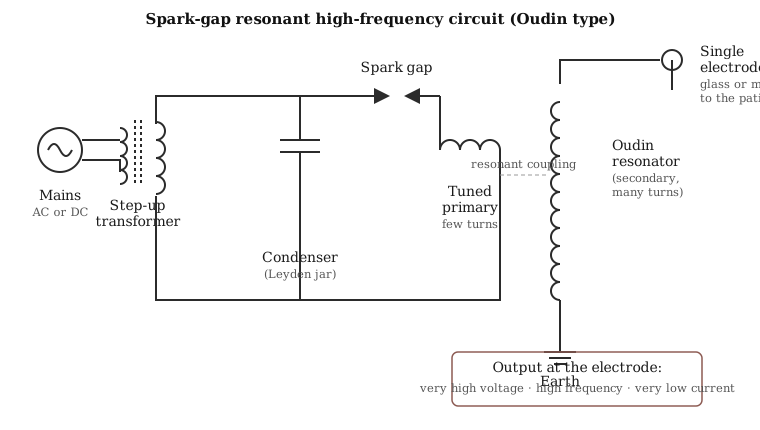
A step-up transformer raised ordinary mains (or a battery through an interrupter) to a high potential — an induction coil or a transformer whose secondary reached the tens of kilovolts needed to charge the next stage. A condenser — historically a Leyden jar or a bank of them — stored that charge. A spark gap set the rhythm: when the condenser’s voltage rose high enough to jump the air gap between two metal points, it discharged suddenly through a resonant coil (a primary of a few turns coupled to a tuned secondary). That sudden discharge does not simply dump the charge; the coil and condenser together form a tuned circuit that rings — it oscillates at its own natural frequency, pouring the stored energy back and forth many times before the energy dies away. The result is a damped high-frequency oscillation: a brief burst of alternating current at a frequency set by the coil and condenser, repeated each time the spark gap fires (Oudin coil, Wikipedia).
This is the classic spark-gap tank circuit, and the same topology powered the first radio transmitters. The frequency of the ringing lay far above anything mains could supply — period medical resonators are cited in the range of roughly 200 kHz to a few megahertz — while the spark gap itself fired only tens or hundreds of times a second. Popular accounts routinely conflate those two very different rates, and a careful reader keeps them apart: the repetition rate of the spark is slow; the oscillation frequency inside each burst is high. Around the 1930s the spark gap and its noisy, damped waves were superseded by vacuum-tube oscillators, which produced smoother continuous high-frequency current and defined the later short-wave diathermy machines (Oudin coil, Wikipedia).
2.3 The three period machine types
Period electrotherapists distinguished three arrangements of this basic circuit, named for their originators, and the distinction is real — it is a matter of how the resonant coil is wound and connected, and therefore of what comes out of it.
The d’Arsonval circuit was the original: a spark-excited single tuned circuit without a separate step-up secondary winding, delivering a comparatively lower voltage but higher current. Sources put its output on the order of ~30 kV — high by domestic standards, low within this family — with the larger current that made it suitable for passing appreciable energy through the body (Oudin coil, Wikipedia).
The Tesla circuit was a bipolar resonant transformer: a few-turn primary encircling the centre of a symmetrical secondary of many fine turns, with an output terminal at each end and neither earthed. It produced high voltage at low current. The Oudin circuit was Paul Marie Oudin’s 1893 modification of d’Arsonval’s apparatus — a unipolar resonator with one end grounded and a single output terminal, reaching still higher potentials for the same low current (Oudin coil, Wikipedia). Medical Oudin resonators of the early twentieth century are described as reaching potentials “of 50,000 up to a million volts” ⟨verify — an upper figure of this kind is easy to state and hard to confirm; it should be read as an order-of-magnitude claim, not a measured spec⟩. The single grounded terminal of the Oudin design is exactly what a “violet ray” handset inherited, and is why one glowing electrode, not two, is the retail form of the technology.
Two geographic notes recur in the literature and are worth flagging, gently, as generalisations rather than laws: the d’Arsonval and Oudin apparatus were more common in Europe, and the Tesla-type in America. The distinction between the three types matters less for the modern reader than the fact they shared the spark-gap-and-tank foundation and differed mainly in output character.
2.4 What the electrode delivered: spark, ozone, warmth
Bring the powered electrode — a bare metal ball or, more often, a partly evacuated glass bulb of the kind Frederick Finch Strong adapted from the Geissler tube around 1896 (the object cast forward to Vol 1 and to the Violet Ray Wands dive) — near the skin, and three things happen, all of them real and all of them modest.
A fine spray of sparks jumps the last small gap. Those sparks carry enough energy to split oxygen molecules in the air, whose fragments recombine into ozone — the sharp, chlorine-like smell that clings to any working high-frequency machine (Electrotherapy Museum, Tousey text). And where current actually enters and passes through tissue, the tissue’s own electrical resistance dissipates energy as warmth. The Austrian worker von Zeyneck explained this heating correctly as early as 1899: the heat is generated by the passage of current through tissue exactly as it would be if resistance were heated by an ordinary current (Gas, 2011). Nothing here is occult. The surface spark and its ozone are essentially a counter-irritant and a smell; the systemic “vitality” that sellers attached to them has no mechanism, a point the retail dive dismantles in detail.
2.5 The load-bearing finding: deep heat without contraction
The one discovery in this whole field that changed medicine was physiological, not electrical, and d’Arsonval made it on himself. Around 1891 he passed a current of about 3 amperes through his own body and felt no sensation except heat — a current that at ordinary low frequency would have been violently, perhaps lethally, dangerous (Gas, 2011). In a similar experiment in 1898 he passed roughly 500 milliamperes and again noted the heating (Gas, 2011).
The reason is that nerve and muscle cannot follow a current that reverses too quickly. Below a few kilohertz, each swing of the current can trigger the nerve; the muscle twitches, and at higher rates fuses into a sustained painful tetanus — the mechanism of every ordinary shock. Above a threshold in the low kilohertz range (Vol 1 places it at roughly 5,000–10,000 Hz ⟨verify — the figure is a soft physiological boundary, not a sharp one, and different sources quote different values⟩), the reversals come faster than the nerve membrane can respond, and the current passes without exciting contraction at all. What remains is the purely thermal effect: the current still deposits energy as heat in the tissue it crosses, but does so safely.
That is the hinge of the entire dive. It means high-frequency current can be used to heat tissue at depth — not merely warm the skin — without the pain and convulsion that made ordinary electrical current unusable for the purpose. Karl Franz Nagelschmidt built the deliberate clinical form of this heating: he demonstrated deep tissue heating around 1907, introduced the term diathermy (“heating through”) around 1909, and published the founding text in 1913 (Gas, 2011). The long-wave, spark-gap diathermy machines of the 1910s–1920s (roughly 0.5–3 MHz) are the direct descendants of the apparatus in this volume, and their full story is the Diathermy Machines dive. Everything genuinely useful about medical high-frequency current flows from this single, verifiable, self-experimented fact.
2.6 Autoconduction and autocondensation
d’Arsonval devised two treatment modes that dispensed with a hand-held electrode entirely and coupled the whole patient into the circuit — and both survive as characteristic period apparatus.
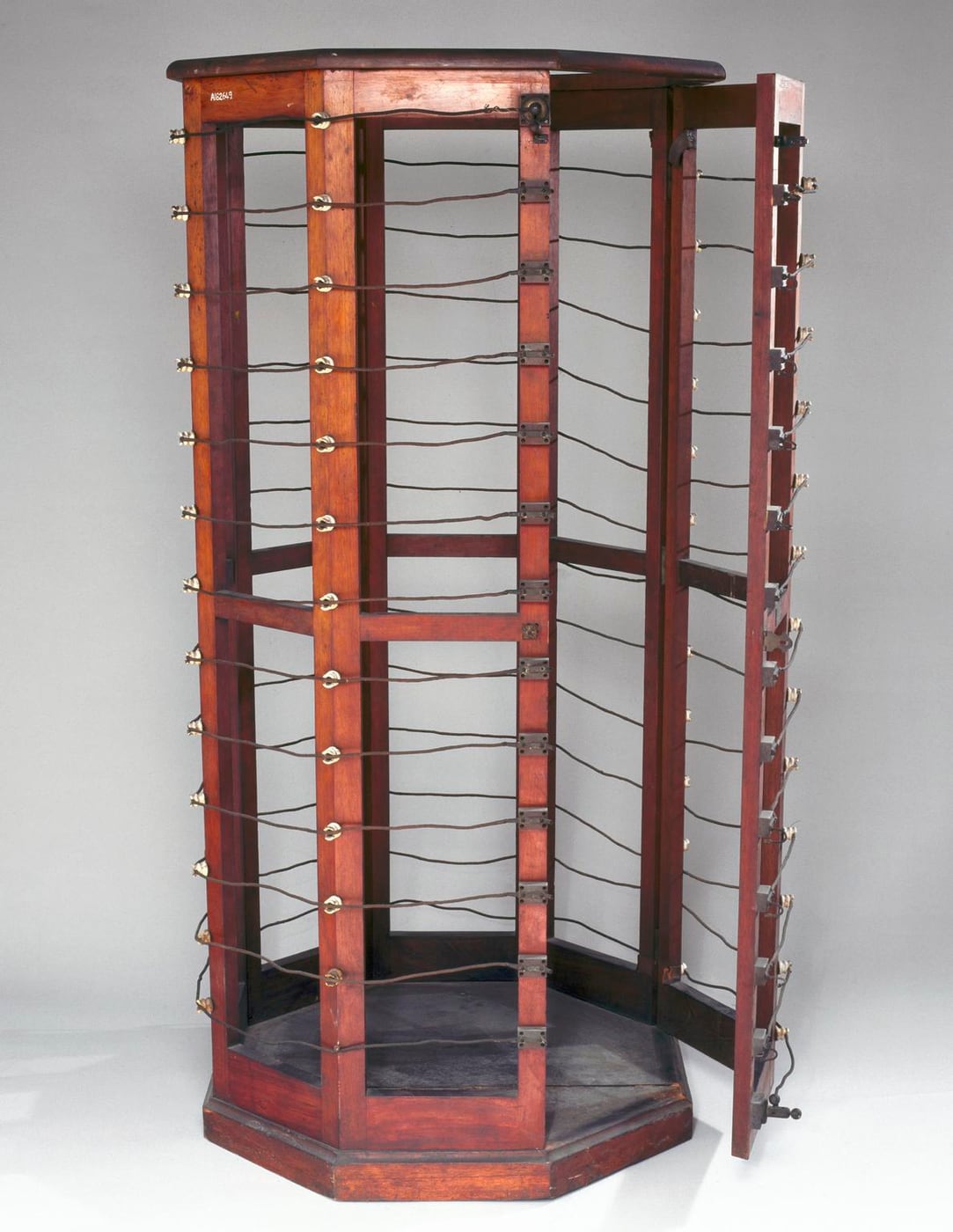
In autoconduction, the patient sat or lay inside a large solenoid — a cage of heavy wire turns carrying the high-frequency current. The changing magnetic field of the coil induced currents in the body without any wire touching it; d’Arsonval himself described the effect as “really induction under the influence of high-frequency electromagnetic field” (Gas, 2011). During 1894–1895 he treated some 75 patients this way, each placed in the great solenoid and exposed for 15–20 minutes a day (Gas, 2011). This inductive cage is the ancestor of the inductive-coil applicators of later diathermy.
In autocondensation, the patient became one plate of a capacitor. Reclining on an insulated condenser couch — a conducting surface separated from the body by a dielectric — the patient’s body formed the opposite plate, and the high-frequency current flowed capacitively through them. Period practice on the condenser couch is recorded at currents of about 350–450 milliamperes for six minutes a day (Gas, 2011). This capacitive coupling is the ancestor of the plate applicators of short-wave diathermy. Both modes travelled under the single name d’Arsonvalization — a word d’Arsonval himself used from the 1890s, and which a 1913 French electrotherapeutic congress is often (but unverifiably) said to have endorsed — the clinical history Vol 3 takes up and weighs. The genuine effect of both was heat and, some period workers claimed, an influence on circulation and blood pressure; the sweeping cures advertised around them belong to the debunking volumes.
2.7 The period numbers, treated with suspicion
This field’s figures were exaggerated by sellers and are quoted inconsistently even in sober sources, so the honest position is to give ranges and flag them. The founding brief for this dive cites a d’Arsonval current “e.g. ~1,500 mA,” which is the right order of magnitude but not one I could pin to a primary measurement; the best-documented figures are d’Arsonval’s own self-experiments (~3 A and ~500 mA) and the condenser-couch practice (~350–450 mA) recorded above ⟨verify — the “1,500 mA” figure should be treated as indicative only⟩. Output potentials are worse: “30 kV” for a d’Arsonval circuit, “50,000 to a million volts” for an Oudin resonator, and “hundreds of kilohertz to a few megahertz” for the oscillation are all repeated across secondary sources but are difficult to confirm against a maker’s calibrated spec sheet ⟨verify⟩. The safe way to describe the output is qualitative and comparative — d’Arsonval lower-voltage/higher-current, Tesla and Oudin higher-voltage/lower-current — rather than pinned to a single dramatic number, which is exactly the kind of number the marketing loved.
2.8 Where this volume hands off
You now have the machine and the physiology: how a spark gap, a condenser, and a resonant coil make damped high-frequency current, how the three period circuit types differ, and the one load-bearing fact — deep heat without muscle contraction — that made any of it medicine. Vol 3 — d’Arsonvalization in the Clinic follows the apparatus into the hospital: the autoconduction cage and autocondensation couch in use, and the unsettled question of how the method came to bear d’Arsonval’s name. Vol 4 — The Hinge to Quackery shows the identical coil sold as a drugstore “violet ray,” cross-linking the retail account in the Quack wing’s Violet Ray Wands dive and the galvanic cousins in its Electropathic Belts dive. Vol 5 — Collecting High-Frequency Apparatus closes on identifying, dating, and safely displaying a surviving high-voltage antique — where the exposed potentials sketched in this volume become a real handling concern.
Sources
- Oudin coil — Wikipedia — supported the spark-excited resonant tank topology; the unipolar Oudin (single grounded terminal) versus bipolar Tesla versus single-tuned d’Arsonval distinction; the 1893 Oudin date; the ~30 kV d’Arsonval and “50,000 to a million volts / 200 kHz–5 MHz” resonator figures (flagged as order-of-magnitude); the European/American geographic split; and the ~1930s transition from spark gaps to vacuum-tube oscillators.
- Piotr Gas, “Essential Facts on the History of Hyperthermia and their Connections with Electromedicine,” Przegląd Elektrotechniczny 87(12b), 2011 — the scholarly backbone: d’Arsonval’s ~3 A self-experiment (c. 1891) feeling only heat and the ~500 mA experiment (1898); autoconduction as induction in a solenoid (“cage”); the 1894–1895 treatment of ~75 patients at 15–20 min/day; the condenser-couch autocondensation at ~350–450 mA for 6 min/day; von Zeyneck’s 1899 resistive-heating explanation; and Nagelschmidt’s diathermy (deep-heating demonstrated ~1907, term “diathermy” introduced ~1909, founding book 1913) with long-wave diathermy at ~0.5–3 MHz.
- Electrotherapy Museum — Tousey, “High Frequency Currents: Oudin, Tesla, d’Arsonval, Piffard, Violet Rays” — period text supporting the spark-generates-ozone chemistry and the Strong vacuum (“violet ray”) electrode from 1896, commercialised 1903.
- Tesla, quacks and violet rays — Wellcome Collection — the d’Arsonval / Oudin / Tesla lineage and the porous boundary between hospital d’Arsonvalization and the drugstore violet-ray wand (developed in Vol 4 and the Quack wing).
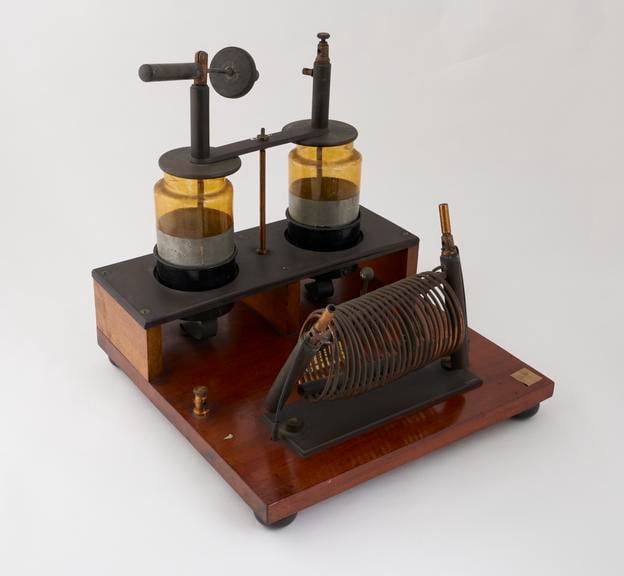
- Science Museum Group — “d’Arsonval type high frequency apparatus” (object co135617) — museum specimen of a cased hospital d’Arsonval apparatus, cited for the lead figure.
- Cross-references (named in prose, not linked): the Diathermy Machines dive (the legitimate maturation of the deep-heating finding) and the Quack wing’s Violet Ray Wands and Electropathic Belts dives (the retail forms of the same and neighbouring physics).
Comments (0)