Hand Pump and Bulb Machines · Volume 5
Collecting Hand Pumps and Bulb Outfits
How a collector identifies and dates a manual embalming outfit by its materials — rubber bulbs and tubing, brass and nickel bodies, glass reservoirs, ground-glass and bone fittings — grades its condition, documents its provenance, and displays it safely as a hazardous antique.
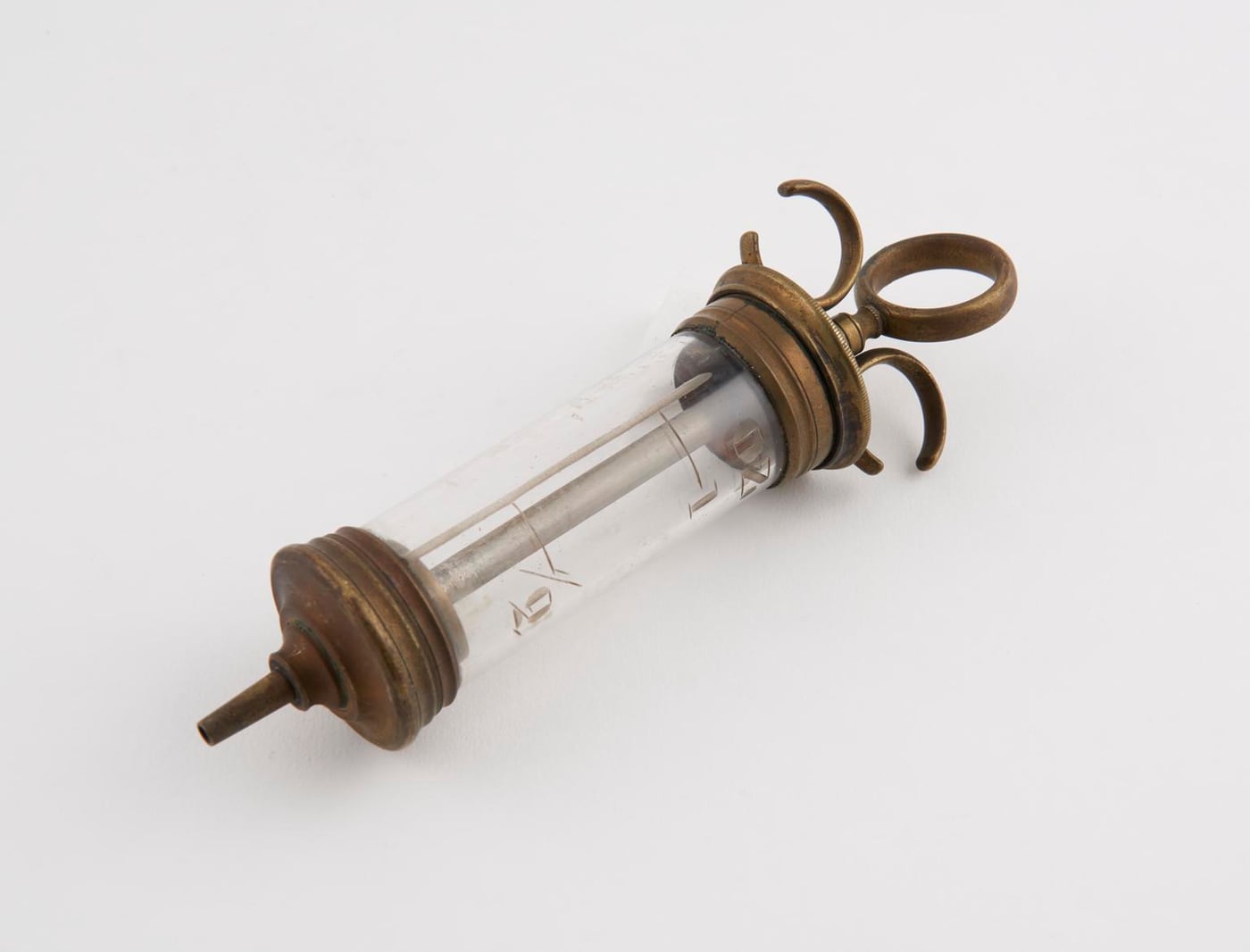
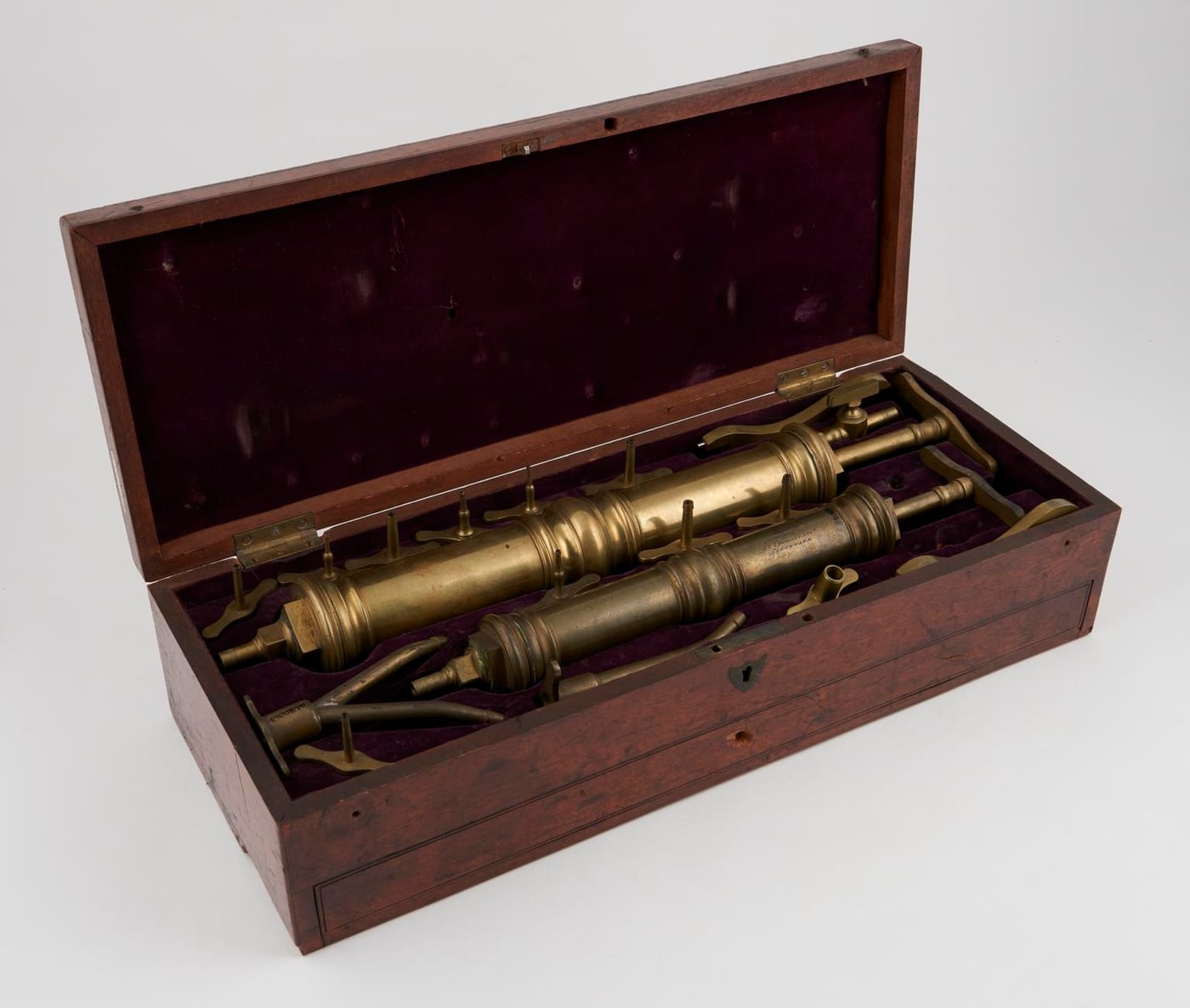
The end of this dive is the object on the bench. Four volumes have explained what a manual embalming outfit is — the bulb syringe, the piston hand pump, and the first continuous-pressure units — what physics they exploited, who built them, and how their form is written into the patent record. This closing volume is for the person who now owns one, or is about to. It is a guide to reading the object: dating it by what it is made of, judging its condition, documenting where it came from, and — the part that matters most — treating it as the hazardous chemical antique it is.
Contents
5.1 About this volume
A hand pump or bulb outfit is a rewarding thing to collect precisely because so much of it survives. Brass and nickel-plated metal, blown or moulded glass, and turned bone or hard-rubber fittings all endure a century in a drawer; the perishable parts — the squeeze bulb, the tubing, the pump’s leather or rubber cup washers — are usually gone or ruined, and their absence is itself a dating and grading cue. These outfits turn up at estate sales, in the back of old funeral homes, and in online listings, usually described with a mixture of romance and guesswork: a nickel-plated hand pump becomes a “veterinary vaccinator,” a plain brass injector becomes a “Civil War relic,” and a loose glass cannula becomes almost anything.
This volume assumes you have read the rest of the dive and refers back rather than repeats. The three device families and how to recognise each by form are laid out in Vol 1 — Three Ways to Make Pressure by Hand; why a squeeze-bulb grows harder to compress as pressure rises, and how check valves make a reciprocating pump deliver in one direction, is the engineering of Vol 2 — Pressure, Rate, and the Check-Valve Pump; the makers — above all the Embalmers’ Supply Company (ESCO) — are catalogued in Vol 3 — ESCO and the Birth of an American Instrument Trade; and reading the patent drawings and trade plates is Vol 4 — The Patent Trail and Reading the Object. Here we date, grade, attribute, and — soberly — put the thing behind glass.
5.2 Telling the three families apart, quickly
Before dating an outfit you have to know which of the three it is, and the distinction is one of form. A bulb outfit is defined by its pump: a rubber squeeze-bulb spliced into a length of tubing, with a one-way check valve at each end so that every squeeze forces a slug of fluid one direction only — the simplest arterial injector the trade sold, and the one most often reduced today to a lone glass or metal cannula because the rubber is gone. A piston or plunger hand pump is a self-contained metal instrument — a barrel, a plunger with a packed cup washer, and an internal check valve — often brass or nickel-plated and drawing from a separate glass or metal reservoir; it delivers a higher, more sustained pressure than a bulb. An early continuous-pressure unit adds a closed, pressurisable reservoir or an air pump so that the operator can hold a chosen pressure rather than pulse it by hand — the mechanical bridge to the electric machine of the next dive. The full visual key, with the tell-tale valve and reservoir features, is Vol 1’s and Vol 4’s to give; what follows assumes you have made that call.
5.3 Dating an outfit by its materials
There is no maker’s date stamped on most of these objects, so a collector dates by material, manufacture, and mark. Each substance carries its own clock.
Rubber — the bulb, the tubing, and the washers. Rubber is the most informative and the least durable part of any outfit. The squeeze-bulbs and tubing are vulcanised natural rubber, and the same chemistry that made them useful dooms them: under ultraviolet light and moisture, natural rubber oxidises, and free sulfur on the surface bonds with water to form sulfates and sulfuric acid, so the material hardens, crazes, goes sticky, and crumbles. A surviving soft bulb that is still supple is therefore almost always a later replacement, not original — a genuine pre-war bulb is typically stiff, cracked, or reduced to fragments. Hard rubber (vulcanite or ebonite), used for pump handles, valve seats, and threaded fittings, is more diagnostic still: black when new, it discolours under UV to a characteristic grey-green then brown, so a mottled brown fitting is a positive age signal rather than mere grime. Hard rubber was a mature material by the mid-nineteenth century — Goodyear and Hancock had patented the vulcanising process in the early 1840s, and hard-rubber medical goods were in commerce from around 1851 — so its presence is consistent with anything from the 1870s onward and does not by itself narrow the window; the degree of oxidation does.
Brass versus nickel plating. Bare polished brass is the older look; nickel plating over brass became the standard bright, corrosion-resistant finish for medical and embalming metalware as the trade professionalised toward and after 1900, so a nickel-plated pump body generally reads later than a plain-brass one, and flaking plating that reveals yellow brass beneath confirms the construction. Beware over-reading this: brass instruments were made throughout the period, and a cleaned or re-plated body can mislead. Treat finish as one line of evidence, cross-checked against the fittings and any mark.
Glass reservoirs and cannulas. Blown and moulded glass reservoirs, feed bottles, and glass arterial tubes date by their own manufacturing marks: an applied or tooled lip and the seams of two-piece moulds point to the nineteenth or very early twentieth century, while a fully machine-made bottle with a seam running unbroken over the top of the lip indicates automatic bottle machinery, widespread only after about 1915. Graduations etched or moulded into a reservoir, and any embossed maker or capacity, are worth recording. Glass being glass, these parts survive when everything softer has perished, which is why so many outfits reach a collector as “a pump and some glass” with the connective rubber missing.
Ground-glass and bone fittings. The finer outfits used ground-glass joints — a tapered, frosted glass-on-glass seal, the same technology as laboratory stoppers — where a leak-tight, solvent-proof connection was wanted, and turned bone (or ivory) for handles, stopcock keys, and small couplings before hard rubber and, later, plastics displaced it. A ground-glass joint or a bone fitting signals an earlier, more expensively made instrument; a Bakelite or other early-plastic fitting signals the 1910s–1930s or later, since phenolic plastics only enter general instrument use in that era. The material sequence — bone and ground glass, then hard rubber, then early plastics — is a rough chronology in miniature.
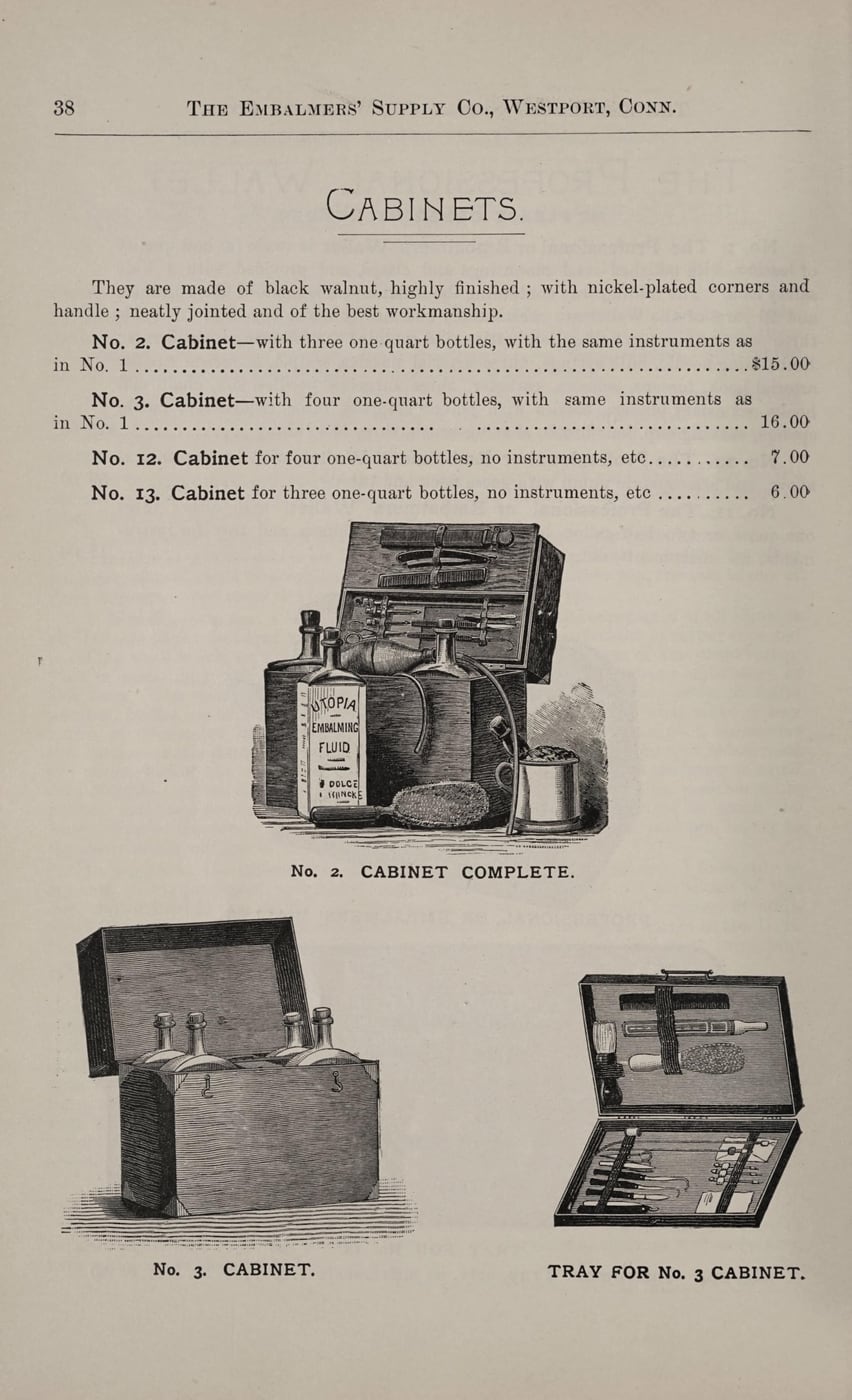
The mark, and the catalogue. The surest date comes from a name. American manufacture of embalming instruments began in earnest with ESCO, founded as the partnership of C. B. Dolge and Max Huncke on 13 April 1886 in Brooklyn (trading also as the Brooklyn Embalming Fluid Company and as Dolge & Huncke), which moved to Westport, Connecticut, in 1890 and claims the first American-made embalming instruments and accessories — “pumps, goosenecks, etc.” — in 1887, before which such apparatus was imported from Germany or made by the user. That “1887 first” is ESCO’s own long-standing corporate claim and is best cited as the company’s account rather than as an independently proven priority; the founding date and the Brooklyn-to-Westport move are corroborated by Westport local history and by records of Huncke’s separate Brooklyn chemical firm. A stamped ESCO mark, or a body that matches an ESCO catalogue plate, therefore places an outfit no earlier than the late 1880s and usually well into the twentieth century. Other names a collector should learn to recognise on plates and bodies — house brands and later specialist makers such as C. M. Sorensen, and casket-and-supply houses like National Casket — are catalogued in Vol 3; match a mark to a dated catalogue page and the guesswork ends.
5.4 Condition assessment
Grade the outfit part by part, in roughly the order that condition governs value.
Completeness. A manual outfit is a system, and its worth is decided first by how much of the system survives together: pump, reservoir, tubing, and the fan of interchangeable cannulas or goosenecks in one fitted case is worth far more than the sum of loose parts. Record what is present against a catalogue plate and note what is missing.
The metal. Look for corrosion pitting under failed plating, split solder seams, stripped threads, and — on a piston pump — a seized or scored plunger. Bright, evenly worn metal is good; green verdigris in the crevices and blistered nickel are cosmetic but tell you the piece was stored damp.
The glass. Check reservoirs and cannulas for chips, star-cracks, cloudy “sick glass” (surface etching from long chemical contact), and the integrity of any ground-glass joint — a chipped ground joint no longer seals and is a real defect.
The perishables. Assume the rubber is compromised. Original bulbs and tubing are usually hardened, cracked, sticky, or gone; a supple bulb is a replacement. The pump’s internal cup washers and any leather are almost always perished. This is expected and is not, by itself, a flaw in a display piece — but it means the outfit cannot and should not be made to function.
The case and fittings. A complete, un-restored fitted case with its bone or hard-rubber fittings intact is a significant part of the value; missing retainers, water-staining, and replaced hardware all count against it.
5.5 Attribution and provenance
Provenance turns a curiosity into a document. Because so few of these instruments are self-dating, the paper and the story around one are disproportionately valuable. A period trade catalogue page matching the object, an undertaker’s or supply-house label, a receipt, a shop’s inventory, or the name of the funeral home it came from all tie the piece to a place and a decade in a way the metal alone cannot. The University of Michigan’s Clements Library, for instance, holds a documented set of embalming and cosmetic instruments belonging to Lowell M. Clapp, an undertaker of Kalkaska, Michigan, active 1907–1935 — exactly the kind of named, dated attribution that transforms “an old brass pump” into evidence of a specific working practice. Record where an outfit came from, photograph every component beside a scale, transcribe every mark, and match forms to a dated catalogue; that record, not the object’s shine, is what separates a documented artefact from an anonymous oddity. Attribution by form is Vol 4’s method; provenance is the collector’s own to build and keep.
5.6 Safe display: a chemical antique, not a working tool
This is the volume’s core caution, so it is stated flatly: a surviving hand pump or bulb outfit is a chemical antique to be displayed cold, not a tool to be operated. Two hazards stack up.
First, the residues. These instruments moved preservative fluids, and the early fluids were built on poisons. Before formaldehyde — which C. B. Dolge imported to America only in 1894, there having been no practical supply before then — arterial fluids were based on arsenic, and also on mercury and zinc salts, preservative precisely because they were toxic; arsenical fluids remained in use until state laws banned them in the early twentieth century, a public-health story picked up in the Gravity Injection Systems dive and closed in the Electric Embalming Machines dive. An old pump, cannula, or reservoir may carry dried arsenical or formaldehyde residue in its bore and threads. Formaldehyde is a recognised human carcinogen and a potent irritant; inorganic arsenic is cumulatively toxic and can be absorbed through skin and mucous membranes. The correct posture is precaution: handle a dug or unclean outfit with gloves, do not blow through it or taste-test it, keep it away from food surfaces and children, and clean it — if at all — wet, gently, and outdoors, never by dry-brushing dust you might inhale.
Second, the perished materials. The rubber is dead and the seals are gone; there is no safe way to pressurise the outfit, and nothing to be gained by trying. Unlike a violet-ray wand — whose collecting volume in the Violet Ray Wands dive (in Quack Devices) makes the parallel case that a surviving unit is an unsafe antique mains appliance best displayed unplugged — a hand pump carries no electrical danger, but the same principle governs it: the object’s value is as a document of the trade, and its safe state is inert.
Displayed cold, a manual outfit is a superb object. Lay the pump, reservoir, and cannulas in an open fitted case or on a stand, keep it dry (to spare the metal and any iron) and out of direct sun (which is what destroys the rubber and discolours the hard-rubber fittings), and label it with everything you have established — family, materials, maker, and provenance. This volume gives no instructions for operating, cleaning-to-use, or restoring an outfit to function, and none touching human remains: the point is that a manual embalming outfit belongs behind glass, read as history.
5.7 Where this volume hands off
This is the last volume of the Hand Pump and Bulb Machines dive. From here the arc of the sub-project continues: the manual outfit’s direct successor — the electric-motor-driven pump with its pressure and rate-of-flow gauges — is the subject of the Electric Embalming Machines dive, where the same two controllable quantities this dive introduced are finally set and held by a machine. The complementary cavity branch, the trocar and the water-jet hydro-aspirator, is the Trocars and Cavity Injection dive; the gravity method that preceded all hand pressure is Gravity Injection Systems; and the pre-refrigeration furniture that surrounded the whole trade is Cooling Boards and Corpse Coolers. Each dive ends, as this one has, on the object a collector holds and how to read it.
Sources
- ESCO’s History — Embalmers’ Supply Company and About Us — Embalmers’ Supply Company — the company’s own account: partnership of C. B. Dolge and Max Huncke founded 13 April 1886 in Brooklyn (also the Brooklyn Embalming Fluid Company / Dolge & Huncke); moved to Westport, CT in 1890; partnership dissolved 1893; “1887 – FIRST American-made instruments and accessories” (“pumps, goosenecks, etc.”) after prior reliance on German imports or user-made apparatus; first formaldehyde imported 1894; early arsenical fluids. Cited as ESCO’s corporate history, not an independently verified priority claim.
- Past and Present: The Max Huncke Chemical Company — Brownstoner and Embalmers Supply Co. tag — 06880 (Westport local history) — independent corroboration of the Dolge/Huncke Brooklyn origin and the Westport, Connecticut relocation.
- Modern Embalming — University of Michigan Clements Library — the documented Lowell M. Clapp instrument set (undertaker, Kalkaska, Michigan, 1907–1935), a model of dated, named provenance for a manual outfit.
- Ebonite — Wikipedia and Reblackening of faded hard rubber — Vintage Pens — hard rubber / vulcanite as a dating material: early-1840s vulcanising patents (Goodyear, Hancock), hard-rubber goods in commerce from ~1851, and the UV-plus-moisture oxidation that turns black hard rubber grey-green to brown (a positive age signal).
- Exploring the Intriguing World of Antique Syringes — LoveToKnow — glass syringe/component use c. 1900s–1930s and general material/dating framing for antique injecting instruments (secondary; used for the glass-era window, cross-checked against bottle-manufacture chronology).
- Old Embalming Hand Pump, Big Metal Brass Syringe — eBay listing and Embalming Equipment, National Museum of Funeral History (Pinterest record) — surviving-market examples confirming the nickel-plated-brass hand pump / glass component / brass injector forms a collector actually encounters, and maker names (e.g., C. M. Sorensen, National Casket) to recognise. Secondary/market sources, used only to characterise surviving object forms.
- Embalming chemicals — Wikipedia and Controlling Formaldehyde Exposures During Embalming — NIOSH/CDC — the arsenic-then-formaldehyde chemistry, arsenic’s toxicity and skin/mucous-membrane absorption, and formaldehyde’s carcinogenicity and irritant thresholds, supporting the “chemical antique — handle with precaution” case for residues in surviving apparatus.
Comments (0)