Hand Pump and Bulb Machines · Volume 1
Three Ways to Make Pressure by Hand
The bulb syringe, the piston hand pump, and the first continuous-pressure outfits — the three families of manual injection apparatus, and how a collector tells them apart by their form.
Contents
1.1 About this volume
This deep dive is about the middle era of the embalmer’s apparatus: the roughly half-century, from the 1880s to the arrival of the electric machine, in which pressure for arterial injection was made by hand. Its companion dive, Gravity Injection Systems, covers the founding technology — an elevated bottle driving fluid into an artery by nothing but the weight of its own column. This dive begins where that one leaves off, at the moment the trade stopped relying on the height of a bottle and put a pump in the operator’s hand.
The task of this establishing volume is narrow and physical. It describes the three families of hand apparatus the trade actually used, in order of rising sophistication: the bulb syringe (a rubber squeeze-bulb with one-way valves), the piston or plunger hand pump (a brass or nickel-plated cylinder drawing from a reservoir), and the first continuous-pressure outfits (which let the operator set a pressure and hold it, rather than pulse it by hand). It ends by showing how a collector, handed an unlabelled object, tells the three apart by their form alone.
It deliberately stops short of the arguments that follow. The real engineering — why pressure and rate of flow are two separate quantities the trade learned to control independently, and exactly how a one-way check valve turns a back-and-forth pump into a one-directional one — is the subject of Vol 2 — Pressure, Rate, and the Check Valve. The company that industrialised this hardware, the Embalmers’ Supply Company (ESCO), and the men who founded it are the subject of Vol 3 — ESCO and an American Instrument Trade. The patent record and how to read a specific object is Vol 4 — The Patent Trail, and the collector’s practical craft of dating and displaying an outfit is Vol 5 — Collecting Hand Pumps and Bulb Outfits. Throughout, the register is that of trade history and engineering: this is about apparatus, not procedure, and no part of it is an instruction.
1.2 The problem hand pressure had to solve
To understand why three families of pump appeared, it helps to see the limits of the method they replaced. Gravity injection makes pressure from a column of fluid and nothing else. A column of water exerts about 0.43 pounds per square inch for every foot of height — a standard hydrostatic figure, and embalming fluid sits close enough to water in density that the same rule holds. A bottle raised two or three feet above the body therefore delivers only on the order of one pound per square inch. That is genuinely useful, and for an uncomplicated case it can be enough. But it has two structural weaknesses that the trade felt keenly.
First, the only control is the height of the bottle: to raise the pressure you physically lift the reservoir, and the practical ceiling of a room and a stand caps how high you can go. Second, the pressure is not steady — as the bottle empties, the column shortens and the pressure falls, so the injection weakens exactly as it proceeds. Where fluid met resistance — a partly obstructed vessel, a region the trade wanted to reach more firmly — gravity simply could not push harder without a taller column than the room allowed.
Hand apparatus was the answer to both problems. A pump makes pressure mechanically, independent of any column, so the operator can raise it past what gravity permits and, in the better designs, hold it steady. The three families below are three escalating solutions to that single want: more pressure than a bottle gives, and more control over it.
1.3 The bulb syringe
The simplest of the three is the bulb syringe — at its plainest, a soft rubber bulb with a length of rubber tubing, and a one-way (check) valve at each end. Squeeze the bulb and the fluid inside is forced out through the outlet valve toward the arterial tube; release it and the bulb springs back to its natural shape, drawing a fresh charge in through the inlet valve. The two valves are the whole trick: each opens for flow in one direction and closes against flow in the other, so that a motion which is in itself merely back-and-forth is rectified into delivery in a single direction. Every squeeze sends one slug of fluid forward; the device is, in effect, a hand-worked reciprocating pump reduced to its barest possible parts.
It was prized for exactly that simplicity. A bulb syringe is self-contained, cheap, has almost nothing to break, and needs no reservoir of its own beyond the vessel it draws from. Trade descriptions frequently pair it with gravity: the body could be run on the gravity bottle, and the operator could periodically squeeze a bulb in the line to boost pressure and rate past what the bottle’s height alone would give — a way to overcome a low ceiling. The bulb also carries a crude but genuine feedback signal. As pressure builds downstream, the bulb grows harder to compress, so the resistance felt in the hand rises with the internal pressure. That tactile “gauge” — the closest a bulb outfit comes to an instrument reading — is a small but real piece of the engineering, and Vol 2 takes it up properly alongside the physics of the check valve.
The bulb syringe’s weaknesses are the mirror of the piston pump’s strengths. Because the pressure is made by a hand closing on soft rubber, it is pulsed, modest, and imprecise; you cannot set a figure and hold it, and the peak pressure is limited by how hard rubber can be squeezed before it simply resists. For many cases that sufficed, and bulb outfits remained in catalogs long after better pumps existed, precisely because they were foolproof. For a collector, the bulb outfit is also the family least likely to survive intact: rubber perishes, so a surviving “bulb syringe” is often only its valve fittings and tube ends, the bulb itself long since gone brittle and lost — a dating and condition point Vol 5 returns to.
1.4 The piston hand pump
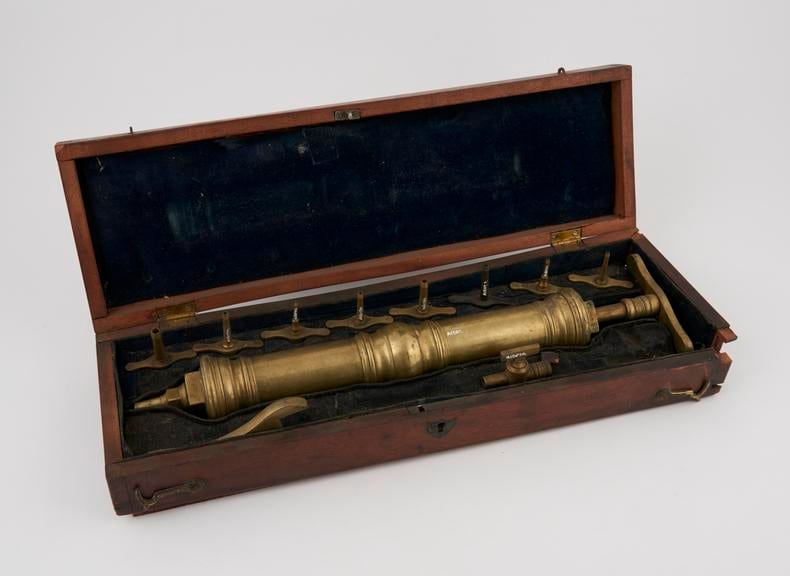
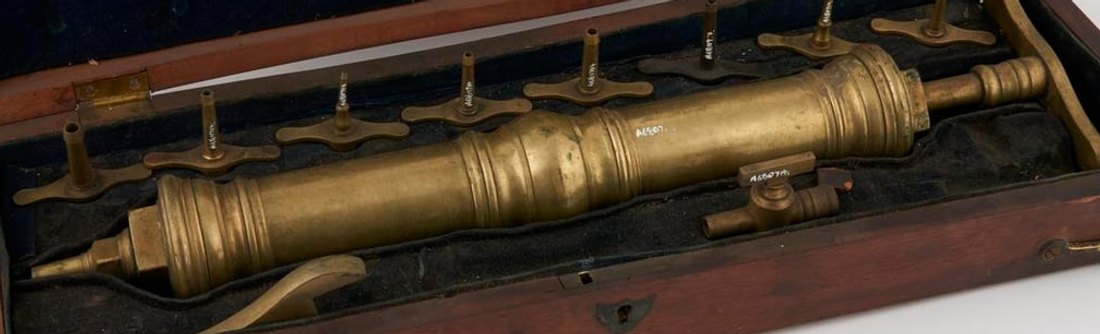
The second family trades simplicity for power. A piston (or plunger) hand pump is a self-contained cylinder pump: a metal barrel with a close-fitting piston worked by a handle, fed from and delivering through valved ports. Pull the handle and the piston’s withdrawal draws fluid from a reservoir — commonly a glass jar or bottle — into the cylinder past an inlet check valve; push the handle and the piston drives that charge out past an outlet check valve toward the arterial tube. As with the bulb, it is the pair of one-way valves that makes the reciprocating stroke deliver in one direction; unlike the bulb, the moving element is a rigid piston in a machined barrel, so it can generate a far higher and more sustained pressure than a hand closing on rubber ever could. Period and modern descriptions liken the object to “a large hypodermic syringe” attached to a bottle, which captures its form well.
The materials are part of the identification. Surviving pump bodies are typically brass, or brass that has been nickel- or chrome-plated — plating chosen for its resistance to the corrosive fluids run through it — with a glass or metal reservoir and rubber tubing to the patient end. The pressures the trade associated with these pumps are higher than gravity’s single pound: secondary sources describe working ranges on the order of a few up to roughly a dozen pounds per square inch, though the exact figures vary between sources and periods and should be treated as indicative rather than a specification. Some accounts tie the target to natural circulatory pressure; those specific “matches the heart” numbers are inconsistent between sources and are best left as approximate. The load-bearing point for this volume is simply relative: a piston pump reaches pressures a bulb or a bottle cannot.
A second capability distinguishes the better hand pumps and points forward to the whole trade. A piston in a barrel can produce suction as readily as pressure — the same withdrawal stroke that fills the cylinder can, plumbed the other way, draw a vacuum. So a single hand pump could serve two functions: pressure for arterial injection, and vacuum for aspiration of the cavities, the work done with the trocar. That dual role is why the pump and the trocar are cousins in the same trade, and the aspirating side of the story belongs to the Trocars and Cavity Injection dive; this volume flags the shared hardware and leaves the cavity branch to it.
1.5 The first continuous-pressure outfits
Both the bulb and the piston pump share one limitation: they make pressure in pulses, one per stroke, and between strokes the pressure sags. The operator holds a pressure only by working the handle steadily, and the delivery rises and falls with the hand. The third family removed the hand from the moment of delivery.
The device the trade generally called the air-pressure machine solved it by pressurising air rather than pumping fluid directly. In its characteristic form it is a hand pump fitted with two hose connections (often described as slip hubs) — one that delivers air, one that draws a vacuum. Connected to a sealed reservoir part-filled with fluid, the air hub pumps air into the closed space above the fluid, raising the pressure on the whole headspace; that trapped air pressure then pushes the fluid steadily out of the bottom of the jar and down the delivery line. The operator pumps the headspace up to the pressure wanted, and the sealed air holds it: the fluid now flows continuously under a pressure that persists between strokes, rather than in pulses timed to the hand. The vacuum hub gives the same outfit the aspirating capability described above. It is, in effect, a pressure accumulator worked by hand — the trapped, compressible air is the reservoir of pressure that a bare piston lacks.
This is the conceptual hinge of the whole dive, because “set a pressure and hold it” is precisely what the twentieth-century electric machine would go on to do automatically. The continuous-pressure hand outfit is the direct ancestor of the powered machine: replace the hand-worked air pump with a motor-driven pump, add gauges that read the held pressure and the rate of flow as separate numbers, and you have crossed from this dive into the Electric Embalming Machines dive. The line runs straight from the sealed, hand-pressurised jar to the Porti-Boy and its kin; what the motor bought was not a new idea but the removal of the hand. That transition, and the true separation of pressure from rate of flow as two independently set quantities, is the ground Vol 2 prepares and the electric dive completes.
1.6 Telling the three families apart
The practical pay-off of this volume is being able to name an unlabelled object from its form. The three families read differently in the hand.
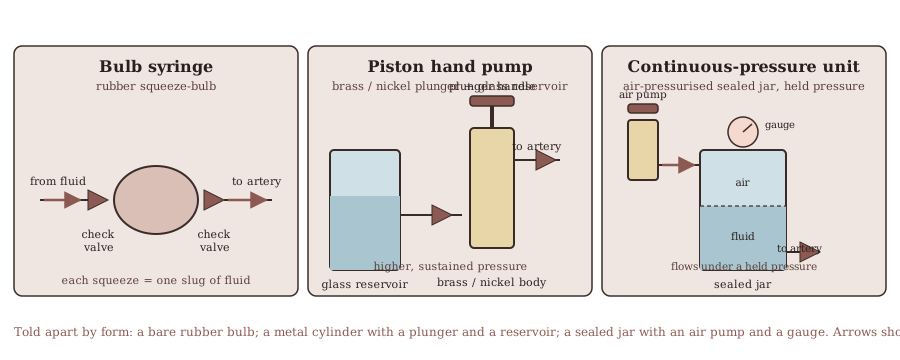
A bulb syringe is the outlier: its working element is a soft rubber bulb, not a rigid mechanism, and apart from the two small valve housings at its ends there is nothing machined about it. If the pressure was made by squeezing rubber, it is a bulb outfit — and if only the tube ends and valve fittings survive with the bulb gone, the perished rubber itself is the tell.
A piston hand pump announces itself with a rigid metal cylinder and a plunger handle, usually brass or nickel/chrome plated, paired with a separate reservoir (classically a glass jar or bottle) and valved ports where the tubing attaches. It looks, deliberately, like an oversized syringe married to a bottle. There is no sealed headspace and no gauge; the operator’s hand is the pressure control.
A continuous-pressure (air-pressure) outfit is distinguished by the sealed reservoir and the evidence that air, not fluid, was being pumped: two hose hubs (one air, one vacuum) rather than a single delivery line, and — on the more finished examples — a pressure gauge reading the held headspace. If the object could hold a pressure with the operator’s hand off the handle, it belongs to this third family. The gauge and the sealed jar are the features that, more than any other, mark the step toward the electric machine.
Materials cut across all three and help with dating: perishable rubber bulbs and tubing, brass and plated-brass bodies, glass reservoirs, and ground-glass or bone fittings on the older pieces. Reading those materials to date and authenticate a specific outfit — and to spot a married-up or reproduction set — is the collector’s craft that Vol 5 is devoted to, and the patents that fix a given mechanism to a maker and a year are the object of Vol 4.
1.7 Where this volume hands off
You now have the three families in hand — bulb, piston, and continuous-pressure — and the vocabulary to tell them apart by form. The next question is the one the objects raise but do not answer: why the trade cared about two separate quantities, pressure and rate of flow, and exactly how a one-way check valve converts a back-and-forth stroke into one-directional delivery — including why a squeeze-bulb grows harder to compress as pressure rises, the crude tactile gauge noted above. That engineering is Vol 2 — Pressure, Rate, and the Check Valve, which also authors the reciprocating-pump-cycle diagram this volume only gestures at. From there the dive turns to the American firm that industrialised this hardware (Vol 3 — ESCO, founded 13 April 1886 by C. B. Dolge and Max Huncke, whose first American-made instruments appeared in 1887), to the patent record and reading a specific object (Vol 4), and to collecting, dating, and safely displaying an outfit (Vol 5). Sideways, the apparatus connects to its siblings: the Gravity Injection Systems dive for the method these pumps improved on, the Trocars and Cavity Injection dive for the aspirating half of the same hardware, and the Electric Embalming Machines dive for where the continuous-pressure idea finally shed the hand.
Sources
- ESCO’s History — Embalmers’ Supply Company (via search of embalmerssupplynj.com) — founding as a Dolge–Huncke partnership on 13 April 1886 (operating as the Brooklyn Embalming Fluid Company / Dolge & Huncke), the introduction of the first American-made embalming instruments and accessories in 1887 (pumps, goosenecks, and the like — previously imported from Germany or user-made), the 1890 move to Westport, Connecticut, the 1893 dissolution and incorporation, and the 1889 United States College of Embalming. Used only for the Vol 3 hand-off dates.
- Modern Embalming — William L. Clements Library, University of Michigan — the professionalisation arc from itinerant “embalming surgeons” to a shop-based trade, and the late-19th-century advance of instruments, chemicals, and schools that frames this dive.
- “How to Learn Hand Pump Embalming” — American Mortuary Coolers (mymortuarycooler.com) — engineering description of the piston hand pump: chrome-plated brass body chosen for chemical resistance, one-way check valves ensuring forward-only flow, the pump’s dual pressure/vacuum capability, and a cited working-pressure range (secondary; treated as indicative, not a specification).
- “A Guide to Embalming Supplies” and related pages — American Mortuary Coolers — trade classification of injection methods (gravity, bulb syringe, gravity-plus-bulb combination, hand pump, air-pressure machine) and the description of the air-pressure machine with two slip hubs pressurising a jar’s headspace to deliver fluid continuously.
- Embalming — Medindia procedure overview — corroborating summary of arterial-injection apparatus types (gravity bottle, hand pump likened to a large hypodermic syringe on a bottle, air-pressure machine). The specific “0.6 kg/cm² per metre” figure it gives is inconsistent with standard hydrostatics and was not used; the hydrostatic value in the text (≈0.43 psi per foot of water column) is the standard physical constant.
- History of Embalming — National Museum of Funeral History (Houston) — museum framing of the mid-1900s embalming room and the trade’s material history (equipment context only; no apparatus-level detail).
- Anatomy, Descriptive and Surgical, for the Use of Embalmers — Nunnamaker & Dhonau (1913), Project Gutenberg — public-domain trade text consulted for period usage; note that it is largely anatomical and offers little apparatus detail, which is itself informative about where the technical record does and does not live.
Comments (0)