Hand Pump and Bulb Machines · Volume 2
Two Quantities and a One-Way Valve
Pressure and rate-of-flow were the two things the trade actually controlled — and the humble check valve is what let a back-and-forth hand stroke deliver fluid in a single direction. Why a squeeze-bulb grows stiffer as it works is a crude gauge hiding in plain sight.
Contents
2.1 About this volume
Vol 1 — Three Ways to Make Pressure by Hand sorted the manual era into its three families — the rubber squeeze-bulb, the brass or nickel piston pump, and the first continuous-pressure units — and showed how a collector tells them apart by form. This volume takes the lid off the mechanism. It answers two engineering questions that the whole trade organised itself around, and that a museum reader needs in order to understand every later machine in this sub-project: what, exactly, was being controlled, and how a device with no moving power source but a human hand could push fluid steadily in one direction.
The answers are simpler than the folklore suggests. The trade cared about two separate quantities — pressure and rate-of-flow — and spent decades learning that they are not the same thing and cannot be read off one another. And the piece of hardware that made hand injection possible at all is the least glamorous part of the whole outfit: the check valve, a one-way gate that turns a back-and-forth stroke into flow in a single direction. This volume authors the diagram of that cycle and then uses it to explain a small, genuine piece of applied physics: why a rubber injecting bulb grows perceptibly stiffer in the hand as it works — a crude pressure gauge that costs nothing and that no one designed on purpose.
The makers and the American supply trade that manufactured this hardware are the subject of Vol 3 — ESCO and the Birth of an American Instrument Trade; the patent drawings that record how the valve-and-pump art evolved are read in Vol 4 — The Patent Trail and Reading the Object; and dating and displaying a surviving outfit is Vol 5 — Collecting Hand Pumps and Bulb Outfits. This volume stays with the mechanism.
2.2 Two quantities, not one
The single most useful idea in manual-era injection is that pressure and rate-of-flow are two different things. Modern embalming pedagogy still teaches them as separate controls, and the distinction is exactly as old as the apparatus. Pressure is force per unit area — the push behind the fluid, measured in pounds per square inch. Rate-of-flow is a volume delivered per unit time — how much fluid moves, conventionally measured in ounces per minute (American Mortuary Coolers, machine guide). One is a how hard; the other is a how fast. A high pressure can accompany a trickle of flow (if the path ahead is nearly blocked), and a generous flow can run at modest pressure (if the path is open). They are related through the resistance of everything downstream, but they are not interchangeable, and confusing them is the classic beginner’s error the trade texts warned against.
The relationship is worth stating precisely because later gauged machines make it visible. On a modern injector the operator reads two states directly: potential pressure is what the gauge shows with the pump running but the flow valve shut — the pressure the machine could deliver against a closed path — while actual pressure is what it shows with the valve open and fluid genuinely moving into the body. The difference between them, written informally as potential minus actual equals differential, is the pressure actually doing the work of distribution (Embalming pressure study notes, Quizlet). (⟨verify — this “potential/actual/differential” vocabulary is standard in twentieth-century mortuary-science teaching, but its exact wording and origin are not attributable to a single primary text.⟩) These specifics belong to the electric-machine era — the sibling Electric Embalming Machines dive — but what matters here is that the two-quantity idea was already the intellectual content of hand injection long before a dial existed to display it.
The hand operator had no gauge. What he had instead was his own muscle sense — and, as the last two sections of this volume argue, a bulb or plunger that fed pressure information back through the resistance he felt. That is the whole reason the manual era is worth studying: it is the same control problem as the electric machine, solved by feel.
2.3 The check valve: making a stroke deliver one way
A human hand can only push and release. A pump built on that motion has a problem: on the return half of every stroke, whatever it just expelled will try to flow straight back in. The device that solves this is the check valve — a valve that permits flow in one direction and blocks it in the other, opening under forward pressure and seating shut under any reverse push (Engineers Edge, positive-displacement pump operation). A reciprocating pump needs two of them: one on the inlet (between the fluid supply and the pumping chamber) and one on the outlet (between the chamber and the delivery line). Working as an antagonistic pair, they rectify the back-and-forth motion into steady one-way delivery.
The cycle has two strokes, and in each stroke the two valves do opposite things:
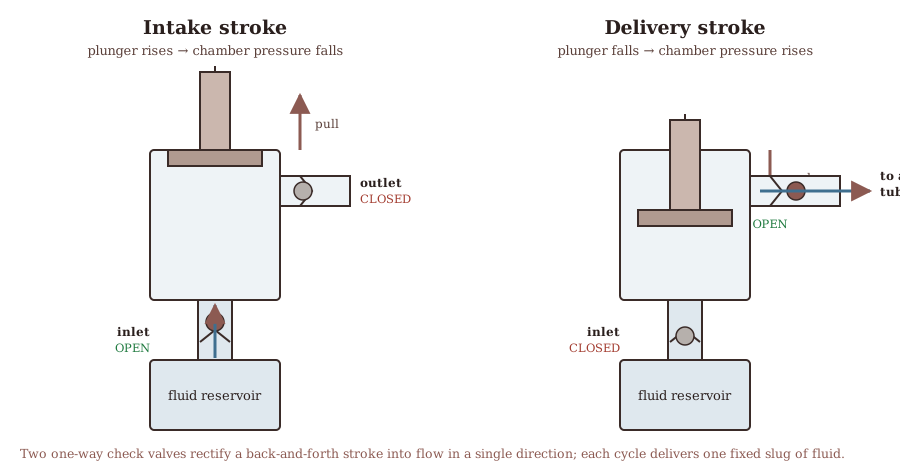
On the intake (suction) stroke, the plunger withdraws or the bulb re-expands, the chamber volume grows and its internal pressure drops; the drop lifts the inlet valve open so fluid is drawn in from the reservoir, while the same drop holds the outlet valve firmly shut against the pressure already downstream. On the delivery (discharge) stroke, the plunger advances or the bulb is squeezed, chamber pressure rises; the rise slams the inlet valve shut so nothing escapes backward into the supply, and opens the outlet valve so a measured slug of fluid is forced onward (Engineers Edge; Pumps & Systems, reciprocating pumps). This is the defining behaviour of a positive-displacement pump: it traps a fixed volume of fluid and displaces it, so each cycle delivers one discrete, repeatable quantity rather than a smooth continuous stream (Pumps & Systems).
Two consequences of this design run through the rest of the sub-project. First, delivery is inherently pulsed — one slug per stroke — which is why the later electric machines, which pump continuously by impeller, sometimes went to the trouble of re-introducing a deliberate pulsation electronically to imitate a pulse. Second, the valves are the part most likely to fail or leak, in an antique as in a working pump: a check valve that will not seat is a pump that surges backward instead of delivering. For a collector, the presence, form, and material of those little valve fittings — brass balls, ground seats, bone or hard-rubber flaps — are among the most diagnostic features of an outfit, a point developed in Vol 5.
2.4 The bulb syringe as a hand-driven pump
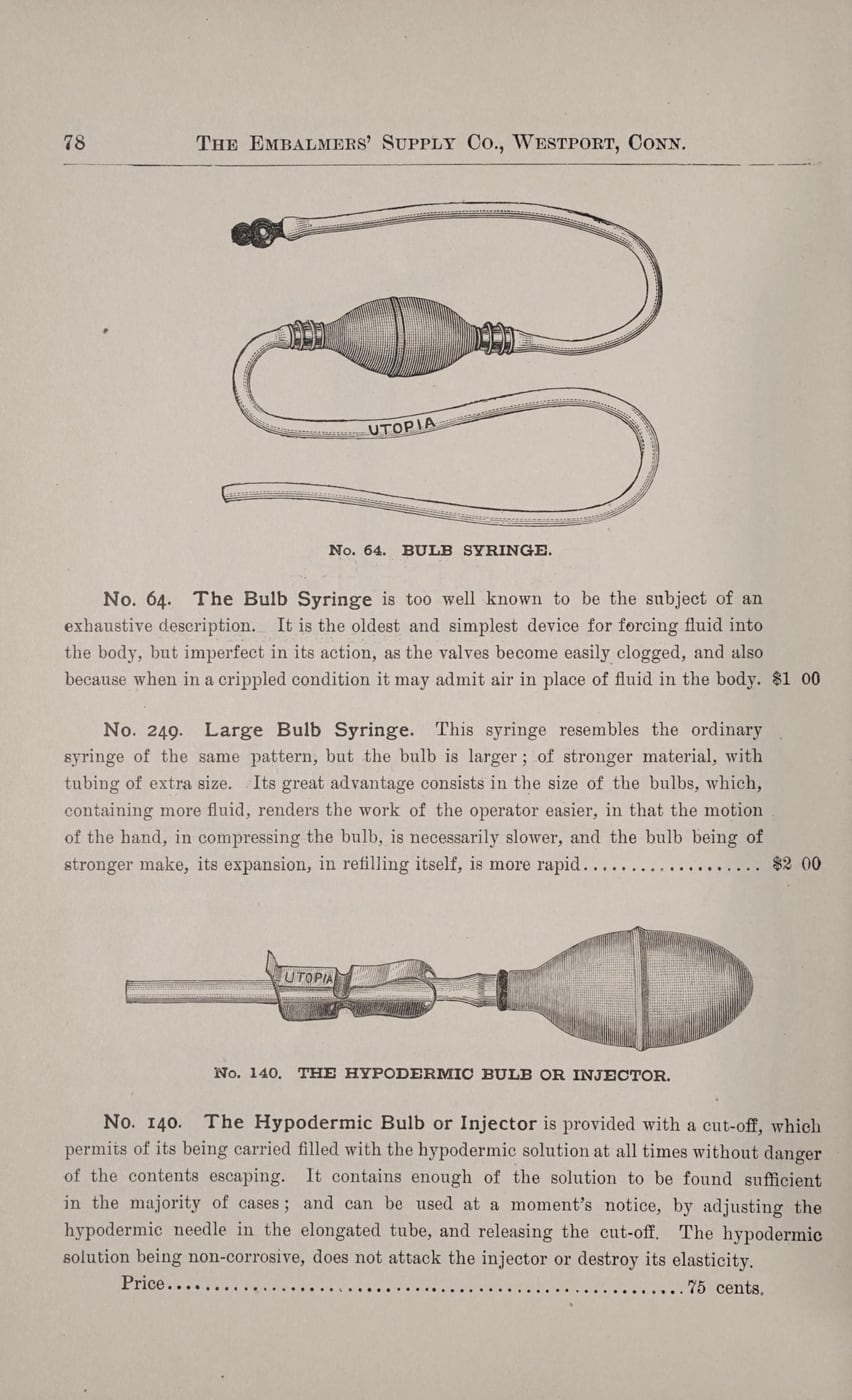
Understood this way, the humblest object in the manual outfit — a rubber squeeze-bulb with a length of tubing at each end — reveals itself as a complete, textbook reciprocating pump. It is, mechanically, the same instrument as the household Higginson-type syringe: a resiliently flexible bulb forming a variable-volume chamber, with a one-way check valve at the inlet and another at the outlet (reciprocating-pump / squeeze-bulb mechanism, patent literature summary). Release the bulb and it springs back to shape; the expanding chamber draws fluid in past the open inlet valve while the outlet valve stays shut. Squeeze it and the collapsing chamber shuts the inlet valve and drives fluid out past the now-open outlet valve. Each squeeze delivers one slug; each release refills the chamber. The hand supplies the reciprocating motion that a plunger supplies in a piston pump.
For the embalmer this had real virtues and real limits, and both come straight from the mechanism. The virtue is control by feel: the operator meters delivery one deliberate squeeze at a time, and can stop instantly. The limit is that a soft rubber bulb can only generate modest pressure — the hand is squeezing against the elastic wall as well as against the fluid — and its delivery is coarsely pulsed and hard to hold steady. This is precisely why the trade moved on to the rigid piston pump for higher, sustained pressure. In the family scheme of Vol 1, the bulb is the low-pressure, maximum-tactility end of the range; everything after it trades some of that immediacy for more pressure and steadier flow.
2.5 Why the bulb grows harder to squeeze
Here is the small, genuine piece of physics the brief singles out, and it is worth getting exactly right rather than mythologising. Work a bulb outfit and you notice that as the injection proceeds, the bulb becomes perceptibly harder to compress. Period operators used this, consciously or not, as a crude pressure gauge — a rising stiffness in the hand standing in for a dial no bulb outfit possessed.
The reason is straightforward positive-displacement mechanics, and it does not require any exotic effect. Because the check valves make the bulb a closed pump, fluid only leaves through the outlet valve, and the outlet valve only opens once chamber pressure exceeds the pressure downstream of it. Early in the work the downstream path is relatively open and low-pressure, so a gentle squeeze suffices. As fluid fills and pressurises the vascular tree ahead, the back-pressure the bulb must overcome climbs; to open the outlet valve and move the next slug, the hand must now generate that higher pressure, so the bulb resists compression more strongly. The stiffening the operator feels is, quite literally, the downstream pressure reflected back into his palm. It is real tactile feedback and a legitimate signal — but it is crude: it is qualitative, uncalibrated, confounded by the elasticity of the rubber itself and by how far the valves have to lift, and it reports the pressure the hand is fighting rather than the rate of fluid actually moving. It tells the operator that pressure is rising, not how much, and nothing directly about flow. That gap between a feel and a number is exactly what the gauged machines of the next dive were built to close.
(One caution against over-reading the effect: a bulb that has trapped an air pocket will also stiffen simply because the trapped gas is being compressed — Boyle’s law, not vascular back-pressure. A properly primed injecting bulb is filled with liquid, which is effectively incompressible, so the stiffness a working outfit reports is genuinely downstream resistance and not an air spring.)
2.6 From pulse to hold: the piston pump and continuous pressure
The reciprocating principle carries directly into the rigid hand pump. Swap the elastic bulb for a machined plunger in a brass or nickel-plated cylinder and you have the same two-valve positive-displacement pump, but able to reach higher and more sustained pressure because the operator is no longer wasting effort deforming a rubber wall — the whole stroke goes into the fluid. The delivery is still pulsed, one slug per stroke, so the operator’s tactile read of rising resistance survives into the piston pump too; it is simply firmer and more repeatable.
The step the trade prized most was escaping the pulse altogether. The early continuous-pressure units charged a reservoir with pressure — by air pump into an air-over-fluid tank, or by a geared or spring drive — so the operator could set and hold a chosen pressure and let fluid flow at a steady rate governed by a valve, rather than pulsing it stroke by stroke. This is the conceptual arrival point of the whole manual era: for the first time, the two quantities of the first section could be handled somewhat independently — hold the pressure with the reservoir, meter the flow with the valve — instead of both being bound together in the rhythm of the hand. It is a short logical step from there to the electric machine, which simply replaces the hand or the air-charge with a motor-driven pump and puts a proper gauge on each quantity. That machine is the subject of the sibling Electric Embalming Machines dive; the intellectual groundwork — two controllable quantities, delivered through one-way valves — was laid entirely by the hand apparatus in this volume.
2.7 What the trade got right, and what it oversold
It is worth separating the sound engineering here from the period salesmanship, in the same spirit that the Quack-Devices wing separates the physics of a violet-ray wand from its marketing. The check-valve pump is honest, competent mechanism: there is nothing pseudo-scientific about a positive-displacement pump, and the trade’s growing sophistication about pressure versus rate-of-flow was real applied knowledge that modern practice still uses. Where period catalogues overreached was in implying that a particular patented pump or valve itself produced superior preservation. It did not, and could not. The pump only moves fluid; whether preservation succeeded depended on the chemistry of the fluid and on distribution — whether the solution actually reached the tissues — far more than on the make of the bulb. A better pump gave finer control over pressure and flow, which helped distribution, but the apparatus was a delivery system, not a preservative. Keeping that line clear — hardware delivers, chemistry preserves — is the sober way to read a glowing trade advertisement for a “perfected” injector, and it is the same discipline of promise-versus-physics that runs through every dive in this collection.
2.8 Where this volume hands off
With the mechanism understood — two quantities, one-way valves, and a bulb that reports pressure through the palm — the story turns to who built this hardware and how an American instrument trade grew up around it. Vol 3 — ESCO and the Birth of an American Instrument Trade tells that history: C. B. Dolge and Max Huncke, the Embalmers’ Supply Company founded on 13 April 1886, the first American-made embalming instruments in 1887, and the embalming schools that turned an itinerant craft into a shop-based profession. Vol 4 — The Patent Trail and Reading the Object then reads the valve-and-pump art through its patent drawings and shows how a collector distinguishes a bulb outfit from a piston pump from a continuous-pressure unit by form. Vol 5 — Collecting Hand Pumps and Bulb Outfits closes on dating, condition, and safe display — where those small brass check valves become one of the most diagnostic features of a surviving set.
Sources
- The Ultimate Guide to Comparing Embalming Machines — American Mortuary Coolers — supported the pressure (psi) vs. rate-of-flow (ounces per minute) distinction as two separate controls, and the indicative working ranges for adult injection (secondary trade source; specific figures belong to the electric-machine era and are cited as indicative, not as manual-era values).
- Positive Displacement Pump Operation — Engineers Edge — supported the check-valve definition and the suction/discharge-stroke behaviour of inlet and outlet valves in a reciprocating positive-displacement pump.
- Positive Displacement Pumps (Part One): Reciprocating Pumps — Pumps & Systems — supported the positive-displacement/fixed-slug-per-cycle characterisation and the pulsed nature of reciprocating delivery, used to author the check-valve-cycle SVG.
- Reciprocating syringe / squeeze-bulb check-valve mechanism (patent literature) — Google Patents US7118554B2 — supported the identification of a rubber squeeze-bulb with inlet and outlet one-way check valves as a positive-displacement reciprocating pump (the Higginson-syringe form).
- Pressures in the Embalming Set (course study notes) — Quizlet — supported the potential/actual/differential-pressure vocabulary of modern mortuary-science teaching (secondary study material; flagged as not firmly attributable to a single primary text).
- ESCO founding facts (13 April 1886; Dolge & Huncke; 1887 first American instruments; Brooklyn then Westport CT from 1890; 1889 school) are carried forward here only in the hand-off and are cited in full in Vol 3; primary/secondary corroboration: the ESCO company history and the Westport local-history record (see Vol 3’s Sources).
- Cross-references named in prose (not linked): the sibling Electric Embalming Machines, Gravity Injection Systems, and Trocars and Cavity Injection dives in this sub-project, and the Violet Ray Wands dive in the Quack-Devices wing (for the promise-versus-physics reading discipline).
Comments (0)