Hand Pump and Bulb Machines · Volume 3
The Supply House and the Trade It Made
How two German immigrants in Brooklyn — C. B. Dolge and Max Huncke — turned embalming from an itinerant demonstrator's sideline into a shop-based American industry, and why the Embalmers' Supply Company, its pumps and goosenecks, and its embalming college matter to a collector holding a hand pump today.
Contents
3.1 About this volume
The three earlier volumes of this dive treated the hand pump and bulb outfit as hardware: Vol 1 — Three Ways to Make Pressure by Hand sorted the bulb syringe, the piston pump, and the first continuous-pressure units into families a collector can tell apart by form, and Vol 2 — Pressure, Rate, and the Check Valve took apart the physics the trade actually cared about — pressure and rate of flow as two separate, controllable quantities, and the one-way check valve that lets a reciprocating pump deliver in a single direction. This volume steps back from the object to ask a different question: who made these things, and how did selling them turn embalming into a trade at all?
The answer, for the United States, runs largely through one firm and two men. The Embalmers’ Supply Company — universally shortened to ESCO — and its founders C. B. Dolge and Max Huncke are the spine of the American instrument story. They did not invent the hand pump or the bulb syringe; those were older and largely European. What they did was manufacture embalming apparatus in America for the first time, sell it by catalog, and — crucially — teach people to use it, so that the pumps and goosenecks of Vols 1 and 2 arrived in the field attached to a method, a fluid, and a professional identity. That bundle is what this volume is about. Every date below has been cross-checked against the company’s own published history and at least one independent source, because this field’s origin stories are contested and the firm’s marketing has a stake in them; where a claim is the company’s own and cannot be independently confirmed, it is flagged as such rather than repeated as settled fact.
3.2 Two Germans in Brooklyn
The business that became ESCO began in Brooklyn, New York, on 13 April 1886, as a partnership between two German-born immigrants. Carl B. Dolge (usually rendered “C. B. Dolge”) is described in the company’s own account as an inventor, businessman, artist, and engraver; Max Huncke was a trained, practicing pharmacist — the chemist of the pair. The division of labor is easy to read in that pairing: Huncke could compound a preservative fluid, and Dolge could build, engrave, illustrate, and sell the apparatus and the printed matter around it.
The partnership did not start life under the tidy name it is remembered by. In its Brooklyn years it traded under a cluster of overlapping names — the Brooklyn Embalming Fluid Company, Dolge & Huncke, and “Brooklyn Fluid Works” all appear in the record — and the crisp corporate title Embalmers’ Supply Company was not fixed until the 1893 reorganization described below. A collector should keep that in mind when dating an early bottle or label: a Brooklyn imprint or a “Dolge & Huncke” mark points to the 1886–1890 window, before the firm ever reached Connecticut.
3.3 From German imports to American-made instruments
The commercially decisive claim in the ESCO story is a manufacturing one, and it lands squarely on the subject of this dive. The company states that in 1887 it introduced the first American-made embalming instruments and accessories — that before then, the apparatus an American undertaker used was either imported from Germany or made by the user himself. That is the hinge this whole volume turns on. The bulb syringes, brass and nickel-plated piston pumps, glass reservoirs, and curved arterial tubes catalogued in Vols 1 and 2 had, up to that point, no domestic maker; ESCO became one.
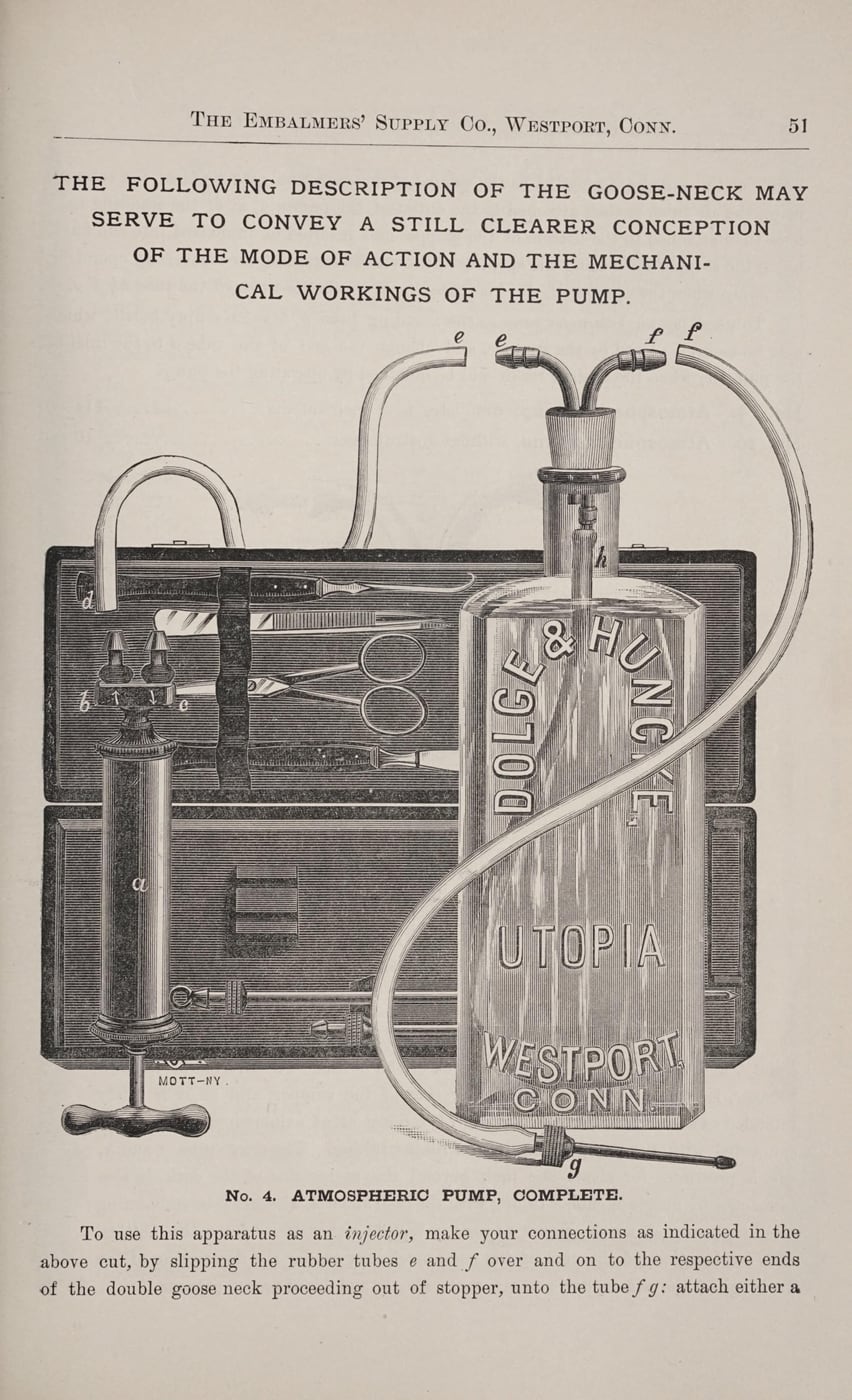
Two of the instrument types named in the early record are worth pinning to the hardware families of this dive. ESCO’s Brooklyn-and-Westport line is documented as including pumps and “goosenecks” among the “instruments and accessories” it sold alongside its fluid. The pump is exactly the hand/piston pump of Vol 1 — a self-contained plunger delivering higher, more sustained pressure than a squeezed bulb. The gooseneck is the curved arterial tube or drainage tube whose bend gives it the name; it is the business end that ties into the vessel, downstream of whichever pressure source the operator chose. A surviving ESCO gooseneck or hand pump is therefore not a generic antique but a datable product of the first American house to make such things — which is why later volumes of this dive lean on maker’s marks and catalog plates to identify a piece.
Two cautions belong on the “first American-made instruments” claim. First, it is the company’s own, repeated on its heritage pages and in secondary trade write-ups that draw from them; no independent 1887 catalog has been examined for this volume to corroborate the exact year, so it is reported here as ESCO’s well-established but self-interested account. Second, “first American-made” is not “first American-used”: undertakers had been buying and improvising injection apparatus for decades — the gravity outfits and Civil-War-era arterial rigs of the Gravity Injection Systems dive predate ESCO by a generation — so the innovation is domestic manufacture at scale by catalog, not the instruments’ invention.
3.4 Westport, incorporation, and the arsenic-to-formaldehyde turn
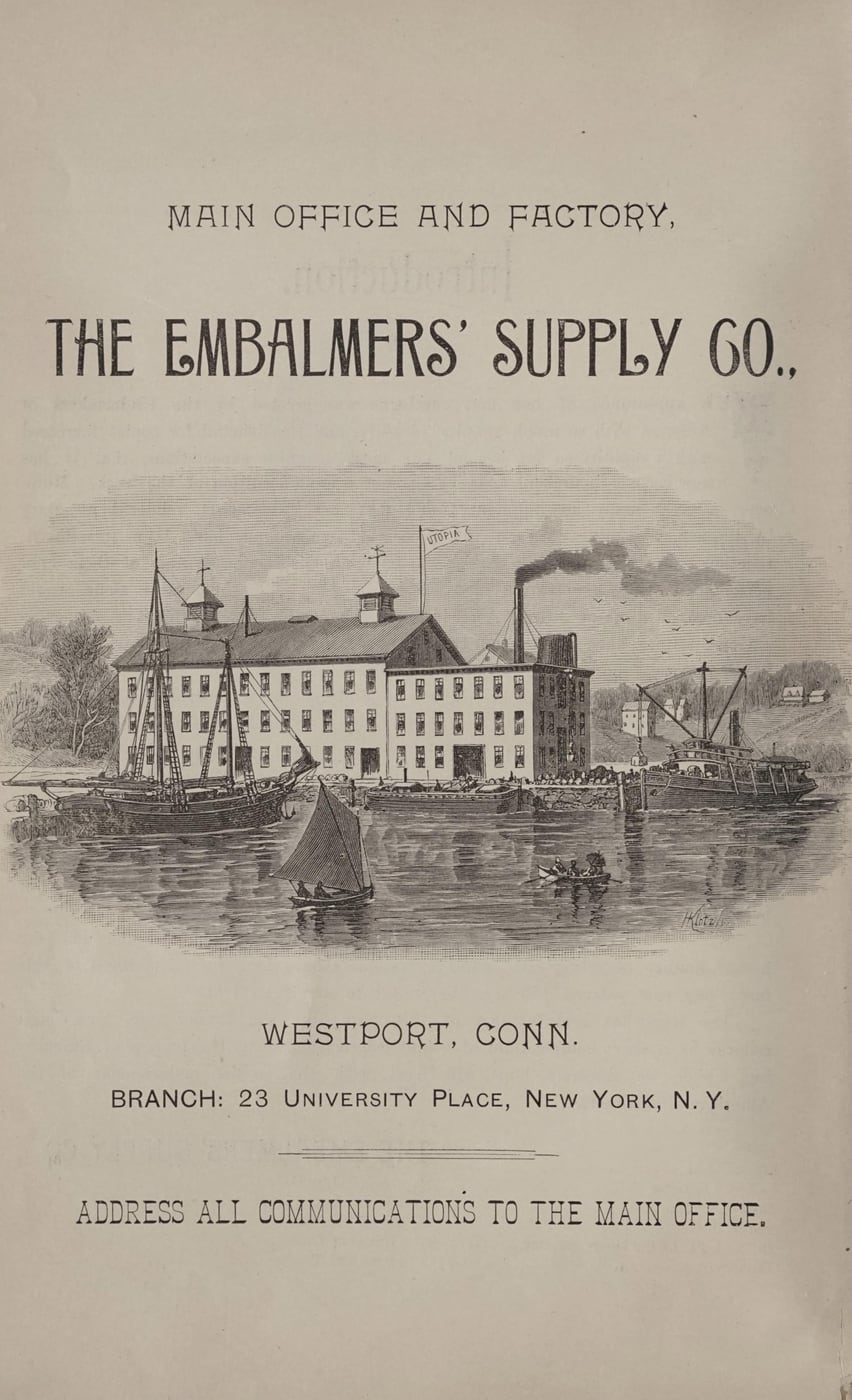
In 1890 the firm left Brooklyn for Westport, Connecticut, settling on the Saugatuck River — first at 14 Wilton Road and later on Ford Road — where it built the works that made it, for much of the twentieth century, the largest company of its kind in the country. (The site sits across the river from the present headquarters of the Bridgewater investment firm, a piece of local trivia that helps place it; the chemical business later moved to East Lyme, Connecticut.)
Three years after the move, the partnership ended amicably on paper. In 1893 it was dissolved, Dolge bought out Huncke’s interest, and the business was incorporated under the present name, the Embalmers’ Supply Company. That is the moment the “ESCO” identity crystallized. Huncke did not vanish from the trade: he went on to found the Max Huncke Chemical Company in Brooklyn (at 626 Fourth Avenue), which held patents of its own and left behind the collectible glass bottles that still surface today; Huncke died in 1929. So a “Max Huncke” bottle and an “ESCO / Embalmers’ Supply Co.” bottle are two branches of the same 1886 partnership, split in 1893 — a genealogy worth knowing at a bottle table.
The fluid the firm sold across those years is the other half of the object. ESCO’s early embalming fluids were arsenic-based, for the plain reason that “there was no formaldehyde available then” — the preservative worked because it was poisonous, the same toxic-equals-preservative logic that the Gravity Injection Systems dive traces back to the arsenic, zinc, and mercury fluids of the nineteenth century, and the same logic that would later leave arsenic in old cemetery soil and drive the regulatory switch. The company’s own history then credits Carl Dolge with importing the first supply of formaldehyde from Germany in 1894, immediately after the chemical could be produced practically, and with compounding the first formaldehyde-based embalming fluid in the Westport laboratory. That date should be read with care: some secondary accounts loosely credit “the partnership” with introducing formaldehyde, but formaldehyde work postdates the 1893 buyout, so it was Dolge’s incorporated ESCO — not Dolge-and-Huncke — that did it, if the 1894 figure holds. The full chemistry arc, and the early-1900s laws that banned metal-salt fluids, is the business of the Electric Embalming Machines dive, where formaldehyde and the motorized pump together define modern arterial embalming; here it matters only as the thing the pumps and goosenecks were built to push.
3.5 Schools, demonstrators, and the making of a trade
Selling apparatus and fluid was not enough to build a market, because in the 1880s most undertakers did not know how to embalm. ESCO’s answer — and the part of the story that turned a supply house into an industry-maker — was instruction. In 1889 — by ESCO’s own account — Dolge founded a permanent embalming school to “popularize the method and his products,” the United States College of Embalming in New York City. That origin is contested: several biographies of Dr. Auguste Renouard (1839–1912) instead date the United States College of Embalming to 1894 and credit Renouard himself, rather than Dolge, with founding it — so the 1889/Dolge framing here is the company’s version of a disputed origin, not settled fact. Either way Renouard is central to the school: already the author of the first American embalming textbook, The Undertaker’s Manual (1878), he served as its demonstrator, later purchased the school, and ran it as the Renouard Training School for Embalmers, continued by his son until it was absorbed into the American Academy McAllister Institute in the mid-1950s.
ESCO’s promotional literature calls the United States College of Embalming the “first permanent school of embalming,” and here the disciplined answer is to correct the marketing gently. The first American embalming school was not Dolge’s: it was the Cincinnati School of Embalming, opened by Joseph Henry Clarke — “the father of American embalming schools” — whose first class of about seven students met on 8 March 1882, seven years before the United States College of Embalming. Clarke’s school is the ancestor the Cincinnati College of Mortuary Science still traces itself to, and Renouard himself is credited with an even earlier Rochester effort. Dolge’s 1889 college was therefore an early and unusually durable school, and plausibly the first permanent one tied to a supply house, but it was not the first embalming school in America. That distinction is exactly the kind of self-flattering “first” this field is full of, and it is worth getting right.
The schools mattered because of what they replaced. Before fixed colleges, embalming knowledge spread through traveling demonstrators — representatives of the fluid companies who toured the country giving one- or two-day “schools of instruction” in the use of their particular product; an undertaker who sat the class and bought a quantity of fluid came away with a certificate as an “embalmer.” This is the world of the itinerant “embalming surgeon,” a demonstrator-salesman moving town to town with a case of apparatus. A permanent college in New York, backed by a manufacturer with a catalog, was a different proposition: it produced graduates, standardized the method, and — not incidentally — standardized demand for a specific maker’s pumps, fluids, and goosenecks. The professionalizing wave around it is unmistakable in the dates: state undertakers’ associations forming from 1881 onward, a national funeral-directors’ body by the early 1880s, and, within a generation, embalming written into law as a licensed occupation practiced in a shop — the funeral home — rather than in the bereaved family’s parlor.
That social shift is the real subject hiding inside the hardware. The hand pump and bulb outfit are the tools of a trade that, in the space of about two decades, moved from itinerant demonstration to fixed premises, from imported or home-made apparatus to catalog-bought American instruments, and from an ad-hoc skill to a schooled and licensed profession. ESCO sat at the center of all three movements — it manufactured the instruments, compounded the fluid, and taught the method — which is why a single Westport firm carries so much of this volume’s weight. The apparatus a collector holds is the surviving trace of that consolidation.
3.6 Where this volume hands off
Knowing who made the apparatus sets up the next problem: how to read a specific object and pin it to a maker and a date. Vol 4 — The Patent Trail and Reading the Object follows the paperwork — the Google Patents drawings that trace how the pump and valve art evolved, and the trade-catalog plates on which ESCO and its peers can be recognized — to separate a bulb outfit from a piston pump from a continuous-pressure unit by form and maker’s mark. Vol 5 — Collecting Hand Pumps and Bulb Outfits then turns the maker knowledge of this volume into practical dating by materials, condition, and provenance, and the safe display of a chemical-handling antique. Readers wanting the professionalization story from the chemistry side — formaldehyde and the electric machine that standardized what these hand pumps did — will find it in the sibling Electric Embalming Machines dive; the parlor-and-cooling-board world these shops grew out of is the Cooling Boards and Corpse Coolers dive; and the cavity-treatment branch that complemented arterial injection is Trocars and Cavity Injection. (For a study of how a different American health-appliance industry sold itself in exactly these decades — catalogs, house brands, and grand claims — the Violet Ray Wands dive in the Quack Devices wing is an instructive contrast: there the marketing outran the physics, whereas embalming’s apparatus did, soberly, what it claimed.)
Sources
- ESCO’s History — Embalmers’ Supply Company (via distributor page, retrieved through search summary) — the company’s own account: founded 13 April 1886 as a Dolge–Huncke partnership in Brooklyn; Brooklyn Embalming Fluid Company / Dolge & Huncke names; first American-made instruments 1887; move to Westport CT 1890; partnership dissolved and incorporated as ESCO 1893 (Dolge buys out Huncke); arsenic fluids then Dolge importing formaldehyde 1894; United States College of Embalming founded 1889 with Auguste Renouard as demonstrator. (Direct fetch failed — DNS unresolved — so this page was read via search-engine summary; corroborated below.)
- Embalmers Supply Company — HealthManagement.org profile — independent restatement of the 1886 founding, German-born Dolge (inventor/artist/engraver) and Huncke (pharmacist), 1890 Westport move, 1893 buyout and incorporation, early arsenic fluids with pumps and goosenecks, and the 1889 United States College of Embalming with Renouard.
- Past and Present: The Max Huncke Chemical Company — Brownstoner — Huncke’s biography and the post-1893 Max Huncke Chemical Company in Brooklyn (626 Fourth Avenue), confirming the 1886 partnership, the overlapping Brooklyn company names, the first-American-made-tools claim, and Huncke’s death in 1929; used to separate the Huncke and ESCO bottle lineages.
- Embalmers Supply Co. tag archive — 06880 (Westport, CT local history) — independent local corroboration of the 1886 founding, the 1890 move to Westport (14 Wilton Road, then Ford Road on the Saugatuck River), Dolge’s 1893 buyout, the arsenic-before-formaldehyde fluid, the pumps-and-goosenecks product line, and the later relocation to East Lyme.
- Cincinnati College of Mortuary Science — history and Cincinnati College of Mortuary Science — Wikipedia — Joseph Henry Clarke’s Cincinnati School of Embalming, first class 8 March 1882, establishing that ESCO’s 1889 “first permanent school” claim postdates the genuinely first American embalming school by seven years.
- Auguste Renouard biography — denverhistory.blog, “Larimer Street, #17” — a Renouard-centered account that dates the U.S. College of Embalming to 1894 and credits Renouard himself (not Dolge) with founding it after his move to New York, and independently confirms his Rochester School of Embalming (1883); source of the disputed-origin flag on ESCO’s 1889/Dolge version.
- Embalming: Development of Modern Embalming — Encyclopædia Britannica — professionalization framing: fluid-company traveling demonstrators, early schools, Renouard’s The Undertaker’s Manual (1878), and the shift to a schooled, shop-based trade (consulted via search summary; direct fetch returned 403).
- Modern Embalming — William L. Clements Library, University of Michigan — museum framing of embalming’s professionalization, fluid companies, and the arsenic-to-formaldehyde transition (consulted via search summary; direct fetch returned 403).
- National Museum of Funeral History — History of Embalming — museum context for the apparatus and the trade; source for the trade-catalog figure plan.
Comments (0)