Hand Pump and Bulb Machines · Volume 4
The Patent Trail and Reading the Object
How to tell a bulb outfit from a piston pump from a continuous-pressure unit by form alone, and how the drawings filed at the Patent Office trace the slow evolution of the pump and its check valves — read as engineering, not folklore.
Contents
4.1 About this volume
The first three volumes of this dive built the object and its trade. Vol 1 — The Three Families set out the bulb syringe, the piston hand pump, and the first continuous-pressure pumps, and taught the eye to sort them. Vol 2 — Pressure and Rate of Flow explained the two quantities the trade actually controlled and drew the check-valve reciprocating-pump cycle that makes a pulsing pump deliver in one direction. Vol 3 — ESCO and an American Instrument Trade told how C. B. Dolge and Max Huncke turned a shop-made craft into a manufactured industry.
This volume is about evidence: the two documentary traces that let a collector or historian date and identify a piece of hand-injection apparatus without a maker’s word for it — the object itself, read by its form, and the patent drawings that record how the pump and its valves changed over sixty years. It is a reference on method, not a catalog. It closes the loop opened in Vol 1: there, the three families were introduced; here, we prove how to tell them apart and how the paper record backs up the reading. The practical business of dating a specimen by its materials, condition, and provenance is the next and final volume’s (Vol 5 — Collecting and Display).
A discipline note, because this field is thick with repeated dates and priority stories that do not survive checking. Every patent number, inventor, assignee, and date below was read off the Google Patents record of the granted patent; where a claim rests only on a manufacturer’s own history page it is flagged as such. This is trade and engineering history — apparatus and drawings — and nothing in it is a procedure to be performed.
4.2 Why the drawings are the honest witness
A trade advertisement tells you what a maker wanted you to believe; a patent tells you what the maker was willing to swear, in writing, was new and how it worked. The two differ in ways a collector learns to exploit. An advertisement can call a modest bulb outfit a “machine”; a patent must describe the mechanism in enough detail that a person skilled in the art could build it, and must draw it in labelled figures. For a family of objects as plain as an injection pump — a chamber, a plunger or a bulb, one or two valves, a length of tubing — the drawing is very close to the object.
There is a nice contrast worth naming here with the sister collection. In the Radionics and Abrams Boxes dive (in Quack Devices), the sealed “black box” was patented and sold precisely so that no one would open it and find that the internals meant nothing. Embalming apparatus is the opposite case: the patents are honest engineering, because the thing genuinely had to move fluid against a real pressure, and a valve that did not seal simply did not work. When you read an embalming pump patent you are reading a true account of a working mechanism. That is exactly why the drawings are the spine of this volume.
The Patent Office record also supplies something advertising rarely does: a firm date. A granted patent carries a filing date and a grant date, both fixed by the government, and an inventor and assignee named on the face of the document. Those anchor a mechanism in time far more reliably than a catalog, which was often reprinted for years with the same plates.
4.3 Reading the object: three forms, one job
Before the paper trail, the object. Vol 1 established the three families; the point to fix here is that they are told apart by the pressure source at the far end of the tubing, not by the arterial tube itself, which is nearly identical across all three — a short brass or hard-rubber cannula tied into a raised artery.
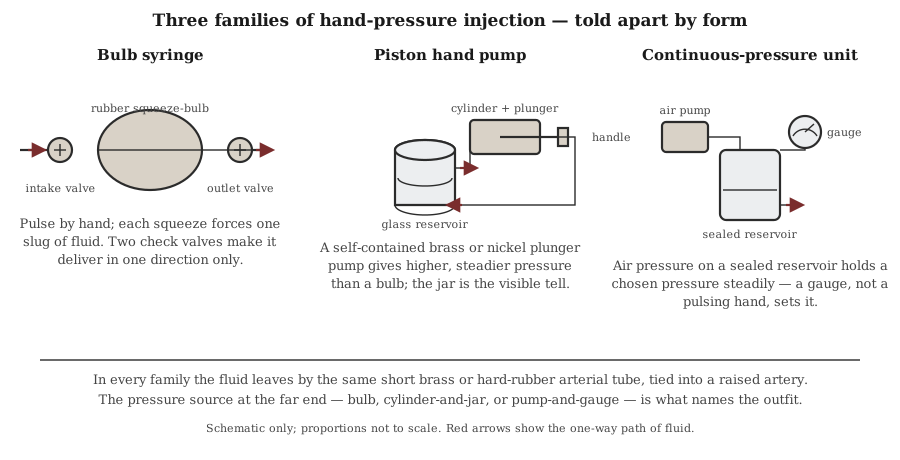
The bulb syringe is the simplest and the easiest to recognise: a soft rubber squeeze-bulb with a length of tubing at each end and a one-way check valve at each end. Squeeze, and the outlet valve opens while the intake valve closes, forcing a slug of fluid forward; release, and the reverse happens, drawing the bulb full again. It delivers only — it cannot aspirate — and it pulses by hand. The tell that it is climbing in pressure is tactile: as back-pressure rises, the bulb grows harder to compress, a crude gauge you feel in the palm rather than read on a dial (the mechanics are Vol 2’s subject). A surviving bulb outfit is recognised at a glance by the two inline valve bodies flanking a perishable rubber bulb.
The piston hand pump is a self-contained plunger pump — a cylinder and a plunger, usually brass or nickel-plated, drawing from a glass reservoir jar and delivering through tubing to the arterial tube. It gives higher and steadier pressure than a bulb because the operator drives a rigid piston rather than squeezing rubber, and it too relies on check valves to rectify the reciprocating stroke into one-way flow. The visible tell is the cylinder-and-jar combination: metal pump body, glass reservoir, and a handle. It is heavier, more mechanical, and more “instrument-like” than a bulb.
The early continuous-pressure unit breaks the pulse. Instead of the operator’s hand setting the rhythm, an air pump pressurises a sealed reservoir, and the fluid is driven out at a pressure the operator chooses and holds, read on a gauge rather than felt in a bulb. The tell is the presence of a pressure vessel and a dial — a maker’s move from feel to measurement. This is the formal boundary between hand-pressure apparatus and the motorised machines that follow it; the electric centrifugal machines belong to the Electric Embalming Machines dive, not here.
The diagram above lays the three side by side. Read left to right, it is also a rough timeline: the bulb and piston are the nineteenth-century forms; the pressurised reservoir and gauge are the hinge into the twentieth.
4.4 The patent trail: how the pump and its valves evolved
Three granted patents, read in order, show the mechanism migrating from the hand to the motor while the underlying pressure-versus-rate problem stays exactly the same — which is the whole point of tracing them.
US 2,252,624 — “Embalming machine” (inventors Thomas Gilmore and Louis Junod, of Brooklyn, New York; filed 18 December 1939, granted 12 August 1941). This is a combined injection-and-aspiration apparatus built around a motor-driven rotary air pump with sliding vanes, giving a suction inlet and a pressure outlet at once. What makes it instructive for the object-reader is the pressure control: between the pump and the working end sit two equalising chambers, one for suction and one for pressure, each with an adjustable relief valve venting to atmosphere, so vacuum and pressure can be set independently from zero to the pump’s maximum, and each chamber (packed with sponge rubber) also smooths out pulsation so the delivery is steady rather than throbbing. Read against the hand-pump: the relief valve here does by machine exactly what the operator’s hand did on a bulb — it caps the pressure — while the equalising chamber does what the human simply could not, holding a truly constant delivery.
US 2,569,016 — “Embalming apparatus” (inventor Gavin G. Mitchell, of Decatur, Illinois; filed 7 January 1946, granted 25 September 1951). This one is worth citing precisely because its heart is a motor-driven reciprocating piston pump — an electric motor turning a reduction gear, crank, connecting rod, and piston in a cylinder — feeding separate vacuum and compression tanks with adjustable relief valves and gauges on each. It is, in plain terms, the old piston hand pump with the arm replaced by a motor: the same reciprocating cylinder, now driven mechanically and read on a dial. Set beside Gilmore and Junod’s rotary-vane design, it shows two different pumping principles — reciprocating piston versus rotary vane — solving the identical trade requirement of independent, gauged pressure and vacuum.
US 3,528,146 — “Embalming machine” (inventors Armen Markarian, of Chicago, and Thadeus Skuba, of Hoffman Estates, Illinois; assignor Armen Markarian; filed 27 June 1968, granted 15 September 1970). By the late 1960s the art has consolidated into a single portable unit with one motor and one pump, combining injection and aspiration and switched between them by two three-way solenoid valves that let only one fluid through the pump at a time, with needle valves metering flow, a relief bypass capping pressure, and a level-sensing interlock that shuts the motor off if the tank runs low. Aspiration here is done by a water-jet ejector — the Venturi suction device that is the subject of the Trocars and Cavity Injection dive — rather than by the pump itself. The evolution the three patents record is not of purpose but of control: the same one-way delivery against a chosen pressure, moving from a squeezed bulb, to a piston, to a valved and interlocked electric machine.
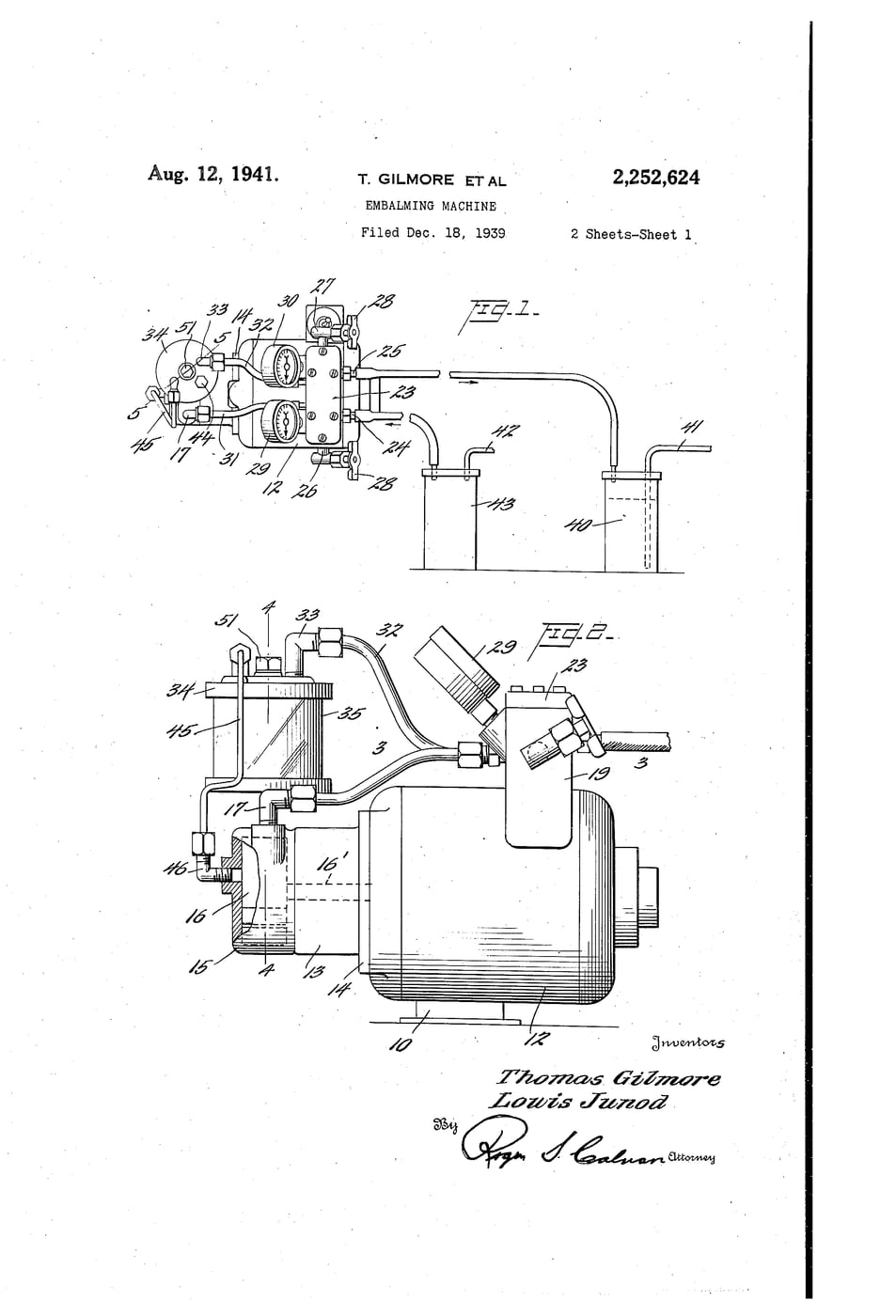
Two cautions belong with these numbers. First, all three are twentieth-century, motor-driven patents — they sit at the far, evolved end of the trail, and are cited here to show where the hand-pump art went, not to date the bulb-and-piston era itself, whose apparatus was often too simple, too old, or too obviously derivative of surgical syringes to have been separately patentable. Second, an inventor’s home city on a patent is not the maker’s factory: Gilmore and Junod filed from Brooklyn, but the patent is assigned to the individuals, not to a supply house, so it documents a mechanism rather than a commercial product line.
4.5 Recognising makers on trade-catalog plates
If the patent dates the mechanism, the trade catalog dates and names the sold object. For the collector, the engraved catalog plate is the second documentary witness, and learning the maker names is most of the skill.
The founding American name is the Embalmers’ Supply Company (ESCO), whose story is Vol 3’s: born 13 April 1886 as the Brooklyn partnership of Dolge and Huncke, credited on its own corporate history with the first American-made embalming instruments in 1887, and settled in Westport, Connecticut, from 1890 (the “first American-made” priority rests on the company’s own account and is best cited as such rather than as an independently verified fact). ESCO plates and the later ESCO catalogs are therefore the baseline a collector calibrates against.
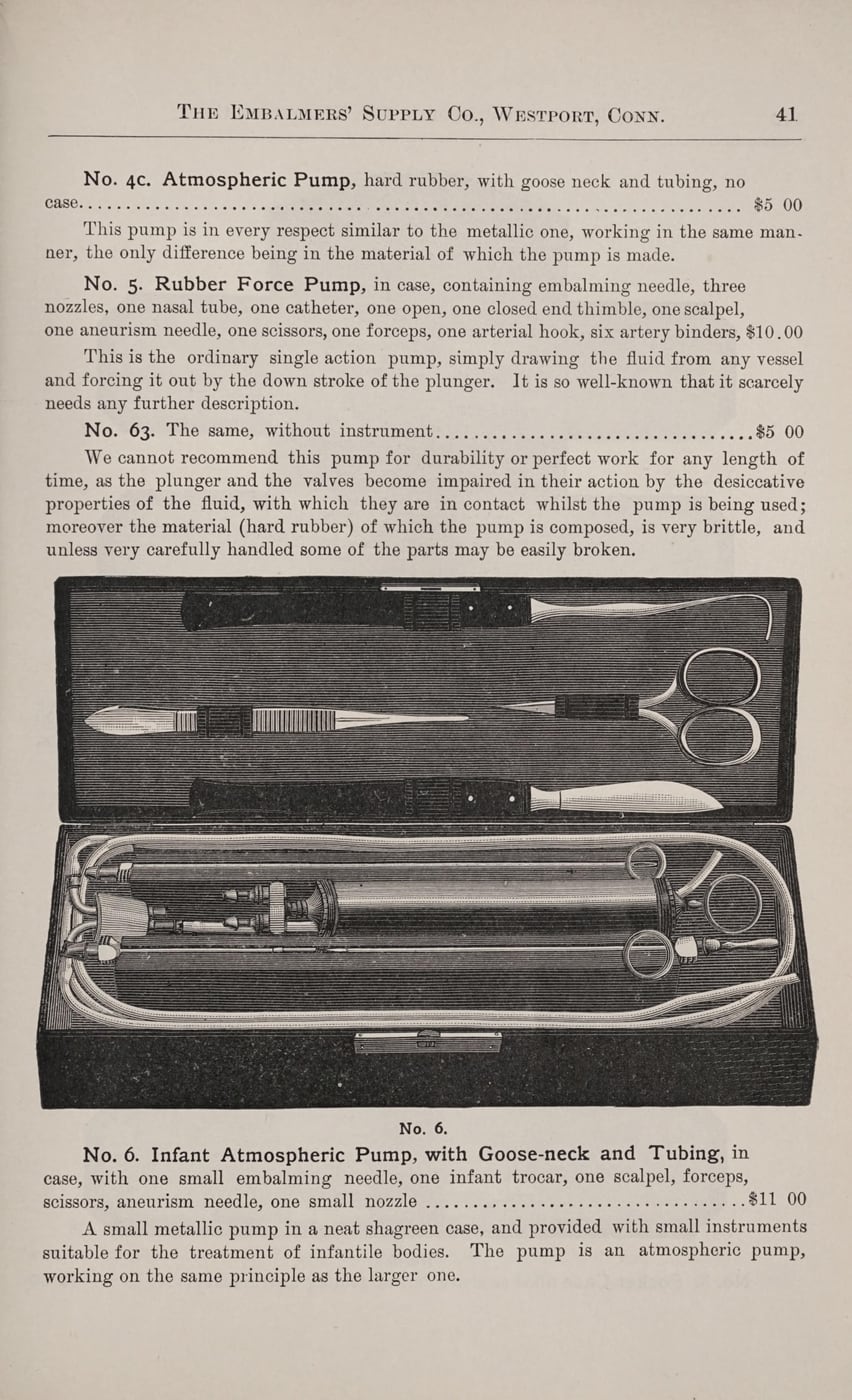
The other names to know on a plate are the great fluid-and-supply houses that also sold apparatus. The Champion Company of Springfield, Ohio — founded in 1878 as the Hill Fluid Company and incorporated as the Champion Chemical Company under Dr. A. A. Baker in 1888 — is the oldest surviving embalming-fluid maker and published the influential Champion Text Book on Embalming (1897), so its name recurs on both bottles and instrument plates. The Dodge Company of Boston traces its line to 1893, when A. Johnson Dodge and his brother bought the Oriental School of Embalming; Dodge grew into the dominant chemical supplier and its catalogs illustrate the full run of preparation-room hardware. Smaller and more localised marks turn up too — the Max Huncke Chemical Company of Brooklyn (Huncke’s own firm after the 1893 dissolution of the ESCO partnership) and regional houses such as the Durfee Embalming Fluid Company of Grand Rapids, Michigan, whose apparatus survives in museum collections. Recognising these marks — and distinguishing a genuine maker’s plate from a reprinted supply-jobber’s page that merely resold another firm’s pump — is the catalog-reading half of “reading the object.”
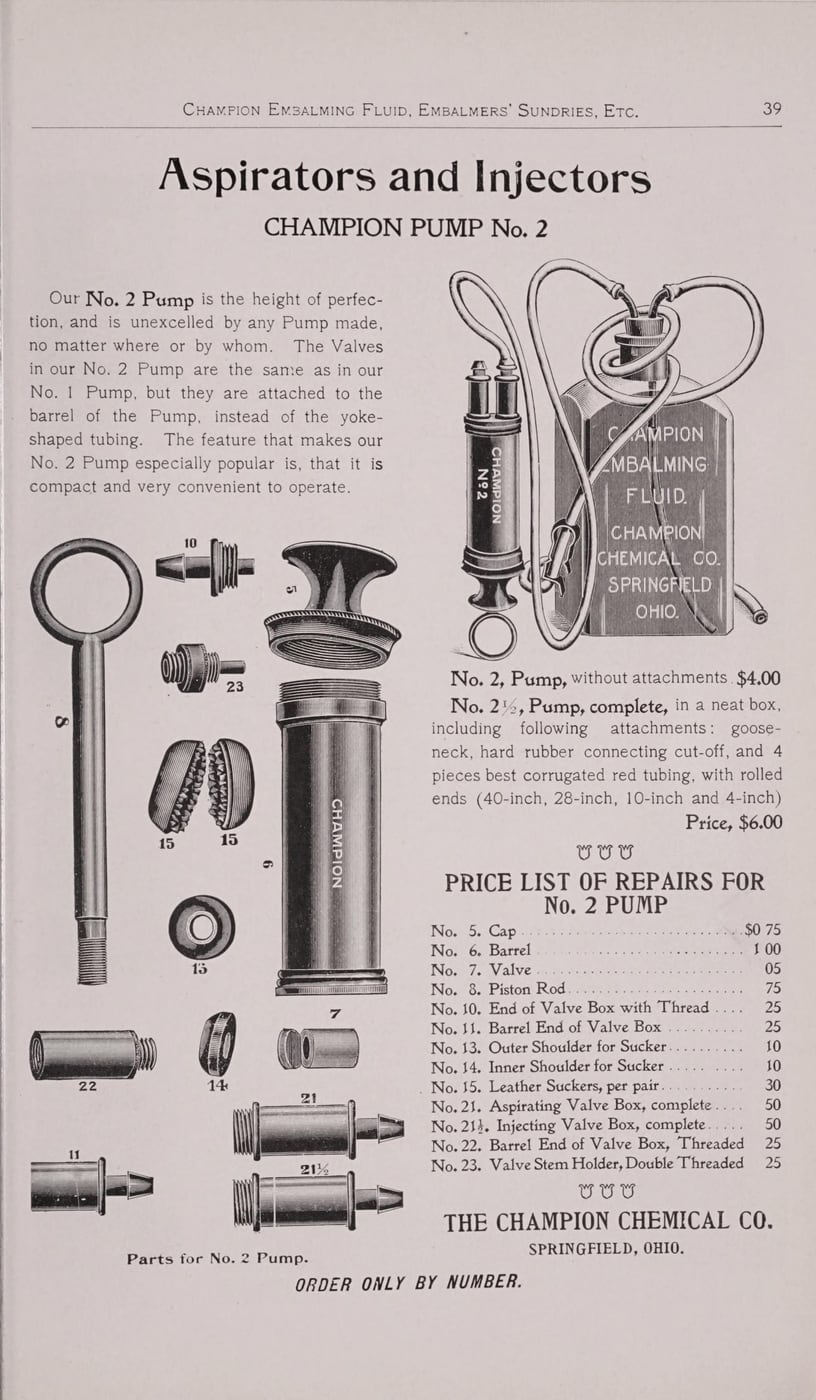
A plate is read the way the object is: find the pressure source. A bulb outfit, a piston-and-jar pump, and a pressurised unit are as distinct on the engraved page as in the hand, and the caption text — “improved hand pump,” “combination bulb and gravity,” “pressure apparatus” — usually names the family outright. Match the plate to the maker’s mark, cross-check the mechanism against the patent record, and a piece with no surviving paperwork can still be placed within a decade or two.
4.6 What a patent proves — and what it does not
A closing caution, because patents are easy to over-read. A granted patent proves that a mechanism was claimed as novel on a certain date and that the Patent Office allowed the claim; it does not prove the device was ever manufactured, sold, or successful, nor that the named inventor was truly first — the file is full of overlapping claims and improvements on improvements. Nor does a patent date the specimen in your hands: a design patented in 1941 might have been sold, essentially unchanged, for thirty years afterward, so a patent date is an earliest-possible bound on a matching object, not its date of manufacture.
The reliable method is triangulation. Read the form to name the family (bulb, piston, or continuous-pressure); read the patent to date and understand the mechanism; read the catalog plate and maker’s mark to identify the sold product and narrow the years. No single witness is sufficient, and the folklore that fills the gaps — the confident “first,” the too-precise date, the maker’s own superlatives — is exactly what the triangulation is there to discipline. That habit of cross-checking every date and priority claim, rather than trusting any one source, is the through-line of this entire sub-project.
4.7 Where this volume hands off
This volume gave you the two documentary witnesses — the object’s form and the patent-and-catalog record — and the method for cross-reading them. The final volume, Vol 5 — Collecting and Display, turns from identification to the specimen itself: dating a piece by its materials (perishable rubber bulbs and tubing, brass and nickel bodies, glass reservoirs, ground-glass or bone fittings), judging condition and completeness, weighing provenance, and displaying a piece of funeral-trade apparatus soberly and safely. Where this volume proved what a thing is and when its mechanism appeared, Vol 5 asks what to do with the one in front of you. For the motorised machines that pick up where the continuous-pressure unit leaves off, see the Electric Embalming Machines dive; for the cavity branch and the water-jet aspirator referenced in the 1970 patent above, see Trocars and Cavity Injection; and for the gravity method that all of these improved upon, the Gravity Injection Systems dive that opens the wing.
Sources
- US Patent 2,252,624 — “Embalming machine” (Google Patents) — primary. Thomas Gilmore and Louis Junod, Brooklyn; filed 18 Dec 1939, granted 12 Aug 1941. Rotary sliding-vane air pump; suction/pressure equalising chambers with adjustable relief valves and gauges — the continuous-pressure control detail cited above.
- US Patent 2,569,016 — “Embalming apparatus” (Google Patents) — primary. Gavin G. Mitchell, Decatur, Illinois; filed 7 Jan 1946, granted 25 Sep 1951. Motor-driven reciprocating piston pump with separate vacuum/compression tanks, relief valves, and gauges — the “hand piston pump, motorised” example.
- US Patent 3,528,146 — “Embalming machine” (Google Patents) — primary. Armen Markarian (Chicago) and Thadeus Skuba (Hoffman Estates, IL); filed 27 Jun 1968, granted 15 Sep 1970. Single-motor portable unit; two three-way solenoid valves, needle-valve metering, relief bypass, level interlock; water-jet (Venturi) aspiration — the consolidated late-1960s mechanism.
- ESCO’s History — embalmerssupplynj.com — the Embalmers’ Supply Company account: founded 13 April 1886 (Dolge & Huncke / Brooklyn Embalming Fluid Company), Westport CT from 1890, “first American-made embalming instruments and accessories” 1887, partnership dissolved and incorporated 1893, United States College of Embalming founded 1889. Company-authored history; the “first American-made” priority is flagged as self-reported.
- Company History — The Dodge Company — Dodge’s line to 1893 (A. Johnson Dodge and his brother buying the Oriental School of Embalming) and its growth into the dominant chemical/hardware supplier whose catalogs illustrate preparation-room apparatus.
- Our Story — The Champion Company and The Champion Text Book on Embalming (1897) — The Public Domain Review — Champion of Springfield, Ohio: 1878 (Hill Fluid Company) / 1888 incorporation, its standard-setting 1897 text, and its role as a maker-name on bottles and instrument plates.
Comments (0)