Faradic and Galvanic Machines · Volume 5
Reading the Case
How to open a fitted mahogany 'medical battery' and read its coil, cells, interrupter, and sponge-tipped electrodes; the makers on both sides of the Atlantic; the cues that date a set; and why a surviving one is an object to study and display, not to switch on.
Contents
| Section |
|---|
| About this volume |
| Reading the fitted case |
| The makers, on both sides of the Atlantic |
| Dating a set |
| Condition, safety, and what “working” means |
| Display and provenance |
| Where this volume hands off |
| Sources |
5.1 About this volume
The end of this dive is the object on the shelf: a wooden box, about shoebox-sized, that opens to a coil, a row of cells, a buzzing interrupter, and a pair of cord-tipped handles. Four volumes have explained what that box is and what its two currents did. This closing volume is for the person who now owns one, or is about to — how to read the case, tell the makers apart, date a set, judge condition, and display it honestly.
It assumes the rest of the dive and refers back rather than repeats. The two currents — galvanic, the steady direct current of a chemical cell, and faradic, the interrupted induced current of a Ruhmkorff-type coil — are defined in Vol 1 — The Two Currents and the Medical Battery. What each does to tissue — the electrochemistry of galvanic iontophoresis and electrolysis, and the motor-nerve depolarisation behind faradic muscle stimulation — is Vol 2 — What the Current Does to Tissue, where the make-and-break interrupter is drawn out as a circuit. Duchenne and the induction-coil pioneers are Vol 3 — Duchenne and the Pioneers; and the split between legitimate physical medicine and the fairground shock-box is Vol 4 — Legitimate Medicine and the Carnival. Here we read the surviving hardware.
One point governs everything below and is best stated at the front: a surviving medical battery is a low-voltage antique shock device, not a treatment. The currents are real, but the “cures” it was sold for — rheumatism, “nervous exhaustion,” lost vigour — were empty, as Vol 4 sets out. This volume describes the object and gives no instructions to apply current to a person.
5.2 Reading the fitted case
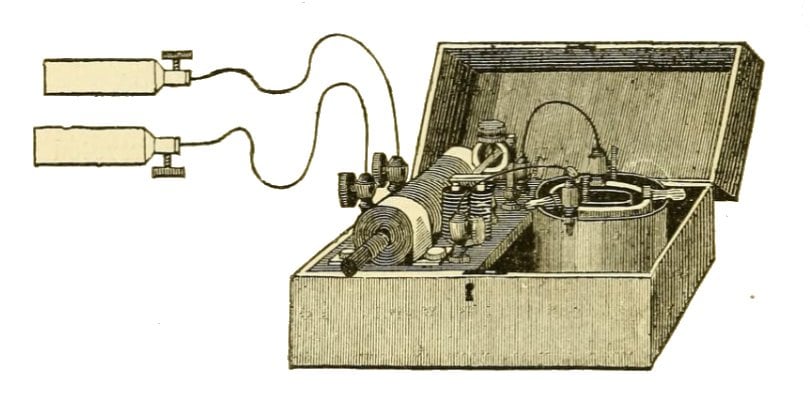
Strip away the romance and a medical battery is, in the words of one historian, “a battery and an iron core encased in a wooden box.” Most were about the size of a shoebox; “pocket” models could be as small as a paperback, and high-end physicians’ outfits as large as a carry-on case. Unlike the gaudy electric belts of the same decades, the box itself was deliberately understated — plain oak, mahogany, walnut, or cherry — because its whole persuasive claim was to look like a serious instrument rather than a novelty.
Open the lid and read the parts in the order the current flows.
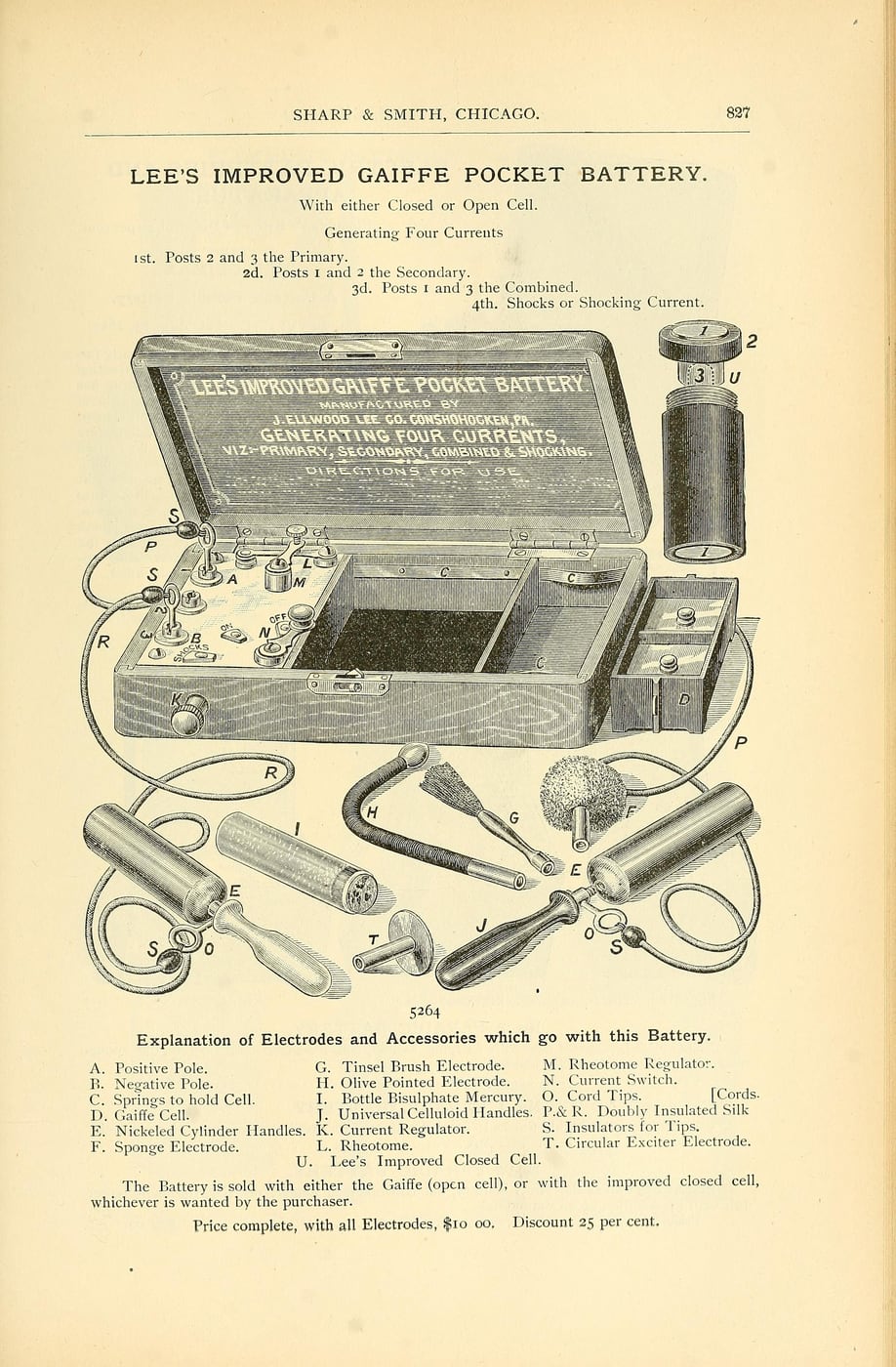
The cells. One or more chemical cells sit in a compartment, usually along the floor of the case; these are the galvanic source and the power for the coil. Early sets used wet cells — a jar of conductive fluid the owner had to keep topped up — while later ones used sealed dry cells whose electrolyte was a paste. Which kind a set carries is the single most useful thing you can read off it, and the next section returns to it as a dating cue. Original cells almost never survive charged; expect corrosion, dried paste, and green verdigris on the terminals.
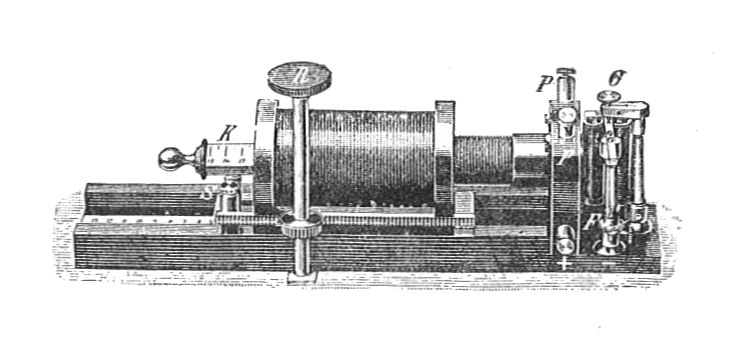
The induction coil. The heart of the box is a spool wound on a bundle of soft iron — a primary winding of a few turns of thick wire carrying the cell’s direct current, and, wound over it, a secondary of many turns of fine wire. When the primary current is switched rapidly on and off, the collapsing magnetic field induces a brief high-voltage pulse in the secondary. That induced, pulsed output is the faradic current; the raw cell output, taken straight from the terminals, is the galvanic. A “combined” battery brought both out to separate posts so either could be used alone. Faradic intensity was set by sliding the secondary coil along the primary (the Du Bois-Reymond “sledge” arrangement) or by a tube that shielded more or less of the winding — the graduator a collector sees as a knurled slide or knob on the coil.
The interrupter. Beside the coil sits the make-and-break: a springy metal reed or hammer tipped with a contact, held near the iron core, which the coil’s own magnetism pulls in and lets go, switching the primary many times a second with a characteristic buzz. Period texts called these automatic interrupters rheotomes. It is the interrupter that turns steady cell current into the pulsed faradic waveform, and its rate that a physician varied to make a muscle twitch or hold in tetanus (the physiology is Vol 2’s). The interrupter and its adjusting screw are the most-fiddled, most-often-bent part of any surviving set.
The electrodes, handles, and sponges. From the output posts run two flexible cords to a pair of insulated handles — usually turned wood or hard rubber — each ending in a metal fitting that takes an interchangeable electrode. The commonest terminal is a metal cup or disc wrapped in a sponge that was wetted before use to make gentle contact with the skin; a full outfit also carried wire-brush electrodes, flat foot-plates, roller and ball electrodes, and specialised shapes. A high-end catalogue such as Waite & Bartlett’s listed on the order of a hundred electrode attachments, “many specially shaped for different parts of the body.” The sponges are almost always gone, or survive as a grey fossil in the cup, and loose electrodes are frequently mismatched by later owners — so a set whose handles, cords, and sponge electrodes are all present and correct is much the better find.
5.3 The makers, on both sides of the Atlantic
No single company defined the medical battery; it was a whole industry. Anna Wexler’s study of the trade counts over 150 firms selling their own brand in the United States alone between 1870 and 1920, plus a hundred more retailers distributing them. They sorted, roughly, into serious electromedical instrument makers who supplied physicians and a much larger tail of electrical-novelty houses who sold to the public — with the line between them, as Vol 4 argues, genuinely blurred.
The American instrument makers. About a dozen high-end firms — clustered in New York, Chicago, Philadelphia, and Baltimore — supplied physicians and were named approvingly in the medical texts. When C. L. Dana wrote in 1885 that “good faradic batteries are now made by a great many firms,” he listed Kidder, the Galvano-Faradic company, Waite & Bartlett, Stammers, Flemming, and McIntosh. The Jerome Kidder Manufacturing Company of New York was among the most respected and, tellingly, opened its catalogue by warning readers against the “obvious humbugs and swindles” of electric belts and brushes. Waite & Bartlett of New York offered everything from ten-dollar family sets up to physicians’ wall-cabinet batteries at $200–$260 (very roughly $5,000–$7,000 in today’s money). Flemming of Philadelphia — whose “No. 1 Faradic Battery” survives in collections dated to the 1880s — and McIntosh of Chicago were singled out by another 1888 text as making “the best American instruments.” Add Victor Electric of Chicago, the Voltamp Electric Manufacturing Co. of Baltimore (whose “medical battery No. 4” appears in its 1904 catalogue), and the Chloride of Silver Dry Cell Battery Company of Philadelphia, and you have most of the maker’s-plate names a US collector will meet.
The family battery and the consumer trade. Almost every one of those reputable firms also carried at least one “family battery” — the entry-level model aimed at the household. McIntosh’s, at $10.00, was frankly advertised as “not merely a toy… but one made of good material, in a substantial manner”; Kidder sold a “No. 4 Office and Family Apparatus.” Below them lay the true consumer trade: electrical-novelty houses selling near-identical boxes under cosier names — “Home Comfort,” “Solace,” “Relief” — through drugstores and mail order, often with the cure-all claims instrument makers avoided. Prices ran from about one to twelve dollars; the Dunn-Martin “shocko” induction coil sold for a single dollar. Names a collector runs into at this end include the Detroit Medical Battery Co. (“Cure Yourself by Electricity,” Popular Mechanics, 1906–08) and the Manhattan Electrical Supply Co., which cheekily branded one model the “Anti-Doc Medical Apparatus.”
The other side of the Atlantic. British and European sets are scarcer in American cabinets but well represented in museum collections, and their makers are the ones to know. In London, S. Maw, Son & Thompson (the long-lived surgical-instrument house), Schall & Son Ltd. of New Cavendish Street, F. Davidson & Co., and the Cox-Cavendish Electrical Co. all supplied cased galvanic-and-faradic apparatus; in Paris, A. Gaiffe and Malaquin & Poulignier did the same for the Continental trade. The British consumer end has one notorious name, here only as a cross-reference: C. B. Harness’s Medical Battery Company of London, whose galvanic “electropathic” belts drew a famous 1892 fraud suit. That story sits with the Quack wing’s Electropathic Belts dive — but note that the firm traded on the very word “battery” to borrow the medical battery’s respectability.
5.4 Dating a set
Read the case in this order and a mystery box usually places itself within a decade or two.
Wet cell versus dry cell. This is the master cue. Until the early 1890s almost all medical batteries used wet cells; from about 1892 onward makers switched to dry cells — paste rather than liquid — precisely because they were tidier, spill-proof, and better suited to a home. A sealed dry-cell set is therefore very unlikely to predate the 1890s, and a firm advertising the “best dry cell battery in the world” (as B. B. Bliss did in 1894) is announcing the new technology. A wet-cell set with jars and terminals for topping-up points earlier.
The label, the plate, and the naming. A moulded or paper maker’s plate or catalogue number inside the lid narrows both firm and era at a glance; cross-check any claimed model against a period catalogue rather than a seller’s description, since loose electrodes and swapped lids are common. The style of the name is itself a clue: instrument makers used flat trade designations — “No. 4 Office Battery,” “No. 2 Battery” — while consumer houses reached for “Home Comfort” or “Relief.” A patent date cast into a fitting or printed on a label is a firm terminus post quem: the Ranney physician’s wall-cabinet, for instance, carries an 1887 patent date in the Waite & Bartlett catalogue engraving.
Case and hardware. Plain varnished hardwood — oak, mahogany, walnut, cherry — spans the whole period, so wood alone dates little; but a leather-covered case with a purple-velvet false lid, latches, and a carrying handle tends to the later, portable, dry-cell era. The McIntosh Electrical Corporation combined dry-cell sets in leather cases are generally placed in the 1920s–1940s (secondary sources give roughly 1922–1946), the tail end of the medical battery’s life.
5.5 Condition, safety, and what “working” means
Grade a set the way you would any electromechanical antique, and keep firmly in mind that it was built to deliver a shock.
The cells are effectively always spent — dried, leaked, or corroded, their terminals eaten. This is normal, not a fault to “fix” by re-powering an antique; leaked electrolyte has often corroded nearby metal and stained the wood.
The coil and interrupter are the parts to inspect and the parts to leave alone electrically. Century-old shellac and cotton insulation on the fine secondary winding is brittle; the interrupter reed is easily bent, its contact points pitted or missing. Whether the buzz still sounds is a question for a specialist bench, not a wall socket.
The electrodes, cords, and sponges. Judge completeness here: matched handles, supple (not perished) cords, and the correct sponge or metal electrodes are what separate a whole set from a box of orphaned parts. Sponges have almost always perished; a fossilised remnant in the cup is common and is best left as evidence rather than cleaned out.
The safety case is simpler than for the mains-powered Violet Ray Wands of the Quack wing — a battery-driven set carries no household mains voltage — but the sensible posture is the same: display it, do not operate it, and never apply it to a person. The historical treatment techniques the texts describe — “general faradisation” with one electrode under the feet and another drawn over the body, “central galvanisation,” and local application, run for ten or twenty minutes at a time — are recorded here strictly as history. They were prescribed in an era whose disease claims Vol 4 shows to have been unfounded, and nothing in this dive is a direction to reproduce them.
5.6 Display and provenance
Displayed cold and open, a medical battery is a quietly handsome object: lay the coil and interrupter across the top, the cells in their compartment, the handles and sponge cups forward, the maker’s plate to the light. Keep it dry (to spare the windings and iron) and out of direct sun (to spare leather, velvet, and label). Conserve, don’t refurbish: don’t descale corroded cells or re-sponge electrodes for use.
Provenance is what turns “an old shock box” into a dated, attributed artefact. A surviving instruction pamphlet — the consumer sets often shipped one, such as the “Complete Guide for Domestic Treatment by Electricity” — a drugstore or catalogue label, a receipt, or the matching page in a period catalogue ties the object to the exact marketplace Vol 1 describes. Photograph every electrode with its shape, record the maker’s plate and any catalogue or patent number, and note whether the cells are wet or dry. For attributions, the standard collector reference is Dean P. Currier’s roughly 500-page Guide to Electrotherapy Instruments and History of Their American Makers (2013), the most detailed directory of the field. These sets trade steadily — commonly in the $50–$300 range depending on completeness and condition — and, in a final irony the scholarship enjoys, are now catalogued by dealers under the very “quack machine” label that the physician-supplied instrument was, in its day, at pains to avoid.
5.7 Where this volume hands off
This is the last volume of the Faradic and Galvanic Machines dive. The two currents in this box do not end here: the low-voltage faradic shock survives, refined, as modern neuromuscular electrical stimulation, and steady galvanic current as iontophoresis and clinical electrolysis — the living descendants traced in Vol 2. Where the current itself goes next is up in frequency: the High Frequency Currents dive picks up the coil where d’Arsonval and Oudin drove it past the point of muscle contraction into deep heating, which the Diathermy Machines dive matures into legitimate physical medicine, and the Early Electroconvulsive Therapy dive follows electricity into psychiatry. And where the marketing goes is sideways, into the Quack wing: the same box sold as a home cure-all is the near cousin of the Violet Ray Wands and the galvanic Electropathic Belts, whose collectors read their objects the same sober way this volume has read this one.
Sources
- Anna Wexler, “The Medical Battery in The United States (1870–1920): Electrotherapy at Home and in the Clinic,” Journal of the History of Medicine and Allied Sciences 72, no. 2 (2017): 166–192 — the scholarly backbone of this volume: the “battery and an iron core in a wooden box” definition and shoebox size; oak/mahogany/walnut/cherry cases; primary/secondary coil and pulsed-induction operation; interrupters as “rheotomes”; the wet-cell-to-dry-cell shift in the early 1890s; over 150 US makers; the Kidder/Galvano-Faradic/Waite & Bartlett/Stammers/Flemming/McIntosh/Victor/Voltamp names, cities, and catalogue dates; the $200–$260 wall cabinet and $10 “family battery” and $1 Dunn-Martin “shocko” prices; general/central faradisation techniques; consumer names (Detroit Medical Battery Co., Manhattan “Anti-Doc”); the 1920 FTC action and 1938 FDCA device authority; the decline after ~1905; and the modern eBay revival with Currier’s collector guide.
- Electrotherapy equipment — Science Museum Group Collection — British and Continental cased galvanic-and-faradic apparatus and their makers: Schall & Son Ltd. (New Cavendish Street, London), F. Davidson & Co. (London), Cox-Cavendish Electrical Co., Gaiffe of Paris, and Malaquin & Poulignier of Paris; large mahogany cases containing coil, cells (including 18-dry-cell sets), and galvanometer.
- S Maw, Son & Thompson — maker profile, Science Museum Group Collection — the London surgical-instrument house (Aldersgate, c. 1901/3–1918) as a British supplier of cased medical apparatus.
- Robinson Induction Coil & Battery — Wood Library-Museum of Anesthesiology — a museum object record for a cased induction coil and battery, corroborating the coil/interrupter/electrode-handle anatomy described here.
- Galvanic and Faradic Batteries — Electrotherapy Museum — surviving specimens and maker names (Williams, McIntosh, Kidder, Chloride of Silver, D. D. Home) illustrating the range of cased faradic/galvanic sets.
- Electrotherapy: Stimulating Medicine — UT Health Science Center Library — museum-holdings overview distinguishing galvanic (localised muscle contraction, electrolysis) from faradic (general stimulant) use, and the McIntosh combined dry-cell battery’s later Chicago dates.
- Illustrated Catalogue of McIntosh Combined Galvanic and Faradic Battery (1883), listing — Steve Finer Rare Books / AbeBooks — confirms the McIntosh combined galvanic-and-faradic office/family catalogue existed by the early 1880s in Chicago.
- Antique 1885 Flemming Faradic Battery No. 3 — LiveAuctioneers listing — a dated surviving Philadelphia Flemming set in a wooden case, corroborating the maker and 1880s period.
Comments (0)