Faradic and Galvanic Machines · Volume 1
Two Currents in a Fitted Case
The steady galvanic current from a chemical cell and the interrupted faradic current from an induction coil — and the mahogany-cased 'medical battery' that a nineteenth-century physician carried to deliver them.
Contents
1.1 About this volume
Lift the lid of a nineteenth-century “medical battery” and you are looking at a genuine chapter of medicine, not a carnival prop. Inside the fitted mahogany or walnut case sit a chemical cell or two, a wooden bobbin wound with insulated wire, a small vibrating hammer, a pair of cloth-covered electrode handles, and a sponge or two gone stiff with age. That modest kit could deliver two entirely different kinds of electric current to the body, and the difference between them is the spine of this whole five-part dive.
This is the establishing volume. Its job is narrow: to define the two currents — galvanic and faradic — precisely and correctly, to trace where each came from, and to describe the cased apparatus that delivered them to patients from roughly the 1850s into the twentieth century. What each current actually does to nerve, muscle, and tissue — the real electrochemistry and the real depolarization of motor nerves — is the subject of Vol 2 — What Each Current Does to Tissue. The pioneers, above all Duchenne de Boulogne, are the subject of Vol 3 — Duchenne and the Pioneers; the line between legitimate medicine and the fairground shock box is drawn in Vol 4 — Legitimate Medicine vs. Carnival; and reading, dating, and displaying a cased set is the collector’s business of Vol 5 — Collecting Medical Batteries.
One point belongs at the front, because the field muddles it constantly: “galvanic” and “faradic” are not two brands of the same thing. They are two physically distinct currents with different waveforms, different sources, and different effects on the body. Getting that distinction right is the single most important thing this volume does.
1.2 The two currents, defined precisely
Galvanic current is steady direct current — a continuous, one-way flow of charge at constant polarity, drawn straight from a chemical (voltaic) cell. The name honours Luigi Galvani, whose 1780s frog-leg experiments opened the whole subject; the “galvanic” current is simply the plain DC that a battery produces. Because it flows in one direction without pause, galvanic current transfers a net charge through the tissue and drives real electrochemistry at the electrodes — an acid reaction gathering at the positive pole, an alkaline one at the negative. That polar chemistry is not a side effect; it is the whole basis of the genuine galvanic therapies (iontophoresis and medical electrolysis) that Vol 2 takes up.
Faradic current is the opposite temperament: a rapidly interrupted, induced current — a train of brief, sharp pulses rather than a steady flow. It is not drawn directly from the cell. Instead the cell’s DC is fed into an induction coil, and it is the coil’s induced output, chopped into pulses by a mechanical interrupter, that reaches the patient. The result is an asymmetrical, alternating, interrupted waveform that — unlike galvanic — transfers essentially no net charge at the electrodes. The current was named faradic after Michael Faraday, who discovered electromagnetic induction in 1831; the usage was popularized by Duchenne, who preferred the induced current in his own work and called it by Faraday’s name. A period authority sums the physical distinction cleanly: galvanic current “produces a net charge transfer,” while with faradic current “there is no net charge transfer at the electrodes … the same amount of charge flows alternately in both directions.”
So the honest one-line version is: galvanic = steady DC from a cell; faradic = pulsed induced current from a coil. Everything cased “medical battery” in this dive is, at bottom, a box built to deliver one or both of those two things.
1.3 Faraday, Ruhmkorff, and the induction coil
The faradic current could not exist before the induction coil, and the induction coil rests on Faraday’s 1831 finding that a changing magnetic field induces a current in a nearby conductor. The engineering that turned that principle into a bench instrument came in stages. The induction coil itself is generally credited to the Irish priest-scientist Nicholas Callan, who built one in 1836. The compact, powerful version that spread across Europe was patented by the Paris instrument maker Heinrich Daniel Ruhmkorff in 1851 — so successful that Ruhmkorff was an early recipient of the Volta Prize, Napoleon III’s 50,000-franc award for the outstanding application of electricity (the exact year is contested in the sources, variously given as 1858, 1863, or 1864). His name became a generic label: a “Ruhmkorff coil” is the classic induction coil, and the medical faradic machines are built on exactly that design.
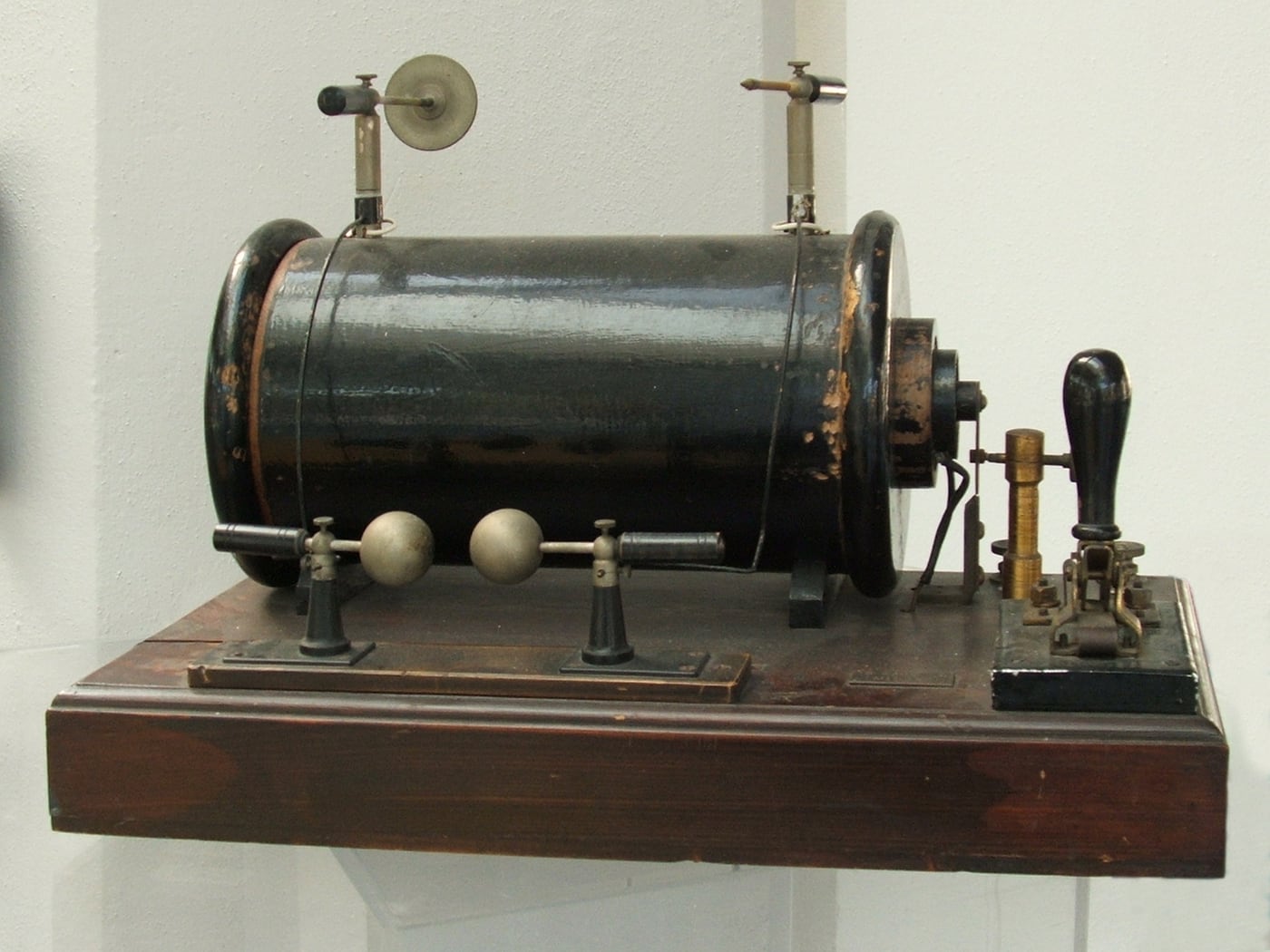
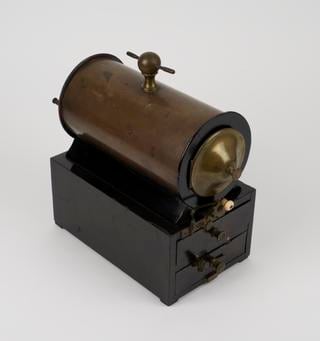
Physically the coil is two windings on a shared soft-iron core. A primary coil of thick, insulated wire, wound over a bundle of soft iron, carries the cell’s DC; a secondary coil of much finer, longer wire is wound over it. When the primary current is switched on and off, the collapsing and building magnetic field in the iron core induces a far higher-voltage current in the secondary. Faradic machines exploited this to offer the physician a choice of output: the lower-voltage “primary” current tapped from the inner coil, which is really an interrupted galvanic pulse; and the “secondary” or true induced current from the outer coil, a higher-voltage induced pulse. Period practitioners drew this primary/secondary distinction but did not agree on which was the more intense or penetrating — many nineteenth-century authors treated the higher-voltage secondary current as the more penetrating — so the two are better described by their voltage than by any settled ranking of “strength.” Sliding the secondary coil over or off the primary — or, in the magneto-electric variants, moving the armature nearer or farther from the magnet’s poles — was how the operator dialed the intensity up and down. A parallel family of machines, the magneto-electric type, dispensed with the battery entirely and generated the induced current by cranking an armature past a permanent magnet; Duchenne’s own later “magneto-Faradic” apparatus in the Museo Galileo collection works exactly this way. Both routes produce a faradic current; only the source of the changing magnetic field differs.
1.4 Inside the make-and-break: the faradic waveform
What converts the coil’s induction into a usable therapeutic train of pulses is the interrupter — the make-and-break. In its commonest form it is a spring-mounted soft-iron hammer (the “Neef’s hammer,” and its function was also called a rheotome) held against a contact. When the primary current flows, the iron core becomes magnetized and pulls the hammer away, breaking the circuit; the field collapses, the hammer springs back, contact is made again, and the cycle repeats — a self-oscillating buzz that chops the current dozens or hundreds of times a second. That buzzing make-and-break is the sound every surviving faradic machine is built to produce, and its rate set the pulse rate of the therapy.
The waveform this produces is worth stating carefully, because it is easy to over-simplify into “faradic is just AC.” It is not a clean sine wave. The induced secondary output is a series of brief, sharp, asymmetrical spikes: because the magnetic field collapses faster on the “break” than it builds on the “make,” the break-induced pulse is stronger and sharper than the make-induced one. A condenser (capacitor) across the interrupter contacts sharpened the break and quieted the sparking. The net effect at the electrodes is an interrupted, alternating pulse train with a strong bias toward the break stroke — which is exactly why it stimulates nerve and muscle so effectively without the electrochemical burning that steady DC causes. The precise physiology of that stimulation, and a clean SVG of the make-and-break circuit itself, are Vol 2’s to give; here it is enough to fix the shape of the current: short, sharp, repeated, and charge-balanced, nothing like the smooth constant flow of the galvanic cell beside it in the same case.
1.5 The medical battery: a therapy in a fitted case
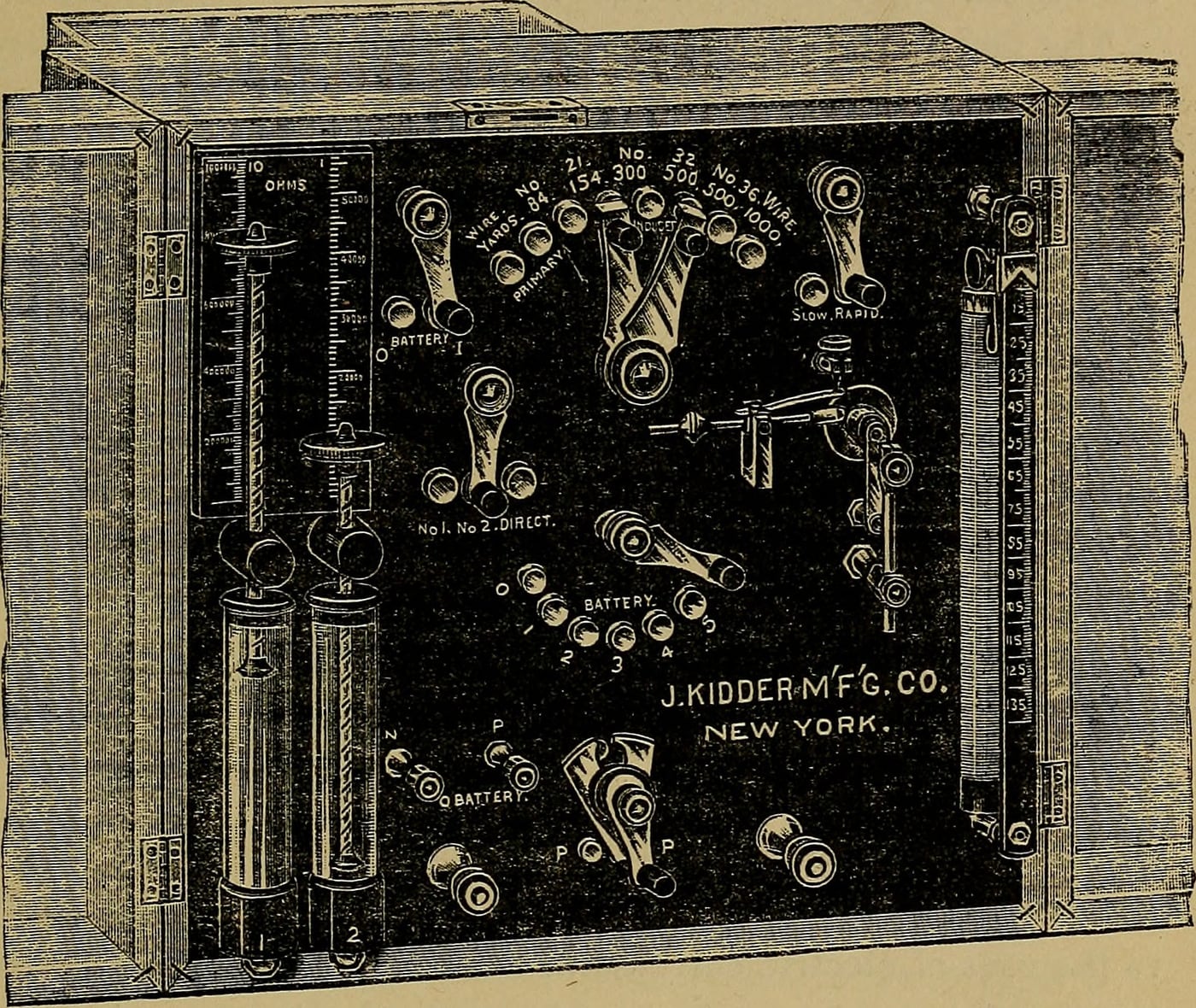
By the middle of the nineteenth century these components were being packaged into a single portable object: the “medical battery,” a fitted wooden case — mahogany or walnut, often velvet- or baize-lined — that a physician could carry on rounds. The best of them combined both currents in one box. The Science Museum Group holds, for instance, an early-twentieth-century electrotherapeutic machine by F. Davidson & Co. of Great Portland Street, London, arranged to deliver “galvanic or faradic current” from a single mahogany case; another in the collection, an electromagnetic induction machine that was a personal relic of the physician Sir Lauder Brunton, holds “various electrodes and cells” in its case. A combined set laid out its parts in a recognizable grammar: the cells (wet Leclanché or bichromate cells, later dry cells) as the DC source; the induction coil and its interrupter to make the faradic current; a control to select galvanic or faradic and to vary the intensity; and, resting in fitted compartments, the electrode handles with interchangeable metal tips and sponge electrodes that were wetted and pressed to the skin. Duchenne’s defining touch, from his 1849 machine onward, was to cover the electrodes in moist cloth so the current could be applied to the skin over a chosen muscle without a puncturing spark — the technique he named électrisation localisée, localized electrization.
The cased medical battery had a long and genuinely medical life. Golding Bird had brought electrotherapy into the mainstream at Guy’s Hospital through the 1840s (he ran the hospital’s electrifying room from 1836 and published his field-legitimising lectures in 1849); by the 1880s the faradic battery was, by contemporary accounts, in widespread medical use. The identical object, however, also had a second life as a mail-order and door-to-door “cure-all,” and the same shock-coil turned up on the fairground as a grip-test amusement — the porous boundary this dive keeps returning to. How to read a specific case, tell the makers apart, and date a set by its cells and coil is the whole business of Vol 5 — Collecting Medical Batteries; the point here is simply that the object and the two currents are one and the same story.
1.6 What the currents honestly did — and what was oversold
It is worth being plain about the physiology, because the marketing of the era was not. Both currents do something real, and something narrow. Steady galvanic current drives ions and small charged molecules through the skin and provokes chemistry at the electrodes — a genuine effect that survives today as iontophoresis and as electrolytic hair removal. Pulsed faradic current depolarizes motor nerves and makes the muscles they serve twitch or, at a fast enough pulse rate, hold a sustained tetanic contraction — the genuine effect that survives as neuromuscular electrical stimulation and muscle re-education. Duchenne exploited both, and in his 1855 treatise De l’électrisation localisée and the work around it he argued — a claim usually dated to 1856 — that the induced faradic current was superior to galvanic for triggering muscle contraction: direct current irritated and blistered the skin at the poles, while the interrupted current produced strong, controllable contractions with far less damage. That is a real, defensible, physiological finding, and it is the honest core of the whole faradic tradition.
What the current could not do is nearly everything else the sellers attached to it. A twitch in a forearm muscle is not a cure for rheumatism, “nervous exhaustion,” impotence, or lost “vital force.” The steady galvanic tingle of a worn appliance is not a systemic tonic. The gap between the small, real, local effect and the vast, advertised, systemic promise is precisely the gap this dive exists to measure — and it is the same gap that runs through the porous Quack wing next door, where the galvanic “electric belt” (see Quack-Devices / Electropathic Belts) and the high-frequency “violet ray” wand (see Quack-Devices / Violet Ray Wands) sold feeble or superficial currents as universal remedies. The medical battery is the sober original of which those are the retail exaggerations.
1.7 Where this volume hands off
You now have the two currents fixed in mind — galvanic as steady direct current from a chemical cell, faradic as the interrupted induced pulse from a Ruhmkorff-type coil and its make-and-break — and the fitted case that delivered them. The next question is the physiological one this volume has only pointed at: what does each current actually do once it is inside the body? That is Vol 2 — What Each Current Does to Tissue, which follows galvanic DC to its electrochemical work at the electrodes (iontophoresis and electrolysis) and faradic pulses to their depolarization of motor nerves (twitch, tetanus, and modern neuromuscular stimulation), and which carries the labelled SVG of the make-and-break interrupter circuit. From there the dive turns to the pioneers who mapped these effects (Vol 3), the split between real medicine and the shock box (Vol 4), and the collector’s reading of a cased set (Vol 5). The static-electricity apparatus that preceded all of this — Franklinization and the influence machine — is the neighbouring Static Electricity Machines dive; the high-frequency currents that followed it are the High Frequency Currents dive.
Sources
- Duchenne Medical Induction Machine, Paris, 1849 — Science Museum Group Collection (co140173) — primary object record: 1849 induction machine made by Charrière, ebony base with brass fittings, Duchenne’s cloth-covered electrodes and “localised electrization”; used against paralysis and nervous disorders. Anchors the faradic/induction-coil object and the 1849 date.
- Duchenne’s Medical Magneto-Electrical Machine — Museo Galileo — a later portable “magneto-Faradic double-current apparatus”: coils wound on a compound permanent magnet, current generated by cranking the armature, intensity varied by sliding copper cylinders or moving the armature from the poles; chamois-covered electrodes. Anchors the magneto-electric route to faradic current.
- Faradic Treatments — Cosmetics and Skin — construction of the faradic battery (cell + primary/secondary induction coil + interrupter); primary current = interrupted galvanic with polar acid/alkali effects, secondary = asymmetrical interrupted induced current with the break stronger than the make; Duchenne naming faradic after Faraday (induction, 1831).
- Faradic vs. galvanic current definitions (search synthesis incl. Taylor & Francis “Faradaic current”) — the precise physical distinction: galvanic DC transfers net charge; faradic AC-coupled current transfers no net charge, flowing alternately in both directions. Supports the “two currents, defined precisely” section.
- Electrotherapy — Wikipedia (lead/history, then cross-checked) — Golding Bird bringing electrotherapy into the mainstream at Guy’s Hospital in the mid-19th century; Duchenne’s 1856 demonstration that alternating (induced) current was superior to direct current for triggering muscle contraction, direct current blistering/pitting at the poles.
- Guillaume Duchenne de Boulogne — Wikipedia (lead, then cross-checked) — De l’électrisation localisée first published 1855; the induction coil converting low-voltage galvanic DC into a high-voltage alternating current, the practice known as faradism; Duchenne as leader of the French faradists. Priority/date claims flagged for further verification.
- “Ruhmkorff’s” induction coil — Chemistry World and Induction coil / Heinrich Daniel Ruhmkorff — Wikipedia — induction coil invented by Nicholas Callan (1836); Ruhmkorff’s compact patented version (1851); the condenser-plus-interrupter mechanism; Ruhmkorff an early recipient of Napoleon III’s 50,000-franc Volta Prize (sources disagree on the year — Chemistry World and the induction-coil article give 1858, while Wikipedia’s dedicated “Volta Prize” page dates his award to 1863 and notes no prize was awarded in 1858; other accounts say 1864 — so the year is deliberately hedged here). Supports the coil-history section.
- Electrotherapy equipment & electromagnetic machines — Science Museum Group Collection — cased combined galvanic/faradic apparatus by F. Davidson & Co. (Great Portland Street, London), the J. R. Chislett patented electromagnetic machine, and Sir Lauder Brunton’s cased induction machine with cells and electrodes. Anchors the fitted-case “medical battery” section.
- The Bakken Museum — museum devoted to medical electricity; induction coils, magneto-electric and galvanic instruments (reference collection for the apparatus family).
Comments (0)