Faradic and Galvanic Machines · Volume 4
The Ledger and the Carnival
Four things a faradic or galvanic current genuinely does to nerve, muscle, and skin — diagnosis, iontophoresis, electrolysis, and muscle re-education — set against the identical cased 'medical battery' sold for nervous exhaustion, impotence, and vigor, and against the same coil bolted into a penny-arcade shock box.
Contents
4.1 About this volume
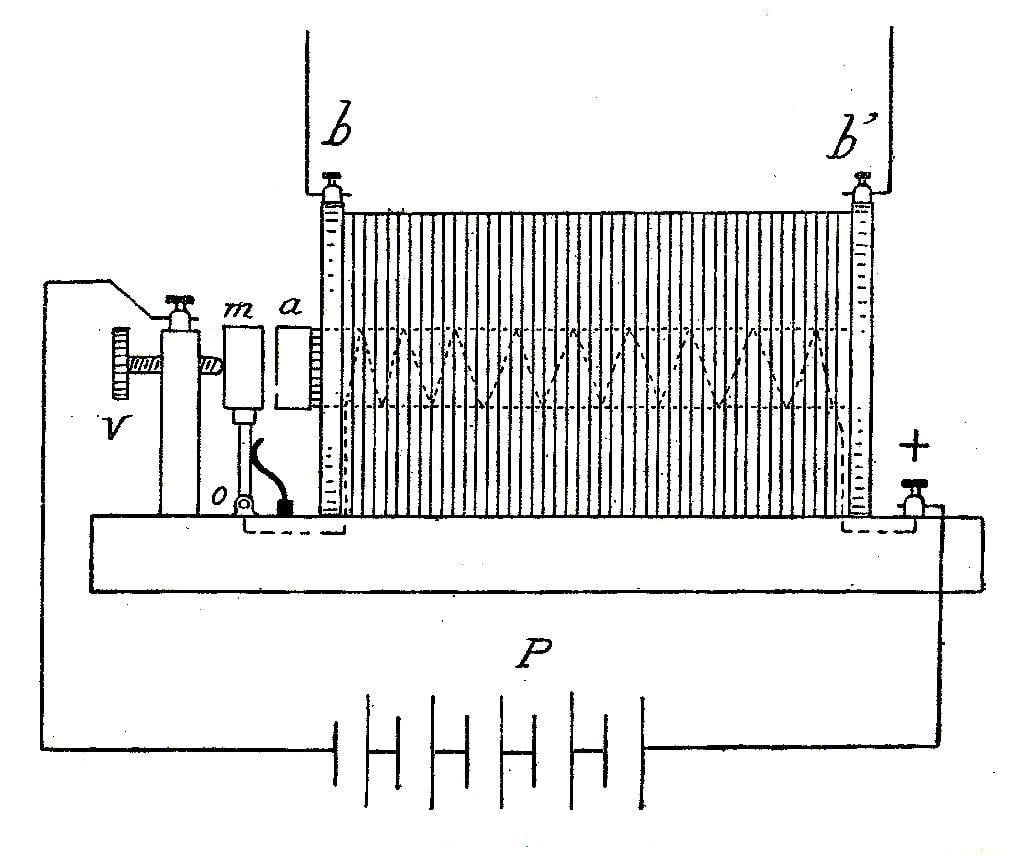
The three volumes before this one establish the hardware and the science: the two currents and the fitted-case “medical battery” that delivered them (Vol 1 — The two currents and the medical battery); what galvanic and faradic current actually do to tissue, with the make-and-break interrupter drawn out as a circuit (Vol 2 — What each current does to tissue); and Duchenne de Boulogne and the pioneers who mapped the body’s response to a controllable induced current (Vol 3 — Duchenne and the pioneers). This volume asks the question the whole dive has been building toward: of everything the medical battery was sold to do, what did it actually do?
The answer splits cleanly, and the split is the point. On one side is a short, sober ledger of genuine effects — real enough that three of the four survive, essentially unchanged in principle, in a modern physiotherapy or dermatology department. On the other is the carnival: the same cased box, with the same coil and the same sponge-tipped handles, marketed for “nervous exhaustion,” impotence, and general vigor — and, stripped of even the pretense of medicine, bolted to a coin slot as the fairground grip-test shocker. The object did not change between the two. Only the claim did.
A note on discipline, because this field’s numbers were exaggerated by the people selling the boxes. Where a date, a name, or a physiological figure could be pinned to a clinical or museum source it is cited below; where a claim rests only on secondary or hobby accounts it is flagged in the prose. Nothing here is medical advice, and nothing here describes how to apply a current to a person — this is the history of what was real and what was sold, not a manual.
4.2 The legitimate ledger
The genuine uses of faradic and galvanic current follow directly from the physiology set out in Vol 2, and there are, honestly, only four of consequence. Galvanic current — steady direct current — drives electrochemistry at the electrodes: it can push ionized drug molecules through the skin (iontophoresis) and it can chemically destroy a hair follicle (electrolysis). Faradic current — the interrupted, induced pulse — depolarizes motor nerves and makes muscle contract, which underlies both a diagnostic test of whether a nerve is intact and the therapeutic re-education of weak muscle. That is the whole ledger. Everything the boxes were additionally sold to cure — rheumatism dissolved, potency restored, “nerve force” replenished — lies outside it.
What makes the ledger persuasive as history is that it was compiled by serious clinicians in real time. The induced current was not a fringe tool; by the 1870s it was moving into mainstream neurology. The task of the honest historian is not to sneer at the whole enterprise but to hold the four working uses apart from the marketing that grew up around, and vastly overran, them.
4.3 Diagnosis: reading a nerve by how its muscle answers
The first genuine use is the one people forget, because it treats nothing: the current as a diagnostic probe. Duchenne’s foundational insight — traced in Vol 3 — was that a muscle stimulated through the skin answers a current in a characteristic way, and that the answer changes when the nerve supplying it is damaged. The underlying observation — that a denervated muscle’s galvanic and faradic excitability changes in a characteristic way — was first described by Eduard Baierlacher in 1859. The German neurologist Wilhelm Heinrich Erb (whose own earliest electrodiagnostic work on peripheral paralysis dates to the late 1860s) systematised and named the phenomenon the reaction of degeneration (Entartungsreaktion) over the following decades — through his 1870s–1880s work, above all his Handbuch der Elektrotherapie (1882): a muscle whose motor nerve has been cut off stops responding normally to the brief faradic pulse while responding, sluggishly and abnormally, to sustained galvanic current.
The physics behind that is genuine and is understood today exactly as the R/D test implies. A healthy motor nerve is excited by a very short electrical pulse — modern electrodiagnosis puts the useful range at roughly 50 microseconds to 1 millisecond — because that is enough to depolarize the nerve, which then commands the muscle. Cut the nerve, wait about two weeks for it to degenerate, and the muscle can no longer be reached that way; it will now contract only to a long-duration current (on the order of 10 milliseconds or more) applied directly to the muscle fiber itself. The faradic machine gave the short pulse; the galvanic battery gave the long one. A clinician with both — that is, with an ordinary medical battery — could distinguish a nerve lesion from a muscle lesion at the bedside, decades before the electromyograph existed.
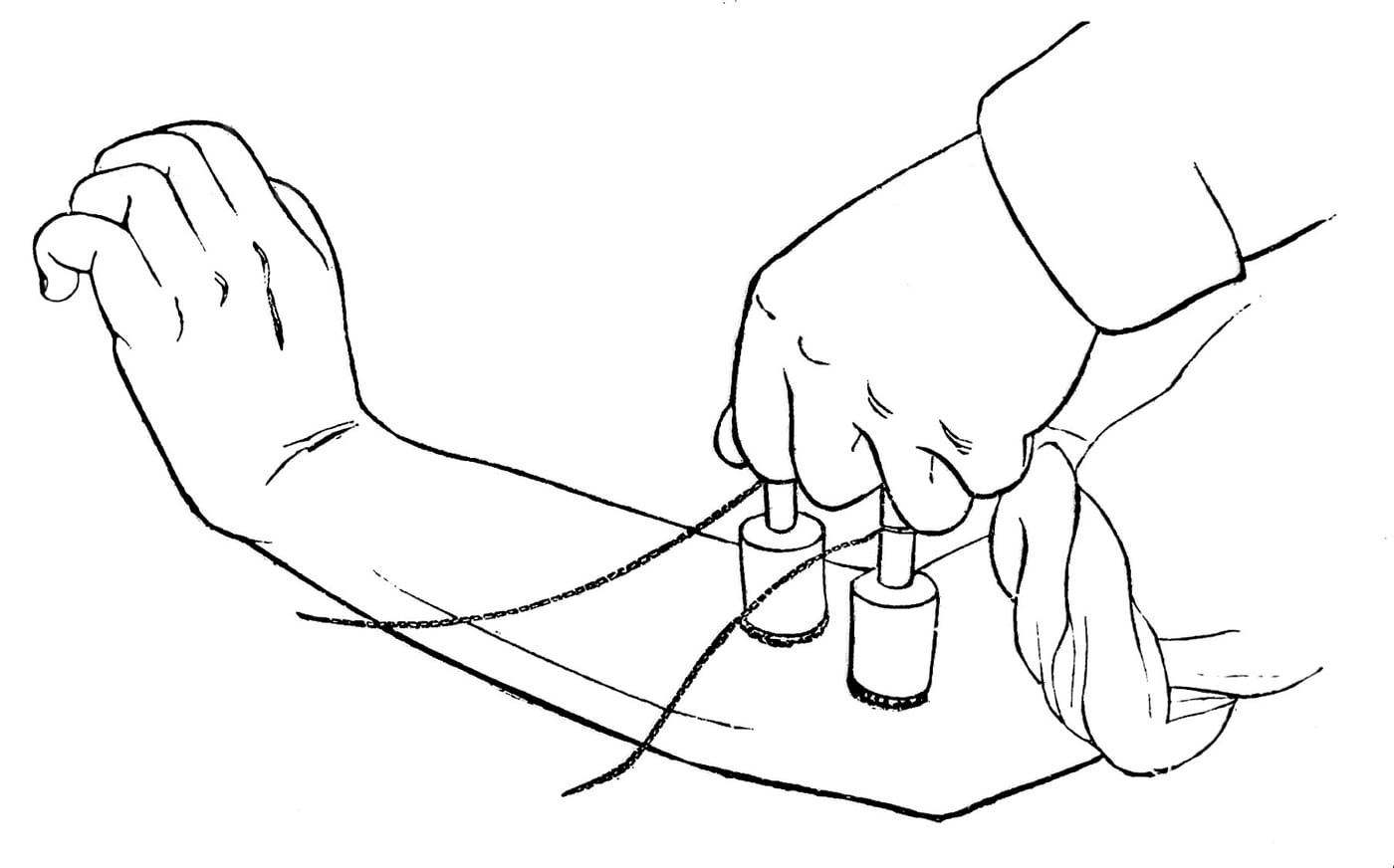
This is the single cleanest example of the medical battery doing real, non-placebo work: not curing, but measuring. The reaction of degeneration remained a standard neurological test into the twentieth century and its principle — that innervated and denervated muscle answer differently to pulses of different duration — is still the basis of strength-duration testing in electrodiagnostic medicine.
4.4 Iontophoresis and electrolysis: electrode chemistry put to work
The second and third genuine uses both belong to galvanic current, and both exploit the fact — established in Vol 2 — that steady DC does chemistry where the electrode meets the tissue.
Iontophoresis uses the current as a pump. Because an electric field drives charged particles, a dissolved drug in ionized form can be nudged through the skin from an electrode of matching polarity. The technique became clinically respectable through the French physician Stéphane Leduc around 1900, who published the governing principles, coined the term iontotherapy, and in a well-known 1903 experiment used two rabbits in series to show that it was the drug ions, not the current itself, that crossed — a strychnine ion driven from one electrode killing the animal on that side of the circuit. (The now-standard word iontophoresis is usually credited to Fritz Frankenhäuser somewhat later, before about 1908; the terminology of the early literature is tangled and the priority is best treated as approximate.) The effect is real and survives: iontophoresis of pilocarpine to raise a patch of sweat is the standard cystic-fibrosis sweat test to this day, and iontophoresis is used clinically for excessive sweating and to deliver some topical anti-inflammatories.
Electrolysis uses the same electrode chemistry to destroy rather than deliver. At the negative electrode of a galvanic circuit, direct current splits water and salt into sodium hydroxide — a caustic — right at the electrode tip. Insert that tip as a fine needle down a hair follicle and the small pocket of caustic destroys the follicle’s growth center. This was not a cosmetic invention but a surgical one: the St. Louis ophthalmologist Charles Eugène Michel (1833–1913) published the first clinical report in 1875 (in the St. Louis Clinical Record), having by his account been treating patients since about 1869. His problem was trichiasis — ingrown eyelashes that scratch the cornea and can, untreated, lead to chronic inflammation and blindness. Removing the offending lash permanently with a galvanic needle was legitimate ophthalmic surgery. Electrolysis for permanent hair removal descends directly from Michel’s needle and remains the only method the U.S. Food and Drug Administration recognizes as permanent.
Both uses share a moral worth stating plainly: they work precisely because the effect is local and chemical, confined to a follicle or a patch of skin. They are the opposite of the “vitality streaming through the body” that the same galvanic battery was sold to provide.
4.5 Muscle re-education: the faradic twitch as therapy
The fourth genuine use is the one that looks most like the marketing and is most often confused with it. A faradic pulse depolarizes a motor nerve and the muscle twitches; deliver the pulses fast enough and the twitches fuse into a sustained tetanic contraction. Duchenne had catalogued exactly this by varying his interrupter (see Vol 3). Applied deliberately to a weak, wasting, or recently re-innervated muscle, that artificial contraction can slow atrophy and help a patient re-learn a movement — muscle re-education.
This effect is genuine and it survives directly as neuromuscular electrical stimulation (NMES) and functional electrical stimulation in modern physiotherapy: after surgery, in stroke and spinal-cord rehabilitation, and to maintain muscle bulk when a limb cannot be voluntarily exercised. The nineteenth-century faradic machine and the twenty-first-century NMES unit stimulate the same motor nerves on the same principle.
But this is also the hinge where legitimacy tips into overreach, and the tip is subtle. Making a healthy muscle twitch feels like exercise and looks impressive, so the faradic contraction was easy to sell as toning, strengthening, and rejuvenation for anyone. The clinical fact is narrower: electrical stimulation earns its keep for muscle that is weak, denervated, or unusable — not as a shortcut to fitness for the well. The line between “re-educating a paralyzed hand” and “electrifying yourself to vigor” is exactly the line between this volume’s ledger and its carnival.
4.6 The carnival: the same case sold for vigor
Now the other side of the ledger. The identical fitted case — coil, cells, interrupter, sponge handles — was sold, from roughly the 1870s onward, as a household cure for things it could not touch. The pivotal marketing concept was neurasthenia, or “nervous exhaustion,” a diagnosis popularized by the American neurologist George Miller Beard, who introduced the term in the Boston Medical and Surgical Journal in 1869 and worked out its electrical treatment with his colleague Alphonse David Rockwell in their 1871 treatise A Practical Treatise on the Medical and Surgical Uses of Electricity. Beard’s premise was that modern civilization drained a finite reserve of “nerve force,” producing fatigue, anxiety, headache, neuralgia, and — tellingly — impotence, and that “general faradization” or “general electrization” could recharge it.
Beard and Rockwell were serious physicians, and this is what makes the carnival hard to caricature: the cure-all did not begin as a swindle but as an over-broad clinical theory sitting on top of the four real effects. Once the theory existed, the market ran away with it. The same box that a neurologist used for the reaction of degeneration was pitched, in mail-order catalogs and by door-to-door canvassers, for nervous debility, rheumatism, kidney and liver complaints, and above all for male sexual anxiety — “lost manhood,” “vital weakness,” restored potency. The physiology forbids all of it: a faint, superficial current that prickles the skin and, at most, twitches a muscle under the electrode does nothing to a kidney, a joint capsule, or the nervous system’s supposed “reserve.” What the patient felt — the tingle, the warmth, the startle, the ritual of a considered instrument in a fitted case — was real sensation attached to no systemic effect. That is the textbook shape of a placebo.
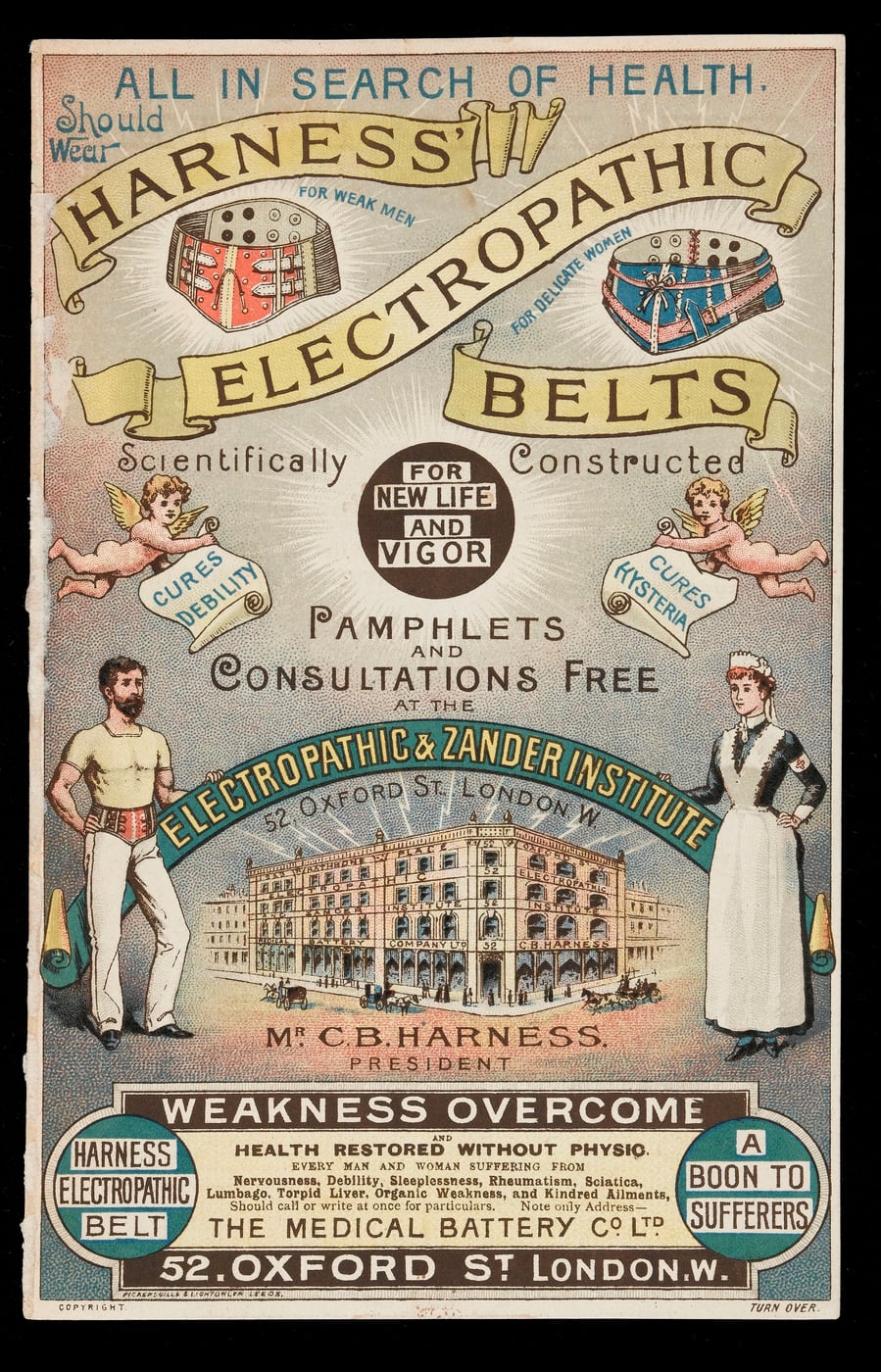
The wearable version of the same idea has its own dive in the Quack wing: the Electropathic Belts — Pulvermacher’s galvanic chain, Dr. Scott’s “electric” appliances, the Heidelberg belt — pressed a feeble (often nonexistent) galvanic current against the skin and sold the identical promise of restored vigor and cured impotence, frequently to the same anxious male buyer. The belt and the cased battery are the wearable and the tabletop faces of one commercial idea, and the boundary with the serious side is genuinely porous: the difference between the clinician’s medical battery and the canvasser’s is not the hardware but the sentence printed on the lid. (The high-frequency version of the same slippage — the physician’s d’Arsonvalization becoming the drugstore Violet Ray Wand — is treated in the High Frequency Currents dive and its Quack-wing counterpart.)
4.7 The shock box: the coil at the fairground
At the far end of the slide, the pretense of medicine falls away entirely and only the sensation is left for sale. The induction coil and interrupter — the working guts of the faradic machine — were fitted with two grip handles and a coin slot to make the penny-arcade shock machine, or “grip test.” The player dropped a coin, seized the handles, and turned one to wind the current up as far as nerve would bear while a dial or bell advertised the feat. According to a history of these “electrotactile” amusements, the machines emerged in the mid-1880s (around 1886), peaked in the 1920s, and lingered in arcades into the 1930s; makers included the Mills Novelty Company of Chicago and Midland Manufacturing, whose device carried the era’s signature slogan, “Electricity is Life.”
That slogan is the whole point. The shock box wore the exact vocabulary of the medical battery — “an excellent treatment for rheumatism, headache, neuralgia, nervousness, debility”; “strengthen your nerve” — but demanded nothing of it, because a paying customer grasping the handles for the thrill of endurance needs no cure to have taken place. The arcade machine is the medical battery with the medicine subtracted and the sensation monetized directly: the same faradic current, the same startle, sold honestly at last as a dare. It is a fitting endpoint for the object, and a clarifying one. Strip away every therapeutic claim and what remains — the one thing the coil could always genuinely deliver — is a tolerable jolt.
4.8 Where this volume hands off
This volume drew the line down the middle of the object: the four genuine effects on one side, the vigor-and-vitality cure-all and the arcade dare on the other, with the same coil and case serving all of them. The final volume, Vol 5 — Collecting medical batteries, returns the box to the present as a collector’s object — how to read a fitted mahogany or walnut case (coil, cells, interrupter, electrode handles and sponges), how to tell the makers on both sides of the Atlantic apart, the cues that date a set, and how to display one soberly as the two-faced artifact it is: a real diagnostic and physiotherapeutic instrument, and the cased ancestor of the fairground shocker, in one box.
Sources
- Michel, 1875 (galvanic eyelash removal) and Charles Michel (ophthalmologist) — Wikipedia — Charles Eugène Michel (1833–1913), St. Louis ophthalmologist; first clinical report of galvanic electrolysis for trichiasis in the St. Louis Clinical Record, 1875, treating cases since c. 1869; the caustic (sodium hydroxide) follicle-destruction mechanism; electrolysis as the surgical origin of permanent hair removal.
- Electrology — Wikipedia — that electrolysis is the only permanent hair-removal method recognized by the U.S. FDA; the medical (trichiasis) rather than cosmetic origin of the technique.
- George Miller Beard — Wikipedia and George Miller Beard — Whonamedit — Beard’s popularization of “neurasthenia” (nervous exhaustion) from 1869 in the Boston Medical and Surgical Journal; symptoms including fatigue, neuralgia, and impotence; the collaboration with A. D. Rockwell and their 1871 Practical Treatise on the Medical and Surgical Uses of Electricity, with “general faradization”/“general electrization” as the electrical treatment for depleted “nerve force.”
- Trials and tribulations of skin iontophoresis in therapeutics (PMC) and Iontophoretic drug delivery: History and applications (JAPS) — Stéphane Leduc (1853–1939) making iontophoresis clinically popular c. 1900, introducing “iontotherapy” and formulating its laws; the 1903 two-rabbits-in-series demonstration that drug ions, not current, cross the skin; the “iontophoresis” term attributed to Frankenhäuser before c. 1908; the surviving pilocarpine cystic-fibrosis sweat test.
- Utilizing the reaction of degeneration test for individuals with focal paralysis (PMC) — Erb’s naming and systematisation of the “reaction of degeneration” for the altered excitability of denervated muscle — the underlying excitability change first described by Eduard Baierlacher (1859), with Erb’s formalisation belonging to his 1870s–1880s work (his Handbuch der Elektrotherapie, 1882) rather than to his earlier (late-1860s) peripheral-paralysis papers; Duchenne’s percutaneous stimulation groundwork and Erb’s use of faradic and galvanic currents; the strength-duration basis (short pulses ~50 µs–1 ms excite nerve; denervated muscle after ~2 weeks needs >10 ms currents) that still underlies electrodiagnosis.
- Shocking Grasps: An Archaeology of Electrotactile Game Mechanics — David Parisi, Game Studies 13(2) — the penny-arcade grip-test shock machines: emergence c. 1886, peak in the 1920s, persistence into the 1930s; grip-handle circuit with an adjustable induced current; makers including Mills Novelty (Chicago) and Midland Manufacturing; the “Electricity is Life”/“strengthen your nerve” framing borrowed wholesale from medical electrotherapy.
- Electricity Is Life shock machines — Gameroom Show — surviving Mills Novelty and related arcade shockers and the transcribed therapeutic-claim placards (“an excellent treatment for rheumatism, headache, neuralgia, nervousness, debility, and all nervous disorders”).
- Science Museum Group Collection and Wellcome Collection — museum object records for cased medical batteries, induction/magneto-electric machines, and electrode handles used as the figure references above.
Comments (0)