Faradic and Galvanic Machines · Volume 2
What the Current Does: Chemistry at the Anode, Twitch at the Nerve
Two currents, two entirely different mechanisms — galvanic direct current works by electrochemistry at the electrodes; faradic pulses work by depolarising motor nerves — and each seeded a narrow, real therapy that survives in modern physiotherapy.
2.1 About this volume
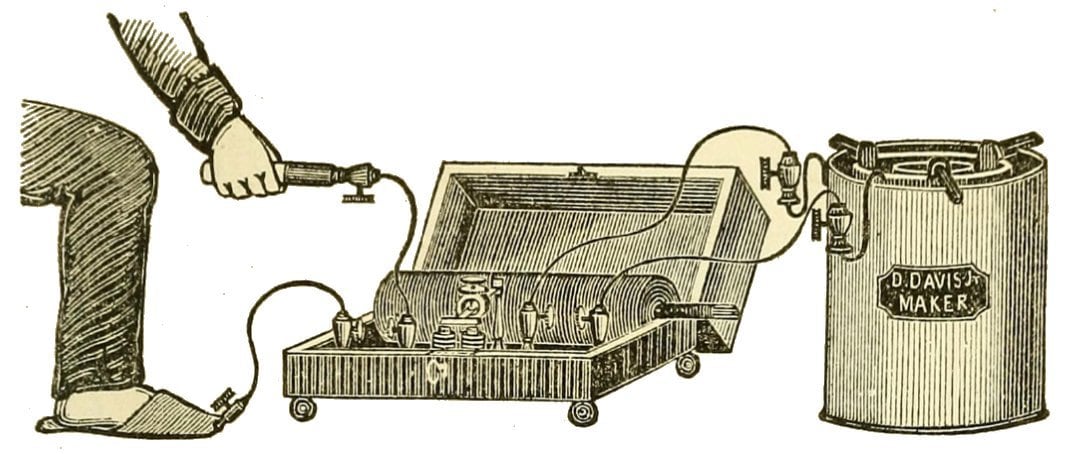
Vol 1 — The Two Currents and the Medical Battery established what the apparatus is: a fitted wooden case holding a chemical cell, an induction coil, a vibrating interrupter, and a set of electrode handles, able to deliver two quite different currents. Galvanic is steady direct current straight from the cell. Faradic is the interrupted, induced current pulsed out of the coil’s secondary winding, named for Michael Faraday’s discovery of induction. This volume takes the lid off and asks the only question that ultimately matters at the bench: what does each current actually do once it enters tissue?
The answer is the spine of the whole dive, because the two currents do not do a stronger and a weaker version of the same thing — they work by two unrelated mechanisms. Galvanic current acts by electrochemistry: sustained direct current drives chemical reactions at the electrodes and pushes charged particles through the skin. Faradic current acts by electrophysiology: its rapid pulses depolarise motor nerves and make muscle contract. Each of those mechanisms is genuinely real, and each seeded a narrow modern therapy — iontophoresis and medical electrolysis from the galvanic side, neuromuscular electrical stimulation from the faradic. Distinguishing those real, local effects from the era’s “electricity cures everything” promise is the work of this volume; the full catalogue of overblown claims and their debunking is dissected in Vol 4 — Legitimate Medicine Versus Carnival.
2.2 One box, two taps: the make-and-break interrupter
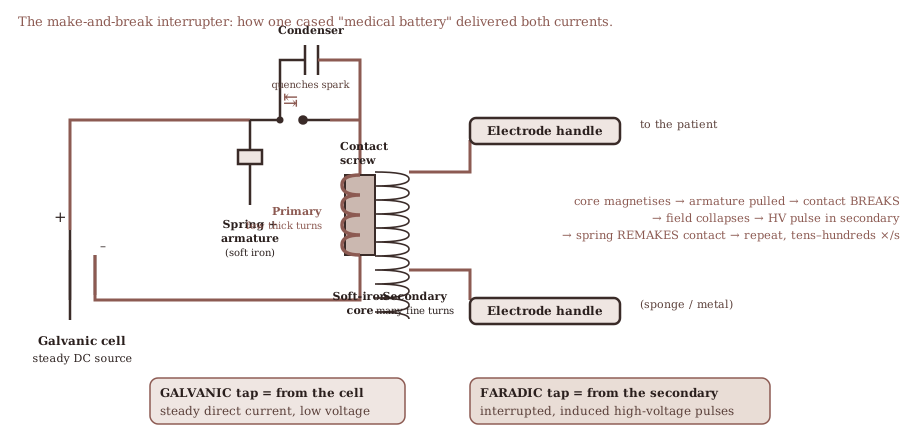
The single component that lets one case produce both currents is the make-and-break interrupter. In its classic form it is a spring-mounted soft-iron armature resting against an adjustable contact screw, sitting beside the coil’s iron core. When the primary current flows, the core becomes an electromagnet and pulls the armature away; that breaks the contact, the current stops, the core demagnetises, and the spring snaps the armature back to remake the contact — whereupon the cycle repeats, tens to hundreds of times a second. Each abrupt break collapses the magnetic field and induces a sharp high-voltage pulse in the many-turn secondary winding. That train of pulses is the faradic output; direct current tapped from the cell before the coil is the galvanic output.
The self-vibrating hammer was introduced by the German physicist Christian Ernst Neef around 1839 and is still called “Neef’s hammer” or the “Wagner hammer” (Induction coil — Wikipedia; Currier, A Biographical History of Induction Coils, Princeton). In 1853 Hippolyte Fizeau added a condenser (capacitor) across the contacts, which quenches the spark that would otherwise waste energy and pit the points, and sharpens the break so the induced pulse is stronger (Britannica — induction coil); Heinrich Daniel Ruhmkorff’s commercial coils of the 1850s made the platinum-tipped self-interrupter standard. A physician varied the interrupter rate to change the character of the faradic current — the very control Duchenne exploited to make a muscle twitch or hold in tetanus, a story told in Vol 3 — Duchenne and the Pioneers.
2.3 Galvanic: chemistry at the electrodes
Galvanic current is unremarkable as electricity — a small, steady direct current, often only a few milliamps — but it is relentless, and where it enters and leaves the body it drives electrolysis of the body’s own salt water. Tissue fluid is a solution of sodium chloride and other electrolytes, and a sustained direct current decomposes it. At the negative electrode (cathode) the reaction liberates hydrogen bubbles and produces sodium hydroxide — caustic alkali — so the tissue there softens and can liquefy. At the positive electrode (anode) chlorine is evolved and acid forms, so tissue there hardens and coagulates (Cosmetics and Skin — Galvanic Treatments). Nineteenth-century operators summarised it in exactly those terms: the cathode was the “softening” pole, the anode the “hardening” pole.
This is a genuinely different physics from anything faradic. The effect depends on charge delivered over time — on current multiplied by minutes — not on any pulse or waveform, which is why galvanic work was always slow, low-current, and one-directional. And it is the electrochemistry, not the electricity as a nerve stimulus, that does the useful work. Two narrow, real therapies grew straight out of it.
2.4 The real descendant, part 1: iontophoresis
If a direct current will drive ions of the body’s salts, it will equally drive ions of a drug placed under the electrode — pushing them through the skin’s pores and follicles by simple electrostatic repulsion, an active electrode of the same sign as the drug ion repelling it inward. This is iontophoresis. The French physician Stéphane Leduc reported in 1900 that a current could drive molecules across skin, and in 1903 showed with paired animals that it was the delivery of the drug ions, not the current itself, that produced the effect (Helmstädter, “The history of electrically-assisted transdermal drug delivery,” Pharmazie 2001, PubMed 11487981). The older name was “cataphoresis”; Fritz Frankenhäuser is credited with introducing the term “iontophoresis” before 1908, and the technique’s nineteenth-century groundwork also involved Benjamin Ward Richardson, Hermann Munk, and William James Morton (same source).
Iontophoresis is a real, still-used physiotherapy modality — but a strictly local one. Modern practice uses a low direct current, typically up to about 5 mA, and low drug concentrations (roughly 2–5%), to deliver agents such as dexamethasone, lidocaine, or acetic acid into superficial tissue for conditions like tendinopathy or carpal-tunnel symptoms (electrotherapy.org — Iontophoresis). It moves a small amount of drug a short distance into the skin beneath the pad. It does not, and cannot, medicate an internal organ or the whole body, and that ceiling is exactly where the period marketing broke faith with the physics.
2.5 The real descendant, part 2: medical electrolysis
The other galvanic descendant is permanent hair removal by electrolysis, and it began as an eye operation. In 1875 the St. Louis ophthalmologist Charles Michel published, in the St. Louis Clinical Record, a method for trichiasis — ingrown eyelashes that scratch the cornea and can end in blindness — in which a fine needle wired to the negative pole of a galvanic cell is slipped down the follicle while a plate at the positive pole rests on the cheek (Electrology — Wikipedia). The chemistry is precisely the cathode reaction above: the current generates sodium hydroxide at the needle tip, and the caustic alkali decomposes the follicle so the hair does not regrow. The journal’s editor, the dermatologist William Hardaway, tried it for unwanted body hair and reported the results to the American Dermatological Association, and galvanic electrolysis became the first genuinely permanent depilation (Electrology — Wikipedia).
It is worth being precise about lineage, because this dive’s neighbours make the same claim: true “electrolysis” is the slow, chemical, galvanic method described here. The faster thermolysis that later dominated electrology destroys the follicle with heat from a high-frequency current — a different physics belonging to the High Frequency Currents dive (in Electrotherapy Devices) and its d’Arsonval ancestry, not to the galvanic cell. The two are routinely conflated under one word; here they are kept apart.
2.6 Faradic: depolarising the motor nerve
Faradic current does something a chemist would not recognise at all. Its brief, sharp pulses depolarise motor nerves — they push the nerve membrane past its firing threshold, and the nerve, not the current, then commands the muscle to contract. Modern physiotherapy characterises the classic faradic waveform as short interrupted pulses of roughly 0.1–1 millisecond delivered at about 50–100 Hz, and notes explicitly that it works “through depolarisation of the motor nerves rather than the muscle fibres directly” (Faradic Stimulation — Physiopedia).
The crucial fact — the reason the interrupter matters so much — is that a nerve responds to a change in current, not to steady flow. A galvanic current excites the nerve chiefly at the instants it is switched on and off; hold it steady and, after the initial jolt, the muscle relaxes even though current still flows. A faradic current is nothing but onset after onset, tens or hundreds of stimuli a second, so it fires the nerve repeatedly. At a low pulse rate each stimulus gives a separate twitch; raise the rate past the point where twitches can no longer relax between pulses and they fuse into a smooth, sustained tetanic contraction — a hold that can generate several times the force of a single twitch (Faradic Stimulation — Physiopedia). Turning the interrupter faster or slower to slide a muscle between twitch and tetanus is the entire diagnostic and therapeutic vocabulary of faradism, and it is why the faradic tap, not the galvanic, became the muscle instrument.
2.7 The real descendant, part 3: neuromuscular stimulation
The modern survival of the faradic principle is neuromuscular electrical stimulation (NMES) — pulsed current applied over a nerve or muscle to produce a contraction the patient may not be able to make voluntarily. It is used to re-educate muscle after injury or surgery, to slow the wasting of a limb held idle, and as an adjunct to strengthening, and its evidence base in rehabilitation is genuine, if modest and task-specific (Nussbaum et al., “Neuromuscular Electrical Stimulation for Treatment of Muscle Impairment,” Physiother Can. 2017, PMC5683854). This is the honest core of “muscle re-education” — a real effect on the muscle under the pad, not a systemic tonic.
The chain from the cased medical battery to the physiotherapy clinic is unbroken: the same depolarise-the-motor-nerve mechanism that Duchenne mapped with a hand-cranked coil in the 1840s is what a modern stimulator delivers with a calibrated pulse. What changed is control and honesty about scope, not the underlying physiology.
2.8 Where the physiology stops and the marketing begins
Set the real effects side by side and the boundary is stark. Galvanic current genuinely drives a little drug into the skin under the pad, genuinely destroys a hair follicle at the needle, and genuinely coagulates or softens tissue at the electrode. Faradic current genuinely twitches and tetanises the muscle beneath the electrodes. Every one of those effects is local, superficial, and bounded by the electrode. None of them reaches an internal organ, restores a failing constitution, or cures a systemic disease.
The trade sold the opposite. The identical cased “medical battery” was advertised for “nervous exhaustion” (neurasthenia), impotence, rheumatism, and a general restoration of “vigour” — claims that required the current to do deep, systemic, whole-body work it is physically incapable of. What a patient actually felt was the twitch, the prickle, the local warmth, and the strong suggestion of an impressive humming machine; the counter-irritation and placebo were real, the systemic cure was not. The same over-reach powers the two most famous quack cousins of this apparatus: the galvanic Electropathic Belts (in the Quack Devices wing) — Pulvermacher chains and their imitators, worn to pass a feeble current for lost “vitality” — and, further along the same coil lineage, the high-frequency Violet Ray Wands. The medical battery, the electric belt, and the fairground “grip-test” shock box are one technology wearing three costumes; the debunking that separates the clinic from the carnival is the whole subject of Vol 4.
2.9 Where this volume hands off
With the mechanisms established, the story turns to the people who worked them out. Vol 3 — Duchenne and the Pioneers follows Guillaume-Benjamin-Amand Duchenne de Boulogne, the “father of electrotherapy,” who from the 1840s used the induction coil for électrisation localisée, argued in the mid-1850s that faradic current beat galvanic for triggering muscle contraction, and whose 1849 medical induction machine (built by Charrière of Paris) survives in the Science Museum Group collection. Vol 4 — Legitimate Medicine Versus Carnival sets the marketing claims against the physiology proven here; Vol 5 — Collecting Medical Batteries closes on reading a fitted case — coil, cells, interrupter, handles, and sponges — and dating it by its maker.
Sources
- Induction coil — Wikipedia — supported the make-and-break interrupter mechanism, Neef’s/Wagner’s self-vibrating hammer (c. 1839), Fizeau’s 1853 condenser across the contacts, and the Ruhmkorff platinum-tipped standard.
- Currier, A Biographical History of Induction Coils (Princeton / Joseph Henry Papers) — supported the attribution of the hammer interrupter to Neef/Wagner and the sequence of interrupter developers.
- Britannica — induction coil — corroborated Fizeau’s 1853 capacitor and the operation of the self-interrupter.
- Cosmetics and Skin — Galvanic Treatments — supported the electrode electrochemistry: cathode → hydrogen + sodium hydroxide (softening), anode → chlorine + acid (hardening), from decomposition of tissue saline.
- electrotherapy.org — Iontophoresis — supported the galvanic/direct-current mechanism, same-charge active electrode, ~5 mA and 2–5% concentrations, delivery via pores/follicles, and the local drug list (dexamethasone, lidocaine, acetic acid).
- Helmstädter, “The history of electrically-assisted transdermal drug delivery (‘iontophoresis’),” Pharmazie 2001 (PubMed 11487981) — supported Leduc’s 1900 report and 1903 animal demonstration, the “cataphoresis → iontophoresis” terminology and Frankenhäuser’s coinage before 1908, and the Richardson/Munk/Morton lineage.
- Electrology — Wikipedia — supported Charles Michel (ophthalmologist), 1875, St. Louis Clinical Record, galvanic needle at the cathode for trichiasis, sodium-hydroxide follicle destruction, and Hardaway’s extension to body hair; and the galvanic-electrolysis vs. high-frequency-thermolysis distinction.
- Faradic Stimulation — Physiopedia — supported the faradic waveform (~0.1–1 ms pulses, ~50–100 Hz), depolarisation of motor nerves rather than muscle fibres directly, and the twitch-versus-tetanus frequency behaviour.
- Nussbaum et al., “Neuromuscular Electrical Stimulation for Treatment of Muscle Impairment,” Physiotherapy Canada 2017 (PMC5683854) — supported NMES as the modern faradic descendant used for muscle re-education and impairment, with a real but bounded evidence base.
- Science Museum Group — Duchenne Medical Induction Machine, Charrière, Paris, 1849 — corroborated the surviving faradic induction machine, its 1849 date and Charrière manufacture, and Duchenne as “father of electrotherapy” (developed in the hand-off to Vol 3).
- Cross-references named in prose, not linked: the High Frequency Currents dive (thermolysis as the RF descendant of electrolysis; d’Arsonval); and the Quack wing’s Electropathic Belts and Violet Ray Wands (the same coil lineage sold as cure-alls).
Comments (0)