Electric Embalming Machines · Volume 4
The Fluid in the Tank: From Arsenic to Formaldehyde
The chemistry that the electric machine was built to pump — how a laboratory curiosity identified in the 1860s, and an accidental discovery in 1893, displaced the arsenical poisons of the Civil-War trade and, together with the motorized pump, defined modern arterial embalming.
Contents
4.1 About this volume
The first three volumes of this dive describe a machine: an electric-motor-driven pump feeding a graduated tank, with a pressure gauge and a rate-of-flow control the operator sets and holds (Vol 1 — The Motorized Machine); the engineering of centrifugal versus reciprocating delivery, electronic pulsation, and the magnetic drive adopted because embalming chemicals destroy conventional shaft seals (Vol 2 — The Engineering); and the maker lineage — ESCO’s Porti-Boy, the Duotronic family, and their competitors — that standardized the hardware in the twentieth century (Vol 3 — Porti-Boy, Duotronic, and the Maker Lineage).
This volume is about the liquid those machines were built to pump. A pump and a gauge are only a delivery system; what they deliver decides whether the work lasts. The story of modern arterial embalming is really two stories braided together — a mechanical one, told in Volumes 1 through 3, and a chemical one, told here. The chemical story is a single substitution: the toxic metal-salt fluids of the nineteenth-century trade — arsenic above all — gave way, between roughly the 1890s and the early 1900s, to formaldehyde. The electric machine and the formaldehyde fluid arrived close enough together, and reinforced each other so completely, that the two define the modern practice jointly. Neither alone would have.
A discipline note, because this corner of trade history is thick with round numbers and tidy origin dates that do not survive checking. Where a claim can be pinned to a maker’s own history, a chemistry reference, or a museum, it is cited as such below; where it rests on secondary retellings — the “first state to ban arsenic,” the exact year Hofmann’s identification is dated — it is flagged in the prose. Nothing here is a formulation or a procedure. This is the history of a chemical substitution and the physics of why it worked, described at the level of the trade and the laboratory only.
4.2 The arsenical era the machine inherited
To see why formaldehyde mattered, start with what it replaced. The arterial embalming that spread through the United States during the Civil War — the trade whose origin story belongs to Gravity Injection Systems and whose instrument-making belongs to Hand Pump and Bulb Machines — ran on the preservative power of poison. Dr. Thomas Holmes’s fluid and its many competitors were built on salts of heavy metals: arsenic most commonly, but also mercury, zinc, antimony, lead, and copper. They preserved because they were toxic — arsenious acid and its kin killed the bacteria of decay outright and denatured the tissue’s own autolytic enzymes.
The doses were extraordinary. Period accounts describe fluids at roughly four ounces of arsenious acid per gallon of water, with as much as twelve pounds of arsenic used on a single body in heavy applications (figures repeated across secondary histories including the Smithsonian’s account; illustrative of scale rather than a controlled measurement). That arsenic did not degrade. It stayed in the body and leached into the ground — the reason Civil-War-era cemeteries are today studied as arsenic-contamination sites.
The same permanence created two problems that eventually doomed the chemistry. The first was occupational: embalmers, and the medical students who later dissected arsenically embalmed cadavers, were poisoning themselves through skin contact and fumes. The second was forensic. A body saturated with embalming arsenic was useless as evidence — a poisoner’s arsenic could no longer be distinguished from the undertaker’s. France had already restricted arsenical embalming on exactly this reasoning in 1846; the American reckoning came later, and it is the subject of a section below. What matters here is that the electric machine, when it arrived, was designed to pump whatever fluid the trade used — and the trade was actively looking for a poison to escape.
4.3 Hofmann and the making of formaldehyde
The escape route had been sitting in a laboratory for decades. Formaldehyde — the simplest aldehyde, formula CH₂O — was first produced in 1859 by the Russian chemist Aleksandr Butlerov, who made it accidentally while attempting to synthesize something else and, misreading his atomic weights, called it dioxymethylen without grasping what he had. The compound was properly identified as an aldehyde by August Wilhelm von Hofmann, the German chemist, who announced its production by passing methanol vapor mixed with air over a hot platinum spiral. Hofmann’s identification is conventionally dated to 1867, though some chemistry histories place the conclusive work in 1868; the one-year wobble is genuine and not worth resolving falsely. The method Hofmann used — partial catalytic oxidation of methanol — is, with refinements, still the basis of industrial formaldehyde manufacture.
Two points deserve emphasis because period marketing later blurred them. First, Hofmann identified and characterized formaldehyde; he did not “discover its power to preserve,” a phrase that circulates in embalming histories and compresses thirty years of separate work into one date. Second, formaldehyde was not commercially available in practical quantity until the 1890s, when industrial routes to it matured in Germany. For the intervening quarter-century it remained a laboratory substance — known, named, and unused by any trade, awaiting both a reason to believe it would fix tissue and a supply large enough to sell.
4.4 Blum and the accident of fixation
The reason arrived by accident. In 1892 the German dye-and-chemical firm Meister, Lucius & Brüning (later part of Hoechst) engaged a young Frankfurt physician, Ferdinand Blum (1865–1959), to investigate formaldehyde’s antiseptic properties — the obvious commercial angle for a powerful germicide (Fox, Johnson, Whiting & Roller, “Formaldehyde Fixation,” J. Histochem. Cytochem. 33:845–853, 1985, which names Meister, Lucius & Brüning as the firm that approached Blum in 1892; the cited ACS/McKone article notes only “a chemical firm”). While handling a roughly four-percent aqueous solution, Blum noticed something the germicide framing had not predicted: the skin on his fingertips had hardened. In 1893 he published on the effect, and in doing so shifted formaldehyde from an antiseptic to a fixative — an agent that makes tissue firm, insoluble, and resistant to decay. Blum sent formalin-fixed tissue to a histology laboratory and reported less shrinkage and distortion than the alcohol fixation then standard. Formaldehyde has been the world’s dominant tissue fixative ever since.
The distinction between antiseptic and fixative is the load-bearing chemistry of this whole volume, so it is worth stating plainly. Arsenic poisoned the agents of decay; formaldehyde rebuilds the tissue itself into something that cannot easily decay. In aqueous solution formaldehyde exists largely as its hydrate, methylene glycol, which penetrates tissue rapidly. There it reacts with the reactive end-groups of proteins — chiefly the amine (nitrogen–hydrogen) groups of amino acids such as lysine — and, crucially, a single formaldehyde molecule can react at two such sites at once, leaving a methylene bridge (–NH–CH₂–NH–) that covalently links one protein to another. Repeated across countless sites, these bridges knit the tissue’s proteins into a stable, cross-linked matrix.
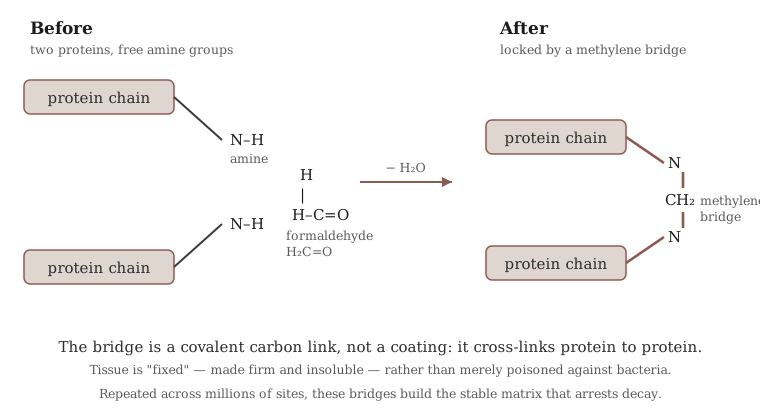
That is why the substitution was not merely a safer poison but a better preservative. A fixed body resists decay through the durability of its own reconstructed proteins, not through a reservoir of toxin waiting in the tissue. The trade press of the 1890s began advertising fluids containing “formalin” — the name given to the roughly 37-percent-by-mass aqueous solution of formaldehyde that remains the industrial stock — and the modern arterial fluid, dyed to restore color and buffered against acidity, took shape from there.
4.5 Dolge imports the first formaldehyde
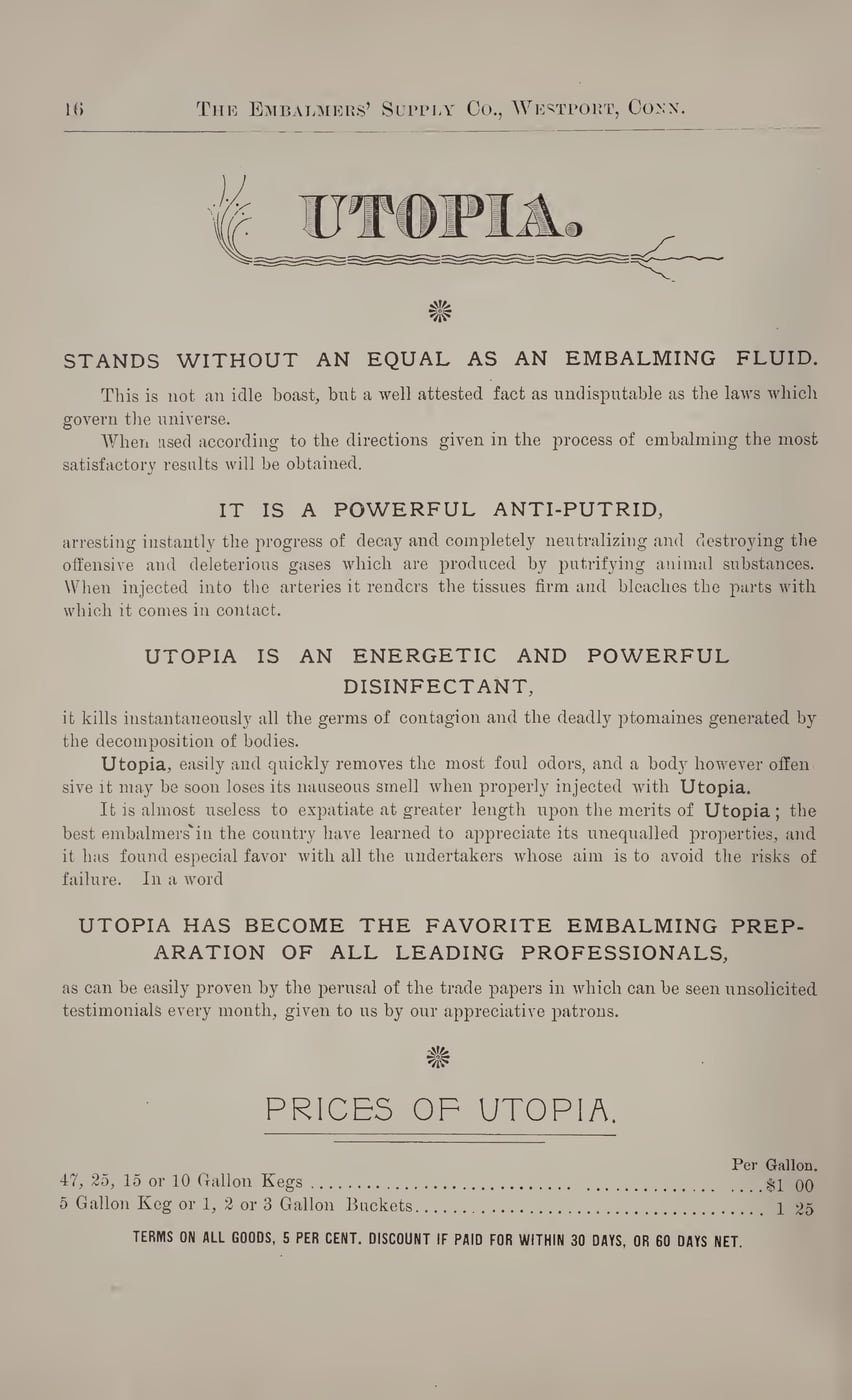
The bridge from Blum’s laboratory to the American undertaker’s tank was built by the firm this dive’s machines come from. The Embalmers’ Supply Company (ESCO) — founded 13 April 1886 by C. B. Dolge and Max Huncke in Brooklyn, and relocated to Westport, Connecticut, in 1890 — had begun exactly where the trade was: by its own company history, ESCO produced its first commercial compound-base fluid in 1891, and that fluid contained arsenic, mercury, and zinc, “since formaldehyde was not yet available.” (ESCO’s instrument-making side, and its 1886 founding, are treated in Hand Pump and Bulb Machines; the Porti-Boy line it later built is Vol 3.)
Then the supply caught up with the science. According to ESCO’s history, Carl B. Dolge imported the first supply of formaldehyde from Germany in 1894, “immediately after practical production of the chemical had been made possible,” and the first formaldehyde-based embalming fluid was compounded in the company’s Westport laboratory — with a U.S.-made, commercially marketed formaldehyde fluid, advertised as non-poisonous, following by about 1900. These dates come from the maker’s own corporate account and should be read as such: a company narrating its own priority. The broad shape is corroborated by the independent chemistry timeline (formaldehyde became practically available in the 1890s; formalin fluids were advertised in that decade), but the specific “first in 1894” claim is exactly the kind of priority statement this field inflates, and it is flagged accordingly.
ESCO was not alone, which is itself evidence that the switch was an industry event rather than one firm’s coup. The Champion Chemical Company of Springfield, Ohio — descended from the Hill Fluid Company of 1878 and incorporated under the Champion name in 1888 — was a direct competitor through the same transition. The “non-poisonous” selling point tells you what the market wanted: not a marginally better preservative, but an escape from the arsenic that was becoming a legal and occupational liability.
4.6 The law drives the switch
Chemistry offered the alternative; the law made adopting it compulsory. Through the early 1900s, American jurisdictions passed statutes prohibiting the use of metal salts in embalming — the plain summary given by the American Chemical Society’s history of the trade, and the firmest single statement of the regulatory arc. Formaldehyde, already proven and by then available, “soon became the compound of choice.”
The commonly cited landmark is that Michigan was the first state to ban arsenic in embalming, in 1895 — a claim repeated across secondary sources but one I could not trace to the statute text itself, and it should be verified against Michigan session law before being treated as settled. Equally common, and equally unverified, is the assertion that “by 1910 the federal government banned arsenic in embalming fluids.” That one deserves outright skepticism: there was no early-twentieth-century federal embalming-fluid statute of that kind. Regulation of embalming was a matter of state law and state boards of health, and the accurate framing is the ACS one — a wave of state prohibitions on metal salts across the early 1900s, not a single federal ban. Where a source asserts a crisp federal date, treat it as folklore compression.
The motives behind those laws were the two arsenic had always carried, now decisive: the occupational poisoning of embalmers and dissectors, and the forensic obstruction of poisoning investigations. The rise of formaldehyde removed both objections at a stroke — it fixed tissue better and it did not salt the body with a permanent, evidence-destroying, soil-contaminating toxin. This is a rare case in the quackery-adjacent history this collection covers where the marketing claim and the reality coincided: the “non-poisonous” fluid genuinely was the safer and better product. Contrast it with the Radioactive Cures dive, where the same period’s faith that a potent substance must be a potent tonic drove people to drink radium — the identical “if it is powerful it must be good for you” category error, resolved here in the trade’s favor and there in catastrophe.
4.7 What formaldehyde actually does — and its own reckoning
Formaldehyde fixation is genuinely effective, and its real behavior is more interesting than the marketing needed it to be. Because the fixing reaction is a chemistry, not a mere soaking, the fluid has to be engineered around it. After death the blood turns acidic — its pH falling from about 7.4 in life to roughly 6.3 during rigor mortis, an “acidic period” lasting on the order of two days — and formaldehyde fixation proceeds best in neutral-to-slightly-alkaline conditions, so arterial fluids are buffered (boric acid with borax, or dibasic sodium phosphate, are among the agents named in the trade chemistry). A second reaction is a liability: formaldehyde can oxidize to formic acid, which in any quantity produces unwanted “formaldehyde pigments” in the tissue, so the formulation works to suppress it. And because fixed tissue loses natural color, dyes are added to restore a lifelike tone — the same functional reason the electric machine’s graduated tank so often holds a faintly pink or amber liquid.
Formaldehyde did not end the chemistry arc so much as become its long-running incumbent, and it acquired a reckoning of its own. It is a respiratory and skin irritant, an occupational asthma trigger and contact-dermatitis agent, and is now classified as a human carcinogen — the modern counterpart to the arsenic hazard it displaced. That drove a search for substitutes: a 1943 patent to Hilton Ira Jones covered a fluid using the dialdehyde glyoxal (it stained tissue yellow and did not catch on), and glutaraldehyde was first used as a formaldehyde substitute in 1955, cross-linking proteins more heavily and diffusing more evenly, though it remains several times more expensive per pound. Later makers pushed further — Champion introduced formaldehyde-free formulations in the 1990s and “green” fluids around 2010. Yet formaldehyde, cheap and well-understood, has remained the dominant embalming preservative in the United States across the whole life of the electric machines this dive documents. The fluid in a mid-century Porti-Boy’s tank was, and in most working machines still is, a buffered, dyed formaldehyde solution — the direct descendant of what Dolge compounded at Westport.
4.8 Where this volume hands off
This volume closed the chemistry arc that runs beneath the whole Embalming Machines sub-project: from the arsenical poisons of the Civil-War trade, through Hofmann’s identification of formaldehyde and Blum’s accidental discovery of fixation, to Dolge’s importation and the state laws that made the switch permanent. Together with the motorized pump of Volumes 1 through 3, formaldehyde fluid is what “modern arterial embalming” actually means.
The final volume, Vol 5 — Collecting Electric Machines Safely, returns the machine to the present as a collector’s object: how these units turn up at estate and trade sales, the condition cues that tell a sound machine from a wrecked one — gauges, tank glass, motor, and the chemical-eaten seals that Vol 2 explained — and, most importantly, the hazardous-materials reality that this volume’s chemistry creates. An old machine may hold residue or old fluid; formaldehyde and, in genuinely antique specimens, the possibility of legacy arsenical residue make these objects for display, not use. Read Vol 5 before you handle, fill, or run one.
Sources
- Formaldehyde — Wikipedia — Butlerov’s 1859 first production (as “dioxymethylen”); Hofmann’s identification as an aldehyde via methanol vapor over hot platinum; the CH₂O formula; formalin as the ~37%-by-mass aqueous solution existing mainly as the hydrate methylene glycol.
- August Wilhelm von Hofmann — Wikipedia — Hofmann’s identity and work; used to corroborate the identification and note the 1867/1868 dating ambiguity.
- Harold T. McKone, “Embalming: A ‘Living’ Rite,” Today’s Chemist at Work (American Chemical Society), December 2002 — the load-bearing chemistry source: Ferdinand Blum (1865–1959) discovering formaldehyde’s fixative/hardening action in 1893 with a ~4% aqueous solution; methylene glycol and protein cross-linking; the formic-acid / “formaldehyde pigments” problem; blood pH falling 7.4→6.3 in rigor and the buffers used; “by the early 1900s, laws prohibiting the use of metal salts in embalming were passed; formaldehyde soon became the compound of choice”; the 1943 glyoxal patent (Hilton Ira Jones) and glutaraldehyde first used as a substitute in 1955.
- ESCO’s history (Embalmers’ Supply Company) — company account: founding 13 April 1886 (Dolge and Huncke, Brooklyn); move to Westport, CT, 1890; first compound-base fluid (arsenic, mercury, zinc) 1891; Carl B. Dolge importing the first formaldehyde from Germany in 1894; the first formaldehyde-based fluid compounded at Westport and a “non-poisonous” U.S. formaldehyde fluid by ~1900. (Maker’s self-narrated priority — the “first in 1894” claim is flagged in text for an adversarial check.)
- Fox, Johnson, Whiting & Roller, “Formaldehyde Fixation,” Journal of Histochemistry & Cytochemistry 33:845–853 (1985) — names the firm Meister, Lucius & Brüning (later part of Hoechst) as having approached the young Frankfurt physician Ferdinand Blum in 1892 to test formaldehyde’s antiseptic properties, corroborating the specific attribution the ACS/McKone article leaves as an unnamed “chemical firm.”
- Arsenic and Old Graves: Civil War-Era Cemeteries May Be Leaking Toxins — Smithsonian Magazine — arsenical fluid amounts (~4 oz arsenious acid/gallon; up to ~12 lb/body); the early-1900s prohibition; the occupational (medical-student cadaver exposure) and forensic (murder-investigation) motives; France’s 1846 restriction; the switch to formaldehyde/glutaraldehyde. Also the widely-repeated “Michigan first, 1895” claim (secondary; flagged unverified).
- Embalming chemicals — Wikipedia — heavy-metal salts (arsenic, antimony, lead, mercury, copper) in early fluids; Champion Chemical Company incorporated 1888; later glutaraldehyde-based and HCHO-free fluids.
- The Champion Company — Our Story — Champion’s lineage (Hill Fluid Company 1878; incorporated as Champion Chemical Company 1888, Springfield, OH) as an ESCO-era competitor through the arsenic-to-formaldehyde transition, and its later formaldehyde-free (1990s) and green (2010) fluids.
Comments (0)