Electric Embalming Machines · Volume 1
The Machine on the Cart
What an electric embalming machine is — a motor-driven pump feeding a graduated tank, with a pressure gauge and a separate rate-of-flow control the operator sets and holds — and why the ESCO Porti-Boy became its archetype.
Contents
| Section |
|---|
| About this volume |
| The machine, plainly described |
| Two dials, not one: pressure and rate of flow |
| The Porti-Boy as archetype |
| What the machine standardised |
| Where this volume hands off |
| Sources |
1.1 About this volume
For most of the nineteenth century, getting preservative fluid into an artery was a problem of muscle or of gravity. An undertaker either squeezed a rubber bulb and worked a hand pump by feel, or hung a glass reservoir on a stand and let the weight of the fluid column do the pushing. Both methods are covered by the earlier dives in this wing — the Gravity Injection Systems dive and the Hand Pump and Bulb Machines dive — and both share the same limitation: the operator could not simply choose a pressure and a delivery rate and then hold them steady while attending to the work. Pressure sagged as a gravity bottle emptied; rate lurched with every squeeze of a bulb.
The electric embalming machine solved that problem by putting a small electric motor and a pump between the fluid tank and the artery. This is the establishing volume of a five-part deep dive, and its job is narrow: to describe the object — a motor-driven pump feeding a graduated tank, fitted with a pressure gauge reading in pounds per square inch and a rate-of-flow control, so that the operator can set both quantities independently and the machine will hold them. That decoupling of pressure from flow is the entire conceptual advance, and it is what this volume exists to explain.
Everything more specialised is handed to the siblings. The pump engineering — centrifugal versus reciprocating action, continuous versus pulsed delivery, and the magnetically-coupled impeller that survives the chemicals — is the whole subject of Vol 2 — The Pump and the Flow Path, which also carries the labelled schematic of the motor-to-artery path. The makers and the model lineage, above all the ESCO Porti-Boy and the electronic Duotronic family, are catalogued in Vol 3 — Porti-Boy, Duotronic, and the Makers. The fluid chemistry that the machine pushed — the shift from arsenical salts to formaldehyde — is Vol 4 — The Formaldehyde Era; and the practical business of finding, dating, and safely displaying a retired machine is Vol 5 — Collecting Electric Machines. This volume introduces the object and hands the arguments to those that follow.
1.2 The machine, plainly described
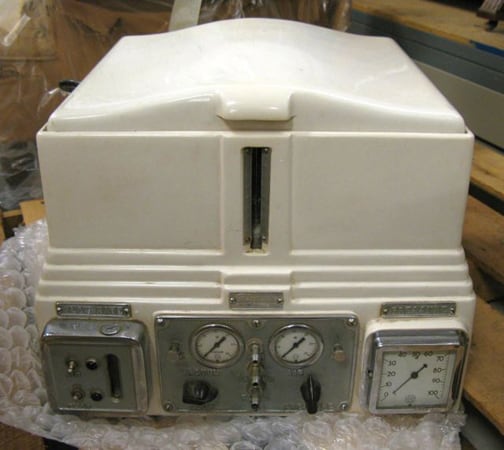
Set on a rolling cart or a bench, a modern electric embalming machine is a compact and unglamorous appliance. At the top sits a clear graduated tank — on current ESCO machines a glass jar of roughly two-and-a-half to three-and-a-quarter gallons — into which the operator pours the mixed fluid. Graduations on the glass let the volume be read off directly, so the operator knows how much solution has been used and how much remains. Below the tank is a metal base, today usually stainless steel, containing the electric motor and the pump, and a front panel carrying a pressure gauge and the control knobs. A short length of hose leaves the machine and connects, downstream, to the arterial tube that the practitioner has tied into a raised artery. That downstream, anatomical end of the work is the province of embalming practice and is deliberately outside the scope of this apparatus history; here the object of interest stops at the outlet hose.
The motors involved are small — a fractional-horsepower unit running on ordinary single-phase household current. ESCO’s current Porti-Boy Mark IV uses a 1/6-horsepower motor and the larger Mark V a 1/4-horsepower motor, both on 110-volt, 60-hertz supply; a comparable rating quoted for the line is about 150 watts. These are not powerful machines, because they do not need to be: arterial injection is a matter of a modest, sustained pressure applied over minutes, not of brute force.
The pump is the heart of the object, and the modern ESCO design is worth naming even though its detailed engineering belongs to Vol 2. It is a magnetic-drive pump: the motor spins a magnet outside the sealed pump chamber, and that magnetic field turns an impeller inside it through the wall of a containment shell, with no shaft physically passing through — and therefore no rotating shaft seal. ESCO’s own marketing makes a virtue of this, describing a high-speed pump with “no seals and only one moving part.” The engineering reason is genuine and is one of the nicer details in the whole subject: embalming fluids are chemically aggressive enough to destroy a conventional shaft seal, so eliminating the seal removes the part most likely to fail. Whether “only one moving part” is literally true or a tidy sales phrase is the kind of maker’s claim Vol 2 exists to test against the drawings; for now it is enough that the seal-less magnetic drive is a real and deliberate response to a real chemical problem.
1.3 Two dials, not one: pressure and rate of flow
The single most important thing to understand about the electric machine — the thing that separates it from every gravity bottle and squeeze-bulb before it — is that pressure and rate of flow are two different quantities, and the machine lets the operator control them separately.
Pressure is the force pushing on the fluid, read on the gauge in pounds per square inch. Rate of flow is the volume of fluid actually moving per unit time — conventionally spoken of in ounces per minute in the American trade. It is tempting to assume that more pressure simply means more flow, but the two are only loosely coupled, because what actually limits flow is the resistance the fluid meets on the far side of the outlet: the bore of the arterial tube, and the condition of the vascular bed it is feeding. A high pressure can coincide with a slow rate if the resistance downstream is high, and a generous rate can be achieved at modest pressure if resistance is low. An experienced operator therefore reads the relationship between the two as diagnostic information about distribution, not as a single “harder or softer” setting.
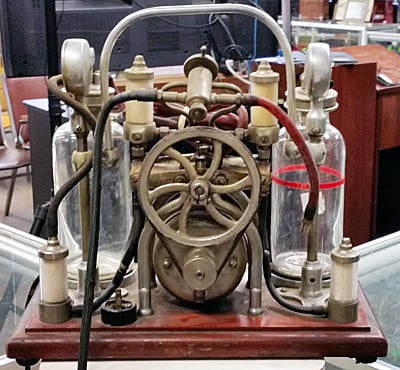
A gravity system offers, in effect, one crude control: the height of the bottle sets a head of pressure, and the flow is then whatever that pressure and the downstream resistance happen to produce. A hand pump offers pressure and rate tangled together in the rhythm of the operator’s hand. The electric machine untangles them. On a typical unit the operator dials in a target pressure, which the motor-and-pump holds steady against the gauge as the tank drains — no sag as the fluid level falls, because the pump, not a shrinking column of liquid, is doing the pushing — and then trims a separate rate-of-flow valve or control to govern how fast fluid is admitted. The result is that the two numbers can be chosen and then held, hands-free, for as long as the injection lasts. That is the whole ergonomic and clinical argument for the machine, and it is why the gauge and the pair of control knobs, not the motor, are the defining features of the object.
Later machines added a further refinement that this volume only flags and leaves to its siblings: deliberate pulsation. A plain centrifugal pump delivers a smooth, continuous stream; from the late 1960s onward, electronically-controlled machines re-introduced a rhythmic pulse — a pump that surges and eases to loosely mimic a heartbeat — on the theory that intermittent pressure aids distribution through the vascular network. ESCO’s current Porti-Boy machines carry such a pulsator. The engineering of continuous-versus-pulsed delivery is Vol 2’s to explain, and the specific electronic machines that pioneered it — the Duotronic line — are Vol 3’s to catalogue.
1.4 The Porti-Boy as archetype
If one object stands for the whole category, it is the Porti-Boy, made by the Embalmers’ Supply Company of Westport, Connecticut, universally abbreviated ESCO. The name is itself a compact history of the object: it comes from the machine’s original conception as a portable unit, light enough to be carried between locations — a real virtue in an era when embalming was still often done in the family home rather than in a central preparation room, and a lasting one for rural firms covering scattered communities. The device that most defined the fixed, motorised, shop-based machine began life as a machine you could pick up and take to the work.
ESCO is one of the oldest names in the American trade. The firm was founded on 13 April 1886 as a partnership between Carl B. Dolge and Max Huncke, two German-born men — an inventor-businessman and a pharmacist — operating in Brooklyn, New York, before relocating to Westport, Connecticut, around 1890 and incorporating there under its present name. In 1887 the company introduced what it describes as the first American-made embalming instruments and accessories, before which such apparatus was imported from Germany or made by the user; that instrument-making story belongs to the Hand Pump and Bulb Machines dive. Dolge was also a formaldehyde pioneer, importing the chemical for fluid work in the 1890s — the thread Vol 4 picks up. The Porti-Boy itself, by trade accounts, was acquired by ESCO in 1975 and became the company’s flagship machine; the pre-ESCO origin of the design is poorly documented in the sources available and is a fair target for further digging. (Treat the 1975 date as trade-repeated rather than archivally confirmed.)
The current line comprises two models whose published specifications neatly illustrate the object. The Mark IV offers a maximum injection-pressure range of about 45–60 psi, a 1/6-horsepower motor, and a 2½-gallon graduated glass tank; the larger Mark V offers roughly 80–100 psi, a 1/4-horsepower motor, and a 3¼-gallon tank. Both use the seal-less magnetic-drive pump and both carry the electronic pulsator described above. These are, it should be stressed, present-day catalog figures for machines still in production, not the specifications of a 1930s antique; the model lineage that connects the two — the Marks that came before, and the competitors that stood alongside — is Vol 3’s to trace.
1.5 What the machine standardised
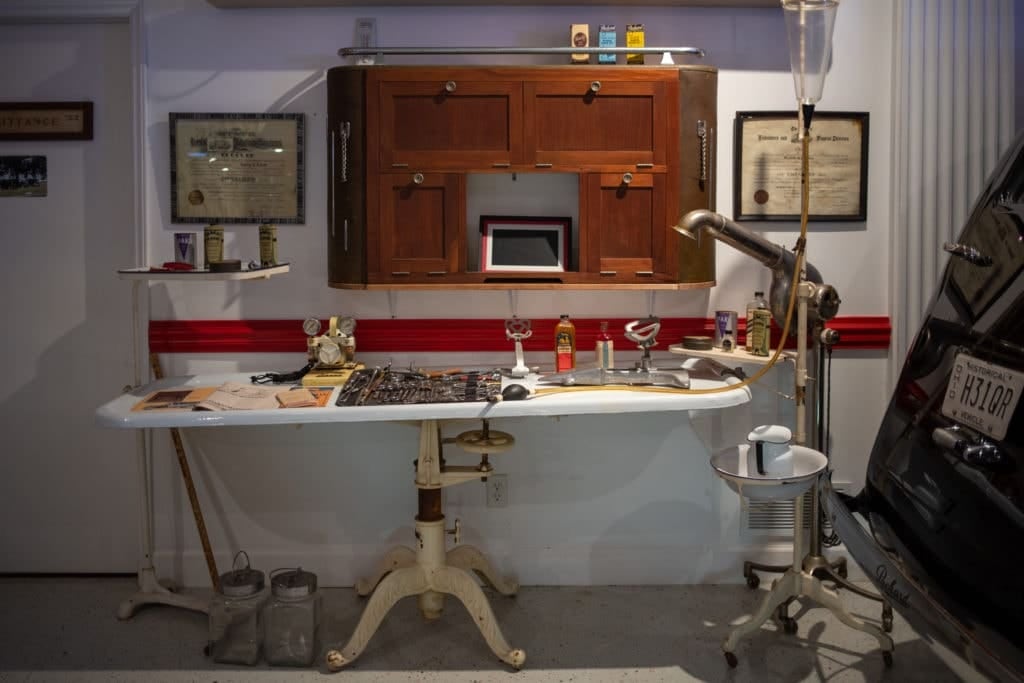
It is easy to overstate what the electric machine changed. It did not invent arterial injection, nor preservative chemistry, nor the idea of controlling pressure — the gravity bottle and the hand pump had all three in cruder form, and those earlier dives make the case that the intellectual work of arterial embalming was largely done before any motor was involved. What the electric machine did was standardise and de-skill the delivery: it turned “hold a steady pressure by feel” into “set a number on a gauge,” and made that steadiness reproducible from one operation to the next and from one operator to another. In doing so it completed the long shift the whole wing traces — from the itinerant embalming surgeon working over a gravity flask in a farmhouse kitchen to the shop-based, appliance-equipped preparation room.
That completion had two halves, and this volume owns only one of them. The hardware half — a motor-driven pump holding a chosen pressure and rate — is described here. The chemistry half — the arrival of formaldehyde-based fluids and the early-twentieth-century laws that banned the older arsenical and metal-salt preparations — is Vol 4’s. Modern arterial embalming is precisely the marriage of the two: the electric machine gave reproducible mechanical delivery, and formaldehyde chemistry gave a fluid worth delivering reproducibly. Neither alone defines it.
Finally, a framing note this wing keeps returning to. These are sober trade objects, and the same porous boundary that runs through the whole Antique Medical collection runs here too: an embalming machine is a genuine, well-engineered piece of professional apparatus, as far from the wishful Violet Ray Wands of the Quack-Devices wing as an object in this collection gets. There is no marketing myth to debunk in the machine itself — only, occasionally, a maker’s superlative such as “only one moving part” worth checking against the drawings. The cavity-treatment instruments that partner the arterial machine are the Trocars and Cavity Injection dive; the pre-refrigeration furniture that surrounded all of it is Cooling Boards and Corpse Coolers. This dive is the arterial machine’s motorised chapter.
1.6 Where this volume hands off
You now have the object: a small electric motor turning a seal-less pump, drawing from a graduated tank, and holding a chosen pressure and a chosen rate of flow that the gauge and the two control knobs let the operator set independently and forget. The next and most technical question is how the pump does it — why a centrifugal impeller gives a continuous stream where a reciprocating hand pump gave pulses, why later machines deliberately put the pulse back, and how a magnetically-coupled impeller survives chemicals that would eat a conventional seal. That is Vol 2 — The Pump and the Flow Path, which also carries the labelled schematic of the whole motor-pump-tank-gauge path. From there the dive turns to the makers and models (Vol 3), the formaldehyde chemistry the machine delivered (Vol 4), and the collector’s questions of condition, dating, and hazardous old residue (Vol 5).
Sources
- Porti-Boy — Embalmers’ Supply Company (ESCO) — the maker’s own product pages: the Porti-Boy line as Mark IV and Mark V, the seal-less magnetic-drive high-speed pump (“no seals and only one moving part”), and the electronic pulsator.
- Porti-Boy Mark V Embalming Machine — Turner Memorial — Mark V specifications: 80–100 psi injection-pressure range, 1/4-hp motor on 110 V / 60 Hz single-phase AC, 3¼-gallon glass tank on stainless base, magnetic-drive pump, pulsation feature.
- Beginner’s Guide to Buying a Portiboy Embalming Machine — American Mortuary Coolers — magnetic-drive pump operation (drive magnet outside a containment shell turning the impeller, no seals), 150-watt motor, ~0–80 lb pressure and up to ~3.8 L/min flow, ~3.5-gallon glass tank, and independent pressure/flow control knobs; the “Porti-Boy = portable” name origin.
- The Ultimate Guide to Choosing an Embalmers Supply Company — American Mortuary Coolers — ESCO history: founded 13 April 1886 by C. B. Dolge and Max Huncke; first American-made instruments 1887; Westport, Connecticut incorporation; and the Porti-Boy acquired by ESCO in 1975 (trade-repeated date, not archivally confirmed here).
- Porti-Boy Embalming Machines now on MortuaryMall.com — Connecting Directors — ESCO “serving funeral service since 1886,” Canada division since 1931; Mark IV / Mark V; magnetic-drive pump described as “no seals and only one moving part.”
- Historical Quickie on Arterial Embalming Equipment — Caleb Wilde — a funeral director’s first-hand contrast between the older gravity flask-and-stand (raise the stand to set pressure) and the motorised Porti-Boy with adjustable pressure and flow-rate controls; context for the home-to-shop transition.
- Embalming — Wikipedia — leads only: arterial solution injected by a centrifugal pump; rate of flow as the volume entering per unit time; general framing of modern arterial embalming.
- An Essential Guide to Duotronic Embalming Machines — American Mortuary Coolers — used only for the flagged forward reference: the Duotronic I (1967) as the electronically-controlled, belt-driven centrifugal machine that introduced the pulse/electronic control later generalised across the trade (full treatment deferred to Vol 3).
Comments (0)