Electric Embalming Machines · Volume 2
The Engineering: Pumps, Seals, and the Return of the Pulse
How the electric machine actually moves fluid — why a centrifugal impeller replaced the pulsing hand pump, why the chemicals forced a sealless magnetic drive, and why the pulse the machine had eliminated was later deliberately put back.

2.1 About this volume
Vol 1 — The Motorized Machine established what the electric embalming machine is: an electric-motor-driven pump feeding a graduated tank, fitted with a pressure gauge reading in pounds per square inch and a rate-of-flow control, so that an operator can set two quantities — pressure and rate — and have the machine hold them independently. This volume takes the lid off and traces how it does that, because the interesting engineering of the electric era is not the motor but the pump, the seal, and a control feature that reads at first like marketing and turns out to be a genuine hydraulic idea.
The arc is a small, satisfying loop. The hand-pump and bulb apparatus of the previous era (the Hand Pump and Bulb Machines dive) delivered fluid in pulses — one squeeze, one slug — because that is simply what a reciprocating pump does. The electric machine replaced that with a continuous, steady stream, which is what a spinning impeller does. And then, decades later, the makers deliberately re-introduced pulsation electronically, having spent a generation removing it. What follows is why each of those three steps made engineering sense, separating the sober physics of the machine from the period sales copy that dressed a distribution aid up as a mechanical resurrection of the heartbeat.
Two facts do the load-bearing work here, and the maker literature backs both: the everyday electric machine uses a rotodynamic (impeller) pump, not a reciprocating one, which is why its native delivery is smooth; and its pump has no rotating shaft seal at all, because embalming chemicals destroy conventional seals — a problem solved with a magnetically coupled impeller. The maker lineage, model names, and dates that go with these machines — Porti-Boy, Duotronic, and their competitors — are the business of Vol 3 — The Makers and Their Machines; here we stay with the hardware.
2.2 Two ways to move a fluid
Every pump in this whole sub-project belongs to one of two families, and the electric machine is interesting precisely because it changed families.
A reciprocating positive-displacement pump — the piston-and-check-valve pump, or the humble squeeze-bulb — traps a fixed volume of fluid and pushes it forward, then draws the next volume in, then pushes again. Its output is therefore inherently pulsating: the flow accelerates on the delivery stroke and slows or stops between strokes. General pump-engineering references describe this plainly — “a pulsing discharge is a characteristic of positive displacement, and especially reciprocating, pump designs,” a pulsation that ordinarily has to be smoothed out with a dampener when steady flow is wanted (Michael Smith Engineers; Castle Pumps). That pulse is exactly what the embalmer of the hand-pump era felt in the palm — and the bulb growing harder to squeeze as back-pressure rose was, in effect, a crude pressure gauge built into the hand.
A centrifugal (rotodynamic) pump works on a completely different principle: a spinning impeller flings fluid outward by inertia, converting rotational speed into a steady head of pressure. Its defining virtue for this application is that it “delivers a smooth and continuous flow,” which is why centrifugal pumps are the default “where fluid stability is essential” (RP Pumps; DAE Pumps). Couple that impeller to an electric motor and you get the essential move of the twentieth century: continuous, operator-set pressure that the machine holds by itself, instead of a pulse the operator produces by hand. The gauge is no longer in the embalmer’s palm; it is a dial on the panel, and the impeller — not the arm — does the sustaining.
A note on a common muddle: whether a pump is centrifugal or reciprocating is a question about how it pushes fluid, and it is entirely separate from how the motor is coupled to it. A magnetic drive (below) can be fitted to either type. Some trade write-ups loosely contrast a modern machine’s “magnetic drive pump” with “centrifugal” as if those were rival categories; they are not. The Porti-Boy’s magnetically driven pump is an impeller pump — a rotodynamic machine with a magnetic coupling — and the two descriptions are about two different parts of the same device.
2.3 The flow path, part by part
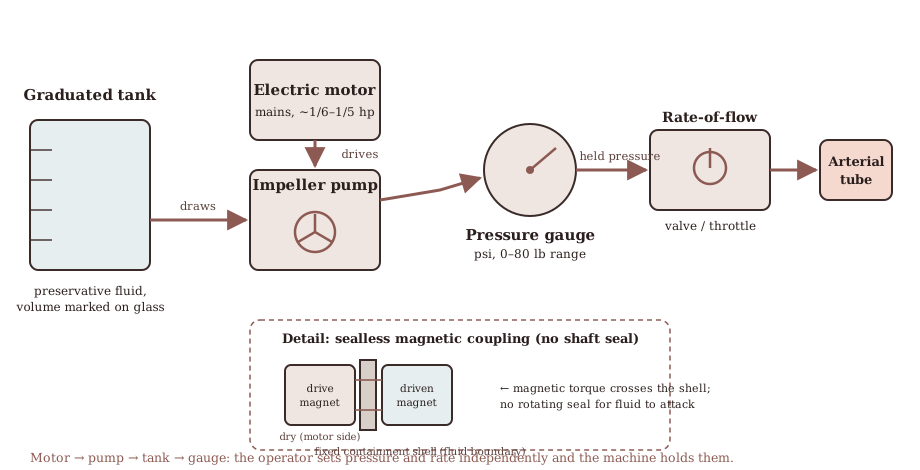
Trace the fluid from jar to artery and the machine’s logic falls out in order. The schematic above lays out the same path.
The graduated tank. A glass jar — 2.5 gallons on the smaller machines, about 3.25 to 3.5 gallons on the larger ones — holds the prepared preservative solution, its side marked so the operator can read how much has been delivered (Kelco Supply; MortuaryMall). Glass is not incidental: it lets the operator see the fluid and its level, and it resists the chemicals better than most metals — which is the same corrosion problem that dictates the pump design a few inches below.
The electric motor. A small fractional-horsepower motor — the Porti-Boy line runs roughly 1/6 hp on the Mark IV and 1/4 hp on the Mark V (Kelco Supply) — supplies the rotation. Nothing about it is exotic; the cleverness is in what sits between the motor and the fluid.
The pump. The motor spins the impeller, which draws fluid from the tank and raises it to pressure. Because it is rotodynamic, the pressure it produces is a function of impeller speed and how much the outlet is throttled — turn the flow control down and the pump “deadheads” up toward its maximum pressure; open it and pressure falls as flow rises. This inverse trade between pressure and flow is a basic property of centrifugal pumps and is why the machine gives the operator two controls rather than one.
The pressure gauge and the rate-of-flow control. The panel carries a pressure gauge reading in pounds per square inch — the maker sheet gives the Mark IV a range of about 45 to 60 psi and the Mark V about 80 to 100 psi, though retail listings quote lower ceilings (Kelco shows roughly 0 to 60 and 0 to 80 psi) (Turner Memorial; Kelco Supply) — and a separate rate-of-flow valve. The whole point of the electric machine, versus everything before it, is that these are independent and held: the operator dials a pressure and a rate and the machine maintains them without a hand on a bulb. (What pressures and rates are appropriate is a clinical judgement outside the scope of a hardware history; the engineering point is only that the machine decouples the two and holds each.)
The arterial tube. The pressurised fluid leaves through tubing to the arterial cannula — the delivery end that the earlier gravity and hand-pump dives share. From the machine’s side, this is just the load: a network of vessels presenting a certain flow resistance and back-pressure, which is exactly what the gauge is reading.
2.4 Why the pump has no shaft seal
Here is the detail that makes the electric machine a nicer piece of engineering than it first appears. In an ordinary motor-driven pump, the motor’s shaft has to pass through the wall of the pump chamber to spin the impeller, and that penetration must be sealed — a mechanical shaft seal or packing runs around the turning shaft to keep fluid in. That seal is a wear part, and it sits directly in the fluid.
Embalming preservative is, chemically, a hostile fluid — modern solutions are built around formaldehyde and related agents, and formaldehyde is described in industrial pumping guides as “highly corrosive and extremely volatile” (March Pump). A rotating seal exposed to it deteriorates, and once it degrades it becomes a leak path for a toxic, corrosive liquid — the worst possible failure in a device handled daily at close quarters. Industrial practice for pumping formaldehyde is unambiguous about the fix: use a sealless magnetic-drive pump, whose great advantage is that “no seal means no seal wear, no seal replacement, and critically, no leakage pathway” (March Pump).
The embalming-machine makers reached the same solution. In a magnetic drive, the motor spins an outer drive magnet; its field passes through a stationary, sealed containment shell and grips an inner driven magnet fixed to the impeller, spinning it without any physical shaft crossing the fluid boundary (the inset in the diagram shows this). The maker literature for the Porti-Boy states the result directly: the “state-of-the-art magnetic drive high speed pump has no seals and only one moving part,” a design that “eliminates problematic seals that would otherwise deteriorate when exposed to harsh embalming chemicals” (American Mortuary Coolers; Connecting Directors / MortuaryMall listing). The claim checks out against general pump engineering: the corrosion problem and the sealless answer are exactly why the wider chemical industry turned to magnetic drives for formaldehyde service, and the embalming machine is a small, domestic instance of that logic. It is the one place where the machine’s design is dictated by the chemistry of Dive 3’s fluid rather than by convenience — a connection that Vol 4 — When the Chemistry Changed picks up from the fluid side.
2.5 The return of the pulse
Having replaced the hand pump’s pulse with smooth centrifugal flow, the makers then spent electronics putting a pulse back. The pulsation feature — present on the Porti-Boy Mark V and absent on the Mark IV (MortuaryMall), and the defining upgrade of the Duotronic II generation covered in Vol 3 — modulates the delivery so that pressure rises and falls rhythmically instead of holding flat.
Why deliberately re-introduce the very thing the impeller was praised for eliminating? Because a steady pressure and an intermittent pressure distribute differently through a resistive, partly obstructed network. A rhythmic push can help open vascular beds and nudge fluid past minor restrictions that a constant head tends to simply dam up against; the trade literature credits pulsation with helping “overcome minor vascular restrictions” and promote “more uniform chemical distribution, particularly in difficult cases” (American Mortuary Coolers — Duotronic). In pump terms, a pulsed drive is a distribution and penetration aid, not a change in the total pressure available. It is genuinely useful, and it is genuinely modern: it required electronic control that the belt-and-motor machines of mid-century did not have.
2.6 What the engineering actually buys
The marketing frame is worth debunking plainly, in the house manner: state the claim, then the physics. The pulsator is universally sold as “mimicking the natural rhythm of a heartbeat” (American Mortuary Coolers). That is a good metaphor and a poor mechanism. The machine is not recreating circulation — there is no beating heart, no venous return, no autoregulation — and it does not need to. What actually helps is far simpler: an intermittent pressure profile penetrates a resistive network more evenly than a constant one, for the same reason a series of taps can seat something a steady shove will not. The “heartbeat” is a mnemonic for the waveform, nothing more.
The pressures involved make the point sharper. A living arterial system runs at roughly 120 mmHg at systole — about 2.3 psi (760 mmHg equals 14.7 psi). These machines make up to roughly 80–100 psi available at the gauge on the larger model — well over an order of magnitude above physiological pressure — which is precisely why the operator’s job is restraint, dialing in a small fraction of the range and holding it, not chasing a bigger number. The engineering value of the electric machine was never raw force; gravity and a hand pump could already exceed physiological pressure. It was control: a held pressure and a held rate, read off a dial, decoupled from the strength and rhythm of a human arm — with pulsation added back, on purpose, as a distribution refinement once electronics could provide it.
Everything in this volume is engineering and trade history, described at the level of the apparatus; none of it is a procedure. The point is simply that the pretty phrases in the catalog sit on top of ordinary, sound hydraulics — a rotodynamic pump, a sealless coupling forced by chemistry, and a deliberately modulated pressure waveform. This is the same discipline the sibling Violet Ray Wands dive in the Quack Devices wing applies to a very different object: keep the honest physics and strip the borrowed glamour.
2.7 Where this volume hands off
With the pump, the seal, and the pulse understood, the story turns to the makers who built them and the names collectors will meet. Vol 3 — The Makers and Their Machines traces the Porti-Boy line (the name a contraction of its original portable design), the Duotronic family and its electronically-controlled and pulsating generations, and their competitors — and pins down the contested dates this volume deliberately left to it. Vol 4 — When the Chemistry Changed closes the chemistry arc that this volume only touched: formaldehyde’s identification, its fixative action, and the regulatory ban on arsenical fluids — the fluid that dictated the sealless pump described here. Vol 5 — Collecting Electric Machines turns the engineering into condition cues: a seized impeller, a clouded or cracked tank jar, a dead gauge, and — the lesson of this volume — perished seals and old residue, which make a found machine a display piece rather than a working one.
Sources
- Beginner’s Guide to Buying a Portiboy Embalming Machine — American Mortuary Coolers — supported the magnetic-drive description (drive magnet, containment shell, driven magnet, “no seals and only one moving part”), the “eliminates seals that deteriorate when exposed to harsh embalming chemicals” rationale, the pulsator “mimics the natural rhythm of a heartbeat” phrasing, and Mark IV/Mark V pressure and tank figures. (Secondary trade blog; corroborated against the maker listing below.)
- Porti-Boy Embalming Machines — Kelco Supply and Porti-Boy Mark V — MortuaryMall, with Turner Memorial for the maker sheet — supported the ESCO model specs: on the maker sheet Mark IV ~45–60 psi / 2.5 gal / 1/6 hp and Mark V ~80–100 psi / ~3.25–3.5 gal / 1/4 hp, with retail listings (Kelco) quoting lower 0–60 / 0–80 psi ceilings; pulsation feature on Mark V and not Mark IV.
- Porti-Boy machines now on MortuaryMall — Connecting Directors — corroborated the ESCO “magnetic drive high speed pump… no seals and only one moving part” maker language.
- An Essential Guide to Duotronic Embalming Machines — American Mortuary Coolers — supported the pulsation-as-distribution-aid rationale (overcoming minor vascular restrictions, more uniform distribution) and the belt-driven-centrifugal / later magnetic-drive lineage. (Secondary; dates reserved for Vol 3.)
- Formaldehyde Pumps — March Pump — supported formaldehyde as “highly corrosive and extremely volatile,” why conventional shaft seals fail, and the sealless magnetic-drive answer (“no seal means no seal wear… no leakage pathway”); the general chemical-industry basis for the embalming pump’s design.
- Positive Displacement vs. Centrifugal Pumps — Castle Pumps, Michael Smith Engineers, RP Pumps, and DAE Pumps — supported the core engineering contrast: reciprocating positive-displacement pumps give pulsating flow; centrifugal (impeller) pumps give smooth, continuous flow, with pressure and flow inversely related.
- Cross-references (named in prose, not linked): the Hand Pump and Bulb Machines and Gravity Injection Systems dives (the reciprocating and hydrostatic antecedents), and the Violet Ray Wands dive in the Quack Devices wing (the same debunk-the-marketing discipline).
Comments (0)