Electric Embalming Machines · Volume 5
Collecting the Electric Machine Safely
How motorized embalming machines reach the estate-sale table, how to read and date one, how to grade its gauge, tank glass, motor and seals — and why the residue of a century of chemistry makes the safe posture display, not use.
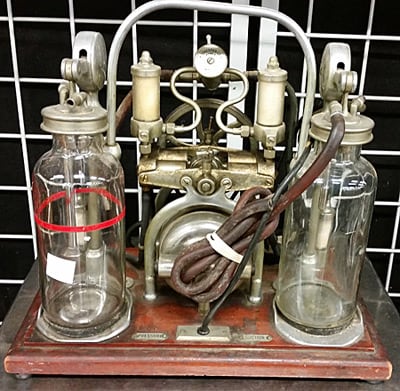
The end of this dive is the object on the shelf. Four volumes have described what an electric embalming machine is — a motor-driven pump feeding a graduated tank under a gauge — how it pumps, who built it, and the formaldehyde chemistry it was made to deliver. This closing volume is for the person who now owns one, or is about to bid on one: how these machines reach the market, how to read and date the cabinet in front of you, how to grade its condition, and — the load-bearing part — why the sensible thing to do with a surviving unit is very often not to run it.
Contents
5.1 About this volume
An electric embalming machine survives better than almost anything else in the funeral-trade field. It is a sealed metal cabinet built for a working shop: a cast-aluminium or stainless housing, a heavy glass tank, a small fractional-horsepower motor, and a pressure gauge on the front. Nothing about it is fragile in the way a blown-glass gravity bottle is, and unlike a rubber bulb syringe it has no perishable heart that rots away in a drawer. So they last, and they turn up — at funeral-home estate sales, at general auction, and increasingly in the private collections of people who keep “antique medical oddities.”
This is the last volume of the dive, and it assumes you have read the rest. It refers back rather than repeats. What the machine is and where it sits in the trade is Vol 1 — The Motorized Machine; why a centrifugal pump delivers a smooth continuous stream where a hand pump pulsed, and why later units use a seal-less magnetic drive, is the engineering of Vol 2 — Pumps, Pulsation, and Magnetic Drive; the makers and model lines — ESCO’s Porti-Boy, the Duotronic family, and their competitors — are catalogued in Vol 3 — The Makers and the Model Lines; and the formaldehyde chemistry the machine was built to push is Vol 4 — The Formaldehyde Era. Here we handle the object as a collectable: sourcing it, dating it, grading it, and making the safety case.
5.2 Where these machines surface
The supply is a by-product of the trade turning over its own equipment. When a funeral home closes, merges, or re-fits, its back-room hardware goes to auction, and the embalming machine goes with it. Listings for “Johnson Funeral Home Estate — Mortuary Furnishings & Equipment” and the like are a recurring auction category, and the machines that come out of them run from Edwardian hand-and-electric hybrids of around 1910 to plain post-war motorized units. Named period makers surface on the block — General Electric-badged units appear paired with a Penberthy aspirator and tubing — alongside the twentieth-century standard names traced in Vol 3.
One name that recurs on the block belongs in a different category entirely, and it is the best cautionary tale this dive has. C. M. Sorensen machines — a twin-cylinder pump and two large glass jars on a wooden base — are routinely catalogued and sold as antique embalming machines, at around $500. They are nothing of the kind. Sorensen’s own trade catalogue identifies the apparatus as an ear-nose-throat and anaesthesia outfit, and the numbers settle it: a 1/20 horsepower motor delivering 10–15 psi into an eight-ounce bottle is not arterial-injection equipment by any reading. The misattribution survives because the architecture is genuinely similar — a period air-pressure embalming machine really did pressurise a fluid bottle through a dip tube — so the shape reads right to an auctioneer who has no reason to look further. The full identification, with the catalogue page that proves it, is in C. M. Sorensen Pressure and Suction. The general lesson for a buyer in this field: an auction title is evidence that an object exists, not evidence of what it is.
Two things about that market are worth a collector’s attention. First, price is set far more by rarity, completeness, and story than by function: a photogenic early machine in its wooden case commands more than a sound but anonymous 1970s box. For scale, a new Porti-Boy Mark IV lists around $3,100 and a Mark V around $3,600 as of the mid-2020s, which anchors what a used working unit is worth against what an antique display piece is worth — they are two different markets. Second, these objects are sold to be looked at: auctioneers place an embalming machine alone on a glass counter, and the buyers are frequently medical-oddity and funeral-history collectors rather than working embalmers. The reference standard for the category is the recreated preparation-room tableau at the National Museum of Funeral History in Houston, whose equipment runs back to the early 1900s — the model for how these machines are properly displayed as history. If you add a specific machine to a wants list, the site’s daily-hunt “for sale” digest is the tool that watches the auction and marketplace feeds for it.
5.3 Reading and dating the machine
Read the maker’s plate and the materials before you trust a seller’s date. A moulded or riveted plate — ESCO (the Embalmers’ Supply Company, founded 13 April 1886 and at Westport, Connecticut from 1890), Edwards/Royal Bond’s Duotronic, or a competitor — fixes maker and rough era at a glance, and a model designation (Porti-Boy Mark IV or Mark V; Duotronic I through V) narrows it further against the maker table in Vol 3. ESCO’s own account puts the Porti-Boy name on a portable design; the company is generally said to have taken the line on around 1975, though that acquisition date rests on trade-supplier secondary pages and is best stated as approximate rather than documented from a primary record.
Absent a plate, the construction dates the machine within the electric era. Cast-aluminium cabinets with baked “nylon” or enamel finishes, stainless bases, and moulded plastic knobs are post-war; earlier electrified units carry more nickel-plated brass, wooden bases or cases, and glass reservoirs closer to their gravity-and-hand-pump ancestors. A centrifugal impeller driven by a small fractional-horsepower motor (ESCO’s current Mark IV uses a 1/6 hp motor, the Mark V a 1/4 hp) marks the mature electric machine; a belt-driven pump and a simple two-speed motor, as on the 1967 Duotronic I, marks an earlier electronic generation. The presence of a pulsation control — a deliberately re-introduced pulsed delivery to mimic a pulse — points to a Duotronic II or later, i.e. the late 1970s onward (see Vol 2 and Vol 3). None of these cues is a birth certificate; cross-check them against the model tables rather than trusting an optimistic listing.
5.4 Condition assessment
Grade the machine in the order of what a fault actually costs you, and — the recurring theme of this volume — grade it cold, without plugging it in. The diagram below marks the five points to work through.
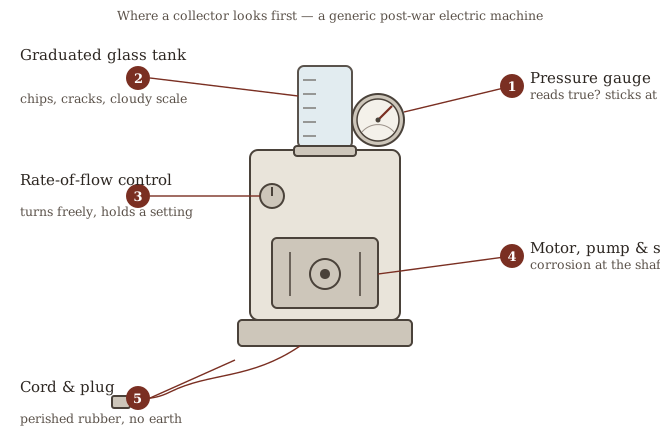
The pressure gauge. The machine’s one precision instrument and its most telling tell. A Bourdon-tube gauge that has sat under residual pressure, or dried fluid, for decades commonly reads high, sticks off zero, or has a fogged or corroded face. On a display piece a dead gauge is cosmetic; as evidence of how hard a life the machine had, a seized needle is worth noting. Do not judge a gauge by energising the pump to watch it move.
The graduated glass tank. Most electric machines meter fluid from a graduated glass reservoir (ESCO’s current tanks are 2.5 gallons on the Mark IV, 3.25 on the Mark V). Hold it to the light for chips at the rim, hairline cracks, and a cloudy or etched scale — old formaldehyde-and-additive fluids leave a haze and a mineral film that no longer wipes clean. A cracked tank is both a value problem and, if it ever held fluid, a containment problem.
The motor, pump, and seal. The heart of the machine, and the part Vol 2 explains was the industry’s chronic weak point: embalming chemicals attack conventional rotating shaft seals, which is precisely why modern ESCO machines advertise a magnetic-drive pump with “no seals” and effectively one moving part. On an older unit assume the seal has been chemically degraded and that the pump cavity and impeller carry corrosion and dried residue. Turn nothing over by powering it; if you must know whether the shaft is free, that is a job for someone servicing it on a bench, not a sale-table test.
The cord and plug. Nearly always the worst survivor. Mid-century rubber-and-cloth cordage goes brittle and crumbles, and older two-wire cords have no earth. Treat the original cord as unusable regardless of how sound it looks.
The case, cabinet, and completeness. Cosmetic but value-setting: corrosion of an aluminium casting, a rusted stainless base, missing knobs, a cracked tank cradle, a lost gauge bezel. A complete machine with its tank, gauge, knobs, and — best of all — its original maker’s plate and any instruction card is worth far more than a stripped hulk.
5.5 The hazardous-materials case: residue and old fluid
This is the part that separates an embalming machine from an old sewing machine, and it must be stated plainly: an electric embalming machine that has seen shop use is a chemical-residue object, not merely a mechanical one. Everything wet about it — the tank, the pump cavity, the internal tubing, the gauge’s pressure line — once carried concentrated preservative fluid, and a machine can arrive with old fluid still in it.
What that residue is matters. The concentrated fluids these machines pushed are formaldehyde-based: undiluted arterial concentrate runs to roughly 35–37% formaldehyde by volume, together with glutaraldehyde, methanol, phenols, and assorted humectants and dyes. Formaldehyde is a recognised human carcinogen and a potent respiratory, eye, and skin irritant and sensitiser; the U.S. occupational standard (OSHA 29 CFR 1910.1048) caps airborne exposure at a 0.75 ppm eight-hour average with a 2 ppm short-term limit and a 0.5 ppm action level — figures that convey how little vapour is considered acceptable. A sealed bottle of decades-old concentrate, or a slug of dried fluid liberated by rinsing a tank, is a genuine irritant-and-carcinogen exposure, not a curiosity. Dispose of any recovered fluid as hazardous waste, never down a drain; formaldehyde is toxic to aquatic life and does not belong in the sewer.
There is an older, heavier hazard on the earliest electrified and hybrid machines. Before Carl Dolge imported the first formaldehyde for fluid work around 1894 (the chemistry arc of Vol 4), and for some years after as stocks were used up, preservative fluids were built on arsenic, zinc, and mercury salts — preservative because toxic. A pre-1900-lineage machine, or one whose provenance is genuinely nineteenth-century, may carry arsenical or metallic-salt residue that does not evaporate and does not degrade; treat any crusted deposit in an early machine as a potential heavy-metal contaminant. The prudent posture across the board is the same: assume the wetted interior is contaminated, wear nitrile gloves and eye protection when handling a machine that has not been decontaminated, keep it out of the reach of children and pets, and do not eat, drink, or sand near it. This is documented caution, not instruction — the point is simply that the inside of the machine is the hazard, and the collector’s job is to leave it undisturbed and sealed.
5.6 Display, not use
Put the two arguments together — a degraded mains appliance with a corroded pump and a perished, unearthed cord, wrapped around a carcinogenic (and sometimes heavy-metal) chemical residue — and the conclusion writes itself. The safe and sensible treatment of a surviving electric embalming machine is to display it, not operate it. This volume therefore gives no operating, restoration-wiring, or fluid-handling procedure, and nothing that reads as instruction to run a machine on remains. There is no collector’s reason to energise one: the pump does nothing worth seeing that a caption cannot explain, and every reason to bring it to life — testing the gauge, hearing the motor — is exactly the action that disturbs the residue and stresses century-degraded insulation.
Displayed cold, the machine is a superb object and an honest one. Set it with its tank in place, gauge forward, maker’s plate legible, cord coiled and unplugged. Keep it dry (to spare the motor windings, the steel, and the gauge) and out of direct sun (which yellows plastics and fades enamel). If a wetted interior is suspected, have it professionally decontaminated and sealed before it goes on open display, and note that history on the label. Provenance is what turns a machine into a document: a funeral-home name, an auction lot record, a surviving instruction card or catalogue page ties the cabinet to the exact shop and decade it worked in. Photograph the plate, the gauge, and the tank; record where it came from. That record is the difference between “an old embalming machine” and a dated, attributed artefact of the twentieth-century funeral trade.
5.7 Where this volume hands off
This is the final volume of the Electric Embalming Machines dive. From here the sub-project branches to the two remaining corners of the undertaker’s technology. The complementary half of the process — the trocar and the water-powered hydro-aspirator used for cavity treatment — is the Trocars and Cavity Injection dive, where the same collecting-and-safety discipline applies to a different instrument. And the pre-refrigeration “furniture” that surrounded all of these machines — the perforated cooling boards and ice-packed corpse coolers that families relied on before, and alongside, embalming — is the Cooling Boards and Corpse Coolers dive. Each closes, as this one has, on the object a collector holds and how to read it safely. Readers who came to this dive from the electrical-quackery wing will find the same “unsafe antique mains appliance” posture argued for the handset in the Violet Ray Wands dive’s collecting volume — a useful companion, since both end on a plug best left in the drawer.
Sources
- Porti-Boy — Embalmers’ Supply Company (ESCO) and Porti-Boy Mark IV / Mark V at MortuaryMall — current model specifications used for condition benchmarks: magnetic-drive pump with “no seals and one moving part,” 2.5- and 3.25-gallon glass tanks, 1/6 and 1/4 hp motors, 45–60 and 80–100 psi ranges, polarized (two-wire) cords.
- Beginner’s Guide to Buying a Portiboy Embalming Machine — American Mortuary Coolers — new-machine pricing (Mark IV ≈ $3,100, Mark V ≈ $3,600) and the 10–15-year service-life claim used to separate the working-tool market from the display market.
- The Ultimate Guide to Choosing an Embalmers Supply Company — American Mortuary Coolers — the (secondary, hedged) claim that ESCO acquired the Porti-Boy line ~1975 and the “portable” name origin.
- ESCO’s History — Embalmers Supply Company (NJ distributor) — founding 13 April 1886 (Dolge & Huncke, Brooklyn), 1890 move to Westport CT, and Carl Dolge’s 1894 import of the first formaldehyde for fluid work; early arsenical fluids “there was no formaldehyde available until 1894.”
- An Essential Guide to Duotronic Embalming Machines — American Mortuary Coolers — Duotronic I (1967, Edwards Equipment, St. Louis; ½ hp two-speed belt-driven centrifugal pump, ~30 psi) and the later addition of pulsation on the Duotronic II; used for the dating cues.
- Controlling Formaldehyde Exposures During Embalming — NIOSH / CDC (Hazard Control 26) and the OSHA formaldehyde standard, 29 CFR 1910.1048 — the 0.75 ppm 8-hr PEL, 2 ppm STEL, and 0.5 ppm action level cited for the residue hazard.
- Formaldehyde exposure hazards (The Champion Company, PDF) and Risks of Formaldehyde for Embalmers — Vodex — concentrated arterial fluid ~35–37% formaldehyde plus glutaraldehyde/methanol/phenols; carcinogen and sensitiser classification; environmental toxicity supporting the “hazardous-waste, not the drain” disposal note.
- Antique embalming machine that’s unnerving — Auction Finds — an ~1910 Edwardian machine in a private “antique medical oddities” collection, illustrating the private-collector market.
- Antique C. M. Sorensen Embalming Machine — Bodnar’s Auction and Antique General Electric Embalming Machine with Penberthy Aspirator — Auctionninja — named makers on the auction block, and the ~$500 price point for the Sorensen. ⚠ The Bodnar’s lot title is wrong: the Sorensen is not an embalming machine. Cited here as an example of the mislabelling, not as a maker attribution.
- 1926 Catalog of Sorensen Tankless Apparatus — Internet Archive — the maker’s own catalogue: 48 pages of ear-nose-throat, anaesthesia and minor-surgical apparatus, zero mortuary references. The 1/20 hp motor, the 10–15 psi, and the 8-oz ether bottle that rule out arterial injection.
- National Museum of Funeral History — History of Embalming — the recreated preparation-room tableau as the reference standard for displaying this equipment as history.
Comments (0)