Electric Embalming Machines · Volume 3
Porti-Boy, Duotronic, and the Maker Lineage
How two long-lived American machines — ESCO's portable Porti-Boy and the electronically controlled Duotronic — standardised in the 20th century what gravity bottles and hand pumps had done by hand, and how a collector reads a maker's badge to place a surviving unit in that lineage.
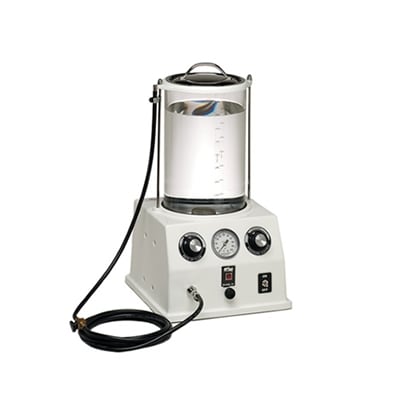
Where Vol 1 — The Motorized Machine introduced the electric embalming machine as an object and Vol 2 — The Engineering took apart its fluid mechanics — centrifugal versus reciprocating delivery, the electronic re-introduction of pulsation, and the magnetically coupled impeller — this volume is about the firms and their models. Two American machines outlived every rival and became the archetypes a modern preparation room still recognises: the Porti-Boy and the Duotronic. Their story is the 20th-century standardisation of functions that the Gravity Injection Systems and the Hand Pump and Bulb Machines dives handled by hydrostatic head and by muscle.
3.1 About this volume
The electric arterial machine did not introduce a new idea; it packaged an old one. Everything the operator wanted — a chosen pressure, a chosen rate of flow, held steady and reproducible — had been available in principle since the gravity bottle, but only awkwardly, and only for as long as an arm or a column of fluid could hold it. What the motorised machine did was make those two quantities into dial settings. This volume traces that packaging through the two firms whose products defined it, then situates their competitors and hands the collector a practical way to read a surviving badge.
The register here is trade and engineering history, not procedure. Nothing below describes work performed on remains; the subject is the apparatus, its makers, and its marks. The deep pump physics stays in Vol 2; the closing of the chemistry arc — formaldehyde and the fluids these machines pushed — is the business of Vol 4 — The Formaldehyde Era; the hands-on condition, hazardous-residue, and display cautions belong to Vol 5 — Collecting Electric Machines Safely. Where a date or a corporate lineage is genuinely uncertain — and in a trade documented mostly by supply catalogs and dealer listings, several are — this volume says so rather than inventing precision.
3.2 What the machine standardised
A gravity outfit gives pressure as a function of height: roughly 0.43 psi per foot of fluid column, so a bottle a few feet up delivers only single-digit psi, and that pressure sags as the bottle empties. A hand or bulb pump lets the operator push harder, but the pressure pulses with the stroke and the rate is whatever the hand happens to deliver. The two quantities are tangled together and neither is repeatable.
The electric machine untangles them. A motor-driven pump — classically a centrifugal impeller, which delivers a smooth continuous stream rather than the slugs of a reciprocating pump — feeds a graduated tank, and the panel carries a pressure gauge in psi and a separate rate-of-flow control. The operator sets a pressure and a rate and the machine holds both, independent of fatigue and independent of how full the tank is. That reproducibility is the entire advance; it is why a mid-century preparation room could specify a treatment in numbers where a Civil-War operator could only raise or lower a bottle. The contrast between continuous centrifugal delivery and the deliberately pulsed delivery that later machines re-introduced electronically is drawn in full in Vol 2; this volume is concerned with who built the cabinets around that idea.
3.3 The Porti-Boy: from a portable Turner box to the ESCO bench standard
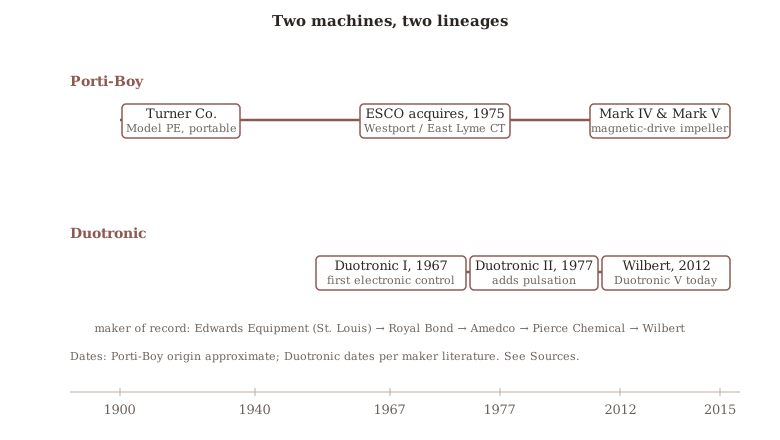
The name is a literal description. The Porti-Boy began as a portable machine — a self-contained box an embalmer could carry to a home or a distant town, the same itinerant use-case that had earlier justified the folding cooling board treated in the Cooling Boards and Corpse Coolers dive. The earliest units were made not by its famous later owner but by the Turner Company, whose “Model PE” Porti-Boy survives as a genuine antique with a glass top; these are the machines that turn up in dealer listings as the original portable design.
In 1975 the Porti-Boy line was purchased by the Embalmers’ Supply Company (ESCO) and folded into that firm’s catalog. ESCO itself is the oldest name in the American trade: founded on 13 April 1886 in Brooklyn as a partnership between the German-born inventor Carl B. Dolge and the pharmacist Max Huncke, moved to Westport, Connecticut, in 1890, incorporated under its present name after Huncke was bought out in 1893, and later relocated within Connecticut to East Lyme. (ESCO’s other and older claim to fame — Dolge importing the first formaldehyde for embalming fluid in 1894 — belongs to the chemistry arc of Vol 4, and the firm’s founding as the first American instrument house is the subject of the Hand Pump and Bulb Machines dive.) By taking over the Porti-Boy, this long-established supply house put its distribution behind a machine that would become, on the makers’ own count, one with “tens of thousands of units in service worldwide.”
The modern line runs to the Mark IV and Mark V. Both are built around a magnetic-drive pump: the motor turns a magnet that couples across a sealed wall to drive the impeller, so there is no shaft seal to be eaten by embalming chemicals and, in the maker’s phrase, “no seals and only one moving part.” That engineering choice — magnetic coupling precisely because arterial fluids destroy conventional seals — is the detail Vol 2 treats as a general principle; here it is the Porti-Boy’s headline feature. The two current models are distinguished mainly by capacity and pressure ceiling: the Mark IV is the smaller-tank, lower-pressure unit and the Mark V the larger-tank, higher-pressure one, with the Mark V adding a finer electronic pulsator and control panel. The exact numbers vary between the maker’s sheet and individual retail listings — figures for the Mark IV’s ceiling range from roughly 60 to 80 psi across sources, and tank capacities from about 2½ to 3½ gallons — so a collector should read the plate and the gauge on the actual unit rather than trust a catalog quotation.
3.4 The Duotronic: electronic control, then a mechanical pulse
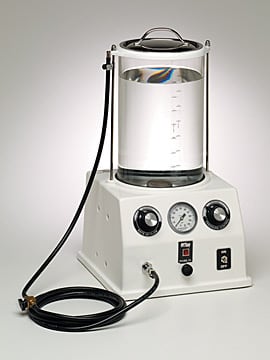
If the Porti-Boy is the portable survivor, the Duotronic is the machine that made electronic control the selling point — and its 50-year run is unusually well dated because the maker celebrated it. The Duotronic I was introduced in 1967 by Edwards Equipment of St. Louis, Missouri. Edwards was not an independent house but a subsidiary created by the chemical firm Royal Bond, Inc. to handle equipment while Royal Bond made fluids; the name “Edwards” is reported to be the maiden name of the wife of one of Royal Bond’s owners, Argo Landau. The first Duotronic paired a ½-horsepower two-speed motor with a belt-driven centrifugal pump delivering up to about 30 psi, a stainless-steel case, and a clear Pyrex tank, and it was marketed as the funeral trade’s first electronically controlled embalming machine. The “50-years” framing is corroborated independently: an American Funeral Director feature of April 2017 ran under the title “Still Nifty at 50,” and a gold-plated 50th-anniversary unit was raffled for charity that same year — both fixing the introduction firmly at 1967.
A decade later the Duotronic II (about 1977) added the feature that most distinguishes the family: pulsation. Rather than a single steady pressure, the machine could deliver the fluid in a rhythmic pulse — marketing described it as mimicking a heartbeat — the electronic re-introduction of the very pulsing that centrifugal pumping had smoothed away, on the theory that intermittent pressure distributes fluid more evenly and helps clear minor arterial resistance. The physics of why a pulse can aid distribution is argued in Vol 2; the point here is that pulsation entered the trade as a named model feature in 1977, not as an original property of electric machines.
The Duotronic’s later history is a chain of corporate hand-offs that a collector will meet on the badge: from Edwards to parent Royal Bond, then to Amedco, a long tenure with Pierce Chemical, and finally to Wilbert Funeral Services in 2012, which builds the current Duotronic V. Secondary trade sources also describe intermediate models — a magnetic-drive Duotronic III of the early 1980s and positive-displacement, high-pressure Duotronic IV and V units in the 2000s and 2010s — but those middle dates and specifications come from retailer and blog summaries rather than the maker’s own anniversary account, and should be treated as indicative rather than settled.
3.5 The rivals and the wider trade
Around these two archetypes sat a small field of competitors, most of them fluid companies that also sold a machine — the same integration of chemicals and hardware that created Edwards in the first place. The Dodge Company, one of the largest American fluid houses, distributes Duotronic machines rather than a wholly separate line. Pierce Chemical carried the Duotronic through its Pierce-branded years and sells machines under its own name. Frigid Fluid Company of Northlake, Illinois — a family firm advertising “five generations” of manufacture — makes the Frigid embalming machine, whose distinguishing marketing claim is that it can inject the harshest products, “even phenols and high-index cavity fluids,” that the maker says the Duotronic, Porti-Boy, and Dodge machines are not built to handle. Hepburn (Hepburn/Superior) is another recognisable preparation-room name. The lesson for the collector is the same one the Violet Ray Wands dive draws for that crowded trade: a machine’s brand often names a chemical company or a distributor, not the actual builder, and the two need not be the same firm.
It is worth being plain that, unlike the apparatus in the Quack-Devices wing, none of this is fraud. An electric embalming machine does exactly and only what it claims — hold a set pressure and rate — and the marketing contests here are ordinary engineering rivalries (pulsation, chemical compatibility, pump type) rather than the physiological over-promises that the High Frequency Currents and violet-ray stories turn on. The one claim to weigh critically is the pulsation-versus-pressure argument: pulsation is a genuine aid to distribution in some cases, but the “gentle heartbeat” language is trade copy, and steady centrifugal pressure remained perfectly standard throughout. Where a maker asserts a hard number — a psi ceiling, a horsepower — it is describing the pump, and, as noted, those numbers drift between the factory sheet and the resale listing.
3.6 Reading the lineage: what a badge tells a collector
Because these machines were durable capital goods rather than throwaway consumer items, identification is usually straightforward where the plate survives — and the plate is the whole game.
The maker’s name places the machine in one of the two lines. A Turner badge marks an early, genuinely antique portable Porti-Boy predating the 1975 ESCO acquisition; an ESCO / Embalmers’ Supply Company plate with a Mark IV or Mark V designation is the modern Porti-Boy. A Duotronic unit can be dated in bands by its maker of record — Edwards or Royal Bond for the earliest, then Amedco, then Pierce Chemical, then Wilbert (2012 onward) — so the company name cast or printed on the case is itself a rough date stamp, in the same way a Detroit versus Marion address dates a violet-ray set in the Violet Ray Wands dive.
The pump and drive corroborate the era. A belt-driven centrifugal unit points to an early Duotronic; a magnetic-drive, sealless pump (“one moving part”) points to a modern Porti-Boy or a later Duotronic. A pulsation control is a post-1977 feature and rules out the first-generation machines.
The tank and panel refine it. Graduated glass or Pyrex tanks, the style of the pressure gauge, and whether the rate control is a simple valve or an electronic regulator all track the shift from mid-century electromechanical panels to modern digital displays (Frigid’s dual digital readouts being the far end of that trend). None of these alone dates a machine; together they place it. As with every object in this collection, the disciplined entry records what the plate actually says, notes the pump type and pulsation capability, and stops short of promoting a distributor’s brand into a manufacturer.
3.7 Where this volume hands off
With the makers and models in hand, the arc turns to the fluid these machines were built to push. Vol 4 — The Formaldehyde Era closes the chemistry story: Hofmann’s 1867 identification of formaldehyde, Blum’s 1893 discovery of its hardening action, ESCO/Dolge importing the first formaldehyde for fluid work about 1894, and the early-1900s laws against arsenical fluids that drove the switch — the electric machine and formaldehyde fluid together defining modern arterial embalming. The physical follow-through — how to recognise, date, and safely handle a Turner Porti-Boy or an early Duotronic pulled from an estate sale, and why old residue is a hazardous-materials concern to display rather than run — is the subject of Vol 5 — Collecting Electric Machines Safely.
Sources
- Porti-Boy — ESCO / Embalmers’ Supply Company — maker’s own product line: Mark IV and Mark V, the magnetic-drive “no seals, one moving part” pump, and ESCO’s 1886 origin.
- Porti-Boy Embalming Machines from The Embalmers’ Supply Company — Connecting Directors — ESCO history (since 1886, Canadian division since 1931), the two Porti-Boy models, magnetic-drive pump, and “tens of thousands of units in service worldwide.”
- Beginner’s Guide to Buying a Porti-Boy Embalming Machine — American Mortuary Cooler — the name from the original portable design, magnetic coupling of the impeller, and Mark IV / Mark V specs (used cautiously; a retail guide, not a museum source).
- The Ultimate Guide to Choosing an Embalmers Supply Company — American Mortuary Cooler and the Turner “Model PE” Porti-Boy resale record — the Turner Company as the original maker and ESCO’s 1975 acquisition (dealer/secondary; the pre-1975 detail is the least firmly documented claim here).
- An Essential Guide to Duotronic Embalming Machines — American Mortuary Cooler — Duotronic I (1967) by Edwards Equipment of St. Louis; the Edwards/Royal Bond relationship and the “Edwards” name; Duotronic II (1977) pulsation; the Edwards → Royal Bond → Amedco → Pierce → Wilbert (2012) ownership chain and the later Duotronic III–V models (middle dates/specs indicative, from a trade blog).
- Duotronic “Still Nifty at 50” — American Funeral Director, April 2017 (Wilbert) and 50th-Anniversary Gold-Plated Duotronic raffle — Connecting Directors — independently fix the Duotronic’s introduction at 1967 (50 years before 2017) and confirm Wilbert as current maker.
- ESCO company history summary — Embalmers’ Supply Company — founding 13 April 1886 (Dolge & Huncke, Brooklyn), Westport CT 1890, incorporation 1893, formaldehyde import 1894 (the formaldehyde detail belongs to Vol 4; used here only to place ESCO).
- The Frigid Embalming Machine — Frigid Fluid Company — the Northlake, IL maker’s “five generations,” dual digital pressure/flow displays, and the phenol / high-index cavity-fluid injection claim distinguishing it from Duotronic, Porti-Boy, and Dodge machines.
- Mopec — Embalming Machines and Kelco Supply — Porti-Boy / Duotronic — current retail listings used to cross-check model names and the general spec ranges (treated as indicative, since figures vary between listings).
Comments (0)