Early Electroconvulsive Therapy · Volume 4
From the Convulsion to the Consent Form
How a violent, unmodified procedure of 1938 became modern electroconvulsive therapy — the mid-century addition of muscle relaxants and general anaesthesia, the shift from sine-wave to brief-pulse stimuli and refined electrode placement, and the arrival of monitoring, informed consent, and regulation. History, not how-to.
Contents
4.1 About this volume
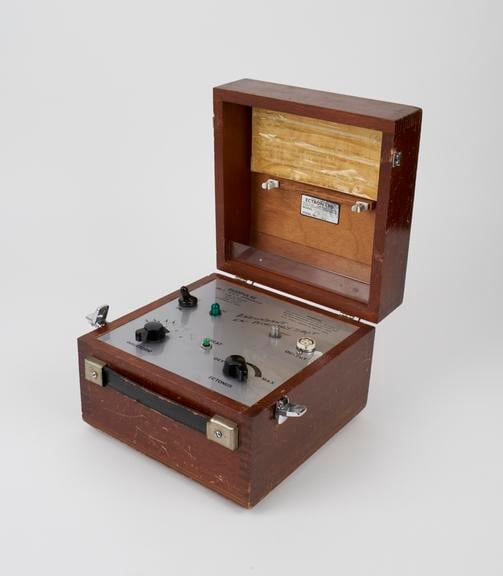
The three volumes before this one told the origin story of electroconvulsive therapy as an event and an object: the convulsive-therapy context that preceded it (Vol 1 — Before the Current), the first human treatment in Rome on 21 April 1938 and Lucio Bini’s apparatus as a milestone (Vol 2 — The First Treatment and the Machine), and the surviving Cerletti–Bini prototype in its museum afterlife (Vol 3 — The Prototype and Its Museum Life). The subject here is the seventy-year distance between that 1938 procedure and the treatment a psychiatric department administers today. It is a history of modification — of the deliberate, incremental changes that turned a raw physical event into a controlled, consented, monitored medical procedure.
Two disciplines govern what follows. The first is factual: every date and attribution in this field is easy to garble, so where a claim rests on a single secondary account it is flagged in the prose. The second is more important. This volume contains no operating detail of any kind — no settings, no dosing, no parameters, nothing a reader could act on. It describes an evolution in medical practice at the level of history and principle. It is not, and must not be read as, a description of how the procedure is performed.
4.2 What modern ECT is — stated plainly
Before any history, the present tense. Modern electroconvulsive therapy is a legitimate, regulated, evidence-based psychiatric treatment, administered only with the patient’s informed consent (or, where a patient cannot consent, under specific legal safeguards), under general anaesthesia and with a muscle relaxant, with the patient’s heart, breathing, and oxygenation continuously monitored by an anaesthetic team. It is reserved for a small number of severe, sometimes life-threatening conditions — most established in severe depressive illness that has not responded to other treatment or that threatens life through suicide risk or refusal of food and fluids, and in catatonia and prolonged, severe manic episodes. Guidance from bodies such as the United Kingdom’s National Institute for Health and Care Excellence (NICE) restricts it to achieving rapid, short-term improvement of severe symptoms after other options have failed or when the illness is life-threatening, and explicitly does not recommend it for moderate depression.
Everything in this volume — the paralysing agents, the anaesthetic, the changed waveform, the consent form — exists because clinicians spent decades removing the very features that made the original procedure frightening and dangerous. The stigma that survives in the culture attaches to the 1938 version; the treatment that survives in medicine is a different thing. (The cultural half of that story — how film and fiction fixed the old image in the public mind — is the subject of Vol 5 — Perception and Clinical Reality.)
4.3 The unmodified procedure and its real hazard
The technique Ugo Cerletti and Lucio Bini demonstrated in 1938 induced a generalised seizure directly, with the patient conscious until the current took effect and neither anaesthetised nor chemically relaxed. The therapeutic target was the seizure itself; the convulsion of the whole body was an unwanted by-product of it.
That convulsion carried a real, physical risk that has nothing to do with the era’s marketing exaggerations and everything to do with mechanics. When every large muscle group in the body contracts at once, with great force and against itself, the skeleton is loaded in ways ordinary movement never produces. The recognised complications of unmodified treatment therefore included fractures and dislocations, classically of the long bones and of the spine and hip — injuries caused not by the electricity but by the strength of the muscular contraction it triggered. This is the concrete problem the next two decades of modification set out to solve: not to make the seizure milder in the brain, where its therapeutic action was thought to lie, but to stop the body from injuring itself while it happened.
4.4 Curare: softening the convulsion
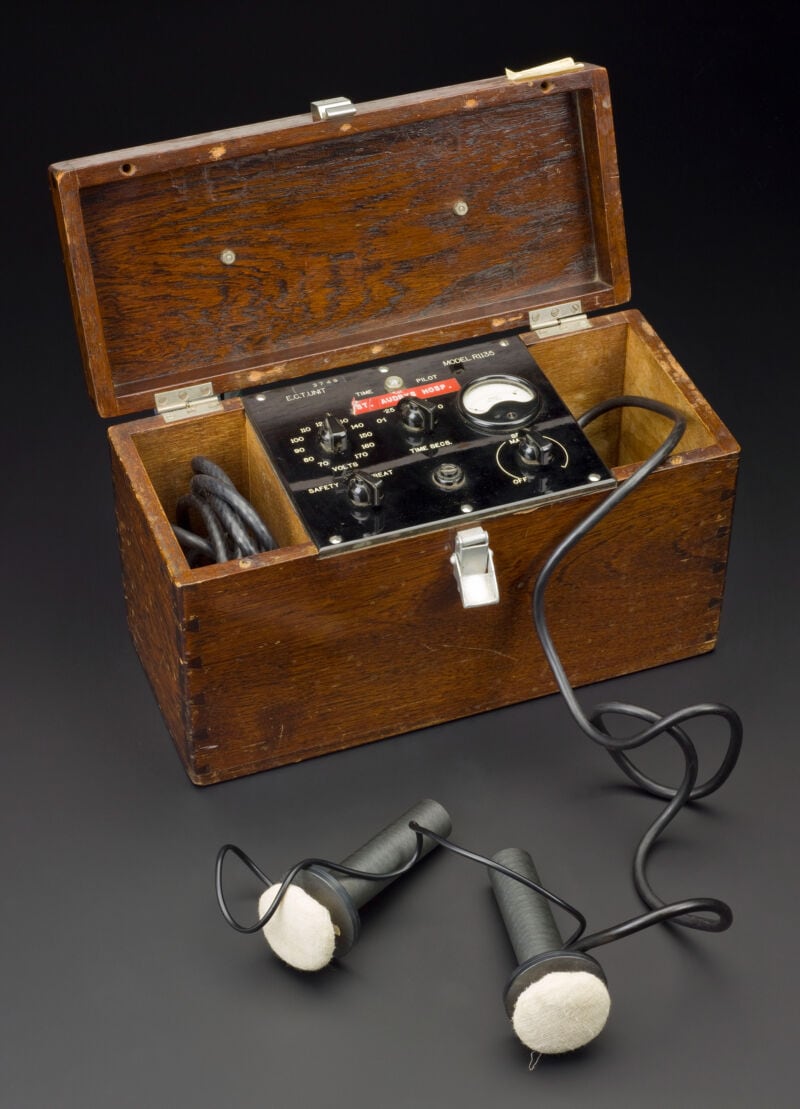
The first modification attacked the muscular contraction chemically. The agent was curare, the South American arrow poison whose active principle blocks transmission at the junction between nerve and muscle, producing flaccid paralysis without touching consciousness. The American psychiatrist Abram Elting Bennett is generally credited with introducing curarised — “modified” — convulsive therapy around 1940, specifically to reduce the fracture and dislocation complications; he is reported to have presented a film on the method at the American Medical Association’s annual session in June 1940. (Verification note: the 1940 date and the AMA film presentation are consistently reported across secondary histories of ECT but were not confirmed against a primary source in this pass; treat the year as reliably attributed rather than primary-verified.)
Curare worked in principle but was awkward and hazardous in practice. Crude preparations were difficult to standardise, the depth and duration of paralysis were hard to predict, and paralysing a conscious patient’s respiratory muscles is intrinsically dangerous. Curare proved the concept — that the seizure and the whole-body convulsion could be separated, the therapeutic event kept and the injurious one suppressed — but it was not the agent that would make modification routine.
4.5 Anaesthesia and succinylcholine: the birth of “modified” ECT
Two changes in the early 1950s converted the idea into standard practice.
The first was a better muscle relaxant. Succinylcholine (suxamethonium), a short-acting synthetic depolarising agent, was introduced clinically around 1951 as a far more controllable alternative to curare, and was applied to convulsive therapy shortly afterward — the report by Holmberg and Thesleff describing its use in electroshock treatment appeared in 1952. Its profound but brief action gave clinicians a paralysis that came on quickly and wore off in minutes, greatly reducing the fracture risk without the long, unpredictable paralysis of curare. (Verification note: succinylcholine’s clinical introduction is variously dated 1951–1952 across sources, with several national groups reporting it near-simultaneously; the Holmberg–Thesleff 1952 paper is the attribution usually given for its specific application to ECT. The precise priority is genuinely contested — treat “early 1950s” as firm and the exact year and first-user as approximate.)
The second change was general anaesthesia. Paralysing the breathing muscles of an awake person produces the terrifying sensation of suffocation; giving a short-acting general anaesthetic before the relaxant spared the patient that experience entirely, rendering them unconscious for the whole procedure. The combination — brief general anaesthetic plus short-acting muscle relaxant, with the anaesthetist supporting the patient’s breathing throughout — is what the term “modified ECT” denotes, and it is the form the treatment has taken ever since.
Adoption was rapid where it mattered. By the mid-1950s most hospitals in Britain routinely used modified ECT, though for a time a minority continued to give unmodified treatment or gave a relaxant without an anaesthetic. A widely cited catalyst on the British side was a 1957 legal case in which a patient suffered bilateral hip fractures from unmodified treatment, which sharpened the debate and hastened the abandonment of the unmodified technique. (Verification note: the 1957 case is repeated in histories of UK ECT but its citation details were not independently confirmed here.) What had been an experimental refinement in 1940 was, within a generation, the standard of care.
4.6 Refining the stimulus: sine wave to brief pulse, and where the electrodes go
Modification made the procedure safe for the body; a parallel line of refinement addressed its effect on memory, the side effect that has always mattered most to patients and that most shaped the treatment’s reputation.
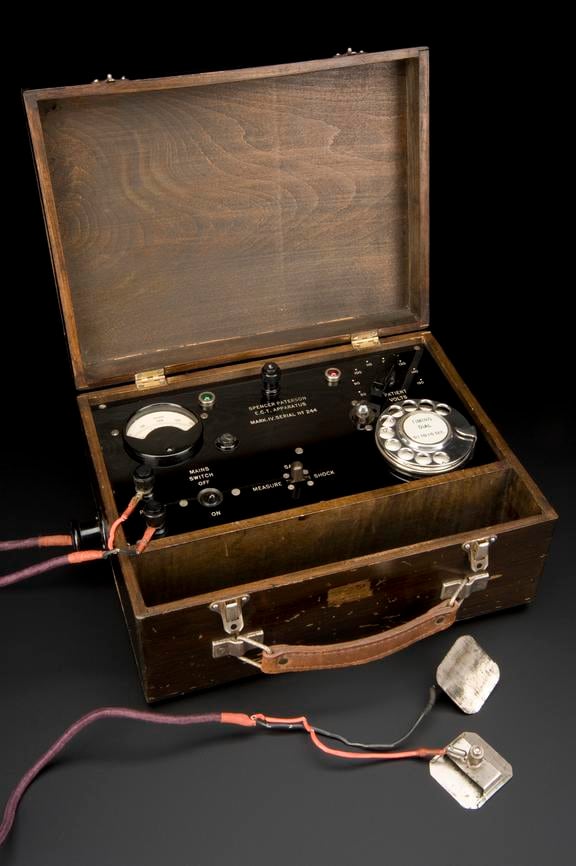
The earliest machines, Bini’s included, used an ordinary sine-wave alternating current — the continuous waveform of mains electricity. From the 1940s onward, investigators experimented with brief-pulse stimuli: instead of a continuous wave, a train of short rectangular pulses separated by gaps. The physiological insight behind the change is that a nerve cell is efficiently stimulated by a brief rising edge of current, while the long tail of a sine wave delivers a great deal of additional electrical energy that does little to trigger the seizure and much to burden the brain. A brief-pulse stimulus can therefore induce the same therapeutic seizure with substantially less total electrical energy — figures on the order of a third of that required by the old sine wave are commonly cited — and that reduction in delivered energy is associated with less memory impairment. Brief-pulse (and later ultra-brief-pulse) stimuli progressively displaced the sine wave over the second half of the twentieth century, and modern apparatus does not use the original continuous waveform at all. (Verification note: the “roughly one-third the energy” comparison is drawn from clinical literature and is presented here as an order-of-magnitude historical claim, not a specification.)
The second refinement was electrode placement. The original technique placed one electrode on each side of the head (bilateral, or bitemporal, placement). From the 1950s, clinicians investigated unilateral placement, with both electrodes over one side, and found — right-sided unilateral placement in particular — that it produced less memory disturbance than bilateral placement, at some trade-off in speed of response that later work sought to balance. The history here is one of continual calibration: the field has spent seventy years adjusting waveform, placement, and stimulus to keep the therapeutic benefit while shrinking the cognitive cost. None of those adjustments is described in this volume as a setting; the point is only that the modern procedure is a heavily refined descendant of the 1938 one, not the same act with better anaesthesia.
This is also where the electrotherapy family tree is worth a glance. The instruments of these sibling dives — the faradic and galvanic “medical batteries” of the Faradic and Galvanic Machines dive, the high-frequency apparatus of High Frequency Currents, the Diathermy Machines — all pass current through the body for a physical effect, but ECT is categorically different: it uses an electrical stimulus solely to induce a controlled seizure, and its therapeutic action lies in that seizure, not in the current’s direct effect on tissue. And it sits at the opposite pole from the cure-all electrical gadgets of the Quack wing — the Violet Ray Wands and Electropathic Belts — whose sellers promised the earth and delivered a tingle. ECT delivers a genuine, sometimes dramatic clinical effect in a narrow set of severe illnesses, which is precisely why it survived scrutiny that the cure-alls did not.
4.7 Consent, monitoring, and regulation
The clinical modifications were matched by an ethical and legal transformation that is, if anything, the more profound change. The 1938 procedure took place in a therapeutic culture with few of the safeguards now considered mandatory. Modern practice is built on three of them.
Informed consent. A competent patient must be given an accurate account of what the treatment involves, its intended benefits, and its risks — memory effects prominent among them — and must freely agree, in the ordinary way that any medical procedure requires. Guidance bodies specifically recommend written patient-information materials to support that decision. Where a patient lacks the capacity to consent, treatment proceeds only under defined legal frameworks and independent safeguards rather than on a clinician’s say-so.
Monitoring. Because the modern procedure is conducted under general anaesthesia with a muscle relaxant, it is carried out by an anaesthetic team with the continuous physiological monitoring that any brief anaesthetic demands — of heart rhythm, blood pressure, and oxygenation — together with recording of the seizure to confirm the treatment had its intended effect.
Regulation and audit. ECT is governed by national clinical guidance and, in many jurisdictions, by device regulators and formal accreditation and audit of the services that provide it. The treatment is no longer at the discretion of an individual practitioner; it operates inside a documented framework of indications, standards, and outside review.
4.8 What the evidence supports today
Held against that framework, the sober clinical position is narrow and well-attested. In severe depressive illness that has resisted other treatment or that threatens life, ECT is one of the more effective interventions available, capable of producing rapid improvement when speed matters most; it also has an established place in catatonia and in severe, prolonged mania. Contemporary guidance frames it as a treatment for a small group of severe presentations, not a general or first-line therapy, and audited outcomes report that a substantial majority of treated patients are much or very much improved by the end of a course. Its principal recognised adverse effect remains memory disturbance, which is exactly why the waveform and placement refinements above were pursued and why reducing cognitive cost remains an explicit clinical goal. (Verification note: reported response rates vary by indication, cohort, and outcome measure; the figures cited in national audits should be read as service-level outcomes, not guarantees.)
That is the whole of the honest account: a real, effective, tightly-indicated treatment for severe illness, carrying a real side effect that the field openly acknowledges and continually works to minimise. It is neither the miracle its earliest enthusiasts hoped for nor the barbarity its cultural image insists on — a distinction this dive’s final volume takes up directly.
4.9 Where this volume hands off
This volume traced the practice from the unmodified convulsion of 1938 to the consented, anaesthetised, monitored, and regulated treatment of today, through curare, succinylcholine and anaesthesia, the sine-wave-to-brief-pulse shift, refined placement, and the arrival of consent and oversight. The gap that remains is between that clinical reality and the treatment’s public image — an image formed largely from the pre-modification era and fixed in place by film and literature. Vol 5 — Perception and Clinical Reality treats that gap as a history of perception: how the culture came to picture ECT, why the picture lagged the medicine by decades, and where the apparatus itself now lives — as catalogued objects in the medical museums whose collections this dive has drawn on throughout.
Sources
- History of electroconvulsive therapy in the United Kingdom — Wikipedia; the curare / Bennett modification, succinylcholine’s 1951 introduction, the addition of a short-acting anaesthetic, the mid-1950s routine adoption of modified ECT, and the 1957 legal case that hastened abandonment of unmodified treatment. Secondary; the primary-source details are flagged in the prose for an accuracy reviewer.
- History of electroconvulsive therapy in the United States — Wikipedia; parallel account of modification, waveform, and placement developments in US practice.
- A Brief History of Electroconvulsive Therapy — American Journal of Psychiatry Residents’ Journal (2020); the Holmberg and Thesleff (1952) attribution for succinylcholine in ECT and the broader modernisation timeline. (Publisher page was access-restricted in this pass; used via search abstract.)
- Suxamethonium chloride — Wikipedia; the early-1950s clinical introduction of succinylcholine and its short-acting depolarising action, supporting the “modified ECT” account.
- ECT and memory: brief pulse versus sine wave — Weiner et al., American Journal of Psychiatry (1986); evidence that brief-pulse stimuli and unilateral placement reduce memory impairment relative to sine-wave and bilateral treatment.
- Overview — Guidance on the use of electroconvulsive therapy — National Institute for Health and Care Excellence (NICE), technology appraisal TA59; the restriction of ECT to severe depression, catatonia, and prolonged/severe mania, its exclusion from moderate depression, and the informed-consent and patient-information framing.
- Electroconvulsive therapy (ECT) — Royal College of Psychiatrists; modern ECT as an anaesthetised, consented, monitored treatment and its audited effectiveness (public-information landing page).
- Electroconvulsive therapy — Wikipedia; the fracture/dislocation hazard of unmodified treatment, the modification measures, and the modern indications and consent framework, cross-checked against the guidance sources above.
Comments (0)