Early Electroconvulsive Therapy · Volume 2
The First Treatment and the Machine as Milestone
April 1938 in Rome, the patent that followed, and the boxy cased instrument that Lucio Bini built — described as a historical object and a turning point, not as anything to operate.
2.1 About this volume
Vol 1 — Where This Came From established the setting: by the mid-1930s psychiatry already possessed convulsive therapies — Ladislas Meduna’s chemically-induced seizures using cardiazol (metrazol), and the insulin-coma work of the same era — and Ugo Cerletti and Lucio Bini, at the Clinic for Nervous and Mental Diseases of La Sapienza University in Rome, were looking for a more controllable, electrical way to induce a therapeutic seizure. This volume is about the moment that search produced a result, and about the physical object that carried it.
Before anything else, the necessary framing. Modern electroconvulsive therapy is a legitimate, regulated, evidence-based psychiatric treatment for a small number of specific and severe conditions. As practised today it is administered under general anaesthesia, with muscle relaxants, monitoring, and informed consent — the evolution that Vol 4 — The Road to Modern Practice traces. This volume is medical history: it describes a 1938 apparatus as a milestone and as a museum artefact, and it contains no operating detail, no settings, and nothing a reader could act on. It is an account of where a still-current treatment came from, not of how it is done.
Two threads run through it. The first is a date and a patent — the documentary record of a beginning. The second is an object: the surviving prototype now held at the Museum of the History of Medicine in Rome, whose own curators describe it as an artefact “that more than any other elicits emotive reactions” (Aruta 2011).
2.2 The first treatment, April 1938
The first human treatment took place in April 1938, on the first floor of a laboratory of the Clinica delle Malattie Nervose e Mentali della Regia Università di Roma — the Rome Royal University Clinic for Nervous and Mental Illnesses (Aruta 2011; Psychiatric Times). The patient was a man with schizophrenia who had been brought to the clinic by police some weeks earlier, found wandering — in most tellings through the streets of Rome, in a few through Naples — communicating only in a self-made slang and showing marked emotional detachment (Aruta 2011; Glenside Hospital Museum).
The specific day is usually given as 21 April 1938, the date cited in the brief for this dive and in the Psychiatric Times account of Cerletti (Psychiatric Times). It is worth being honest that the exact day is not perfectly fixed in the literature: some sources give 11 April, others 18 April, and the primary museum study is content to say only “April 1938” (LITFL; Aruta 2011). The month and year are secure; the day carries a genuine ⟨verify⟩ caveat that no amount of confident repetition resolves.
What is not in doubt is that the new method was presented to the scientific community shortly afterward: Cerletti and Bini reported it at the R. Accademia Medica in Rome on 28 May 1938 (Aruta 2011). Within a month, in other words, an experimental result had become a public claim — the point at which the apparatus stopped being a private laboratory device and started becoming a milestone in the record.
2.3 The origin story and its myth
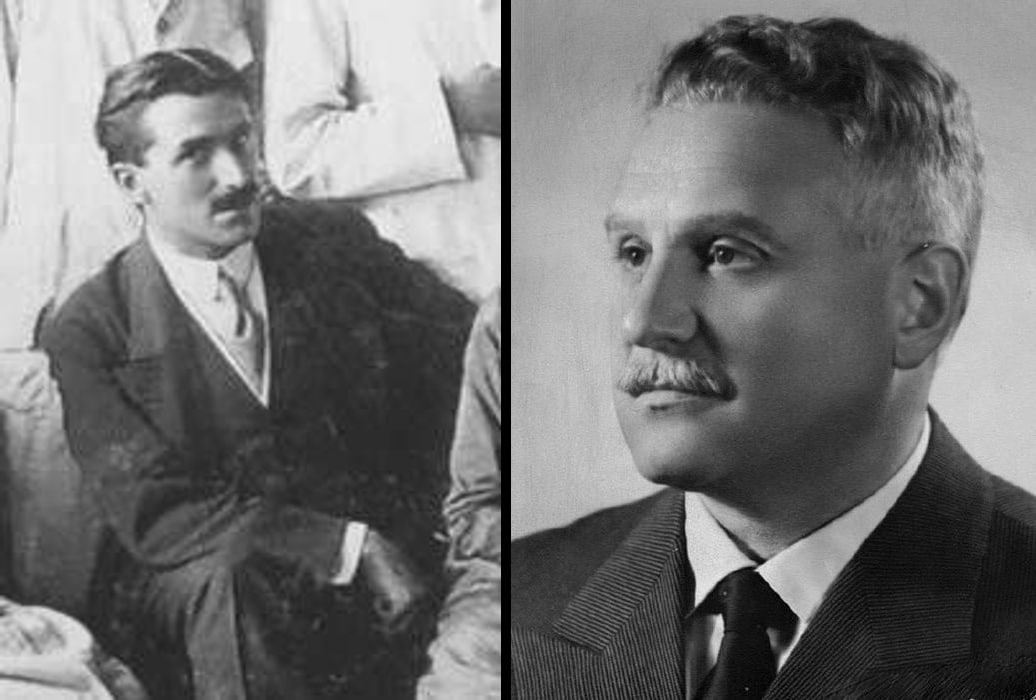
The received version of that first treatment is dramatic and often repeated: Cerletti, the story goes, resolved his doubts about passing current through a human head after observing that pigs at a Rome abattoir were stunned — not killed — by a current applied across the temples, sparing the heart (Psychiatric Times). The account of the treatment itself is equally vivid, down to the patient reportedly calling out before the second application.
A responsible history has to flag that this heroic narrative has been questioned. Roberta Passione, who studied Bini’s own notebooks, argues that the polished eyewitness account “crosses the border of myth” — that it omits at least three earlier failed attempts and reshapes a messy sequence of experiments into a tidy tale of clinicians overcoming uncertainty (Aruta 2011). Cerletti himself, on this reading, was a self-celebrating author of his own legend. The underlying facts — a first treatment in April 1938, a public report in May — stand; the cinematic detail around them should be held at arm’s length. That gap between the object’s documented history and the story told about it is exactly what makes it such rich museum material, and it is picked up again in Vol 5 — Perception and Reality.
2.4 The apparatus as a museum object
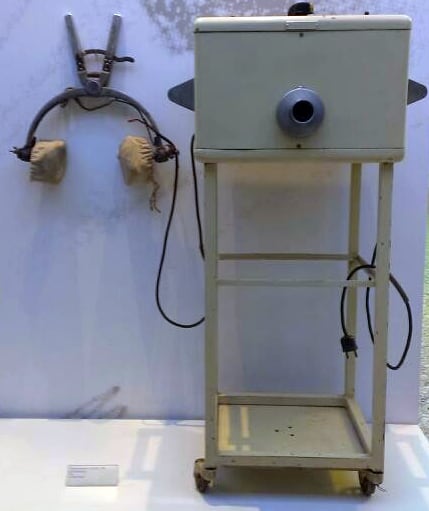
Treat the machine, for a moment, purely as a thing. The surviving prototype — built by Bini under Cerletti’s instruction, and intended first as a research instrument rather than the “simple and practical” clinical tool it became (Aruta 2011) — is today a display object at the Museo di Storia della Medicina of Sapienza University in Rome, alongside its manuals, patents, and related documentation.
As it stands in the museum photograph, it reads as a compact, boxy cased instrument: a rectangular housing with control knobs and a gauge set into its top panel, mounted on a wheeled metal stand so it could be moved to a bedside (Aruta 2011, Fig. 1). It is, in the curators’ own phrase, treated almost “like a golden chalice” — an unremarkable-looking box that carries an outsized historical weight. Period cased electromedical instruments of this class typically combined a painted-metal or bakelite front panel with a wooden or metal case and prominent dials, and the commercial descendants of Bini’s machine sit squarely in that idiom; the exact materials of any individual survivor are best confirmed against its own museum catalogue record rather than assumed, and I flag the “bakelite and wood” description as a general period characterisation rather than a measured account of this specific object. What matters here is the object’s plainness — nothing about its appearance announces that it changed twentieth-century psychiatry.
The point of describing it at all is to let the object tell the origin story, which is the approach Vol 3 — The Prototype and Its Museum Life develops in full: the provenance, the display, and what a plain box can and cannot communicate to a visitor.
2.5 The patent and its chronology
The paper trail is more precise than the calendar of the first treatment. In October 1938, Lucio Bini applied for a patent on the electrical installation of the apparatus; it was protected (granted) in March 1939, naming Bini as the sole inventor of the device (search of the Croatia ECT history, PMC8212646; LITFL). The museum in Rome holds the patent documents themselves; its study notes plainly that the apparatus “was also patented (by Bini, according to documents in our museum)” and later “exported around the world,” and that all the patents and franchises for its sale can be viewed in the museum archive (Aruta 2011).
Bini went on to secure protection in several jurisdictions beyond Italy, and the patent became “a source of considerable economic gain,” a fact that itself became a point of friction with colleagues (Aruta 2011; LITFL). I have not been able to confirm a specific Italian patent number from an authoritative index, so the number stays a ⟨verify⟩ item; the chronology — filed October 1938, granted March 1939, Bini as sole named inventor — is corroborated across sources.
2.6 Arcioni and the commercial life of the machine
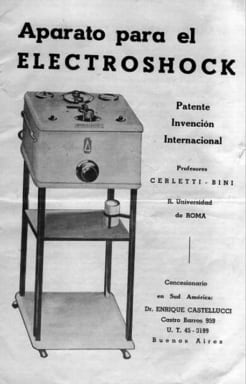
A patented instrument needs a maker. The first company licensed to produce Bini’s electroshock apparatus was Officine Elettrotecniche Italiane Ing. Vittorio Arcioni — an Italian electrotechnical firm, reported as a Milan (Milanese) house, trading as a S.a.s. limited partnership (search summaries of the Croatia and material-history literature). Advertising brochures and manuals printed in 1939 carried the title “Apparecchio per l’elettroshock — brevetto Prof. Bini” (“Electroshock apparatus — patent of Prof. Bini”), placing Bini’s name and the patent front and centre as a selling point.
The machine did not stay in Rome. It was exported and marketed internationally: the museum’s own archive preserves a Spanish-language brochure — “Aparato para el electroshock, Patente Invención Internacional, Profesores Cerletti–Bini” — that even lists a South American concessionaire in Buenos Aires (Aruta 2011, Fig. 2). Several models followed the original, including a portable version that the Rome museum also holds (Aruta 2011). The details of the Arcioni licensing — the firm’s city and exact corporate form — rest partly on secondary summaries rather than a primary company record I could inspect directly, so the Milan attribution carries a ⟨verify⟩ note; that Arcioni was the first licensed manufacturer and that 1939 manuals bore the “brevetto Prof. Bini” title is consistently reported.
2.7 Sine-wave current, and what came after
One technical fact belongs in this volume because it defines the object’s place in the lineage, and it can be stated at the level of a historical characterisation without any operating detail. The early machines — Bini’s included — drove the electrodes with an ordinary sinusoidal alternating current, essentially the mains-type waveform of the period, rather than the shaped stimuli used in modern practice (PMC review of ECT practice). This is simply what was straightforward to build in 1938 from the electrical supply of the day.
Later psychiatry moved away from that sine-wave approach toward brief-pulse stimuli — short pulses rather than a continuous sinusoid — which came to be understood as achieving the clinical goal with less delivered energy and a more favourable side-effect profile. This was a long, incremental change, not a single event: brief-pulse ideas were being investigated as early as the late 1930s, developed further through the 1940s, and only much later became the standard the modern devices embody (PMC review of ECT practice; Croatia ECT history). The precise dates and named contributors of that waveform evolution are a ⟨verify⟩ matter and belong to Vol 4 — The Road to Modern Practice, which treats the whole set of changes — waveform, electrode placement, and above all anaesthesia, muscle relaxants, monitoring, and consent — that separate the 1938 object from the modern treatment. The single point to carry away here is directional: sine-wave then, brief-pulse now, with the 1938 machine sitting firmly on the “then” side of that line.
2.8 A porous boundary with the electrotherapy bench
It is easy to file early ECT away as something wholly apart from the rest of this wing, but the apparatus sits inside the same world of interwar electromedical hardware. Bini was, in effect, an electrical engineer building a controlled-output instrument in an era already full of cased medical machines that passed current through the body — the faradic and galvanic “medical batteries” of the Faradic and Galvanic Machines dive, the high-frequency d’Arsonval apparatus of the High Frequency Currents dive, and the diathermy units of the Diathermy Machines dive. What set Bini’s machine apart was not exotic physics but its purpose and its careful, deliberate control — it was designed to do one specific thing reliably, at a time when the same broad family of technology was also being sold, unregulated and undercontrolled, as a cure for everything.
That contrast is the whole reason this dive and the porous Quack Devices wing cross-reference each other. The Violet Ray Wands and Electropathic Belts dives describe cased electrical instruments of the very same decades whose makers promised the moon and delivered a tingle. Early ECT is the counter-example on the other side of the porous line: a real, if crude and now-transformed, medical intervention that emerged from the same technological soil. Keeping the two clearly distinct — the marketed cure-all versus the controlled clinical instrument — is one of the organising jobs of this whole collection.
2.9 Where this volume hands off
The date is set and the object introduced. Vol 3 — The Prototype and Its Museum Life stays with the object itself: the surviving Cerletti–Bini prototype at the Museo di Storia della Medicina in Rome, its provenance and documented display, and how a museum tells an uncomfortable origin story through a plain box on a wheeled stand. From there, Vol 4 — The Road to Modern Practice carries the history forward to anaesthesia, muscle relaxants, consent, and the refined-waveform practice of today, and Vol 5 — Perception and Reality treats the cultural afterlife — the film-and-literature stigma — strictly as history of perception, held apart from what the treatment actually is now.
Sources
- Shocking Waves at the Museum: The Bini–Cerletti Electro-shock Apparatus — Alessandro Aruta, Medical History 55 (2011): 407–412 (PMC3143851) — the primary museum study, and the backbone of this volume: the April 1938 first treatment and the Rome laboratory setting; the 28 May 1938 report to the R. Accademia Medica; the object’s appearance and its display at the Museo di Storia della Medicina; the patent held in the museum archive; the international sales brochure with a Buenos Aires concessionaire; the “various models… portable one” note; and Passione’s argument that the heroic origin story “crosses the border of myth.”
- Eighty Years of Electroconvulsive Therapy in Croatia… (PMC8212646) — supported the patent chronology (filed October 1938, protected March 1939, Bini as sole inventor), the Officine Elettrotecniche Italiane Ing. Vittorio Arcioni licensing and the 1939 “Apparecchio per l’elettroshock — brevetto Prof. Bini” manual title, and the later brief-pulse evolution.
- Lucio Bini — LITFL Medical Eponym Library — supported Bini’s dates (1908–1964), his role as builder of the apparatus, the multi-jurisdiction patents, and an alternate first-treatment date (11 April), which is why the exact day is flagged as uncertain.
- The Man Who First Used ECT: Ugo Cerletti — Psychiatric Times — supported the 21 April 1938 date, the abattoir observation, and the identity of the first patient.
- The Birth of Electroconvulsive Therapy — Glenside Hospital Museum — supported the “Enrico X,” police-brought, eleven-treatments account and the public demonstration at the Royal Academy of Medicine.
- Electroconvulsive Therapy Part I: A Perspective on the Evolution and Current Practice of ECT (PMC3042260) — supported the sine-wave-alternating-current characterisation of the original device and the historical move toward brief-pulse stimuli.
- Cross-references named in prose (not linked): the sibling Faradic and Galvanic Machines, High Frequency Currents, and Diathermy Machines dives in Electrotherapy Devices, and the porous Violet Ray Wands and Electropathic Belts dives in Quack Devices.
Comments (0)