Early Electroconvulsive Therapy · Volume 1
Before the Current: The Convulsion as Cure
The chemical- and insulin-shock era of the 1930s that preceded electroconvulsive therapy, and why two physicians in Rome went looking for a controllable electrical way to induce a therapeutic seizure.
Contents
1.1 About this volume
This is a history dive, and it opens with a plain statement that governs everything after it. Modern electroconvulsive therapy is a legitimate, evidence-based psychiatric treatment, administered under general anesthesia and muscle relaxation, with informed consent and physiological monitoring, for a small number of specific and severe conditions — most established of these, treatment-resistant or life-threatening major depression, and catatonia. It is regulated, it is refined, and it bears little resemblance in practice to the raw procedure of the 1930s. This volume, and the four that follow, describe where that treatment came from and how its apparatus survives as a museum object. Nothing here is an operating account, a set of parameters, or anything a person could act on. The evolution to modern, consented, anesthetized practice is the subject of Vol 4 — The Road to Modern Practice; the cultural memory and the film-and-fiction version are treated as history of perception in Vol 5 — Perception and Clinical Reality.
The device this dive is finally about — the Cerletti–Bini electroshock apparatus of 1938 — did not appear out of nowhere. It was the answer to a problem that a whole decade of psychiatry had already posed and tried to solve by other means. To understand why anyone reached for electricity, you first have to understand the strange, brief, and now-largely-abandoned era of the shock therapies: insulin coma, and the deliberately induced chemical convulsion. This establishing volume tells that story. It deliberately stops at the threshold of Rome. The first human treatment on 21 April 1938 and the apparatus as a physical object belong to Vol 2 — The First Treatment and the Machine, and the surviving prototype in its museum to Vol 3 — The Prototype and Its Museum Life.
1.2 The decade of the shock therapies
For most of its early history, psychiatry could describe severe mental illness far better than it could alter it. By the early twentieth century the asylums of Europe and America held large populations of chronically ill patients — many with what was then called dementia praecox, later schizophrenia — for whom the available treatments were essentially custodial. Then, across a remarkably compressed span in the 1930s, four somatic (“bodily”) interventions arrived in quick succession and were adopted with enormous, evidence-thin enthusiasm: insulin coma therapy, chemical (metrazol) convulsive therapy, prefrontal lobotomy, and electroconvulsive therapy. Of those four, ECT is the only one still in clinical use — the others discredited, abandoned, or, in the case of lobotomy, regarded as a grave medical error.
Two features of that decade matter for our story. The first is that these were “heroic” therapies in the old medical sense: drastic, physically violent, and administered in the belief that a severe illness justified a severe remedy. The second is that convulsive therapy — deliberately inducing an epileptic-type seizure as a treatment — was already an established idea before electricity entered the picture. The seizure was the point. Electricity, when it came, was simply a new and more manageable way to produce one. That reversal of the usual assumption — that the current was the means, not the therapy — is the single most important thing to carry into the volumes that follow.
1.3 Insulin: Sakel and the deliberate coma
The first of the shock therapies came from an accident of dosing. Manfred Sakel (1900–1957), a physician working in Berlin in the late 1920s, observed that an overdose of insulin — then a very new drug — produced a hypoglycemic stupor that appeared to calm agitated patients, including morphine-withdrawal cases. Returning to Vienna’s neuropsychiatric clinic, he began, around 1933, deliberately administering insulin to schizophrenia patients to drive them into deep hypoglycemic comas, from which they were then revived. He reported his results to the Medical Society of Vienna in 1933 and published through the mid-1930s.
Sakel claimed striking recovery rates — figures on the order of 70–88 percent improvement in recent-onset cases are attributed to him — and insulin coma therapy spread rapidly through European and then American hospitals. Those figures should be read with caution: they were the enthusiast’s own, gathered without controls or blinding, in an era with no shared standard for what “recovery” from schizophrenia meant, and the therapy’s apparent successes were later attributed largely to intensive nursing, selection of favorable cases, and spontaneous remission. Insulin coma was also genuinely dangerous — protracted or irreversible coma and death were real risks — and it was labor-intensive and expensive, demanding dedicated wards and constant supervision. By the 1950s and 1960s, as controlled evaluation arrived and antipsychotic drugs became available, it was abandoned. It matters here for one reason: it established, in the psychiatric imagination of the 1930s, the idea that a violent, whole-body physiological “shock” could be therapeutic — and it set the practical bar (dangerous, costly, hard to control) that the next methods were measured against.
1.4 Meduna and the antagonism that wasn’t
The convulsion proper was the contribution of Ladislas J. Meduna (1896–1964), a Hungarian neuropsychiatrist working in Budapest. Meduna came to it through neuropathology and a hypothesis that turned out to be wrong. Studying brain tissue, he believed he saw an inverse relationship between epilepsy and schizophrenia — more glial cells in the brains of epileptics, fewer in those of schizophrenics — and he was struck by clinical reports that epileptic patients who developed psychotic symptoms sometimes had their seizures remit, and that epilepsy seemed rare among people with schizophrenia. From this he drew the idea that the two conditions were somehow biologically antagonistic, and that deliberately inducing seizures might therefore drive back psychosis.
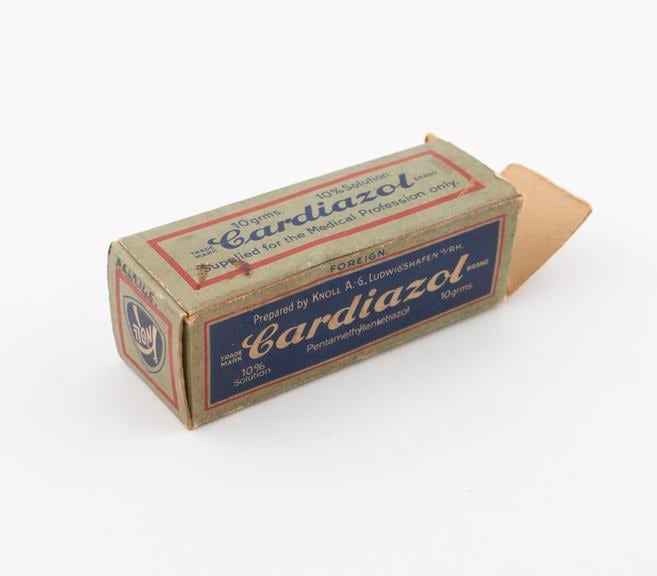
The antagonism theory is now understood to be mistaken; the epidemiological premise did not hold up, and modern practice found convulsive treatment most useful not for schizophrenia at all but for severe mood disorders. But the wrong theory led to a procedure that, by the standards of its moment, appeared to work. On 23 January 1934, at the Lipótmező state asylum near Budapest, Meduna gave a catatonic patient an injection of camphor dissolved in oil — a long-known convulsant — to induce a seizure. The patient improved over a series of treatments. Camphor, however, was unreliable: the convulsion came slowly and unpredictably, and the wait was miserable. Meduna soon switched to cardiazol (pentylenetetrazol), a synthetic circulatory and respiratory stimulant marketed in the United States under the trade name Metrazol, which produced a seizure far more quickly and reliably after intravenous injection. He published his first series in 1935, and within a very few years cardiazol convulsive therapy was in use across Europe and North America. Meduna, like Sakel, later emigrated to the United States, where he continued the work in Chicago.
1.5 The terror of the injection
Cardiazol worked as a convulsant, but it carried two serious problems that would directly motivate the search for something better. The first was the fractures. The induced seizure was a full, unmodified grand-mal convulsion in a conscious body with no muscle relaxant of any kind — muscle relaxants and anesthesia would not be added to this class of treatment until the mid-twentieth century, a development traced in Vol 4. The violence of that muscular contraction could break bones. Compression fractures of the vertebrae were common enough to become their own subject in the radiology literature of the late 1930s, and were especially likely in institutionalized patients whose bones were weakened by poor diet.
The second problem was psychological, and in the accounts of the period it looms even larger. Between the injection and the seizure there was a gap of perhaps a minute during which the patient remained conscious, and many experienced in that interval an overwhelming, indescribable dread — a sensation of impending death or annihilation so severe that patients came to fear and resist the treatment. The procedure was, in a plain sense, terrifying to undergo. It is this combination — uncontrollable timing, injury, and terror — that later observers pointed to when they explained why electricity so quickly displaced the drug. The historical judgment recorded again and again in the sources is blunt: electroconvulsive therapy spread because, relative to the metrazol injection, it was cheaper, more convenient, easier to control, and less frightening. That the electrical method could be called “less frightening” than what preceded it is itself a measure of how grim the chemical era had been.
1.6 Rome: the search for a controllable seizure
This is the problem that reached Ugo Cerletti (1877–1963). Cerletti was an established neuropsychiatrist and neurohistologist who, in 1935, succeeded Sante De Sanctis as professor and head of the Clinic for Nervous and Mental Diseases at the University of Rome, La Sapienza. He had a long-standing research interest in epilepsy, and — importantly for what followed — experience using electricity to produce seizures in experimental animals in order to study the brain changes that epilepsy left behind. In his clinic he had a gifted younger colleague, the physicist-physician Lucio Bini (1908–1964), whose particular strength was instrumentation.
Cerletti and Bini were working in a field that had already accepted Meduna’s premise: that a therapeutic seizure was worth inducing. What they set out to solve was the how. If the seizure itself was the active ingredient, then the ideal method would be one that could deliver it on demand, at a controllable moment, and reproducibly — sparing the patient the slow, dread-filled onset of the chemical injection. Electricity, which Cerletti already knew could induce a convulsion in an animal, was the obvious candidate; the obstacle was safety, since passing current through the body carried an obvious risk to the heart.
Two threads brought the problem toward a solution, and the sources treat them with differing confidence. The first is documented: Cerletti and Bini experimented on animals — dogs and pigs — and found that applying the current across the head, rather than from one end of the body to the other, allowed a convulsion to be induced without the fatalities that a heart-crossing path produced. The second is the famous anecdote, retold in nearly every history but best labelled as tradition rather than firmly documented fact: that Cerletti, seeking a reliable supply of animals and a demonstration that a head-only shock need not be lethal, drew crucial reassurance from a Rome slaughterhouse, where pigs were said to be electrically stunned before slaughter and did not die of the shock itself. The story is emblematic and may well be broadly true, but its details vary between tellings and it should be read as a founding legend as much as a laboratory record.
By early 1938 the animal work had convinced them that a controllable, non-fatal electrically induced seizure was achievable in a human being. What happened next — the first treatment of a patient, on 21 April 1938, and the small dial-and-bakelite apparatus Bini had built to do it — is the threshold at which this volume stops.
The porousness of this whole field is worth flagging even here. The same decades that produced the shock therapies also produced the vast, mostly worthless trade in domestic and clinical “electrical medicine” catalogued elsewhere in this collection — the faradic and galvanic “medical batteries” of the Faradic and Galvanic Machines dive, the high-frequency d’Arsonval currents of the High Frequency Currents dive, and their door-to-door cousins the Violet Ray Wands and Electropathic Belts of the Quack wing. It is essential not to conflate them. Those devices passed small currents through the body for vaguely defined “vitalizing” effects and cured essentially nothing. What Cerletti and Bini were after was categorically different: not a current with a claimed direct healing action, but a controllable trigger for a generalized seizure, in a clinical context where the seizure — for reasons Meduna had guessed wrongly but observed correctly — appeared to relieve specific severe symptoms. The distinction between “electricity as tonic” and “electricity as a means to induce a seizure” is the line this dive keeps.
1.7 Where this volume hands off
You now have the world the apparatus was born into: a decade in which psychiatry, largely without controlled evidence, embraced insulin coma and the chemical convulsion; a mistaken theory that nonetheless produced a treatment; and a specific, well-recorded set of reasons — injury, terror, unreliability, cost — why physicians wanted a controllable way to induce the therapeutic seizure that metrazol produced so brutally. Into that gap stepped Cerletti and Bini in Rome.
Vol 2 — The First Treatment and the Machine crosses the threshold this volume stops at: the first human treatment of 21 April 1938, the patent Bini filed later that year, the first licensed manufacturer, and — described strictly as a historical object, never as something to operate — the machine itself, its bakelite-and-wood-and-dial appearance and its place in the record. From there the dive follows the surviving prototype into the Museum of the History of Medicine in Rome (Vol 3), traces the changes that produced modern anesthetized, consented practice (Vol 4), and separates the cultural memory of ECT from its present clinical reality (Vol 5).
Sources
- Electroconvulsive therapy — Wikipedia — leads only, verified against primary/secondary sources: the four 1930s somatic therapies (insulin coma, metrazol convulsive therapy, lobotomy, ECT), ECT as the only survivor, and the Cerletti–Bini Rome origin.
- Convulsive therapy — Wikipedia — Meduna’s 1934 introduction, camphor then metrazol, the (mistaken) epilepsy–schizophrenia antagonism theory, and the statement that ECT replaced metrazol worldwide because it was cheaper, more convenient, and less frightening.
- “The Origins of Electroconvulsive Therapy (ECT)” — PubMed 11940939 — ECT developed by Cerletti and Bini at the Clinic for Nervous and Mental Disorders, Rome, 1938; the four somatotherapies of the 1930s and ECT as the only one still used.
- Ladislas J. von Meduna: A Brief Biography — Cerebro & Mente (State University of Campinas) — Meduna 1896–1964; the glial-cell/antagonism hypothesis; strychnine and caffeine trials before camphor; switch to metrazol/cardiazol; the 26-patient pilot and later 110-patient series.
- Ladislas Meduna — LITFL Medical Eponym Library — Budapest / University of Budapest and the Lipótmező asylum; first camphor treatment on 23 January 1934; the shift to metrazol and treatment of over 100 patients; later US career.
- Manfred Sakel — LITFL / Wikipedia and Insulin shock therapy — Wikipedia — the accidental late-1920s Berlin observation; deliberate insulin-coma induction in Vienna from c. 1933; the reported (and later discounted) high recovery figures; danger, cost, and eventual abandonment.
- “A landmark in psychiatric progress”? The role of evidence in the rise and fall of insulin coma therapy — PMC8886299 — supports the cautious reading of insulin coma’s claimed efficacy and its decline once controlled evaluation and antipsychotics arrived.
- “Dr. Ugo Cerletti invents electroconvulsive therapy” — Hektoen International — the antagonism rationale; the dangers of metrazol and insulin methods; head-only vs. head-to-tail application in animals; the slaughterhouse anecdote (framed as legend); the 1938 treatment and 1939 conference presentations.
- [“The Man Who First Used ECT: Ugo Cerletti” — Psychiatric Times] (https://www.psychiatrictimes.com/view/ugo-cerletti) — biographical framing of Cerletti and Bini and the search for an electrical means (page returned HTTP 403 on direct fetch; corroborated via the search summary and the sources below).
- About us — Department of Human Neurosciences, Sapienza University of Rome — Cerletti succeeded Sante De Sanctis as Chair of Mental and Neurological Diseases at La Sapienza in 1935; ECT developed there with Bini; the prototype preserved at the Sapienza Museum of the History of Medicine.
- “Fractures of the Vertebrae Following Metrazol Therapy” — Radiology 36(6):725 (1941) and Metrazol therapy overviews (neurolaunch.com) — the pre-seizure dread window and the vertebral compression fractures of unmodified convulsive therapy.
- “Heroic therapies in psychiatry” — Science Museum (London) — museum framing of insulin coma, metrazol, and early ECT as the drastic somatic treatments of the 1930s.
Comments (0)