Early Electroconvulsive Therapy · Volume 5
The Image and the Instrument
How ECT was pictured in film and literature, held apart from what the treatment is in clinical practice today, and where the original apparatus now sits as museum history.
Contents
5.1 About this volume
This closing volume is about a gap: the distance between what most people picture when they hear “electroshock” and what the treatment, called electroconvulsive therapy (ECT), actually is in a hospital today. That gap is unusually wide, and it is worth stating the conclusion at the front, plainly, because everything after depends on it. Modern ECT is a legitimate, regulated, evidence-based psychiatric treatment. It is given only with the patient’s informed consent, under general anaesthesia, with a muscle relaxant, in a monitored clinical setting, for a small number of specific and severe conditions. It is not a punishment, not a restraint, and not something a person could or should improvise. The historical account that follows never describes how any apparatus is operated; it treats the machine as an object and a milestone, and it treats the frightening popular image as history of perception, examined and set beside the clinical record rather than repeated.
The rest of the dive is the story of where the treatment and its apparatus came from. The convulsive-therapy context that preceded it — Ladislas Meduna’s chemically induced seizures and the insulin-coma era — is Vol 1 — The Convulsive Idea. The first human treatment in Rome in 1938 and Bini’s device as a historical object are Vol 2 — The First Treatment and the Apparatus. The surviving prototype and its museum life are Vol 3 — The Prototype and Its Museum. The changes that produced modern practice — anaesthesia, muscle relaxants, consent, monitoring, refined technique — are Vol 4 — Evolution to Modern Practice. This volume takes the last question: why the public memory of ECT diverged so sharply from its clinical present, and where the founding object rests today.
5.2 The picture the public inherited
Ask most people to describe electroshock and they will describe a scene from a film. The single most influential is Miloš Forman’s One Flew Over the Cuckoo’s Nest (1975), adapted from Ken Kesey’s 1962 novel — a film that swept the major Academy Awards and lodged its imagery permanently in the culture. In it, Randle McMurphy (Jack Nicholson) is given ECT while conscious and unrestrained by anaesthesia, writhing on a table; crucially, the treatment is shown not as medicine but as a ward’s instrument of control, applied to a disruptive patient. Half a century on, surveys and reviews still identify it as the most frequently cited screen depiction of ECT, and researchers have documented that many people who saw it say it “put them off” the treatment, describing the procedure thereafter as scary, traumatic, or brutal.
Literature carried the same charge. Sylvia Plath’s The Bell Jar (1963) renders a first course of ECT through the protagonist Esther Greenwood as a terrifying ordeal — administered without proper anaesthesia, ineffective, and followed by dread — drawn from Plath’s own experience of a severe depressive episode. Later films reinforced the template: Girl, Interrupted (1999), from Susanna Kaysen’s memoir, again presents the treatment as something done to patients to subdue them. The cumulative effect is a stock scene — a strapped-down, fully awake body convulsing under punitive current — that has become the default mental picture of a treatment almost no viewer has witnessed in a real clinic.
5.3 When the image was true, and when it stopped being true
The uncomfortable part of the history — and the reason the fictional scenes had such force — is that they were not invented from nothing. In its first two decades, ECT was frequently given in “unmodified” form: without a general anaesthetic and without a muscle relaxant. The seizure itself produced a full-body convulsion, which could be violent enough to cause injury, and the experience for a conscious patient could be frightening. Kesey drew on the period directly; he had worked the night shift as an aide in a psychiatric facility in the late 1950s, when the threat of “shock” was, in some institutions, genuinely used to manage difficult wards. The Bell Jar itself marks the transition: Plath contrasts Esther’s harrowing first, unmodified treatment with a later, properly modified course that is calm and helps her — a distinction the novel is careful to draw, and one most readers of the famous first scene forget.
So the popular image is best understood as a photograph of a real but superseded era, mistaken for a photograph of the present. The changes that closed the gap are the subject of Vol 4 — Evolution to Modern Practice: the introduction of general anaesthesia and muscle relaxants around the middle of the twentieth century, which is precisely what removed the convulsive struggle the films depict; the establishment of informed consent as a legal and ethical requirement; physiological monitoring; and refinement of the electrical stimulus itself, as the early sine-wave alternating current gave way to brief-pulse stimuli. The screen image froze at the beginning of that arc. The clinic kept moving.
5.4 What the treatment is now
Set the fiction aside and the clinical record is specific and sober. Modern ECT is administered by a team including an anaesthetist. The patient is asleep under a general anaesthetic and has received a muscle relaxant, so the body does not undergo the violent movement of an unmodified seizure; a mouth guard protects the teeth, and heart rhythm and brain activity are monitored throughout. National psychiatric bodies — among them the Royal College of Psychiatrists in the United Kingdom and the Royal Australian and New Zealand College of Psychiatrists — describe it in these terms and set out the requirement for informed consent, which the patient may withdraw at any time, including immediately before a treatment.
Its use is narrow and serious. ECT is not a general-purpose or first-line intervention; it is reserved chiefly for severe, treatment-resistant, or life-threatening depression, for catatonia, and for some episodes of severe mania, typically when other treatments have failed or when a rapid response is needed. On the evidence, it is one of the more effective treatments in psychiatry for these particular indications, and studies of hospitalised patients with depression have associated a course of ECT with a reduced risk of death by suicide in the period afterward, without evidence of a clinically significant increase in serious medical events. It is not without recognised effects — memory disturbance around the time of treatment is the most discussed — and the modern regime of consent, monitoring, and refined technique exists precisely to weigh and minimise those effects. None of that resembles the scene in the film, and it is important that a reader hold the difference clearly: this volume describes what the treatment is only in order to keep the history honest, not as guidance, and nothing here is a description of how it is done.
5.5 The object in the museum
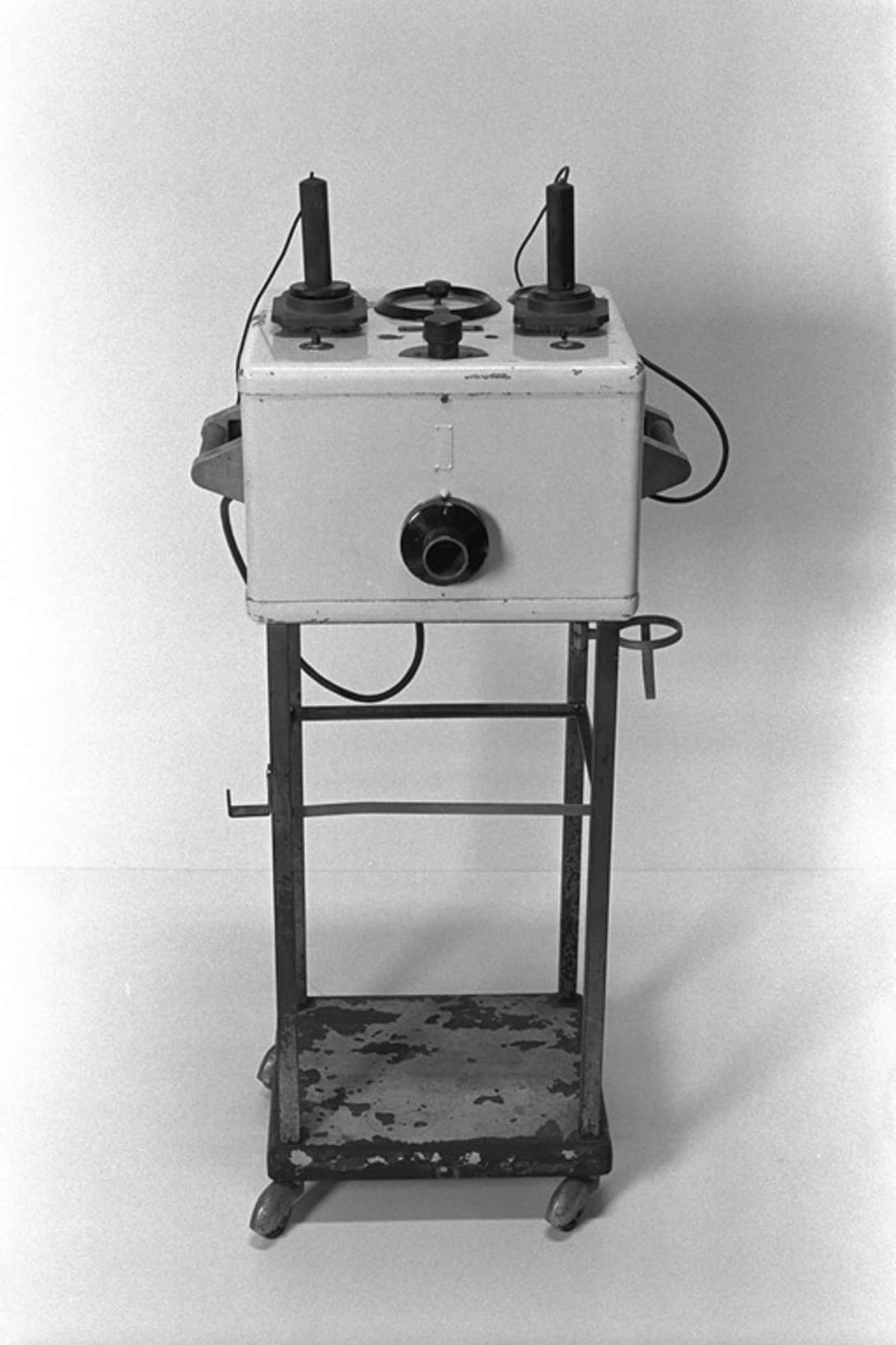
The apparatus at the origin of all this survives, and its home is a museum. The original Cerletti–Bini electroshock device — built at the Clinic for Nervous and Mental Diseases at La Sapienza University in Rome, where Ugo Cerletti and Lucio Bini carried out the first human ECT treatment in the spring of 1938 (the date is usually given as 21 April 1938, though sources vary and the precise day is contested) — is now owned and displayed by the Museo di Storia della Medicina, the Sapienza Museum of the History of Medicine in Rome. It stands in the collection as an artefact: a period assembly of dials and terminals of its era’s making, with a portable companion unit also held, shown among the instruments, documents, and manuals of the clinic that produced it. Its full provenance and museum life are the subject of Vol 3 — The Prototype and Its Museum; this volume notes only where it has ended up, and what that placement means.
There is a genuine gap in the record that scholarship has flagged. Alessandro Aruta, writing in Medical History (2011), and — in the later study “From the Madhouse to the Docu-Museum” (2020) — Elisabetta Sirgiovanni and Alessandro Aruta, note that there is no clear documentary record of how or exactly when the prototype passed from the neuropsychiatric clinic into the museum’s keeping — an “enigma” around an object that is otherwise one of the best-known milestones in the history of psychiatry. Accounts that the apparatus was, at some point around the 1960s, the subject of interest or contention between Italian and American scientific institutions are reported in this literature but are not firmly documented, and are best treated as uncertain. What is settled is the endpoint: the founding machine of ECT is a catalogued museum object in Rome, and the museum’s own framing wrestles openly with the object’s doubleness — a genuine therapeutic advance and, simultaneously, a thing bound up with real human suffering and later overuse.
5.6 Holding the two apart
The value of this dive is that it keeps two things in separate hands. In one hand is the history of perception: a machine that could be, and sometimes was, misused; an unmodified early technique that was frightening; and a set of powerful cultural images — Kesey’s ward, Plath’s bell jar — that captured a real moment and then outlived it, hardening into a stigma that clinicians say still deters some patients who might benefit. In the other hand is the clinical present: a consented, anaesthetised, monitored, and evidence-based treatment used for a few severe conditions. Both are true. The historical apparatus is a museum object precisely because the treatment moved on from it; the stigma persists precisely because the popular imagination did not.
This is the same discipline the rest of the collection uses, turned to a harder case. Elsewhere in these wings the task is to separate a genuine physical effect from a fraudulent marketing claim — the harmless violet glow sold as a cure-all in the Quack wing’s Violet Ray Wands dive, the feeble current of the Electropathic Belts, or the real but oversold high-frequency heating in this wing’s High Frequency Currents and Diathermy Machines dives. ECT inverts the usual shape of that problem. Here the physiological effect is real and the treatment is genuine, and it is the reputation that is distorted — not by sellers inflating a worthless device, but by a culture remembering a superseded practice as though it were the current one. The honest account neither romanticises the object nor sensationalises it; it dates the frightening image, credits what was real in it, and sets the museum artefact where it belongs — in a vitrine, as history.
5.7 Where this volume hands off
This is the last volume of the Early Electroconvulsive Therapy dive, and with it the Electrotherapy Devices wing closes. The five volumes have traced a single object from the convulsive idea that preceded it (Vol 1), through the 1938 Rome treatment and the apparatus as milestone (Vol 2), the surviving prototype and its museum keeping (Vol 3), the evolution into modern consented, anaesthetised practice (Vol 4), and finally the divergence between the image and the instrument here. The wing’s sober-engineering neighbours — static and influence machines, faradic and galvanic batteries, high-frequency currents, and diathermy — sit alongside this dive as the legitimate branches of medical electricity, and they share a porous border with the Quack wing next door, where the same coils and currents were sold door-to-door as cure-alls. Read across that border rather than pretending it is clean: the difference between a hospital instrument and a fairground promise was never in the physics, but in the honesty of the claim and the consent of the patient — which is exactly where this volume has tried to leave the reader.
Sources
- Shocking Waves at the Museum: The Bini–Cerletti Electro-shock Apparatus — Medical History 55 (2011), PMC3143851 — the prototype’s display at the Sapienza Museo di Storia della Medicina, its physical description, the 1938 first treatment at the Rome Royal University clinic, the absence of a clear record of how the apparatus reached the museum, and the museum’s own framing of the object as blessing, hope, and burden at once.
- Sirgiovanni & Aruta, “From the Madhouse to the Docu-Museum: The Enigma Surrounding the Cerletti–Bini ECT Apparatus Prototype” — Nuncius 35:1 (2020) — the provenance “enigma,” the object’s later museum life, and the reported (but not firmly documented) mid-century interest of Italian and US institutions in the apparatus; supports the hedging in the museum section.
- The Misrepresentation of Electroconvulsive Therapy in Movies — UTHealth Houston, Dept. of Psychiatry (2024) — One Flew Over the Cuckoo’s Nest (1975) and Girl, Interrupted (1999) as punitive, anaesthesia-free portrayals, contrasted with modern anaesthetised, muscle-relaxed, consented, monitored practice.
- Fifty Years of One Flew Over the Cuckoo’s Nest — International Journal of Mental Health Nursing (2025), PMC12645358 and Electroconvulsive therapy: a history of controversy, but also of help — The Conversation — the film as the most-cited ECT depiction, its documented effect on public attitudes, Kesey’s 1950s psychiatric-aide background, and the fact that unmodified ECT and its use to manage wards were real in the depicted era.
- Electroconvulsive Therapy (ECT) in Literature: Sylvia Plath’s The Bell Jar — PubMed 24290484 and The Bell Jar — Wikipedia (lead) — Plath’s 1963 novel contrasting a frightening unmodified first treatment with a later, beneficial modified course.
- Electroconvulsive therapy (ECT) — Royal College of Psychiatrists — modern practice under general anaesthetic with a muscle relaxant and mouth guard, use chiefly for severe depression, and informed consent that can be withdrawn at any time.
- Electroconvulsive therapy (ECT) — RANZCP — a national psychiatric body’s statement that ECT is an effective, evidence-based, consented treatment for specific severe conditions, corroborating the modern-practice framing.
- Electroconvulsive therapy — Wikipedia (lead, verified against the above) — Cerletti and Bini at La Sapienza, the 1938 origin, the sine-wave-to-brief-pulse evolution, and the modern indications (severe/treatment-resistant depression, catatonia, mania); used only to cross-check claims sourced above.
Comments (0)