Early Electroconvulsive Therapy · Volume 3
The Prototype and Its Museum Life
The surviving Cerletti–Bini apparatus in the Museum of the History of Medicine at Sapienza University, Rome — its documented display, the gap in its provenance, and the 1960s tug-of-war that decided where the object of ECT's origin would finally rest. History and archive only.
Contents
3.1 About this volume
The two previous volumes established where electroconvulsive therapy came from — the chemical-convulsive precedent that preceded it in Vol 1 — Before the Current — and the first human treatment and the machine as a documented milestone in Vol 2 — The First Treatment and the Apparatus. This volume narrows to a single surviving artifact: the original Cerletti–Bini prototype, the machine used at the very start, and the improbable path by which it came to sit behind glass in a university museum in Rome. It is a story told through the object — its cataloguing, its provenance, and the one moment when the object itself became contested property.
One thing must be said plainly at the front, and this volume repeats it because it is the frame for everything that follows. Modern electroconvulsive therapy is a legitimate, evidence-based psychiatric treatment. It is used today only for a small number of specific, severe conditions — most often profound, treatment-resistant depression and certain life-threatening psychiatric emergencies — always with the patient’s (or an authorized surrogate’s) informed consent, always under general anesthesia and a muscle relaxant, and always with medical monitoring. It bears little physical resemblance to the 1938 procedure, and none at all to its lurid cultural caricature. This volume is about a museum object and its history; it is not, in any part, an account of how the procedure is or was performed. The evolution from the 1938 method to that modern, consented, anesthetized practice is the subject of Vol 4 — Toward Modern Practice; the cultural mythology is held apart, as history of perception, in Vol 5 — Perception and Reality.
3.2 The museum that holds the object
The prototype lives in the Museo di Storia della Medicina — the Museum of the History of Medicine — of Sapienza Università di Roma, at Viale dell’Università 34 in Rome. The museum was founded in 1938 by Adalberto Pazzini, a physician and medical historian, and its present three-floor premises, laid out as a walk-through itinerary of Western medical thought from antiquity to the modern era, were inaugurated in 1954. Its holdings run from apothecary majolica and portable pharmacies to surgical and dental instruments, microscopes, and reconstructed historical interiors. Within that collection, in the section devoted to the nervous system, sits the object this volume is about, catalogued in the plainest possible terms: “Apparecchio di Cerletti–Bini per l’elettroshock, 1938.”
There is a quiet symmetry in the dates. The therapy and the museum that would one day enshrine its first machine were born in the same year, a few kilometres apart in the same city — the therapy in the university’s psychiatric clinic, the museum under Pazzini a short walk away. That the object’s origin and its final resting place should share a founding year is coincidence, but it is the kind of coincidence that makes the artifact feel less like salvage and more like something the institution was always going to keep.
3.3 The gap in the record
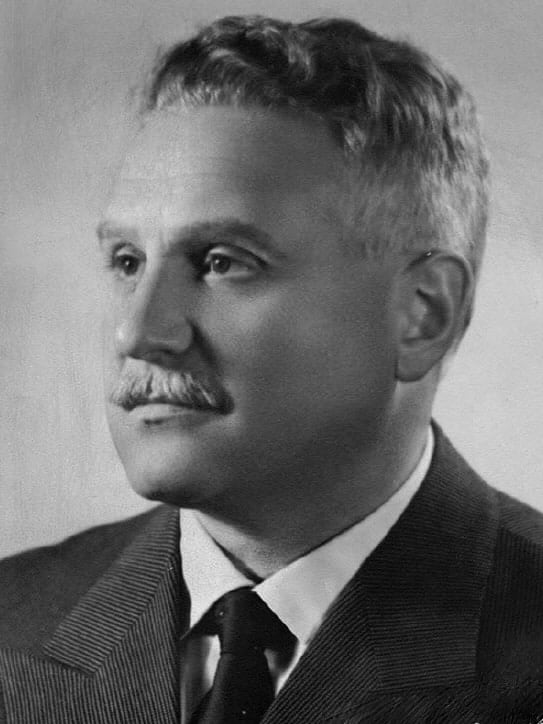
For an object this historically loaded, the prototype’s paper trail is startlingly thin — and that absence is itself the subject of the best recent scholarship on it. The apparatus was built in 1938 by Lucio Bini (1908–1964) under the direction of Ugo Cerletti (1877–1963), in the Clinica delle Malattie Nervose e Mentali della Regia Università di Roma, the university’s clinic for nervous and mental diseases. It was used, it was written about, versions of it were manufactured and exported — and then, as an object, it effectively vanishes from the documentary record.
In a 2020 study in the journal Nuncius pointedly titled “From the Madhouse to the Docu-Museum,” the historians Elisabetta Sirgiovanni and Alessandro Aruta traced this silence directly. After the machine’s clinical use, they found, no trace of the physical device can be reliably followed until the 1960s, when it surfaces on film — in a silent black-and-white reel dedicated to the university’s newly rehoused and renovated Museum of the History of Medicine, showing the prototype already installed as a display piece. Crucially, the authors report, there is no surviving record of the circumstances under which the apparatus was transferred from the neuropsychiatric clinic to the museum: no accession note, no dated hand-over, no curator’s memorandum. The object simply reappears, already a specimen. For a collector or a historian this is a familiar and honest kind of problem — a genuinely important artifact whose chain of custody has a hole in the middle — and the responsible thing is to say so rather than to invent a tidy donation story.
3.4 The 1964 tug-of-war
If the middle of the object’s life is a blank, one episode near the end of that blank is unusually well documented, and it is the most human chapter in the machine’s museum life. Sirgiovanni and Aruta reconstructed it in a companion 2020 paper in History of Psychiatry, “The electroshock triangle,” and it turns on the summer of 1964.
By the early 1960s a climate of public condemnation was gathering around ECT, even as the prototype’s historical value was rising. In that atmosphere the machine became, in the authors’ word, contended — the object of a quiet trans-Atlantic tug-of-war. On one side stood American psychiatry, represented by the brothers Karl and William Menninger of the celebrated Menninger clinic in Topeka, Kansas, who took an interest in acquiring or displaying the historic device. On the other stood Adalberto Pazzini, founder and steward of the Sapienza museum, who meant to keep the origin of ECT in the city where it began. The third point of the “triangle” was Bini himself — one of the two men whose names the machine carries, and a natural mediator between the clinic that produced it and the institutions that now wanted it.
That mediation never happened, because Bini died unexpectedly that same summer, in August 1964, at only fifty-five. His death removed the one figure who could have spoken directly to the object’s meaning and disposition. In the event, the prototype stayed in Rome, in Pazzini’s museum, where it remains. The episode is worth telling not for drama but because it is the one point at which the record is full: it shows a scientific artifact acquiring the status of a relic in real time — argued over by two nations’ museums precisely as the therapy it embodied was becoming culturally toxic.
3.5 Reading the origin story through the object
The value of the surviving machine is that it lets the origin story be told through a thing rather than a legend, and the object quietly corrects the legend at the same time. The tidy version — a single decisive switch-on, an instant cure — is exactly the sort of founding myth that grows around a landmark. The historian Roberta Passione, working from the archival material, has shown the first treatment was more halting than the legend allows: the successful session in April 1938 followed earlier failed attempts at lower intensity before a convulsion was produced. This volume records that correction as history and deliberately gives no numbers, settings, or sequence — the point here is that the celebrated account was smoothed, not the details of how anything was done, which are Vol 2’s to frame and this dive’s guardrail keeps off the page entirely.
The machine also anchors the true intellectual origin, which was not a workshop but a slaughterhouse. Cerletti, who had spent years studying experimental epilepsy, drew the idea of a controllable electrical route to a seizure from observing the electrical stunning of animals in Roman abattoirs — the observation that a current across the head could reliably and survivably produce a convulsion. That is the genuine seed of the apparatus, and standing in front of the object one is standing in front of the first attempt to turn that grim observation into a clinical instrument. The prototype is displayed with the surrounding paper that makes this legible: the museum holds, alongside the machine, Bini’s patent and related manuals and scientific documents, so that the object is presented as a milestone in a documented programme rather than as a curiosity in isolation.
3.6 The object on display today
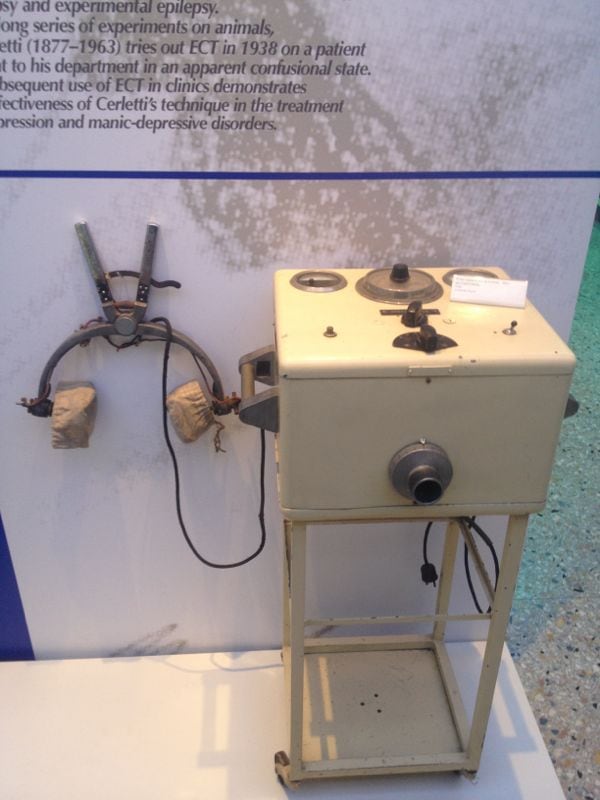
As an object, the prototype belongs firmly to its moment: a piece of late-1930s laboratory electrical apparatus, its housing in the wood, Bakelite, and metal idiom typical of the period — a general period characterisation rather than a measured account of this specific survivor, whose exact materials are best confirmed against the museum’s own catalogue record rather than assumed — its front carrying the dials and terminals of a bench instrument of that era rather than the moulded plastic of a later hospital console. In its original laboratory setting, contemporary description places it as a boxy unit that stood on a table among the tangle of a working laboratory; as displayed today at the museum it stands instead on a wheeled (castored) metal stand, so that the same object is seen in two different rooms of its life. It carried a pair of electrodes for application at the temples and a simple bite-guard for the patient — the whole ensemble reading, to a modern eye, as unmistakably improvised, which it was. The museum is also recorded as holding a portable version, a reminder that the design was iterated and carried beyond the room where it began. These are descriptions of an artifact’s appearance, offered for the same reason a museum label is: to let a viewer understand what they are looking at. They are not, and must not be read as, any account of operation.
The machine’s internal character belongs to the electrical world of the other dives in this wing. Early ECT apparatus of this generation delivered an ordinary sine-wave alternating current of the kind any mains-driven bench device of the 1930s produced — the same family of current that, at radio frequencies and in a glowing glass electrode, the porous Quack wing was simultaneously selling door to door as the Violet Ray Wand, and that reputable physicians applied as high-frequency therapy in the High Frequency Currents dive. The line between a serious clinical instrument and a cure-all gadget in this era was never drawn by the physics; it was drawn by the intent, the setting, and the honesty of the claim. The sinusoidal waveform of these first machines was itself later superseded by brief-pulse stimuli, a refinement that belongs to the modern-practice story in Vol 4 and is noted here only to place the object in its technical generation.
What the visitor meets, then, is a genuinely double-edged relic: the concrete first step of a treatment that remains in legitimate, regulated use today, and simultaneously the emblem of a procedure whose cultural memory is dominated by fear. The museum’s decision to keep it, label it plainly, and surround it with its own documentation is the sober answer to both — the artifact presented as evidence, neither trophy nor horror. It sits, appropriately, near the electrotherapeutic apparatus with which it shares an electrical ancestry but not, in the end, an intent — the honest medical batteries and static machines of the Faradic and Galvanic Machines and Static Electricity Machines dives, and across the porous boundary from the frank quackery of the Violet Ray Wands and Electropathic Belts dives in the Quack wing.
3.7 Where this volume hands off
The object is now placed: built in 1938, lost to the record for a generation, contended between Rome and Topeka in 1964, and kept — plainly catalogued and documented — in the Sapienza Museum of the History of Medicine, where it can still be seen. What the object cannot show, because it predates them entirely, are the changes that turned the 1938 procedure into the treatment practised now: general anesthesia and muscle relaxants, formal informed consent, monitoring, and refined waveform and electrode placement. That transformation — and the plain statement that modern ECT is an evidence-based, regulated, consented, and anesthetized treatment for specific severe conditions — is the whole subject of Vol 4 — Toward Modern Practice. The stigma the object accumulated in the culture, held carefully apart from that clinical reality, closes the dive in Vol 5 — Perception and Reality.
Sources
- Shocking Waves at the Museum: The Bini–Cerletti Electro-shock Apparatus — Medical History (2011), via PMC — that the prototype is held and displayed by the Museo di Storia della Medicina, Sapienza, Rome; the April 1938 first treatment in the university’s Clinica delle Malattie Nervose e Mentali; the machine standing “on a table” amid laboratory apparatus; temple electrodes and a gauze-wrapped bite pipe; the museum’s holding of a portable version and of Bini’s patent and documents; Passione’s finding of failed prior attempts.
- Sirgiovanni & Aruta, “From the Madhouse to the Docu-Museum: The Enigma Surrounding the Cerletti–Bini ECT Apparatus Prototype” — Nuncius 35(1) (2020) — the core provenance gap: no record of how/when the prototype passed from clinic to museum, and its reappearance in a 1960s silent black-and-white film of the newly rehoused Museum of the History of Medicine. (Publisher page fetch was blocked; details drawn from the abstract and ResearchGate listing.)
- Sirgiovanni & Aruta, “The electroshock triangle: disputes about the ECT apparatus prototype and its display in the 1960s” — History of Psychiatry 31(3) (2020) — the summer-1964 contest over the prototype between the Menninger brothers (Topeka) and Pazzini’s Sapienza museum amid public condemnation of ECT, and Bini’s unexpected death that summer.
- Museo di Storia della Medicina — Polo Museale Sapienza (Turismo Roma) — the museum’s founding in 1938 by Adalberto Pazzini, its address at Viale dell’Università 34, the 1954 inauguration of the present premises, its three-floor layout, and the catalogued “Apparecchio di Cerletti–Bini per l’elettroshock, 1938.”
- Lucio Bini — LITFL Medical Eponym Library — Bini’s dates (1908–1964); his construction of the device; the 1939 patent and his sole patent rights in several countries; the April 1938 first treatment; and that “a prototype is preserved at the Museo di Storia della Medicina in Rome.”
- Ugo Cerletti — LITFL Medical Eponym Library — Cerletti’s dates (1877–1963) and Rome chair; the 1933–1938 animal studies and the Roman-slaughterhouse observation of electrical stunning that inspired the electrical method; the prototype’s preservation in the Rome museum.
- Electroconvulsive therapy — Wikipedia (leads, verified against the above) — the 1934 Meduna chemical-convulsive precedent; the early-1940s move from sinusoidal current to brief-pulse and unilateral placement; and the statement that the prototype “is now owned and displayed by the Sapienza Museum of the History of Medicine in Rome.”
A note on contested particulars. Sources cite the first-treatment day variously (11, 18, and other dates in April 1938); the exact date is Vol 2’s to fix and is not asserted here. One secondary abstract prints Cerletti’s birth year as 1867; the weight of biographical sources gives 1877, used above. The provenance of the prototype between its 1938 clinical use and its 1960s museum appearance is, by the specialist literature’s own account, genuinely undocumented — stated here as a gap, not filled with a guess.
Comments (0)