Diathermy Machines · Volume 1
Heating Through: What Diathermy Is
The one high-frequency device in this collection with an uncontested clinical place — a machine built to warm tissue from within — and how the therapeutic heater differs from the surgical cutting unit that shares its physics.
Contents
1.1 About this volume
Walk into a hospital physiotherapy department in 1935 and, among the wax baths and infrared lamps, you would find a cabinet the size of a small radio set: a panel of dials, a glowing meter, two insulated cables ending in flat rubber-covered pads or hinged metal plates. A therapist would settle the plates a few centimetres from a patient’s shoulder or knee, tune a knob until the meter peaked, and the patient would feel, over several minutes, a deep and pleasant warmth rise from inside the joint — not the surface heat of a hot-water bottle, but heat that seemed to come from within the tissue itself. That machine was a diathermy apparatus, and the sensation was real, the physics sound, and the clinical use — unlike almost everything else in this wing of the collection — genuine.
This is the establishing volume of a five-part deep dive, and its job is deliberately narrow: to say plainly what diathermy is, what its heat is for, and where it sits among the high-frequency devices of the previous dive. Diathermy is the sober, respectable maturation of the high-frequency story told in the High Frequency Currents dive — the same current that a drugstore sold as a glowing “violet ray,” disciplined into a measured clinical tool. It is one of the few objects in the whole Antique Medical Equipment collection that survives, in modernised form, in real medicine today.
This volume stops short of the interesting machinery and the interesting arguments. The move from spark-gap long-wave sets to vacuum-tube short-wave oscillators — and the frequencies involved — is Vol 2 — Longwave to Shortwave, Spark to Tube. What the heat does to nerve, muscle and tissue at the cellular level, and the burns and hazards that drove medical-device safety practice, is Vol 3 — What It Does to Tissue. The sober clinical record set against the mid-century overreach — the years when diathermy was oversold to “cure” infection or cancer — is Vol 4 — Legitimate Physiotherapy vs. Overreach. Identifying, dating and displaying a machine is Vol 5 — Collecting Diathermy Machines. Here we simply establish the object and its claim to a clinical place.
1.2 What “diathermy” means
The word is a piece of clean nineteenth-century Greek. Diathermy joins dia (διά, “through”) to thermē (θέρμη, “heat”): literally, heating through. It was coined in 1908 by the German physician Karl Franz Nagelschmidt, who performed the first extensive experiments treating patients with high-frequency current and, in 1913, wrote the first textbook on the subject. Nagelschmidt is generally credited as the founder of the field, though the underlying idea was slightly older: in 1899 the Austrian investigator von Zaynek had measured how much heat tissue produces as a function of current frequency and density, and first proposed using high-frequency currents specifically for deep heating. (Both the 1908 coinage and the 1899 priority rest on secondary and encyclopaedic accounts rather than a run of primary papers, and are best treated as the received chronology rather than settled to the year.)
The name carries the whole idea. Ordinary heat therapy — a hot pack, a warm bath, an infrared lamp — warms the skin, and the warmth then conducts slowly and weakly inward. Diathermy inverts that: it uses a high-frequency alternating current or field that passes through the surface with little effect there and deposits its energy in the deeper tissue, which becomes the heat source. The skin can stay comfortable while a joint capsule several centimetres down reaches therapeutic temperature. That is the single physiological trick the entire field is built on, and the reason the device exists at all.
Crucially, the current has to be high-frequency to do this safely. The Faradic and Galvanic Machines dive covers the low-frequency currents that make nerves fire and muscles jump; the High Frequency Currents dive covers d’Arsonval’s discovery, from 1889 onward, that above roughly five to ten thousand cycles per second a current stops triggering that violent muscular response and instead simply warms the tissue it passes through. Diathermy is the direct, legitimate child of that discovery. Where d’Arsonval and Oudin apparatus produced a somewhat uncontrolled mix of surface sparks, ozone and warmth, diathermy is the engineering effort to keep only the useful part — the deep, measured heat — and throw the theatre away.
1.3 The object and what its heat actually does
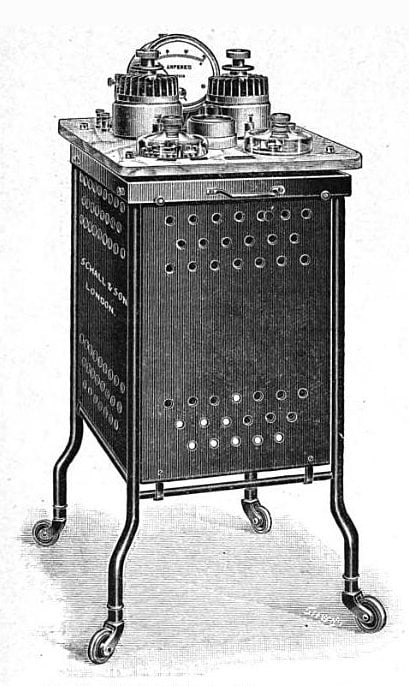
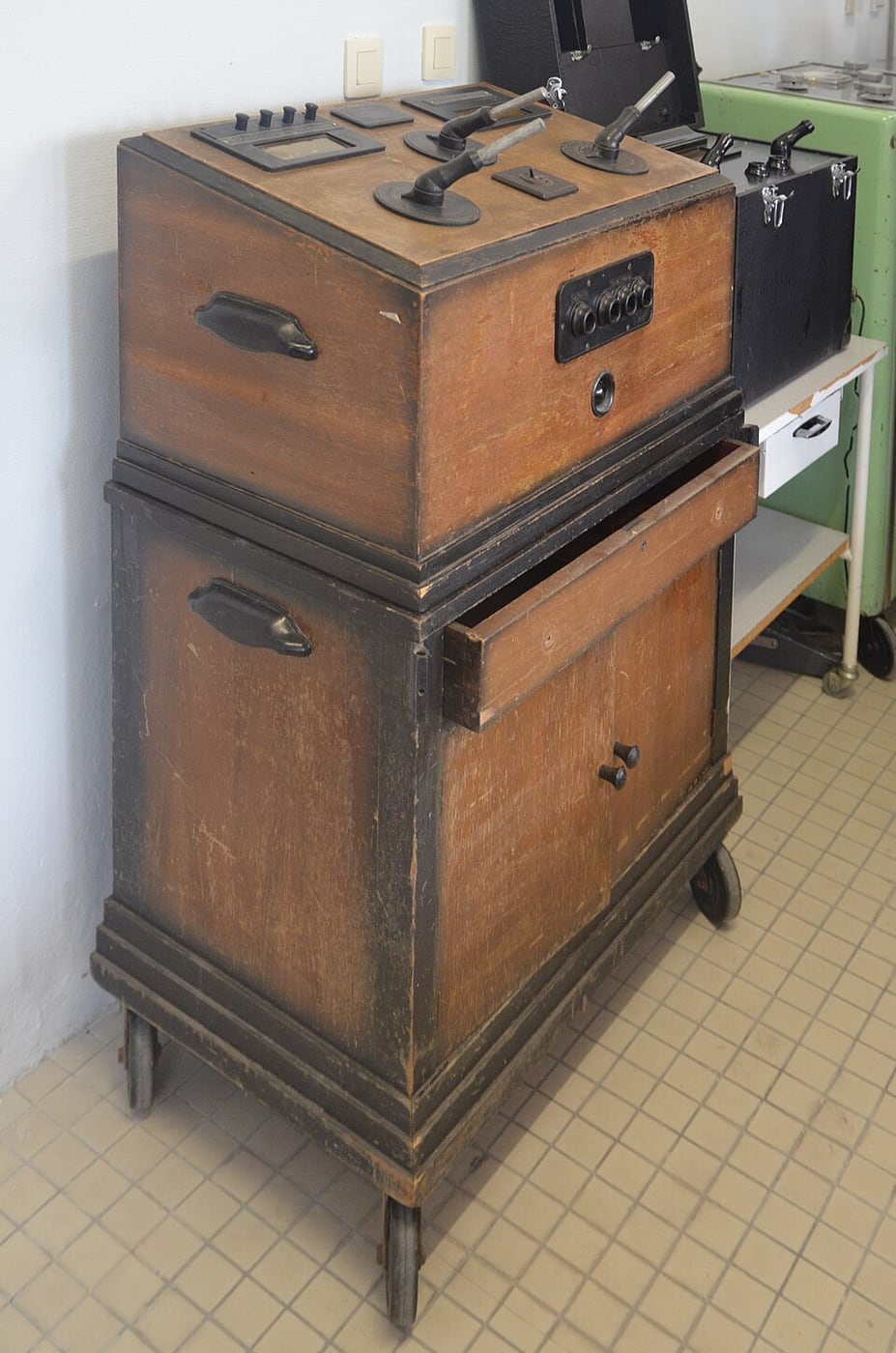
Physically, a diathermy machine of the classic era is a bench or trolley cabinet housing an oscillator, a means of tuning it, and a pair of applicators connected by heavy insulated leads. Long-wave machines of the 1910s and 1920s carried a spark gap and looked much like the hospital high-frequency apparatus they descended from; short-wave machines from the later 1920s onward were built around vacuum tubes and presented a tidier face of dials, a tuning control and an output meter. The applicators are the giveaway as to type. Some couple the energy through capacitive plates — rigid or hinged pads placed on either side of the body part, with the tissue between them acting as the dielectric of a capacitor. Others use an inductive coil or drum, a cable or flat spiral laid against the area so that its magnetic field induces heating currents within. The point of both — and the reason the era moved toward them — is that neither needs to make firm electrical contact with bare skin, which reduces the risk of concentrated burns. (The evolution of these applicators, and how a collector tells a capacitive-plate machine from an inductive-drum one, is Vol 5’s subject.)
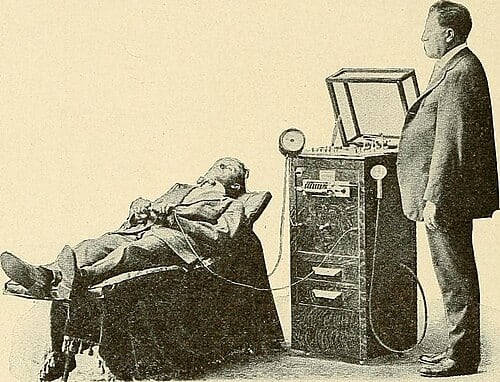
What the deep heat actually does is modest, real, and worth stating precisely because so much of this collection consists of effects that were invented by the marketing. Warming tissue a few degrees genuinely increases local blood flow as vessels dilate, raises the local metabolic rate, and makes dense fibrous tissue — the collagen of tendons, joint capsules and scars — more extensible, so that it stretches more easily and with less pain. Heat also has a straightforward analgesic and muscle-relaxing effect, easing spasm and the ache of stiff joints. These are the accepted benefits of therapeutic heat generally; diathermy’s contribution was simply to deliver that heat deep, to structures a hot pack cannot reach. Applied to muscle strain, joint stiffness, contracture and the slow business of rehabilitation, this is legitimate physical medicine, and modernised forms of it remain in use in physiotherapy today.
What the heat does not do is anything systemic or curative. It does not dissolve disease, kill infection, or reach the whole body; it warms the region in the field and nothing more. The gap between that honest, local, temporary effect and the sweeping mid-century claims made for diathermy — that it could treat deep infection or even cancer — is the entire moral of Vol 4, and the safety hazards that the very real heat could cause (deep burns, dangerous interactions with metal implants and pacemakers) are Vol 3’s. Here it is enough to fix the honest baseline: controlled deep warmth, useful for pain and stiffness, and nothing beyond that.
1.4 Heating versus cutting: the therapeutic unit and the surgical Bovie
The most important distinction this volume has to draw is the one the shared physics hides. A therapeutic diathermy machine and a surgical electrosurgery unit — the kind universally known in America as a “Bovie” — both work by pushing high-frequency current into tissue and both make heat. They are nonetheless different instruments with different purposes, and confusing them is the classic beginner’s error with these objects.
The difference is one of concentration and intent. Therapeutic diathermy spreads its energy over broad applicators and comparatively large volumes of tissue, aiming to raise the temperature by only a few degrees — enough to help, never enough to destroy. Surgical electrosurgery does the opposite: it concentrates the same kind of high-frequency current at the fine point of an active electrode so that the tissue immediately at the tip is heated intensely and near-instantly, to the point of cutting (vaporising a thin line of tissue) or coagulating (searing small vessels shut to stop bleeding). Same band of the spectrum; opposite dose. One warms a shoulder for fifteen minutes; the other parts tissue in a fraction of a second.
The surgical instrument’s history is well fixed. The engineer William T. Bovie, working at Harvard, developed the first practical commercial electrosurgical generator, and on 1 October 1926 the neurosurgeon Harvey Cushing used it at the Peter Bent Brigham Hospital in Boston to remove a head tumour — an operation in which controlling bleeding had long been the decisive obstacle. The device could both cut and coagulate, and it transformed neurosurgery; Bovie, famously, is said to have sold the rights to his invention for a single dollar. Electrosurgery generally runs in the high-frequency range from a few hundred kilohertz up toward a couple of megahertz — overlapping the lower end of the diathermy band — which is exactly why the two families of machine can look, on a schematic, so alike. It is also why British and Commonwealth usage muddies the water further by calling the surgical instrument itself “surgical diathermy,” a name that means electrosurgery and not the physiotherapy heater at all. The word is the same; the machine on the trolley is not.
For this collection the two lines share a common ancestor in the high-frequency apparatus of the 1890s and 1900s and then diverge by purpose. This dive follows the heating branch. The cutting branch — the Bovie and its descendants in every operating theatre today — belongs to the history of surgical instruments, and appears here only as the near-twin that clarifies, by contrast, what therapeutic diathermy is: a machine tuned to warm, never to wound.
1.5 Why this object earns its place
Set the diathermy machine beside its neighbours in this collection and its distinction is obvious. The violet-ray wand of the Violet Ray Wands dive produced a real glow, a real spark and a real smell of ozone, all of them trivial and none of them therapeutic. The galvanic appliances of the Electropathic Belts dive passed a current so feeble it did nothing at all. Diathermy is the counter-example: a high-frequency device whose central claimed effect — deep, controlled tissue heating with genuine benefit for pain, stiffness and rehabilitation — is physically real and clinically accepted. It is the device that shows the boundary between this wing and the Quack wing was never a wall. The same coil a door-to-door canvasser called a “health generator,” a physicist called a d’Arsonval apparatus and a hospital, disciplined and measured, turned into a legitimate diathermy machine.
That legitimacy is exactly why the object is worth five volumes rather than a footnote. Because diathermy really worked, and really deposited energy deep in living tissue, it also had the capacity to do real harm — to burn, to overheat tissue near metal, to interfere with implanted devices — and the effort to make it safe is one of the places where the practice of medical-device electrical safety was worked out. And because it really worked for some things, it was inevitably oversold for others, blurring at its edges back into the “high-frequency health” quackery it had grown out of. The honest device and the overreaching claims travelled together, and telling them apart is the work of the volumes that follow.
1.6 Where this volume hands off
You now have the object and its claim: a machine built to heat tissue through the skin, useful for the deep warmth that eases pain, loosens fibrous tissue and aids rehabilitation, and distinct from the surgical unit that uses the same high-frequency current to cut and coagulate. The next question is how the machine actually makes that current — the move from long-wave spark-gap generators to short-wave vacuum-tube oscillators, the frequencies they settled on, and the plate-versus-coil applicators that couple the energy in. That is Vol 2 — Longwave to Shortwave, Spark to Tube, which follows the hardware from Nagelschmidt’s era to the standardised short-wave band and carries a block diagram of a tube-oscillator diathermy set. From there the dive turns to what the heat does to tissue and the hazards that built device safety (Vol 3), the sober clinical record against the mid-century overreach (Vol 4), and the collector’s questions of identifying, dating and displaying a machine (Vol 5).
Sources
- Diathermy — Wikipedia — the Greek etymology (“heating through”); Karl Franz Nagelschmidt coining the term in 1908, his first patient experiments and 1913 textbook; von Zaynek’s 1899 proposal of high-frequency currents for deep heating; the long-wave / short-wave / microwave frequency bands; therapeutic effects (blood flow, muscle relaxation, joint stiffness); and the distinction between therapeutic diathermy and surgical “electrosurgery/electrocautery,” plus hazards (burns, implants, pacemakers, spinal-cord stimulators).
- Diathermy — Cleveland Clinic — a current clinical description: “deep heating,” short-wave / microwave / ultrasound types, the conditions treated (arthritis, chronic pain, muscle spasm, sprains/strains, edema), and the contraindications (metal implants, pacemakers, pregnancy, cancer, open wounds) — used for the “still in modified use today” framing and the honest scope of the benefit.
- “Electrosurgical in the Operating Room” — Harvey Cushing/John Hay Whitney Medical Library, Yale — the 1 October 1926 operation at Peter Bent Brigham Hospital, Boston; William T. Bovie as the Harvard engineer who built the first commercial electrosurgical generator; the unit’s dual cut/coagulate capability; and Cushing’s transformation of neurosurgical mortality.
- “Bovie, Cushing, and The Era of Electrosurgery” (Li & Isaacson, 2024) and William T. Bovie and electrosurgery (PubMed 8644002) — corroboration of the Bovie/Cushing chronology and the ~250 kHz–2 MHz high-frequency range used for cutting and coagulation, supporting the overlap-yet-distinction argument with therapeutic diathermy.
- Diathermy set, United Kingdom, 1930 — Science Museum Group Collection (co143473) and Short-wave diathermy apparatus — Science Museum Group Collection (co137660) — museum specimens of period diathermy apparatus (oak-cased sets, electrode leads, Stanley Cox short-wave units used in physiotherapy practice) grounding the physical description and the figure plan.
- Diathermy — Smithsonian National Museum of American History (object nmah_1985196) — a US museum record of a diathermy machine, cited for the object’s appearance and period context (fetch blocked, listing consulted via search).
Comments (0)