Diathermy Machines · Volume 2
Longwave to Shortwave, Spark to Tube
How the diathermy machine grew up: Nagelschmidt naming the field around 1908, the noisy spark-gap long-wave sets of the 1910s, the vacuum-tube short-wave oscillators that settled on 27.12 MHz, and the later reach into the microwaves — and why the energy came to be coupled through plates and coils rather than pressed against bare skin.
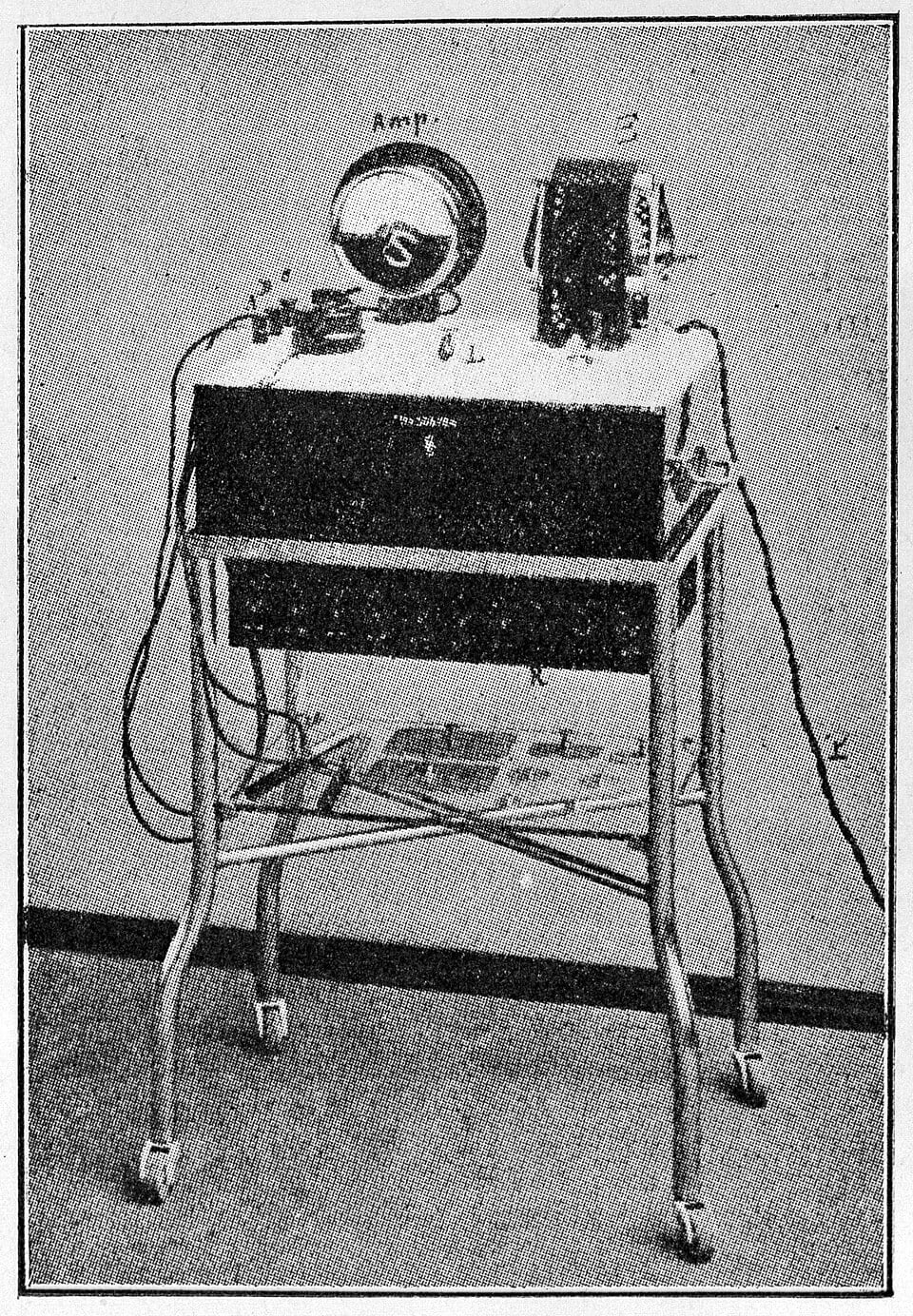
Contents
2.1 About this volume
Vol 1 — Heating Through established what diathermy is: a machine built to deposit controlled heat deep inside living tissue, distinct from the surgical unit that uses the same high-frequency current to cut. This volume follows the hardware across the roughly forty years in which it grew from a noisy laboratory curiosity into a standardised clinical instrument. The through-line is a single engineering ambition — push the frequency higher, and make the delivery of the energy cleaner and safer — pursued across two great technological shifts: long wave to short wave, and spark to tube.
Those two shifts are not the same event, though they happened close together. The move from long to short wavelength is a change in frequency; the move from spark gap to vacuum tube is a change in the device that generates the oscillation. They travelled together because the second made the first practical: a spark gap can only be pushed so high and stays crude and damped, whereas a triode valve can be made to oscillate cleanly at frequencies a spark could never reach. By the end of the story the field had also reached past radio frequencies entirely, into the microwaves.
Everything here is engineering history, not a manual. What the resulting heat does to nerve, muscle and tissue — and the burns and hazards that drove the safety rules — is Vol 3 — What It Does to Tissue; the sober clinical record against the mid-century overclaims is Vol 4; and how a collector tells one generation of machine from another is Vol 5. This volume is the account of how the machine came to make its current.
2.2 Nagelschmidt and the long-wave era
The field acquired its name from the German physician Karl Franz Nagelschmidt, who is credited with coining diathermy — Greek for “heating through” — in 1908, performing the first extensive treatment of patients with high-frequency current, and writing the first textbook on the subject in 1913 (Wikipedia, “Diathermy”). The year is not perfectly firm: at least one physiotherapy-history source dates his introduction of the term to 1907 (history.physio), and both the coinage and the priority rest on secondary and encyclopaedic accounts rather than a settled run of primary papers, so “around 1908” is the honest form of the claim.
Nagelschmidt worked with the only high-frequency apparatus that existed: the spark-gap machines of the d’Arsonval, Oudin and Tesla lineage covered in the High Frequency Currents dive. A capacitor charged to a high voltage discharged across a spark gap, ringing an oscillating circuit and producing a damped train of high-frequency waves. Machines of this first generation are what the field later called long-wave (or long-wave) diathermy, and their frequencies were comparatively low — sources put the long-wave band at roughly 0.1–2 MHz, and note that these “noisy spark-discharge Tesla coil and Oudin coil machines were used” until the 1920s (Wikipedia, “Diathermy”). The output was applied through contact electrodes pressed directly against the body, and that direct contact “could cause skin burns” — a limitation that shaped everything that followed.
The long-wave era is therefore the diathermy machine wearing its inheritance on its sleeve. It looked like, and largely was, the hospital high-frequency apparatus of the 1900s, redirected from producing sparks and ozone toward producing measured deep heat. Its two weaknesses — a crude, damped, hard-to-control waveform and burn-prone contact electrodes — set the agenda for the next thirty years.
2.3 The vacuum-tube turn: short-wave diathermy
The decisive change came with the thermionic vacuum tube. Where a spark gap generates a messy, damped burst of oscillation and cannot be pushed to very high frequency, a triode valve arranged as a feedback oscillator produces a continuous, clean, tunable wave and will happily run at frequencies far beyond a spark’s reach. As radio engineering matured through the 1910s and 1920s the same valves that carried broadcasting were turned to medicine, and “in the 1920s the development of vacuum tube machines enabled frequencies to be increased to 10–300 MHz, a range called ‘shortwave’ diathermy” (Wikipedia, “Diathermy”).
The pivotal work is usually placed in Germany in 1928. The physicist Abraham Esau, at Jena, built for the clinician Erwin Schliephake, at Giessen, apparatus reported as capable of delivering on the order of 400 watts at about 100 MHz (history.physio; ETHW, “Biological Effects of Electromagnetic Radiation”). Esau supplied the engineering and the electrode arrangements; Schliephake carried the technique into clinical use, famously making the first human application on himself — using air-spaced electrodes of the kind still used later — and reporting that it cleared a furuncle (a boil) on his own nose. For that he is often called the creator of short-wave diathermy. (The 400 W / 100 MHz figures and the exact division of credit between the two men come from history-of-physiotherapy summaries rather than primary instrument records, and are best read as the received account.)
Short-wave diathermy is thus the diathermy machine coming of age as a piece of radio technology. The higher frequency did real work: it penetrated more usefully, it made the muscle-and-nerve response of ordinary shock even less relevant, and — the point most stressed at the time — it allowed the energy to be delivered without a direct galvanic-contact electrode at all, which is where the burn problem finally began to yield.
2.4 Anatomy of a tube-oscillator set
Because this volume’s brief is to make the tube-oscillator machine legible, the diagram below traces its stages. Nothing in it is a build instruction; it is a reading aid for a museum cabinet.
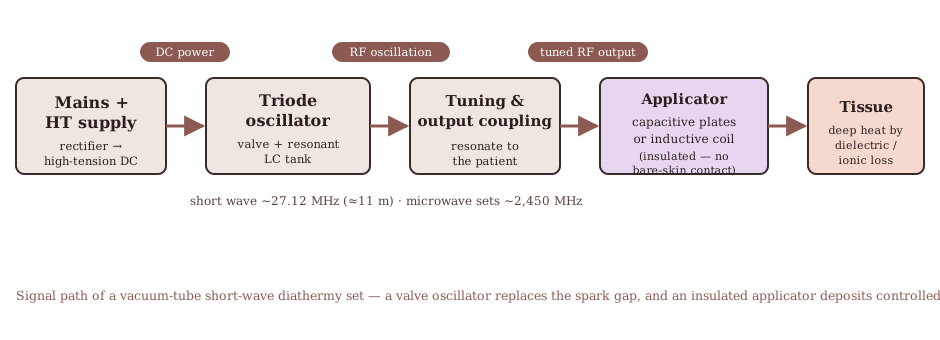
Mains and high-tension supply. The set plugs into ordinary mains, but the oscillator wants smooth, high-voltage direct current, so the first stage is a power supply — a transformer and rectifier (itself often a valve) producing high-tension DC to feed the oscillator’s anode.
The triode oscillator and its tank. The heart of the machine is one or more triode valves wired as a feedback oscillator around a resonant tank — an inductor and capacitor whose values set the natural frequency at which the circuit rings. This is the part that replaces the spark gap: instead of a capacitor dumping across a gap in damped bursts, the valve sustains a continuous oscillation, and the tank determines its frequency. This is why a short-wave set presents a tidy panel of dials and a meter rather than the crackling spark and rotary gap of the earlier machines.
Tuning and output coupling. The patient, plus the applicators and leads, form part of the resonant system, so the machine carries a tuning control that the operator adjusts until the output circuit resonates with the patient’s circuit — the moment the panel meter peaks. Coupling the output loosely to the patient circuit, rather than wiring it in hard, is part of what keeps the delivery controlled.
The applicator. The tuned radio-frequency output finally reaches the applicator — capacitive plates or an inductive coil or drum — discussed in its own section below.
2.5 Taming the spectrum: 27.12 MHz and the ISM bands
A machine that oscillates in the short-wave radio range is, from the point of view of the wider world, a radio transmitter — an unintentional one, but a powerful one, and hospitals full of them interfered with broadcasting and communications. The resolution was regulatory: reserve specific frequencies for Industrial, Scientific and Medical (ISM) use, so that any device could radiate freely within a narrow band without disrupting the spectrum around it. The ISM bands were formalised internationally at the International Telecommunication Union conference in Atlantic City in 1947, precisely because devices such as medical diathermy sets and the nascent microwave oven needed somewhere to sit (ISM radio band, Wikipedia).
The band that came to be identified with short-wave diathermy is 27.12 MHz — a wavelength of about 11 metres — sitting in the ISM allocation running from roughly 26.957 to 27.283 MHz. It is one of a family of reserved short-wave ISM frequencies that also includes 13.56 and 40.68 MHz (Wikipedia, “Diathermy”). Twenty-seven megahertz became the de facto clinical standard for short-wave therapeutic heating, and it remains the frequency modern short-wave diathermy equipment is built around. It is worth being precise about what the standard is: not a claim that 27.12 MHz is medically optimal, but an administrative choice of a protected slice of spectrum in which the machines could legally and quietly operate. The physiology did not pick the number; the radio regulators did.
2.6 Into the microwaves: 2,450 MHz
The last step took diathermy past radio frequencies altogether. The Second World War produced compact, powerful microwave sources — the cavity magnetron built for radar — and in its aftermath that hardware was turned, like the valve before it, to medicine. Microwave diathermy operates far above the short-wave band, at about 2,450 MHz (a wavelength of roughly 12 cm). In the United States that frequency was made available for therapeutic use in 1946, in the same window in which the Federal Communications Commission was clearing 2,450 MHz for Raytheon’s new “Radarange” microwave oven (ETHW; Microwave oven, Wikipedia). Early clinical investigators, working with apparatus supplied by Raytheon, reported their microwave-heating experiments under the mouthful microkymatotherapy (Mayo Clinic Proceedings, 1946).
Microwaves interact with tissue differently from short waves — very generally, they are absorbed more strongly and in shallower, more selective volumes, which is both their attraction and their limitation. (One frequently repeated figure holds that water absorbs 2,450 MHz energy on the order of thousands of times more strongly than it absorbs 27 MHz; the precise multiplier varies between sources and is best treated as illustrative rather than exact.) For a museum reader the significant point is simply that by the late 1940s “diathermy” spanned three quite different regimes — long wave, short wave and microwave — each defined by its frequency and each with its own applicators and its own tissue behaviour.
2.7 Plates or coils: coupling the field without contact
Running through the whole hardware story is a second theme as important as frequency: how the energy gets into the body. The long-wave machines pressed metal electrodes directly onto the skin, and that direct contact concentrated current and caused burns. The great practical gift of the short-wave era was that its energy could be coupled into tissue without a bare-metal contact, through insulated applicators of two broad kinds (Wikipedia, “Diathermy”).
The first is capacitive coupling: two plate electrodes, insulated from the skin, placed on either side of the body part, so that the tissue between them becomes the dielectric of a capacitor sitting in the machine’s oscillating field. The second is inductive coupling: a coil, cable or flat “drum” applicator laid against the area, whose alternating magnetic field induces circulating (eddy) currents within the tissue, which then heats. The two methods share a purpose — deposit energy in the depth without a burn-prone point of metal-to-skin contact — but they favour different tissues, and telling a capacitive-plate machine from an inductive-drum one is one of the clearest ways a collector dates and classifies a surviving set, which is Vol 5’s work.
This is also where the diathermy machine finally, cleanly separated itself from its retail cousin. The glowing contact electrode of a drugstore “violet ray” wand — the Violet Ray Wands dive — kept the surface spark and the theatre; the hospital diathermy set threw both away in favour of an insulated plate or coil delivering measured deep heat. Same lineage of high-frequency apparatus; opposite destinations. And the feeble galvanic appliances of the Electropathic Belts dive, which passed a current too small to warm anything, stand at the far end from a 400-watt short-wave oscillator that genuinely could.
2.8 Where this volume hands off
You now have the machine’s technological arc: from Nagelschmidt’s spark-gap long-wave sets of around 1908, through the vacuum-tube short-wave oscillators pioneered by Esau and Schliephake in 1928 and standardised onto the protected 27.12 MHz ISM band, to the post-war microwave sets at 2,450 MHz — with the energy coupled ever more by insulated plates and coils rather than pressed against the skin. What none of this has yet explained is what actually happens where that energy lands: how a radio-frequency field becomes heat inside living tissue by dielectric and ionic loss, what that heat does and does not do, and how the very real capacity of these machines to burn — especially near metal implants — drove the safety and regulatory practice that much of medical-device engineering inherited. That is Vol 3 — What It Does to Tissue. From there the dive turns to the sober clinical record against the mid-century overreach (Vol 4) and to identifying, dating and displaying the machines themselves (Vol 5).
Sources
- Diathermy — Wikipedia — Nagelschmidt coining “diathermy” in 1908 and his 1913 first textbook; the long-wave band (~0.1–2 MHz, spark-discharge Tesla/Oudin machines used until the 1920s) with burn-prone contact electrodes; the 1920s vacuum-tube short-wave machines at 10–300 MHz with energy coupled via inductive coils or capacitive plates to reduce burns; and the short-wave ISM frequencies including 27.12 MHz.
- Short wave diathermy — history.physio — an alternative date (1907) for Nagelschmidt’s introduction of the term (used to hedge the coinage year), and physiotherapy-history framing of the long-wave-to-short-wave transition.
- Biological Effects of Electromagnetic Radiation — Engineering and Technology History Wiki (ETHW) — the 1928 Esau (Jena) / Schliephake (Giessen) short-wave apparatus (~400 W at ~100 MHz), Schliephake’s self-treatment, and the emergence of microwave diathermy at 2,450 MHz after the war. (Consulted via search summary; direct fetch was blocked.)
- ISM radio band — Wikipedia — the formalisation of the Industrial, Scientific and Medical bands at the 1947 ITU Atlantic City conference, driven partly by diathermy interference, and the 27.12 MHz / 26.957–27.283 MHz allocation.
- Microwave oven — Wikipedia — the 1946 FCC clearance of 2,450 MHz and Raytheon’s Radarange, contemporaneous with microwave diathermy’s arrival at the same frequency.
- Microkymatotherapy: heating effect of microwaves (“radar”) in living tissues — Mayo Clinic Proceedings, 1946 — a primary post-war report of microwave (2,450 MHz) tissue heating using Raytheon apparatus, supporting the microwave-diathermy origin date and the “microkymatotherapy” naming.
- Diathermy — Britannica — general corroboration of the short-wave/microwave frequency framing and the deep-heating principle.
- Cross-references named in prose, not linked: the High Frequency Currents, Violet Ray Wands, and Electropathic Belts dives — for the spark-gap d’Arsonval/Oudin/Tesla lineage the long-wave machines inherited, and the retail high-frequency devices from which the hospital diathermy set diverged.
Comments (0)