Diathermy Machines · Volume 4
The Honest Heat and Its Overreach
Where diathermy's real clinical record ends and the mid-century salesmanship begins — the brief, brutal era when deep heat genuinely fought infection, the cancer and cure-all claims that outran the physics, and the safety and regulatory story that followed.
Contents
4.1 About this volume
The three volumes before this one built a machine and a physiology: what diathermy is — deep heat delivered through the skin by high-frequency current (Vol 1 — Heating Through); how the hardware moved from spark-gap long-wave sets to vacuum-tube short-wave oscillators (Vol 2 — Longwave to Shortwave, Spark to Tube); and what the heat does to living tissue, together with the burns and hazards that follow from the fact that it genuinely deposits energy inside the body (Vol 3 — What It Does to Tissue). This volume is about the claims — where the honest, defensible record of diathermy ends and the mid-century overreach begins.
That boundary matters more here than in almost any other object in this collection, because diathermy is the rare case where the line is not obvious. A violet-ray wand did nothing systemic and never could; the argument there is simply promise versus physics. Diathermy is harder. It really warmed deep tissue, that warmth really helped some conditions, and — for a brief window before antibiotics — its heat really did fight certain infections. The task of this volume is to hold the genuine effect and the salesmanship apart without flattening either into the other, and then to lay out plainly the safety and regulatory story that grew up around a device powerful enough to help and to harm. Nothing here is medical advice; it is the history of how a legitimate heater’s claims were tested, and where they broke.
4.2 The honest core: what diathermy could really do
The defensible record is narrow and was set out in Vol 1: controlled deep heating raises local blood flow, relaxes muscle, eases the pain and spasm of stiff joints, and makes fibrous tissue — tendon, joint capsule, scar — more extensible so it stretches with less pain. Applied to muscle strain, joint stiffness, contracture and the slow work of rehabilitation, that is real physical medicine, and it survives in modernised form in physiotherapy departments today. The Cleveland Clinic still describes short-wave, microwave and ultrasonic diathermy as tools for arthritis pain, muscle spasm, sprains and strains — with heat as the whole of the mechanism, and with a list of contraindications (metal implants, pacemakers, pregnancy, cancer, open wounds) that is itself a quiet catalogue of the ways the heat can go wrong.
Two features of that honest core are worth fixing before the overreach is described, because every exaggeration is a distortion of one of them. First, the effect is local: diathermy warms the region in the applicator’s field and nothing beyond it, reaching no organ it is not aimed at. Second, the effect is temporary and symptomatic: it relieves pain and stiffness while tissue is warm, but cures no underlying disease of the joint or muscle. Keep those two limits in mind — local, and symptomatic — and each mid-century claim below reads as the erasure of one or the other.
4.3 Fever therapy: the “treats infection” claim that briefly had teeth
The most surprising thing a modern reader learns about diathermy is that “it treats infection” was, for perhaps fifteen years, not a lie. It was a real and terrible therapy, and it rested on a Nobel Prize.
In 1917 the Austrian psychiatrist Julius Wagner-Jauregg began deliberately infecting patients who had general paresis of the insane — the dementia of late (tertiary) neurosyphilis, then untreatable and fatal — with Plasmodium vivax, the mildest malaria parasite, to induce repeated high fevers, afterwards halting the malaria with quinine. The startling result was that a substantial minority of these otherwise-doomed patients improved. Wagner-Jauregg received the 1927 Nobel Prize in Physiology or Medicine for the work, the only psychiatrist so honoured for most of the century. The insight that matters for diathermy came later: it was the heat itself, the sustained high body temperature, not the malaria, that was doing the work — the syphilis spirochete is heat-sensitive. Reported outcomes for malaria fever therapy vary across the literature but sit broadly around a 50–80% rate of remission or improvement, against a treatment mortality of roughly 10–15% — a hazard that tells you how desperate the alternative was. (These figures come from review sources and should be read as the received range, not exact tallies.)
If heat was the agent, then heat could be delivered without a second disease — and here diathermy walked directly onstage. Through the 1930s, physicians raised patients’ whole-body temperature by physical means: artificial-fever cabinets such as the Kettering hypertherm, which circulated hot, humid air to bring the body to a high fever for hours, and short-wave diathermy, whose radio-frequency field could heat the body’s core from within. The two were often combined. Fever therapy by these means was turned on gonorrhea as well as neurosyphilis: a representative 1930s protocol held patients at about 41 °C for several hours, over three or four sessions, and the best-documented series (Owens, 1936) recorded 52 cures among the 64 patients who completed treatment — an 81% figure — with a meaningful fraction unable to tolerate the ordeal at all; scattered, less rigorous period reports claimed cure rates ranging higher still, but the antibiotic-era ~95% figures belong to drug therapy, not fever therapy. Judged against the untreated natural history of these diseases, those were genuine results, and the therapy was mainstream physical medicine, not quackery.
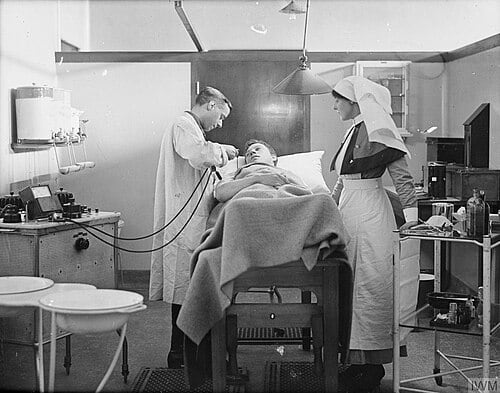
What ended it was not scandal but a better tool. Sulfonamides arrived for gonorrhea in the later 1930s, and penicillin became widely available for both gonorrhea and syphilis during and just after the Second World War. Against a drug that cured the same infections in days, cheaply, safely and without roasting the patient, fever therapy had no argument, and it was effectively obsolete by the mid-1940s. This is the pivotal fact of the whole overreach story: diathermy’s single legitimate claim against infection was real, was superseded by antibiotics, and then — this is the trap — went on being asserted long after the ground beneath it had gone. A claim that was true in 1936 was quackery by 1950, unchanged in its wording and wholly changed in its truth.
4.4 When the claims outran the physics: cancer and cure-all
The heat that could fight a heat-sensitive microbe invited an obvious, fateful extrapolation: if warmth kills the spirochete, might it not kill the tumour? There was even a thread of real laboratory work behind the question — as early as 1933 the U.S. Public Health Service investigator J. W. Schereschewsky reported that high-frequency electromagnetic heating could inhibit or destroy transplanted tumours in mice. Modern oncology has, in fact, made a disciplined descendant of exactly this idea: clinical hyperthermia, in which tumour tissue is deliberately warmed to roughly 40–45 °C as an adjunct to radiotherapy and chemotherapy for certain accessible tumours — a real, evidence-based, tightly controlled specialty, and a genuine (if distant) heir of the diathermy field.
The mid-century overreach was not that idea; it was the leap from “heat can, under exacting conditions and as an adjunct, damage some tumours” to “diathermy cures cancer” — the local, adjunctive, laboratory-scale effect inflated into a systemic cure sold to a walk-in patient. It was the same erasure of the two honest limits from the previous section: the local effect claimed as whole-body, the adjunctive and symptomatic effect claimed as curative. The same inflation attached diathermy to a widening roster of internal disease — pelvic and prostatic complaints, “toxaemia,” chronic infection generally — for which the machine offered only regional warmth and the marketing offered a cure. None of this had the physiological footing of the fever-therapy era; it was the language of that era, retained for its authority and applied where it did not belong.
The point is not that diathermy was fraudulent, but that a genuinely useful heater was pushed steadily past what its heat could do — and that the further the claims travelled from “deep, local, temporary warmth,” the more they came to resemble the frank quackery this sub-project catalogues.
4.5 The blur with “high-frequency health”
At its outer edge, diathermy’s overreach did not merely resemble the quack trade — it merged with it. This is the porous boundary the collection insists on. The generator inside a hospital short-wave diathermy cabinet and the generator inside a drugstore “high-frequency health” appliance were, at bottom, the same kind of thing: a high-frequency oscillator. What differed was calibration, dosage, supervision and honesty. A physiotherapist’s apparatus was tuned, metered and aimed at a measured therapeutic temperature; the mail-order “health generator” was sold on the idea of high-frequency energy as vitality, with no measured dose and no defensible target.
The clearest cases of this blur are catalogued elsewhere in the project, and belong there rather than duplicated here. The Violet Ray Wands dive follows the handset that borrowed high-frequency prestige to sell a glowing spark as a cure for everything from baldness to cancer; the Electropathic Belts dive follows the wearable “body battery” that promised vitality from a current too feeble to do anything at all. Diathermy sits on the respectable side of that boundary — it delivered a real, measurable dose of useful heat — but its cure-all fringe reached across the line to shake hands with the wands and belts. The lesson the diathermy story teaches the quack wing is that the difference between medicine and marketing here was never the physics. It was the discipline: a measured dose, an honest claim, and a stopping point.
4.6 Burns, implants, and the safety record
Because diathermy’s heat was real, so were its hazards, and the safety record is inseparable from the regulatory one. The dominant risk was always the burn — a device that deposits energy deep in tissue can overheat it, and concentration of the field at a bad contact, at moisture, or at a boundary between tissue types could injure well below an intact, comfortable-feeling skin surface. That danger is why, as traced in Vol 3, the field moved toward capacitive plates and inductive drums that need no firm skin contact.
Two hazards particular to this volume’s period followed from metal and implanted electronics. Metal in the field — a surgical implant, a fragment, even jewellery — could concentrate heating and burn the surrounding tissue, which is why diathermy is contraindicated over implants. Far more serious, as implanted electronics became common, was the interaction with cardiac pacemakers, and later spinal-cord stimulators: the radio-frequency field could couple into the device and its leads, and in the case of a stimulator, transferred energy at the electrode has been described as capable of causing severe injury or death. Microwave diathermy carried the added liability that, for all its higher frequency, it penetrated tissue relatively poorly — heating the surface more than the depth — and it, together with occupational concern about radio-frequency exposure of the staff standing beside these emitters all day, saw microwave and some short-wave applications recede over the second half of the century. The device that had once been pushed as a near-universal remedy was, in the end, hemmed in by a growing list of the specific, real ways its genuine energy could hurt.
4.7 The regulatory arc: from the 1938 Act to “nonthermal shortwave therapy”
The legal story runs on the same track as the Violet Ray Wands dive, and the two should be read together. The Federal Food, Drug, and Cosmetic Act of 1938 first extended federal jurisdiction to medical devices, making a machine’s therapeutic labelling actionable if it claimed what it could not deliver. That gave the government, for the first time, a lever against a diathermy machine sold as a cure for infection or cancer.
The decisive structural change came with the Medical Device Amendments of 1976, which sorted devices into three risk classes and required pre-market review. Under that framework, diathermy for its honest purpose — generating deep heat — settled into Class II as a physical-medicine device with recognised standards. The regulation is most revealing, though, in what it did with diathermy’s dishonest fringe. Devices sold as “shortwave diathermy for all other uses” — that is, short-wave apparatus claiming benefit by some mechanism other than heating, the so-called non-thermal or “pulsed” effect — were treated as the highest-risk Class III category, unproven and requiring full pre-market approval. In 2015, after decades of that limbo, the FDA reclassified these “all other uses” devices into Class II with special controls and pointedly renamed the category “nonthermal shortwave therapy,” severing it by name from diathermy — which means heating — precisely because the claimed non-heating benefit was what remained in doubt. The naming is the whole argument in miniature: the part of the field that was about heat had earned a settled, regulated clinical place; the part that claimed to help without heat was quietly walled off under a different name. The shortwave band itself, meanwhile, had long since been pinned down: the standardised industrial-scientific-medical allocation of 27.12 MHz (with related bands such as 13.56 and 40.68 MHz) became the workhorse frequency, and microwave apparatus its 915 MHz and 2.45 GHz cousins.
The 1938 Act made lying about a device illegal; the 1976 Amendments made a device prove itself by class; and the regulatory handling of diathermy ratified exactly the boundary this volume has drawn — the deep-heating claim kept its clinical licence, and everything that reached beyond heat was required either to prove itself or to stop calling itself diathermy at all.
4.8 Where this volume hands off
This volume drew the line the whole dive was building toward: on one side, diathermy’s honest record — local, temporary, symptomatic deep heat, useful for pain and stiffness and, for one brutal pre-antibiotic decade, genuinely effective against heat-sensitive infection; on the other, the mid-century overreach that inflated that record into cures for cancer and disease at large, and at its fringe merged with the “high-frequency health” quackery of the Violet Ray Wands and Electropathic Belts. The safety hazards and the regulatory arc from 1938 to 2015 traced that same boundary in law.
The final volume returns the machine to the present as an object. Vol 5 — Collecting Diathermy Machines is about identifying, dating and displaying the surviving hardware: the cased short-wave units with their dials and pad or plate electrodes, the 1920s spark-gap sets and the tungsten spark gaps that outlive them as collector items, and the working distinction between an inductive-drum and a capacitive-plate applicator. It closes the dive where a collection should — with the thing itself on the shelf, its claims understood, its history told straight.
Sources
- Diathermy — Wikipedia — the standardised short-wave ISM bands (13.56, 27.12, 40.68 MHz) and microwave bands (915 MHz, 2.45 GHz); the poor penetration of microwave diathermy; hazards and contraindications (burns, metal implants, pacemakers, spinal-cord stimulators); and the note that diathermy hyperthermia (41–45 °C) is used adjunctively with radiotherapy/chemotherapy for superficial tumours.
- Diathermy — Cleveland Clinic — the current, honest clinical scope: short-wave/microwave/ultrasonic deep heating for arthritis, muscle spasm, sprains and strains, with heat as the mechanism, and the contraindication list (metal implants, pacemakers, pregnancy, cancer, open wounds) used to fix the “local and symptomatic” limits.
- Therapeutic hyperthermia for the treatment of infection — a narrative review (PMC10410565) — Wagner-Jauregg’s malaria fever therapy from 1917, the recognition that heat per se (not malaria) was the agent, the ~50–80% improvement range against ~10–15% treatment mortality; the 1930s shift to physical fever induction (Kettering hypertherm and short-wave diathermy) for gonorrhea; the ~41 °C protocol, the Owens 1936 series (52 cures of 64 completing, 81%), and antibiotics rendering fever therapy obsolete.
- Nobel Prize in Physiology or Medicine 1927 — Julius Wagner-Jauregg (nobelprize.org) and Julius Wagner-Jauregg — Britannica — confirmation of the 1927 Nobel award for fever/malaria therapy of neurosyphilis (general paresis).
- “Medicine: Fever Therapy” — TIME archive and Fever Therapy in Venereal Diseases (stdpioneer.org) — period framing of artificial-fever/diathermy therapy for venereal disease before antibiotics, corroborating the fever-cabinet and short-wave-diathermy methods and their cure-rate claims.
- Physical Medicine Devices; Reclassification of Shortwave Diathermy for All Other Uses, Henceforth To Be Known as Nonthermal Shortwave Therapy — Federal Register, 2015 and 21 CFR Part 890 — Physical Medicine Devices (eCFR) — the Class III preamendments status of “shortwave diathermy for all other uses” under the 1976 Medical Device Amendments, its 2015 reclassification to Class II with special controls, and the renaming to “nonthermal shortwave therapy,” used for the non-thermal/pulsed-claim regulatory argument.
- Part II: 1938, Food, Drug, Cosmetic Act — FDA and History of Medical and Radiation-Emitting Device Regulation — FDA — that the 1938 FDCA first brought devices under federal authority and the 1976 Amendments established the three-class risk framework and pre-market review.
- Schereschewsky’s 1933 report of high-frequency electromagnetic heating inhibiting transplanted mouse tumours — cited via period and secondary summaries as the laboratory seed of the diathermy-and-cancer idea and of modern clinical hyperthermia; flagged below for primary confirmation.
Comments (0)