Diathermy Machines · Volume 3
Into the Tissue: The Heat, and the Hazards That Wrote the Rules
How a radio-frequency field becomes warmth inside living tissue — ionic and dielectric loss, the real analgesic and circulatory effects, and the burns, implant interactions and exposure concerns that turned diathermy into an early proving ground for medical-device safety.
Contents
3.1 About this volume
Vol 1 — Heating Through established the object and its honest claim: a machine built to warm tissue through the skin. Vol 2 — Longwave to Shortwave, Spark to Tube followed the hardware from Nagelschmidt’s spark-gap generators of around 1908 to the vacuum-tube short-wave oscillators of the later 1920s and the standardised bands they settled on. This volume goes inside the patient. Its questions are physical and physiological: how a radio-frequency field turns into heat once it enters living tissue, what that heat actually accomplishes in nerve, muscle and vessel, and why the very reality of the effect made diathermy dangerous in ways that shaped how medical electrical devices came to be regulated.
That last point is the heart of it. Almost everything else in this collection is harmless because it does nothing: the violet-ray wand of the Violet Ray Wands dive glows and sparks to no clinical purpose; the galvanic appliance of the Electropathic Belts dive passes a current too feeble to matter. Diathermy is the opposite case. It works — it deposits real energy deep in the body — and a device that can genuinely warm tissue from within can genuinely burn it. The safety literature of diathermy is therefore not the debunking of a fraud but the clinical record of a real tool being made safe, and it is worth reading on its own terms. The mid-century over-claims for diathermy, and the formal regulatory history, belong to Vol 4 — Legitimate Physiotherapy vs. Overreach; here the subject is the physics of the heating and the physical hazards that follow directly from it.
3.2 From field to warmth: ionic and dielectric loss
An oscillator — a spark gap in the early long-wave sets, a triode tube in the short-wave machines that replaced them — drives a resonant tank circuit that rings at radio frequency, and that oscillating energy is coupled into the body. Once the field is inside the tissue, the tissue itself becomes the heat source through two distinct physical mechanisms, and the balance between them shifts with frequency.
The first is ionic (conductive) loss. Body tissue is an electrolyte: its fluids are full of dissolved ions — sodium, potassium, chloride — that are free to move. An alternating field drives these ions back and forth, and as they are jostled through the crowded, resistive medium of the tissue they dissipate energy as heat, exactly as current heats a resistance wire. This is ordinary Joule heating, and it is the dominant mechanism at the lower frequencies of the old long-wave machines (roughly 0.1–2 MHz), where the field mostly just pushes conduction currents through the tissue.
The second is dielectric loss. Tissue also contains a great many polar molecules — water above all — that behave like tiny electrical dumb-bells with a positive and a negative end. An alternating field tries to twist each of these into alignment, and because the field reverses millions of times a second the molecules are wrenched back and forth, colliding with their neighbours and shedding the energy of that agitation as heat. This is the same effect a microwave oven uses on food. Dielectric loss is negligible at the low long-wave frequencies but becomes increasingly important as the frequency climbs into the short-wave (tens of MHz) and microwave (hundreds to thousands of MHz) ranges. Real tissue heating in a short-wave machine is a mixture of both mechanisms; the useful mental model is simply that the current makes the ions jostle and the field makes the water molecules churn, and both come out as heat where you least expect it — deep inside, not at the surface.
That “deep, not at the surface” is the whole clinical point, established in Vol 1, and it is also the whole hazard, developed below. A hot pack heats the skin and cannot reach far; diathermy passes the surface with comparatively little effect and deposits its energy where the tissue is most lossy — which is not always where the therapist intends.
3.3 Where the heat lands: coil versus plate
The two families of applicator introduced in Vol 1 and Vol 2 do not merely couple the energy differently; they heat different tissues, and understanding this is the difference between a treatment and a burn.
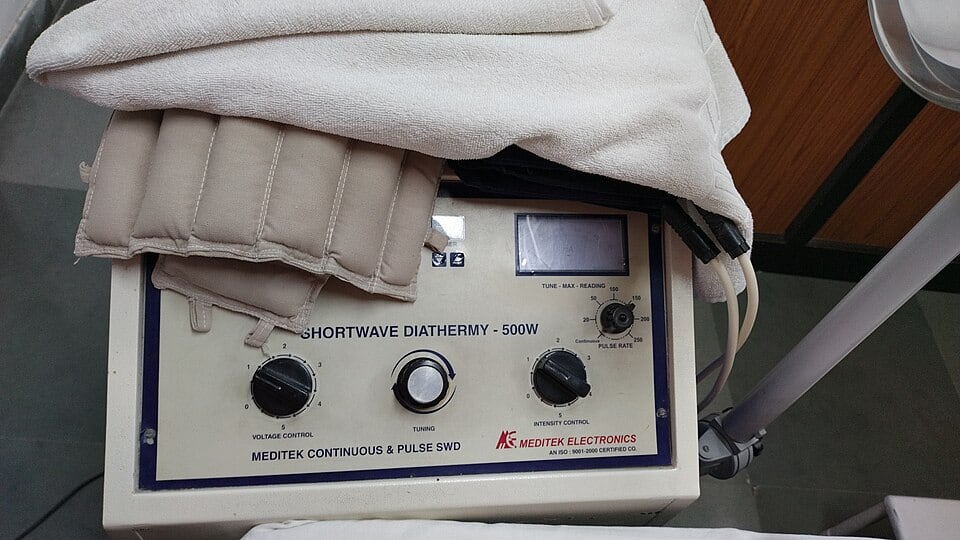
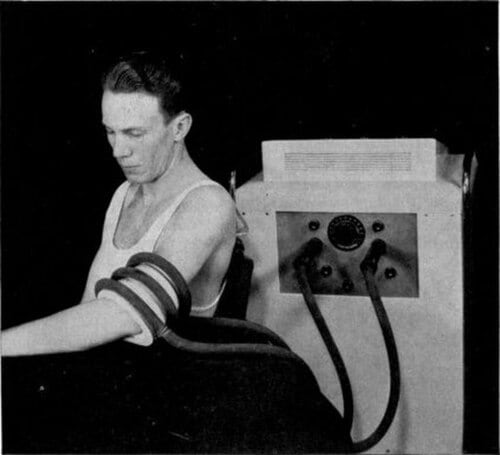
An inductive applicator — a coil, cable or flat “drum” laid against the body — works by its oscillating magnetic field, which induces circulating eddy currents in the tissue. Eddy currents flow most freely where conductivity is highest, and the most conductive tissues are the water- and electrolyte-rich ones: skeletal muscle and blood. An inductive applicator therefore heats muscle preferentially, while the poorly conducting layers of skin and subcutaneous fat stay relatively cool.
A capacitive applicator — rigid plates or pads placed on either side of the part, with the tissue between them acting as the dielectric of a capacitor — works by its oscillating electric field. Here the heating concentrates by a different rule, and the field tends to deposit more of its energy in the water-poor tissues it must cross: skin and subcutaneous fat, which heat more than the muscle beneath. Because the patient sits electrically between the plates, the patient becomes, in effect, part of the machine’s circuit — a fact that matters enormously for safety.
This selectivity is genuine and measurable — controlled studies of short-wave methods find the largest muscle-temperature rises under inductive coils and the largest skin-temperature rises under capacitive plates — but it is a tendency, not a guarantee, and it is easily defeated. Anything that locally raises conductivity or concentrates the field — a bead of sweat, a moist skin fold, a metal object — overrides the intended pattern and pulls the heat to a point. That is the bridge from physiology to hazard.
3.4 What the heat genuinely does — and does not
Before the hazards, the honest benefit, stated precisely because so much of this collection is built of invented effects. Raising the temperature of deep tissue by a few degrees does a small number of real things. Warmed blood vessels dilate, so local blood flow increases; the local metabolic rate rises; dense collagenous tissue — the fibrous stuff of tendons, joint capsules and old scars — becomes more extensible, stretching further and more comfortably; and heat has a direct analgesic and muscle-relaxing action, easing spasm and the ache of stiff joints. These are the accepted effects of therapeutic heat in general. Diathermy’s specific contribution was to deliver that heat to structures a surface application cannot reach, which is why modernised forms remain in legitimate use in physical medicine, as Vol 1 set out and Vol 4 documents.
What the heat does not do is anything systemic, curative or selective toward disease. It warms the region in the field; it does not sterilise infection, dissolve tumours, or reach the body as a whole. The distance between that modest, local, temporary effect and the sweeping claims later made for diathermy is the subject of Vol 4. The tell is preserved even in the current regulatory language: the U.S. Food and Drug Administration’s own device definitions describe diathermy as intended to generate deep heat “for the treatment of selected medical conditions such as relief of pain, muscle spasms, and joint contractures, but not for the treatment of malignancies” — a phrase that is itself a fossil of an old over-claim, corrected in law.
3.5 The hazards that wrote the rules
Everything that makes diathermy useful also makes it dangerous, and the catalogue of its hazards reads as a straight consequence of the physics above.
Burns. This is the oldest and most direct hazard. The earliest long-wave machines applied current through metal contact electrodes pressed to the skin; where contact was uneven the current crowded into small areas and burned them, which was one of the pressures that drove the whole field toward the coupled coil-and-plate applicators of Vol 2. But coupling did not abolish the danger, it relocated it. Because heat forms inside the tissue where the patient cannot feel the surface warning, and because it concentrates wherever the field concentrates, deep burns could occur with no dramatic skin sign until damage was done. The classic mechanisms are all field-concentration effects: sweat pooling or a moist dressing creating a low-resistance hot spot; two skin surfaces touching (behind a knee, between fingers) so the field short-circuits through the contact point; a treatment cable allowed to touch the skin and dump its field into one line of tissue. The counter-measures that grew up around the machines — keeping skin dry, separating opposing skin surfaces with towelling, never letting the leads rest on the patient — are not arbitrary ritual; each is the negative image of a specific way people were burned.
Metal in the field. A conductor placed in a radio-frequency field concentrates it. A metal implant, a surgical pin or plate, a piece of jewellery, or shrapnel therefore acts as a focus that can raise the temperature of the surrounding tissue sharply and cause a deep burn around the metal even when the general heating is mild. This is why metal in or near the treatment field has long been treated as a contraindication, and it is a physical certainty, not a probabilistic worry — though it is worth noting that the evidence base for the specific case of pulsed short-wave energy over orthopaedic implants is thinner and more contested than the blanket rule suggests, and modern practice distinguishes cases the old rule lumped together.
Active implanted devices. The most serious modern hazard is diathermy near an implanted electronic device, and here the concern is twofold: the field can heat the implant’s conductive leads, and it can disrupt the device’s function. Short-wave and microwave diathermy are regarded as absolutely contraindicated in a patient with a cardiac pacemaker or an implantable defibrillator: the RF field can alter the pacing rate or rhythm, or cause the device to malfunction. The gravest documented case concerns implanted neurostimulator systems, such as spinal-cord stimulators — regulators warn that diathermy energy can be transferred along the implanted leads and cause tissue damage at the electrodes “resulting in severe injury or death.” That warning language is exactly why diathermy sits inside the medical-device regulatory system rather than beside it.
Operator and bystander exposure. A separate, later, and more diffuse concern is that a diathermy machine radiates, and the therapist operating it — not just the patient in the field — stands in a stray radio-frequency field many times a day. From the later twentieth century this prompted formal review of the electromagnetic-field exposure of physiotherapy staff and precautions about working distance and equipment leakage. The magnitude of any long-term risk here is genuinely uncertain and remains debated; it is noted as a real object of study rather than a settled harm.
Taken together, these hazards are the reason diathermy became an early testing ground for the sober questions of medical-device safety: how to specify a dose that helps without destroying, how to write a contraindication list that reflects real physics, and how to reckon with a device that interacts with other devices inside the same body. In today’s framework the therapeutic short-wave machine is a regulated Class II device (in the United States, under 21 CFR 890.5290), cleared on evidence of safety and equivalence rather than sold on a leaflet’s promise. It is a fair claim — though a broad one that should be held loosely — that the discipline of turning a genuinely powerful electrotherapy device into a safe one was worked out substantially on machines of this kind.
3.6 Where this volume hands off
You now have the physiological core of the whole dive: a radio-frequency field that becomes heat inside tissue by ionic and dielectric loss; coil and plate applicators that steer that heat into muscle or into fat; a real, modest, local benefit for pain, stiffness and circulation; and a suite of hazards — burns, metal-focused hot spots, implant interactions, operator exposure — that follow inexorably from the fact that the heating is real. The next question is historical and moral rather than physical: given a device that honestly did this much and no more, why was it sold, at mid-century, as something that could treat infection or cancer or “cure” broadly, and how was that overreach finally checked? That reckoning — the sober clinical record against the marketing, and the regulatory story in full — is Vol 4 — Legitimate Physiotherapy vs. Overreach. The physical objects themselves — cased short-wave units, the surviving tungsten spark gaps, and how a collector tells a capacitive-plate machine from an inductive drum — are the subject of Vol 5 — Collecting Diathermy Machines.
Sources
- Diathermy — Wikipedia — the long-wave (0.1–2 MHz, contact electrodes) versus short-wave (10–300 MHz) versus microwave (915 MHz–2.45 GHz) frequency ranges; the ISM short-wave allocations (4.00, 8.00, 13.56, 27.12, 40.68 MHz); the reduction of burn risk by moving from contact electrodes to insulated coils and plates; and the pacemaker/spinal-cord-stimulator contraindications (“severe injury or death”).
- Short Wave Diathermy — ScienceDirect Topics overview and Tissue heating in different short wave diathermy methods: a systematic review (Physiotherapy, 2021) — the selective-heating rule: inductive (magnetic-field/eddy-current) coupling preferentially heats water-rich, high-conductivity tissue (muscle, blood); capacitive (electric-field) coupling deposits relatively more heat in water-poor skin and subcutaneous fat; and measured muscle- versus skin-temperature rises confirming the pattern.
- Diathermy / Dielectric heating — physics summaries (Nature, Scientific Reports 2019; overview literature) — the two heating mechanisms: ionic/conductive (Joule) loss from ion motion, dominant below ~1 MHz, and dielectric loss from the rotation of polar molecules (chiefly water) in the alternating field, which grows with frequency; used for the “ions jostle, water churns” account of how the field becomes heat.
- 21 CFR 890.5290 — Shortwave diathermy (Cornell LII / eCFR) and FDA reclassification of shortwave diathermy for all other uses (Federal Register, 2015) — the current U.S. device classification (Class II, product code ILW, 510(k)); the definition applying RF energy at 13.56 or 27.12 MHz “to generate deep heat within body tissues … but not for the treatment of malignancies”; and the parallel microwave-diathermy (915 MHz–2,450 MHz) definition.
- Physiotherapy and cardiac rhythm devices: a review of the current scope of practice (Europace, 2009) and Use of pulsed shortwave diathermy over surgically implanted metal: a case series (JOSPT, 2006) — the absolute contraindication of RF/microwave diathermy with pacemakers/ICDs (rate/rhythm disturbance, loss of pacing); the metal-implant hot-spot mechanism; and the more contested, thinner evidence around pulsed short-wave energy over orthopaedic metal, supporting the hedge.
- Electromagnetic fields from therapeutic diathermy equipment: a review of hazards and precautions (Physiotherapy, 2010) — the later concern with operator/bystander radio-frequency exposure and working-distance precautions, cited as a real object of study whose long-term risk remains uncertain.
Comments (0)