Cooling Boards and Corpse Coolers · Volume 2
The Corpse Cooler and the Ice Casket
The metal ice-box that chilled the dead before refrigeration — from a box of ice over the breast to John Gravenstine's patented casket-on-ice — how it worked, why it was dangerous, and why it was only ever a stopgap.
2.1 About this volume
Vol 1 — The Cooling Board established the plainest piece of pre-refrigeration furniture: a perforated board on which a body was laid, with ice set beneath it to draw off heat. This volume follows the same idea as it was engineered upward into a container — the metal corpse cooler and the patented ice casket — where the ice was no longer a loose heap under a plank but part of a purpose-built box with a chamber, a lid, a drain, and sometimes a viewing window.
These objects sit at the exact seam of the whole Embalming Machines sub-project. They are what most nineteenth-century American families actually got when someone died at home, because arterial embalming — the gravity, hand-pump, and electric methods of the sibling dives — was slow to spread beyond the cities and the battlefield trade. The cooler bought time: a few days for relatives to travel and for the funeral to be held. It bought that time with physics as simple as an icebox, and it carried hazards to match.
Two facts anchor everything that follows, and each is a corrective to the marketing of the day. First, a corpse cooler retards decomposition by chilling; it does not preserve in the chemical sense that embalming does. Second, the same design choices that made it work — a sealed body chamber, ice held close, meltwater running off — were exactly what made it a public-health nuisance and, in a handful of documented cases, a genuine danger. The patent record and the period controversy are the two halves of this volume.
2.2 The corpse cooler: a box of ice over the body
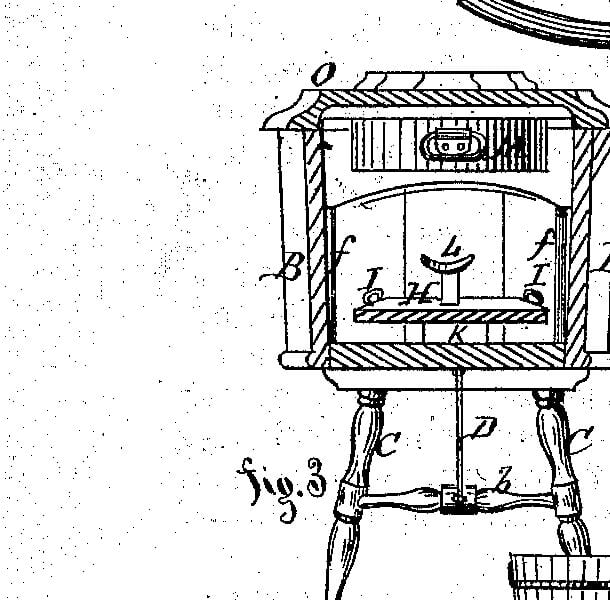
The corpse cooler was not one object but a family of them, and the patent record shows the idea arriving well before the Civil War made it commonplace. A “Refrigerator for Corpses” was granted to Robert Fredrick and G. A. Trump in 1846 (US Patent 4,504): an ice box designed to be placed over the body on the cooling board, resting against the chest and abdomen (Midwestern Death Trip). That over-the-body form persisted for decades — later period descriptions note coolers made in two sizes, an “immense ice-chest” enclosing the whole body and a smaller unit “covering only the abdomen and breast,” where cooling the trunk was thought to matter most (The Victorian Book of the Dead).
The engineering was straightforward and honest about what it was: a metal trough or box, packed with ice (sometimes ice and salt for a colder mixture), placed in contact with, or close over, the body on its cooling board. Meltwater was the recurring design problem, and every serious cooler had to deal with it — a drainage outlet, a hose led out a window, a pan beneath.
A representative patented example is the corpse cooler of James Y. Black of Cleveland, Ohio, granted 20 December 1870 (US Patent 110,337). Black’s design was double-walled: an outer wooden case lined with sheet metal, enclosing an inner casket with an air space between, and that space “filled with a freezing mixture of ice and salt, or with ice only.” The stated goal was blunt — the body “is soon frozen solid, thereby arresting its further decomposition” — so a body could be held until distant relatives arrived or shipped a long distance. A conduction-pipe carried off meltwater, and the cover chamber could hold antiseptic textile (Google Patents, US110337A). The physics is that of a domestic icebox pointed at a single, grim application. Later coolers refined the form: Philipp Weber’s 1874 “Improvement in Corpse Coolers” (US Patent 155,818) added folding legs, a nod to the same portability that made cooling boards collapsible for the travelling undertaker (Midwestern Death Trip).
2.3 Gravenstine’s Corpse-Preserving Casket
The most cited object in this class is John Gravenstine’s “Corpse-Preserving Casket,” of 1871. Where the plain cooler was a box of ice set over a body, Gravenstine’s design integrated the two: an icebox set atop a sealed casket, so that the refrigeration travelled with the coffin as a single unit. The Library Company of Philadelphia, which documents surviving trade material from Laurel Hill Cemetery, records his patents under the titles “Improvements in Corpse-Preserving Cases and Refrigerators” and “Refrigerating Apparatus,” both dated 1871 (Library Company of Philadelphia).
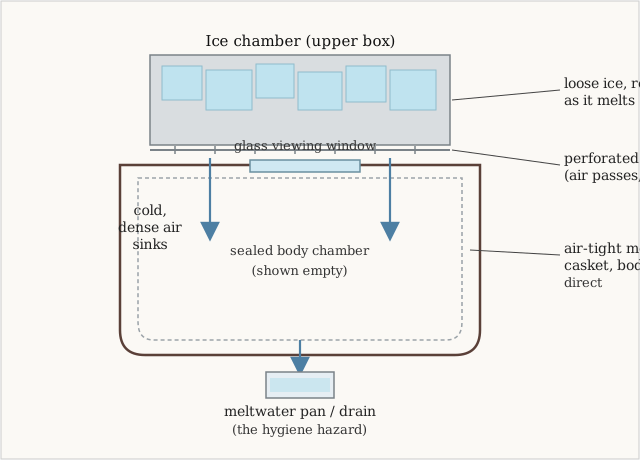
Two ideas met in the design, and Gravenstine essentially bolted them together. One was the airtight coffin — already familiar in Philadelphia, where the Arctic explorer Elisha Kent Kane (1820–1857) had been interred in a sealed casket at Laurel Hill. The other was mobile refrigeration: the first ice-cooled railway boxcar dated to about 1851, and the upper box of Gravenstine’s casket was, functionally, a small version of one. He advertised the chamber as good for more than the dead — suitable, the patent claimed, for “refrigerators, or to any closed vessel within which it is desired to maintain animal or vegetable matter in a cool condition” (Library Company of Philadelphia). That generic language is telling: the invention was refrigeration technology, and the corpse was one advertised use among several.
Gravenstine was not alone. The true “inventor” of the ice casket is genuinely unclear, because several closely similar patents cleared the office in the same 1870–71 window — the partnership of Disbrow & Van Cleve filed in the same period, and manufacturers such as J. C. Taylor of New York (whose production the Hornthal Company took over in 1893) carried the form into commerce (Burials & Beyond). Taylor’s model added a refinement families valued: a tilting glass viewing window, letting mourners see the deceased while a pane held back warm breath and kept the cold in. The commercial ice casket, in other words, converged on a recognisable object — ice chamber above, sealed and often metal-lined body chamber below, a drain for meltwater, and a window in the lid.
One caution for the collector and the historian: while the 1871 date and Gravenstine’s name are well attested by the Library Company’s holdings and the secondary literature, an exact US patent number for Gravenstine’s casket did not surface in the Google Patents record during research and should be treated as unconfirmed until a primary patent scan is located. The patents that are firmly numbered — Fredrick & Trump (4,504), Black (110,337), Weber (155,818), and Bartholomew Hartwell’s 1875 “Improvement in Corpse-Preserving Caskets” (US Patent 160,186) — are surveyed in the makers-and-patents volume. Hartwell’s, incidentally, shows how quickly the type matured: modular ice sections that could be “readily filled with ice from the wagon,” a glass window with a removable cover, a drainage faucet, and a cooling board on a stand so the body never sat in its own meltwater (Google Patents, US160186A).
2.4 What the ice actually did — and did not do
The mechanism is pure passive thermodynamics, and it is worth stating plainly against the period language of “preservation.” Cooling slows two processes that break a body down: the action of the body’s own enzymes (autolysis) and the growth of bacteria. Both are strongly temperature-dependent; both slow dramatically as tissue approaches, and especially below, freezing. That is the entire principle. Ice, having a large latent heat of fusion, is a cheap and effective heat sink — it holds near 0 °C while it melts, absorbing heat from the warmer body until the ice is gone. In a cooler, cold dense air also sinks from the ice chamber down over the body, the same convection that makes an icebox work.
Crucially, this is retardation, not preservation. Nothing in a cooler alters the tissue chemically the way formaldehyde-era arterial fluid does (a story completed in the Electric Embalming Machines dive). The moment the ice ran out, decay resumed. So the useful window was measured in days and depended entirely on keeping the chamber fed with ice — which is why every cooler had a drain, and why the drain was the trouble.
There was also a quiet contradiction built into the ice casket in particular. The body chamber was advertised as airtight, which was meant to keep warmth and odour out; but a truly sealed chamber cut the body off from the very cold air the ice was generating, so the cooling had to work by conduction through the metal lining rather than by air contact. The two selling points — “sealed” and “refrigerated” — pulled against each other, and how well any given casket balanced them is a fair question to ask of a surviving specimen.
2.5 The undertaker’s ice-box controversy
For all its usefulness, the ice-box drew sustained criticism through the 1870s–1890s, and the objections divide into three sober strands.
Meltwater and hygiene. The most mundane hazard was also the most constant. A cooler was a slowly melting block of ice against a decomposing body, and the runoff had to go somewhere. Period accounts describe hoses hung from windows to drain the chests — a sensory signature of the practice — and the whole arrangement was an obvious sanitary nuisance in a home or crowded tenement (The Victorian Book of the Dead). Contaminated meltwater, standing pans, and the odour that escaped an imperfect seal were exactly the concerns a rising sanitary movement seized upon.
Premature icing — the real danger. The graver charge was that undertakers, sometimes without any physician’s certification of death, iced bodies that were not certainly dead. Dr. S. Oakley Vanderpoel — a former Health Officer of the Port of New York and a state surgeon-general — documented cases in which persons in states of syncope or “suspended animation” were placed in ice-chests. He cited an 1872 Brooklyn case of a woman who fainted after dysentery and was partly frozen without a doctor’s certificate, and an 1874 case of a wealthy woman found in an undertaker’s ice-chest of whom he remarked that if there was ever a case of possible restoration “that should have been one.” Vanderpoel’s medical point was that decomposition does not begin for roughly twelve hours after death, so hasty icing was never necessary; waiting a few days would let the certain signs of death appear. That “twelve hours” is a period medical assertion of Vanderpoel’s own era, not a verified modern forensic figure (postmortem onset varies widely with temperature and condition), and is reported here as his argument rather than as established fact (The Victorian Book of the Dead). A blunt line from the Cincinnati Enquirer of 21 June 1896 captured the fear: “A person supposed dead but not really such would inevitably be frozen to death in the ice box long before the funeral.” (These incidents reach us through period newspapers and reform-minded medical journals — The Medical Advance, 1881, among them — and carry that literature’s moral colouring; treat the individual anecdotes as reported rather than forensically proven.)
Commercial rivalry. The third strand was self-interested and worth naming as such. The rising class of embalmers actively opposed the ice-box, arguing that arterial embalming cost no more, left no meltwater, and gave “absolute” certainty of death before burial — a critique that was hygienically fair and commercially convenient at the same time, since the cooler was the embalmer’s chief competitor (The Victorian Book of the Dead). The controversy, in other words, was partly a public-health debate and partly a trade war over how the American dead would be handled.
2.6 Why it was only a stopgap
Set the marketing beside the physics and the verdict is clear. The ice casket promised preservation and delivered delay; it promised cleanliness and generated meltwater; it promised certainty and, in its worst applications, threatened the opposite. It was a bridge technology, useful precisely because the two things that would replace it were not yet available at the undertaker’s door: reliable chemical embalming, and mechanical refrigeration.
Both arrived. Embalming spread from the Civil War trade into a shop-based profession, and by the early twentieth century arterial injection with formaldehyde fluid gave the durable, transport-ready result the cooler had only approximated. Mechanical refrigeration then removed the ice itself — refrigerated holding rooms and metal embalming tables did the cooler’s job continuously, cleanly, and without a melting block to replenish. The ice-and-board era did not end overnight, and in some rural regions the old logic survived for decades (Appalachian families held a body in a cold barn or room through winter until the ground thawed) — but as a manufactured object the corpse cooler had roughly a thirty-year commercial life before it faded, and surviving examples are now scarce museum pieces (Burials & Beyond).
2.7 Where this volume hands off
Vol 3 — From Ice to Mechanical Refrigeration picks up exactly here, tracing how refrigerated rooms and metal tables displaced ice-and-board practice and where the old cold-storage habit survived. Vol 4 — Makers, Patents, and the Trade-Catalog Record reads the patent drawings and engravings named above — Frederick & Trump, Black, Weber, Hartwell, and Gravenstine’s contested number — as objects, with the construction and dating cues. Vol 5 — Collecting Cooling Boards, Coolers, and Ice Caskets closes on how a surviving cooler is dated by its joinery, metal lining, cast fittings, and folding hardware, and displayed. For the chemical preservation that ultimately made the ice-box obsolete, see the Gravity Injection Systems, Hand Pump and Bulb Machines, Electric Embalming Machines, and Trocars and Cavity Injection dives — the machines this “furniture” surrounded and, for a generation, substituted for.
Sources
- Library Company of Philadelphia — “Corpse-Preserving Casket” — primary scholarly source for John Gravenstine’s 1871 patents (titled Improvements in Corpse-Preserving Cases and Refrigerators and Refrigerating Apparatus), the icebox-atop-sealed-casket design, the Elisha Kent Kane airtight-coffin precedent, the 1851 ice boxcar, and the “animal or vegetable matter” advertising language.
- Midwestern Death Trip — “Coffins, Gravestones, and other Sepulchral Patents” — the numbered patent trail: Fredrick & Trump (US4,504, 1846, over-the-body ice box), James Y. Black corpse cooler (US110,337, 1870), Philipp Weber folding-leg cooler (US155,818, 1874), and others.
- Google Patents US110337A — James Y. Black, corpse-preserving coffin (1870) — verified inventor, date, and the double-walled ice-and-salt “frozen solid” mechanism with conduction-pipe drainage.
- Google Patents US160186A — Bartholomew Hartwell, “Improvement in Corpse-Preserving Caskets” (1875) — verified the matured type: modular wagon-filled ice sections, glass window, drainage faucet, and a cooling board keeping the body clear of meltwater.
- Burials & Beyond — “Ice, Ice, Body: Introducing Ice Caskets” (2020) — secondary synthesis supporting the Gravenstine / Disbrow & Van Cleve priority ambiguity, J. C. Taylor’s tilting viewing window, the Hornthal succession (1893), the meltwater-drainage detail, the roughly thirty-year commercial life, and surviving museum examples.
- The Victorian Book of the Dead — “Corpses on Ice: The Dangers of the Undertaker’s Ice-Box” (2019) — secondary source compiling the period controversy: the two cooler sizes, Dr. S. Oakley Vanderpoel’s premature-icing cases (1872, 1874), the twelve-hour decomposition point, the Medical Advance (1881) and Cincinnati Enquirer (1896) quotes, and the embalmers’ commercial opposition. Its anecdotes carry the moral tone of reform-era journalism and are cited as reported.
- Wikipedia — “Cooling board” — background on the board-and-ice principle and the Appalachian cold-room survival, cross-referenced with Vol 1.
Comments (0)