Cooling Boards and Corpse Coolers · Volume 5
Collecting Cooling Boards, Coolers, and Ice Caskets
The object on the shelf: how a surviving cooling board, corpse cooler, or ice casket is dated by joinery, cane versus plank, cast fittings, and folding hardware — and how provenance, condition, and display turn a grim curiosity into a documented artefact of the pre-refrigeration trade.
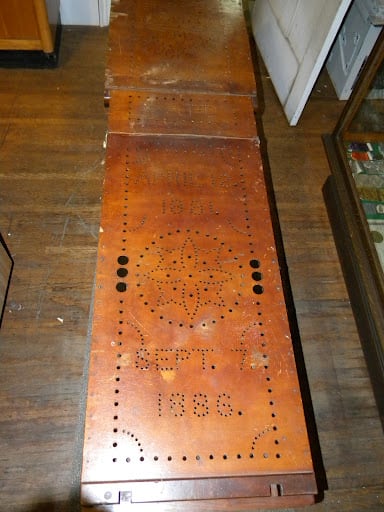
Four volumes have described what this furniture is and how it worked. This closing volume is for the person who now owns one of these objects, or is about to bid on one: how to tell a manufactured folding cooling table from a rough parlour plank, how to read the joinery and the cast fittings for a date, how to weigh provenance against romance, and how to display a piece of pre-refrigeration funeral technology honestly. The surviving objects are surprisingly collectable — sober, sculptural, and cheap by antique-furniture standards — precisely because most families of the period could not afford embalming and these were the tools that stood in for it.
5.1 About this volume
A cooling board is one of the more approachable objects in this whole sub-project. It is furniture, not a machine: no perished rubber, no high-voltage coil, no radioactive residue, no hazardous fluid. What it demands instead is the eye of a furniture collector — an ability to read wood, joinery, and hardware — applied to a trade object most people misidentify on sight.
This volume assumes you have read the rest of the dive and refers back rather than repeats. What a cooling board is, and the plain thermodynamics of ice-beneath-a-perforated-board, is Vol 1 — The Cooling Board; the metal corpse coolers and John Gravenstine’s patented ice casket are Vol 2 — Corpse Coolers and the Ice Casket; the shift to mechanical refrigeration that ended the practice is Vol 3 — From Ice to Mechanical Refrigeration; and the patent drawings and trade-catalogue record that this volume leans on for attribution are laid out in Vol 4 — Makers, Patents, and the Trade-Catalog Record. Here we catalogue the dating cues, weigh provenance, and make the case for cold, honest display. As with the closing volume of the Violet Ray Wands dive over in the Quack-wing, the end of the dive is the object in the room and how to read it.
5.2 What survives, and the survival bias
Start with a blunt point about the sample. The objects that come to market are not a fair cross-section of what the trade actually used — they are the pieces that happened to survive, and the survival is heavily biased toward the manufactured folding tables of roughly 1880–1910.
Two things drive that bias. First, the humblest and most common arrangement left almost nothing to collect. For most of the nineteenth century a “cooling board” was often no board at all but an improvisation: a house door lifted off its hinges and laid across two chairs or trestles, or a single wide plank kept in the barn. The Wikipedia summary of the practice records exactly this — “a door suspended over two chairs or blocks” — and such things were re-hung, re-used, or burned, never catalogued. Second, wood that spent its working life wet with meltwater and drainage tends not to last; as one museum holding of a B.F. Gleason table notes, many examples “haven’t survived since they’re primarily wood.” What endured are the sturdier, drier, factory-built tables an undertaker treated as professional equipment — oak-framed, cased, and worth keeping.
The upshot for a collector is that a manufactured folding table with a maker’s plaque is the typical surviving object, while a plain solid-plank board is in its own way rarer, even though the plank was the older and more widespread form. A documented British example makes the point: an Antiques Atlas dealer listing describes a Victorian Welsh undertaker’s board “made from a single slab of elm,” roughly 5 ft 3.5 in long, meant to rest on two trestles in the parlour, sold as “only a handful in existence.” That is not rarity of manufacture — it is rarity of survival.
5.3 Reading the joinery and the top
With an object in hand, the collector’s questions are the furniture-maker’s questions: how is it joined, what is the top, and what wood is it?
Joinery. Period tables were built with mortise-and-tenon joints, not screwed butt-joints; the frame members interlock and are pinned. Fasteners are hand-forged or cast iron and brass, dull with age — bright, uniform, plated modern screws are a warning of repair or reproduction. This is standard antique-furniture dating logic, and it applies here directly.
Cane versus plank — the top. The defining surface is either a hand-woven cane lattice stretched in the frame or a perforated wooden plank (often pine, softer and cheaper than the oak frame). Both exist for the same reason: the holes gave drainage for fluids and let the chill of ice set beneath the board rise through the bed by convection — passive cooling, never preservation chemistry, as Vol 1 sets out. Cane is the more sought-after and the more fragile; it sags, splits, and is frequently re-woven, and a professionally re-caned bed is a legitimate but value-affecting repair. A solid-plank board with drilled perforations is the older, plainer idiom and shades into the improvised door-and-trestle form. Which of the two a board has is both a dating and an attribution cue: the manufactured folding tables favour cane; rural and home-made boards favour the plank.
Wood. Oak dominates the manufactured frames — chosen, as period practice suggests, because it resisted warping under repeated wetting, cleaned well, and was available to makers across the country. Regional and home-made boards used whatever was local: the Welsh example above is elm, and softwoods appear in cheaper work. The frame wood and the top material together — oak frame with cane bed, versus a single elm or pine slab — sort most surviving boards into “factory” or “vernacular” at a glance.
5.4 Cast fittings, folding hardware, and maker’s marks
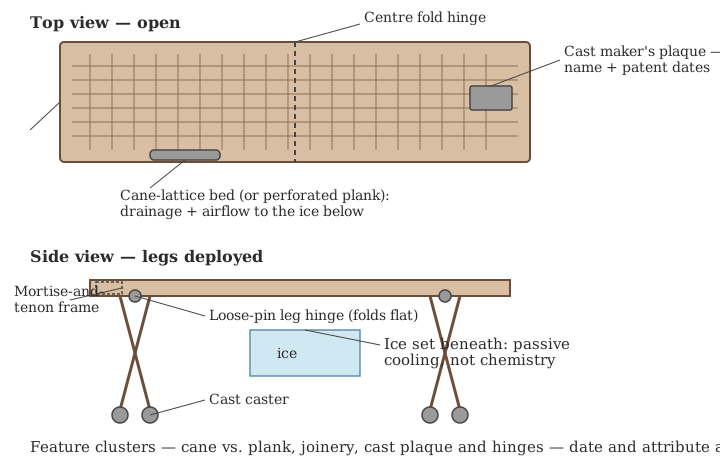
The hardware is where a manufactured table gives up its identity and often its date. The travelling undertaker wanted a table that folded to something he could carry into a house “almost like a briefcase,” and the mechanisms built to do that are distinctive, patented, and datable.
The cast maker’s plaque. The best-case find is a cast or stamped metal plaque, usually on the handle or headboard, carrying the maker’s name and — crucially — patent dates. The archetypal name is B.F. Gleason of Brockport, New York, a nationally-distributed maker whose tables are reported to carry the patent dates April 13, 1881 and September 7, 1886 — but those dates come only from secondary collector and mortuary-trade sources, and no primary Gleason patent number has been located on Google Patents (Vol 1 flags the same “Gleason, 1881/1886” as unconfirmed trade lore), so do not present them as established fact. A frequently repeated Gleason signature — found in collector accounts rather than any verified museum object record — is that the perforations of the bed were themselves patterned to spell out his name and those patent dates, so the mark is said to be in the holes as well as on a plate; treat that too as unverified lore until an object record or photograph confirms it. Another documented plaque reads “THE CLIMAX — MADE BY THE ENTERPRISE MFG. CO., COLUMBUS, OHIO,” on an oak, brass, and hand-woven-cane folding table. Other regional makers (a name such as H.A. Wynkoop appears alongside Gleason in collector accounts) built closely similar designs with small mechanical variations. Treat any plaque as the anchor of the attribution and cross-check it against Vol 4’s catalogue and patent record rather than the seller’s description.
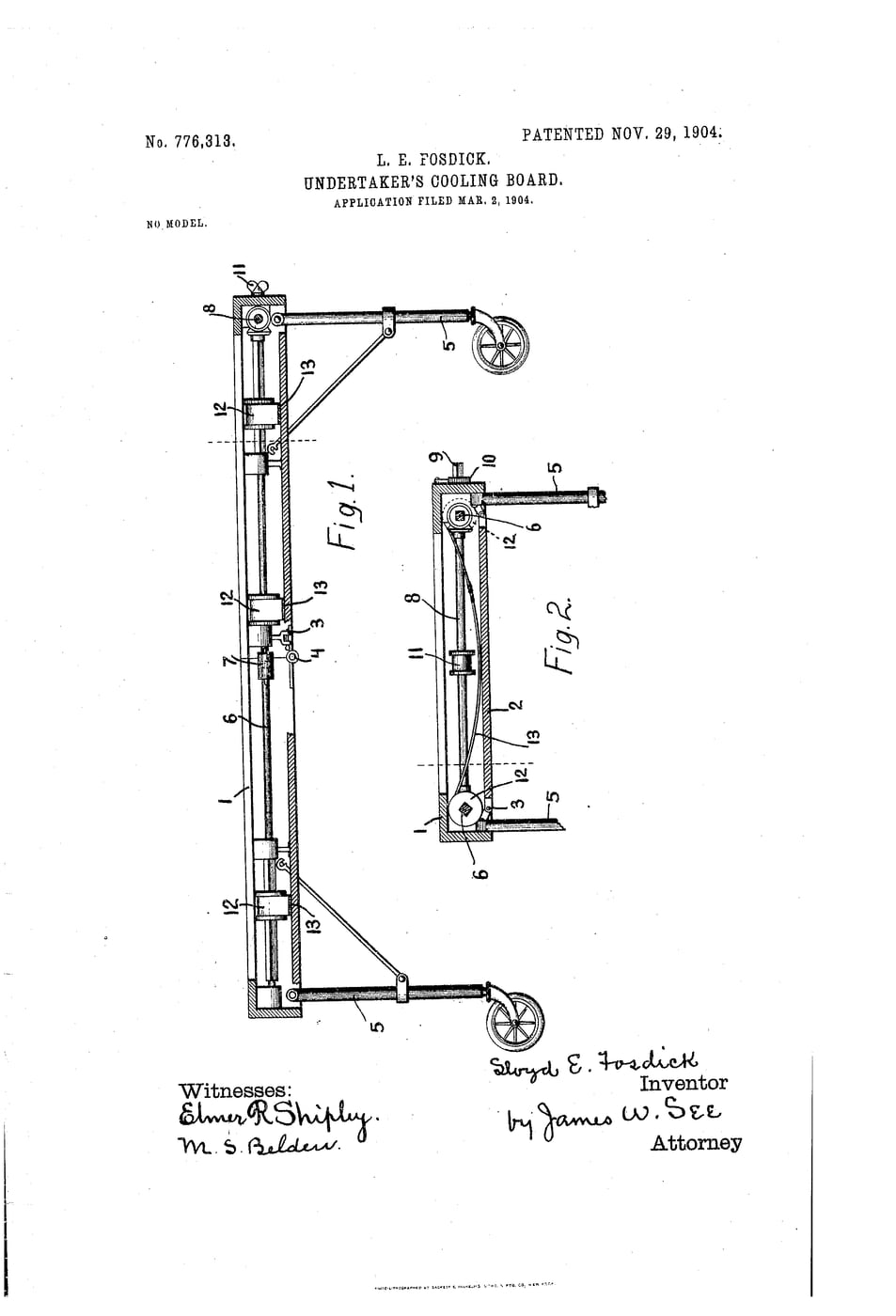
Folding hardware as a dating cue. Where a plaque is absent, the folding mechanism itself dates and distinguishes a table. A genuine period patent shows how specific this engineering was: US Patent 776,313, “Undertaker’s Cooling-Board,” granted to Lloyd E. Fosdick on November 29, 1904 (filed March 2, 1904), describes an open rectangular frame with hinged joints so it folds to a shorter length, legs hinged at each end with casters that fold up within the frame, a detachable board on loose-pin hinges, and even a strap-and-rotary-shaft lift with a ratchet and friction-brake so one person could transfer a body. Not every table has the lift gear, but the vocabulary — centre fold hinge, loose-pin leg hinges, folding casters, a recessed carry handle hidden under the headboard — is exactly the cluster of cast fittings a collector looks for and roughly places a table in the 1880s–1900s manufactured window. Reproductions and later “console-table” conversions rarely reproduce the full mechanism convincingly.
Dimensions. The manufactured adult tables cluster around 73–76 in long by about 19–22 in wide, folding to roughly half that length, with child-sized variants near 42 × 15 in — consistent with the brief’s cited late-1800s example of about 75 × 22 × 20 in. The documented “Climax” folding table measures about 41.75 in open and closes to 21 in, a small (likely child or short) example; sizes vary enough that a single measurement dates nothing on its own. Use dimensions to sort adult from child and folding from fixed, not to pin a year.
5.5 Provenance and the folklore to distrust
Because a bare board tells you so little, provenance does much of the collecting work here — and it is also where the field’s folklore is thickest, so it pays to be sceptical.
Good provenance is documentary: a board bought, as the Welsh elm example was, directly from the descendant of a named undertaker-and-coffin-maker who remembered using it; a table that stays with the papers of a family funeral business; a museum donation record tying an object to a town and a date. That kind of chain turns “an old perforated table” into a dated artefact of a specific shop, and it is the single biggest multiplier of both interest and value. Record it obsessively: who owned it, where it worked, every plaque and patent date, and photographs of the joinery, the top, and the hardware.
Two persistent claims deserve plain debunking. First, cooling boards and coolers attract a fog of ghost-lore — “haint” stories, the old idea that a body must be watched on the cooling board lest it be disturbed — which is genuine folk history worth knowing but tells you nothing about an object’s date or maker; do not let a seller’s spooky narrative substitute for a hardware examination. Second, and more concretely, it is sometimes claimed that Civil War surgeons used these folding cooling tables as portable operating or amputation tables. Treat that as folklore: the named manufactured tables carry patent dates in the 1880s, two decades after the war, so a Gleason or Enterprise table cannot be a Civil-War field object, however evocative the story. A plain plank could of course be pressed into any use, but the specific “collectable folding cooling table = Civil War surgery” pairing is an anachronism a careful buyer should reject.
5.6 Condition, value, and display
Condition. Grade the wood and the mechanism, in that order. Look for an honest patina — gradual darkening over more than a century — rather than artificial distressing; wear where a body rested on the lattice; and period-appropriate repairs in matching materials. The cane is the usual casualty: sagged, split, or re-woven. The folding legs, hinges, casters, and handle should be present and should still articulate; a seized or replaced mechanism costs value. Distinguish the object from its neighbours on the misidentification shelf — a military folding cot lacks the perforated draining top; a true embalming table has a solid, dished zinc or porcelain top with no airflow holes (the metal-table successor described in Vol 3); and, again, nothing here is Civil-War-era.
Value. By antique-furniture standards these are inexpensive. Collector-market figures gathered from dealers and mortuary-history sources put common examples around $300–$600, well-preserved complete folding tables roughly $2,000–$6,000, and exceptional pieces with a maker’s mark and documented provenance above $5,000. Those are secondary-market impressions, not an index — the market is thin and idiosyncratic, so treat any single number as indicative only. Value is driven by the same short list every time: an intact original cane bed, a complete working folding mechanism, a legible maker’s plaque, and a documented provenance chain.
Display. A cooling board displays with unusual dignity precisely because it is spare. Show it as furniture, cold and empty: the open folding table on its own legs, or a plank board across trestles, plaque forward, the cane bed lit to read. Keep it out of direct sunlight and at a stable, moderate humidity (a conservator’s 45–55 % is a sensible target) so the frame does not check and the cane does not embrittle. It needs no special hazard handling — unlike the coolers, there is no meltwater sump and no residue — which is part of why it makes such a good, sober museum object. Displayed this way it does the same work the whole sub-project asks of its objects: it documents a real chapter of the pre-refrigeration trade without sensationalising it.
5.7 Where this volume hands off
This is the last volume of the Cooling Boards and Corpse Coolers dive, and the pre-refrigeration frame around the whole Embalming Machines wing. From here the collection turns to the machines the cooling board stood beside and was eventually displaced by: the elevated reservoirs of Gravity Injection Systems, the squeeze-bulbs and piston pumps of Hand Pump and Bulb Machines, the motorised Porti-Boy line of Electric Embalming Machines, and the trocars and hydro-aspirators of Trocars and Cavity Injection. Each of those dives ends, as this one has, on the surviving object and how a collector identifies, dates, and safely keeps it — and the same discipline carries across the hall to the Quack-Devices and Electrotherapy wings, where the objects are stranger but the questions are the same.
Sources
- Cooling board — Wikipedia — the cane-latticework-versus-solid-plank distinction, drainage holes and ice beneath, the improvised “door suspended over two chairs or blocks,” and the Appalachian winter-barn practice; general framing of the object.
- US Patent 776,313 — “Undertaker’s Cooling-Board” (Lloyd E. Fosdick, granted Nov. 29, 1904) — Google Patents — a verified period patent documenting folding-frame hinges, folding legs with casters, loose-pin board hinges, and a strap/ratchet lift; used for the folding-hardware dating vocabulary and the 1904 date.
- Rogers (Arkansas) Historical Museum — B.F. Gleason cooling table (Donation of the Month) — a municipal-museum specimen record for a Gleason table (Brockport, NY), corroborating the maker, the adult/child sizes, and the survival-bias point that many wooden boards did not last.
- Imponderabilia history blog — “B.F. Gleason Cooling Tables” — Gleason’s Brockport, N.Y. factory, the briefcase-like fold with a pull-out handle hidden beneath the headboard, and adult/child examples; secondary collector source.
- American Mortuary Coolers — “An Essential Guide to Identifying Antique Cooling Tables” — the Gleason patent dates (April 13, 1881 and Sept. 7, 1886), mortise-and-tenon joinery versus modern screws, cane/perforated-pine tops, oak frames, adult (73–76 × 19 in) and child (42 × 15 in) dimensions, misidentification against cots and embalming tables, and price ranges; a secondary mortuary-trade vendor source, used with caution.
- Atelier de Hahn — “Cooling board table” — a documented “THE CLIMAX / ENTERPRISE MFG. CO., COLUMBUS, OHIO” folding table in oak, brass, and hand-woven cane, with exact open/closed dimensions and the brass-plaque-on-the-handle attribution.
- Antiques Atlas — “Victorian Welsh Undertaker’s Cooling Board” — a single-slab elm parlour board (~5 ft 3.5 in) resting on trestles, purchased from the descendant of a named Welsh undertaker; used for the plank-versus-cane contrast and the value of documentary provenance.
Comments (0)