Cooling Boards and Corpse Coolers · Volume 4
Makers, Patents, and the Trade-Catalog Record
The paper trail behind the cooling board and the corpse cooler — the patent family from the 1846 corpse refrigerator to the 1880 folding cooling board, the ice-casket makers around John Gravenstine, the undertakers' supply catalogs, and the construction cues by which a surviving object is dated.
Contents
| Section |
|---|
| About this volume |
| Reading the patent record |
| Gravenstine and the ice-casket makers |
| The trade-catalog record |
| Construction and dating cues |
| Where this volume hands off |
| Sources |
4.1 About this volume
The first three volumes of this dive describe the objects and the physics: the perforated cooling board with ice placed beneath it (Vol 1 — The Cooling Board); the metal corpse cooler and the patented ice casket, and why ice-and-airtight-box preservation was always a stopgap (Vol 2 — Corpse Coolers and the Ice Casket); and the twentieth-century shift from ice to mechanical refrigeration and the metal embalming table (Vol 3 — From Ice to Mechanical Refrigeration). This volume is the documentary spine underneath all of that — the patents, the makers, and the trade catalogs that put these objects into the American undertaker’s shop, and the physical construction cues by which a surviving one is identified and dated.
It is worth saying at the outset what kind of history this is. The cooling board and the corpse cooler were furniture and hardware, not chemistry; the account that follows is engineering and trade history in exactly the sense that the sibling Gravity Injection Systems, Hand Pump and Bulb Machines, and Electric Embalming Machines dives treat the arterial pump. Every date and patent number below was checked against the granted patent itself on Google Patents or against a museum record, because the ice-casket story in particular is thick with confident secondary retellings that disagree on names and years. Where a claim could not be pinned to a primary document — most importantly the exact patent number of Gravenstine’s casket — it is flagged as such in the prose rather than dressed up as certainty.
4.2 Reading the patent record
The single most useful thing a collector or historian can do with these objects is read them against the U.S. patent series, because the corpse-cooler and corpse-preserving-casket patents form a tight, legible family spanning roughly 1846 to the early 1900s — and the granted specifications describe the very features that survive on the objects.
The earliest is genuinely early. U.S. Patent 4,504, “Refrigerator for Corpses,” granted 9 May 1846 to Robert Fredrick and G. A. Trump of Baltimore, Maryland, is essentially a lidded ice reservoir “having a bottom formed to fit the corpse,” set down over a dressed body lying on a cooling board so that the cold bore directly on the chest and abdomen. Its stated selling point was economy: it froze “those parts most important” quickly, without wetting the body directly and without the mountain of ice needed to surround a whole coffin. That 1846 date matters — it means the ice-box-over-the-body idea predates the Civil War and the embalming boom by a full generation, and it establishes the body-conforming ice pan as the founding form.
The form matured after 1870 into two branches. One branch chilled the body from above, with a portable ice box; the other sealed the body inside a refrigerated casing. Both are well documented:
- U.S. 110,337, “Improvement in Corpse-Preserving Coffins,” James Y. Black, Cleveland, Ohio, 20 December 1870 — a sheet-metal-lined outer case surrounding an air-tight inner casket, the intervening space packed “with a freezing mixture of ice and salt, or with ice only” to freeze the remains solid for transport.
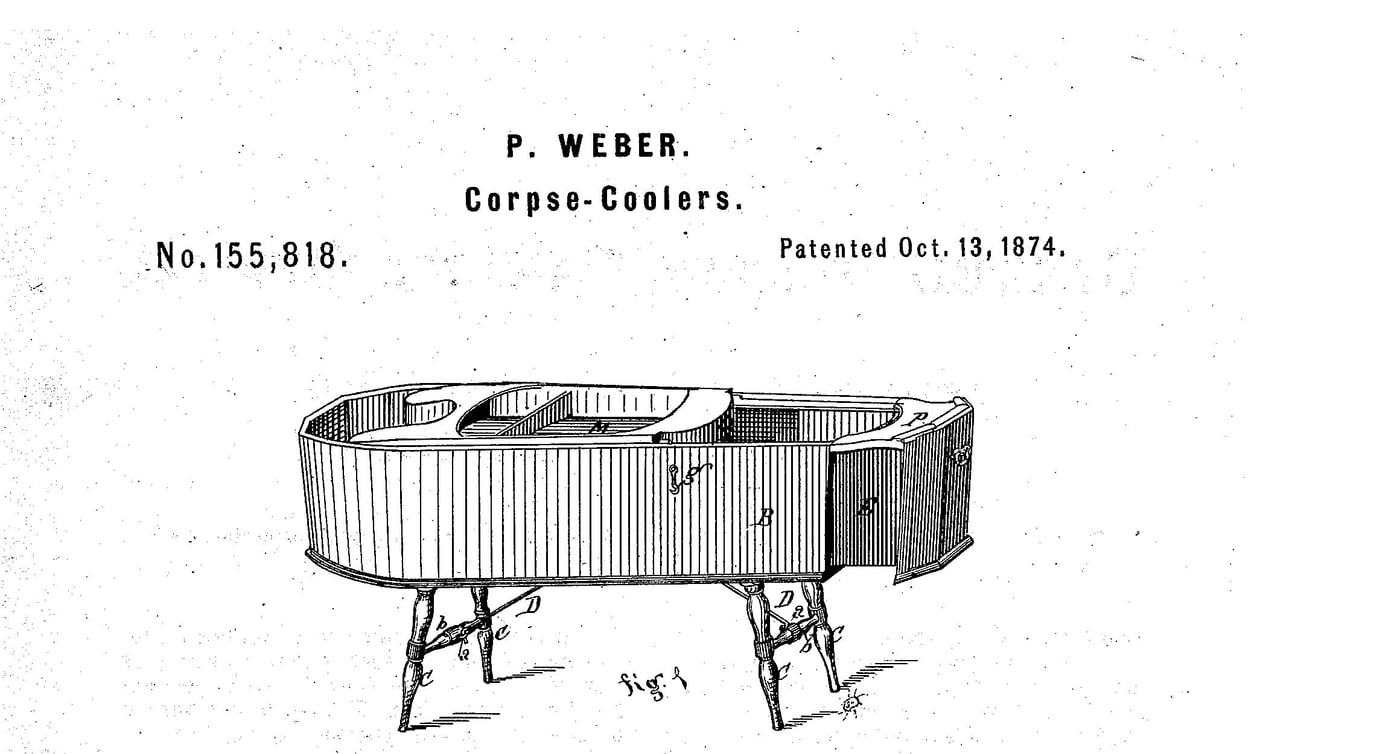
- U.S. 155,818, “Improvement in Corpse-Coolers,” Philipp Weber, Pittsburgh, Pennsylvania, 13 October 1874 — a two-compartment ice pan whose “bottom is curved to conform as nearly as possible to the shape of the body,” a height-adjustable cooling board catching in notches, meltwater carried off by a pipe rather than perishable rubber tube, folding legs hinged to the box, and a sliding extension end to lengthen the box “some six or more inches” for a taller body.
- U.S. 160,186, “Improvement in Corpse-Preserving Caskets,” Bartholomew Hartwell, Baltimore, Maryland, 23 February 1875 — a nearly air-tight two-part casing with a glass top for viewing, a removable cooling board keeping the ice off the body, adjustable head-rest clamps, and modular ice chambers that could be filled outside so no one had to shovel ice audibly indoors.
- U.S. 201,525, “Improvement in Corpse-Coolers,” George O. Hill, Salisbury, Maryland, 19 March 1878 — a two-part metallic casing with a perforated body platform over a disinfecting pan, a hinged glass cover over the face, and a removable upper section for full access.
- U.S. 234,980, “Cooling-Board for Corpses,” Romeo Gregg, Noah T. Shaw, and William Felton, Columbus, Ohio, 30 November 1880 — the fullest surviving description of a cooling board as a manufactured article: a frame about eight feet long on hinged folding legs, a centrally hinged board “constructed of cane, perforated zinc, or wood” with an adjustable incline and headrest, a removable ice-box with pockets above, a removable lid over the face, and folding standards to carry a canopy and curtains.
Read in sequence, these six patents are a compact engineering history of the object. The body-conforming ice pan (1846) persists into Weber’s cooler of 1874; the folding leg appears by 1874 and is standard by 1880; the glass viewing panel enters with Hartwell in 1875; and the deck material is stated outright in 1880 as cane, perforated zinc, or wood — the exact three-way choice a collector still uses to place a surviving board. A useful compilation of these sepulchral patents has been assembled by the Midwestern Death Trip project, and each number above was then confirmed against the granted patent on Google Patents.
The family does not end at 1880. Two further cooling patents carry the same engineering into the following decades and are load-bearing in the sibling volumes: Henry Clay Johnson’s “Corpse Cooler and Preserver” (U.S. 311,764, Meadville, Pennsylvania, 3 February 1885), whose cross-laminated perforated board Vol 1 relies on, and Lloyd E. Fosdick’s “Undertaker’s Cooling-Board” (U.S. 776,313, 29 November 1904), the folding-hardware patent Vol 5 reads for its dating cues. Counting these, the documented patent family runs from 1846 to 1904 rather than closing in 1880.
4.3 Gravenstine and the ice-casket makers
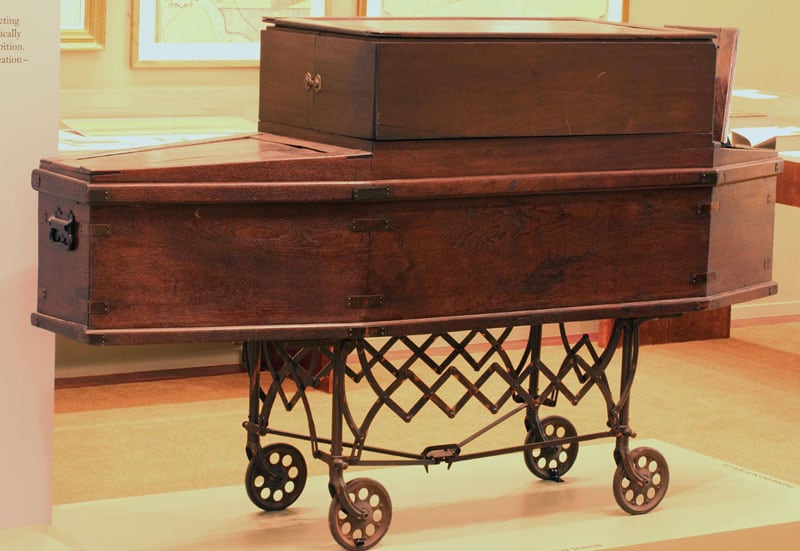
The best-known single object in this whole subject is John Gravenstine’s “Corpse-Preserving Casket,” of Philadelphia, dated by the Library Company of Philadelphia to about 1871 — a mahogany ice-box on wheels made to stand atop a sealed casket, described by the museum as “an ungainly melding of several cutting-edge technologies, including mobile refrigeration and airtight coffins.” The patent language quoted from the drawings frames the upper chamber as a general refrigerator, suited to “corpse-preserving caskets” but also to “refrigerators, or to any closed vessel within which it is desired to maintain animal or vegetable matter in a cool condition.” The surviving example is the centerpiece of the Library Company’s Building a City of the Dead exhibition on Laurel Hill Cemetery.
One honest caution belongs here. Gravenstine’s name and the ca. 1871 date are well attested by the Library Company and repeated in the WHYY coverage of that exhibition, but the museum record does not publish a patent number, and no granted patent under his name could be confirmed in this pass; the “1871” is a museum dating of the object and its drawings, not a verified issue date. Treat the specific year, and any specific patent number attached to Gravenstine elsewhere, as unconfirmed until checked against the patent series itself. This is exactly the kind of contested detail the whole dive is meant to flag rather than launder.
Gravenstine was not alone, and the priority is genuinely muddy. Secondary funeral-history accounts place Disbrow and Van Cleve filing an ice-casket design in the same 1870–71 window, later marketed as the “Centennial” preserver around 1876; Van Cleve reportedly switched the lining from felt to asphaltum by 1881, advertising that it eliminated odors and disinfected the casing. A “celebrated” ice casket with viewing windows was sold by J. C. Taylor of New York, whose production is said to have passed to the Hornthal Company of New York by 1893. These maker names come from secondary compilations (notably the Burials & Beyond survey of ice caskets) rather than from primary catalogs seen directly, so they are offered as the documented trade lineage, not as verified corporate history.
What every one of these makers actually sold, stripped of the marketing, was passive ice cooling in a box — and the period marketing plainly oversold it. The word “preserving” implied durable, chemical-grade preservation; the physics delivered only local refrigeration that slowed bacterial and enzymatic decay near the ice, for as long as the ice lasted and the meltwater was managed. “Air-tight” was an aspiration that imperfect nineteenth-century joinery rarely met. The hazards — meltwater, drainage, and hygiene — were real and were argued about at the time; the period “undertaker’s ice-box” controversy is treated in Vol 2, and the reason mechanical refrigeration finally displaced all of it is Vol 3’s subject. The patents themselves quietly concede the point: Hill’s 1878 cooler builds in a disinfecting pan, and Hartwell’s 1875 casket goes to trouble to fill its ice outside the house — features you add only because the basic method is leaky and unpleasant.
4.4 The trade-catalog record
Patents show what was claimed; trade catalogs show what was actually sold, and the American undertaker bought from illustrated supply catalogs by the 1860s. The Smithsonian Libraries hold, and have digitized, the Illustrated Catalogue of Undertakers’ Hardware and Trimmings published by James M. Shanahan of New York in 1869 — a representative example of the trade literature that carried coffin hardware, trimmings, and preparation furniture to undertakers by mail and by traveling salesman. By 1882 the Columbus Coffin Company was issuing its Illustrated Catalogue of Wood and Cloth Covered Coffins and Caskets, Undertakers’ Hardware and Sundries, Robes, Linings, and General Supplies — the kind of volume from which an undertaker, or a family, chose handles, studs, thumbscrews, engraved name plates, and the cooling and preparation equipment alongside them.
These catalogs are the reason the objects look the way they do. The corpse cooler and the cooling board were catalog goods, engraved as line plates beside caskets and coffin furniture, sold on price and portability to a shop-based trade that was professionalizing in exactly the decades covered by the patents above. Contemporary accounts note that ice-box cooling boards were even displayed in shop windows, and that supply houses sent drummers to smaller towns to demonstrate correct preparation and to move hardware. For the collector, the catalog engravings are frequently the only surviving image of a given maker’s model, and the surest way to match an anonymous surviving board or cooler to a name and a date — which is where the sibling collecting volume, Vol 5, picks up.
4.5 Construction and dating cues
Because so many surviving pieces carry no maker’s mark, they are dated and identified largely by how they are built — and the patent record above supplies the vocabulary. The diagram below assembles the recurring features into one annotated object.
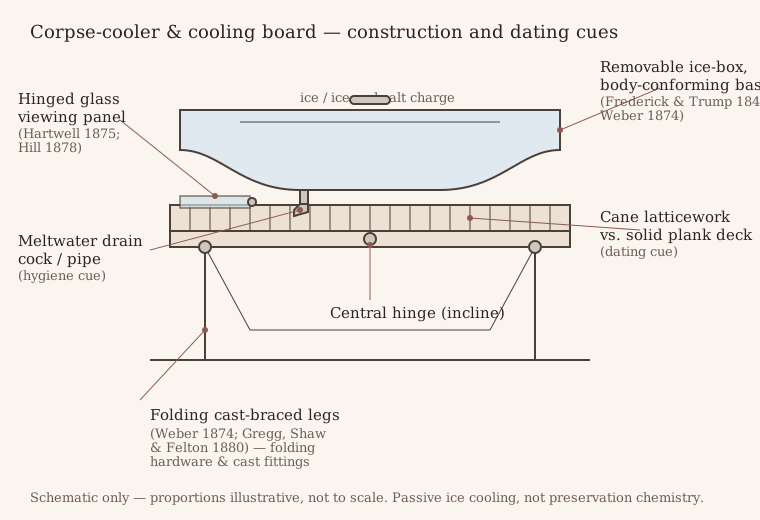
The cues, in the order a collector usually reads them:
- Deck material — cane vs. plank vs. perforated zinc. The 1880 Gregg–Shaw–Felton patent names all three outright. A solid perforated plank is the plainest and often earliest or cheapest form; cane latticework is lighter, more clearly a manufactured article, and photographs distinctively; perforated sheet zinc signals a later, factory-made, more “sanitary” board. The deck is the first thing to read.
- Folding hardware. Hinged, folding legs are the signature of the traveling undertaker’s board and are explicit in the Weber (1874) and Gregg–Shaw–Felton (1880) patents. Original iron hinges, folding standards, and brace rods are both an identifying feature and a common point of repair or replacement — so the hardware also reads on condition.
- Cast fittings. Cast-iron or cast-brass leg brackets, thumbscrews, clamps, and adjuster hardware date and place a piece; the same foundry vocabulary appears on the coffin furniture in the trade catalogs, which is why catalog plates help attribute loose hardware.
- Ice pan and its curved bottom. A body-conforming curved ice-pan bottom traces straight back to the 1846 Fredrick–Trump refrigerator and recurs in Weber’s 1874 cooler; a surviving metal ice pan shaped to the torso is a strong indicator that a box is a genuine corpse cooler rather than a repurposed chest.
- Viewing glass. A hinged glass panel over the face marks the later “ice casket / preserving casket” branch (Hartwell 1875, Hill 1878) rather than the plain cooling board, and separates a display-and-preservation object from a simple preparation platform.
- Drainage. Stop-cocks, drain pipes, and disinfecting pans (Fredrick–Trump 1846; Weber 1874; Hill 1878) are both a mechanical and a hygiene cue; Weber’s specification pointedly used a metal pipe instead of perishable rubber tube, so surviving rubber, where present, is likely a later replacement — a dating tell in itself.
None of this is preservation chemistry, and the diagram says so: every one of these features exists to move heat and meltwater, not to fix tissue. That distinction — the same one that separates the cooling half of this dive from the injecting machines of the four sibling Embalming dives, and that separates all of it from the wishful “vitality” apparatus catalogued in the Quack-wing dives such as Violet Ray Wands, Electropathic Belts, and Radioactive Cures — is the through-line of the whole subject.
4.6 Where this volume hands off
This volume supplied the documentary and constructional evidence: the patent family from 1846 to 1880, the makers around Gravenstine, the supply catalogs that sold the hardware, and the build cues that identify a surviving piece. The final volume, Vol 5 — Collecting Cooling Boards, Coolers, and Ice Caskets, turns that evidence into practice — dating by joinery and cane-versus-plank, reading cast fittings and folding hardware for originality, establishing provenance, and displaying these funeral-history antiques soberly and safely. Read Vol 5 alongside the patent drawings named here; together they are the collector’s field guide to the objects the first three volumes explained.
Sources
- Corpse-Preserving Casket — The Library Company of Philadelphia — the primary museum record for John Gravenstine’s ca. 1871 casket: the “icebox atop a sealed casket” description, the “any closed vessel… animal or vegetable matter in a cool condition” patent language, and the post-1850 preservation context. Does not publish a patent number.
- Building a City of the Dead — WHYY — corroborates Gravenstine’s name, the ca. 1871 date, and the “mahogany contraption set on wheels… an icebox placed on top of a coffin” description, as the centerpiece of the Library Company’s Laurel Hill exhibition.
- Coffins, Gravestones, and other Sepulchral Patents — Midwestern Death Trip — the compilation that flags the corpse-cooler and corpse-preserving patent numbers used here; each was then confirmed against the granted patent below.
- U.S. Patent 4,504 — Refrigerator for Corpses (Fredrick & Trump, Baltimore, 9 May 1846) — the founding body-conforming ice-pan form; verified title, inventors, and date.
- U.S. Patent 110,337 — Improvement in Corpse-Preserving Coffins (James Y. Black, Cleveland, 20 Dec 1870) — ice-and-salt chamber around an air-tight inner casket; verified.
- U.S. Patent 155,818 — Improvement in Corpse-Coolers (Philipp Weber, Pittsburgh, 13 Oct 1874) — body-conforming ice pan, folding hinged legs, sliding extension, metal drain pipe; verified.
- U.S. Patent 160,186 — Improvement in Corpse-Preserving Caskets (Bartholomew Hartwell, Baltimore, 23 Feb 1875) — air-tight two-part casing, glass viewing top, ice filled outside the house; verified.
- U.S. Patent 201,525 — Improvement in Corpse-Coolers (George O. Hill, Salisbury MD, 19 Mar 1878) — perforated platform, disinfecting pan, hinged glass face cover; verified.
- U.S. Patent 234,980 — Cooling-Board for Corpses (Gregg, Shaw & Felton, Columbus OH, 30 Nov 1880) — the fullest cooling-board specification: cane, perforated zinc, or wood; folding legs; removable ice-box and lid. The load-bearing source for the deck-material and folding-hardware dating cues.
- U.S. Patent 311,764 — Corpse Cooler and Preserver (Henry Clay Johnson, Meadville PA, 3 Feb 1885) — verified; the cross-laminated perforated board Vol 1 relies on, showing the patent family extends past 1880.
- U.S. Patent 776,313 — Undertaker’s Cooling-Board (Lloyd E. Fosdick, 29 Nov 1904) — verified; the folding-frame, casters, and loose-pin-board hardware Vol 5 reads for dating, carrying the family to 1904.
- Ice, Ice, Body: Introducing Ice Caskets — Burials & Beyond — secondary survey supplying the maker lineage (Disbrow & Van Cleve / “Centennial” 1876, asphaltum lining 1881; J. C. Taylor and the Hornthal Company by 1893) and the priority-dispute framing; used for trade context, not verified corporate history.
- Illustrated Catalogue of Undertakers’ Hardware and Trimmings (James M. Shanahan, New York, 1869) — Smithsonian Libraries — a representative, digitized 1869 undertakers’ supply catalog; the trade-literature context for how cooling and preparation furniture reached the shop.
- Cooling board — Wikipedia — leads only: perforated wooden platform or cane latticework, ice beneath, drainage holes, and displacement by metal embalming tables; corroborates the plank-vs-cane construction distinction.
Comments (0)