Cooling Boards and Corpse Coolers · Volume 1
The Cooling Board: Furniture for the Interval Before Burial
A perforated plank or cane-lattice platform, often folding for the travelling undertaker, with ice set beneath — the simplest instrument in the whole trade, and pure thermodynamics rather than chemistry.
Contents
1.1 About this volume
Almost everything else in this sub-project is a machine: a pump, a coil, a gauge, a needle. This volume is about a plank. The cooling board is the humblest object in the undertaker’s kit and, for most nineteenth-century American families, by far the most likely one they ever saw — a perforated wooden platform on which the dead were laid, washed, dressed, and displayed for the short interval between death and burial, with ice set beneath it to slow the change. It is furniture, not apparatus; it did its work by simple physics rather than by chemistry; and it belongs at the front of a five-volume dive because it frames everything the machines were later invited to replace.
This is the establishing volume. Its job is to describe the object plainly — plank versus cane latticework, the drainage holes, the folding legs that let a travelling undertaker carry it house to house — and to state, without exaggeration, the one thing it actually did: it got the body cold and kept it cold. The metal ice-boxes and patented “ice caskets” that tried to do the same job in a sealed container are Vol 2 — Corpse Coolers and the Ice Casket; the twentieth-century shift from ice to mechanical refrigeration is Vol 3 — From Ice to Mechanical Refrigeration; the patent and trade-catalog record that lets a collector read a maker off a surviving board is Vol 4 — Makers, Patents, and the Trade-Catalog Record; and the practical business of dating, valuing, and displaying one is Vol 5 — Collecting Cooling Boards, Coolers, and Ice Caskets.
One clarification belongs here at the top, because the language of the trade blurred it. A cooling board is not an embalming table, and cooling is not embalming. Embalming — the arterial injection of a preservative fluid described in the Gravity Injection Systems, Hand Pump and Bulb Machines, and Electric Embalming Machines dives — is a chemical intervention that halts decay from the inside. A cooling board does nothing chemical at all. It merely lowers the temperature, and lets the cold do the arithmetic.
1.2 What a cooling board is
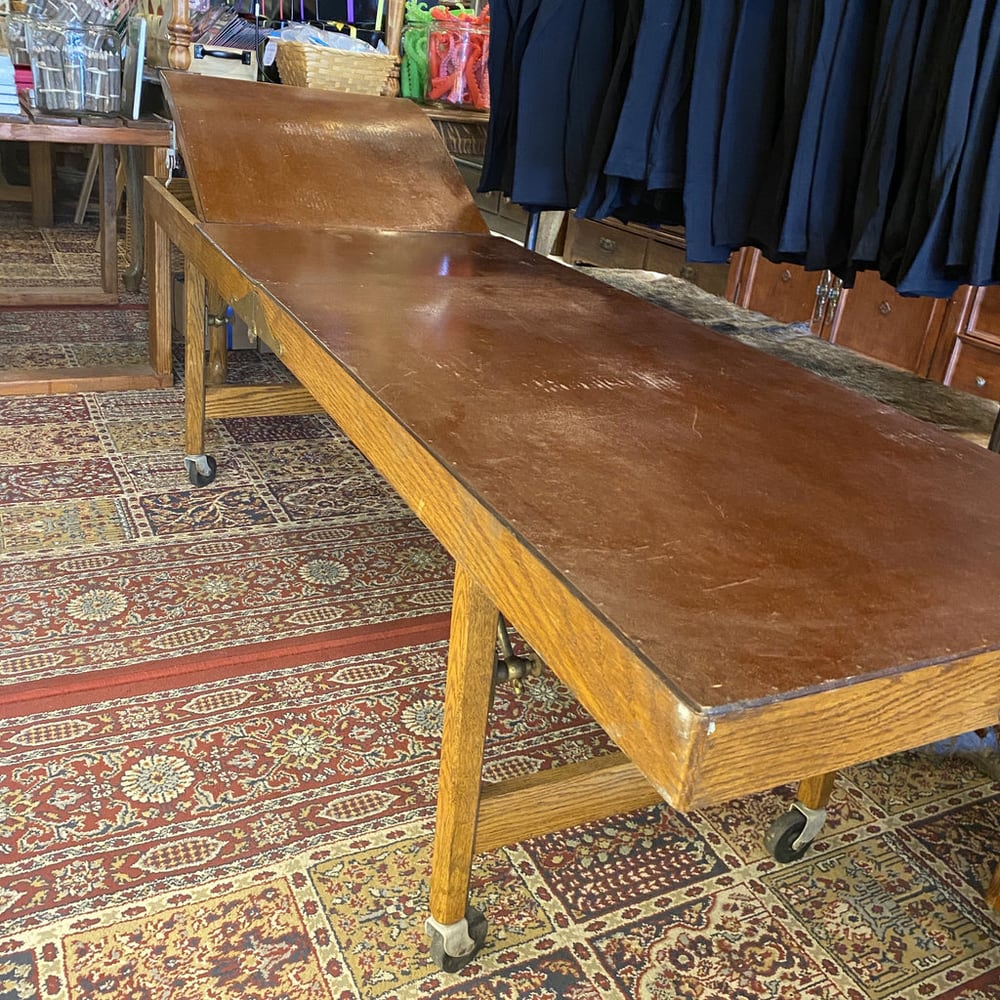
Stripped to its essentials, a cooling board is a rigid rectangular platform, a little longer and wider than a person, raised on legs so that a cooling agent can sit in the space underneath. The defining feature is that the platform is not solid: it is drilled with drainage holes or, in the better examples, woven as an open cane latticework stretched in a frame. Contemporary patents specify the top as being of “cane, perforated zinc, or wood,” and one 1885 patent describes it as “a number of layers of wood cemented together with the grain crossed, the whole being perforated … to permit free passage of air.” Those perforations serve two purposes at once: they let fluids drain away, and they let air — and cold — move freely through the plane the body rests on rather than being trapped against a solid slab.
The frame was typically oak for strength, with a top surface of cane lattice or perforated pine, and fittings of forged iron or brass; better boards carried an adjustable head-rest and, on the portable models, standing handles “for the carrying of the board with its burden.” A sheet or “wicking” linen was laid over the lattice, both for decency during the viewing and because a damp cloth over an open weave adds a little evaporative cooling of its own.
It is worth saying what the board was for in the household economy of death. In nineteenth-century America, dying was overwhelmingly a domestic event: a person died in their own bed, and the family — or a hired “layer-out” — washed and dressed the body at home. There was no refrigeration and, for most, no embalming. The body had to be held presentable for a wake and a viewing that might run two or three days while relatives travelled and a grave was dug. The cooling board was the piece of equipment that made that interval possible.
1.3 The travelling undertaker’s folding board
The undertaker of the 1870s and 1880s did not, as a rule, bring the body to a parlor; he brought his equipment to the house. That single fact drove the most distinctive engineering feature of the American cooling board: it folds. A good travelling board had legs that hinged and tucked up beneath the frame, so the whole thing collapsed to a flat bundle a man could carry up a farmhouse staircase and set up in a front room.
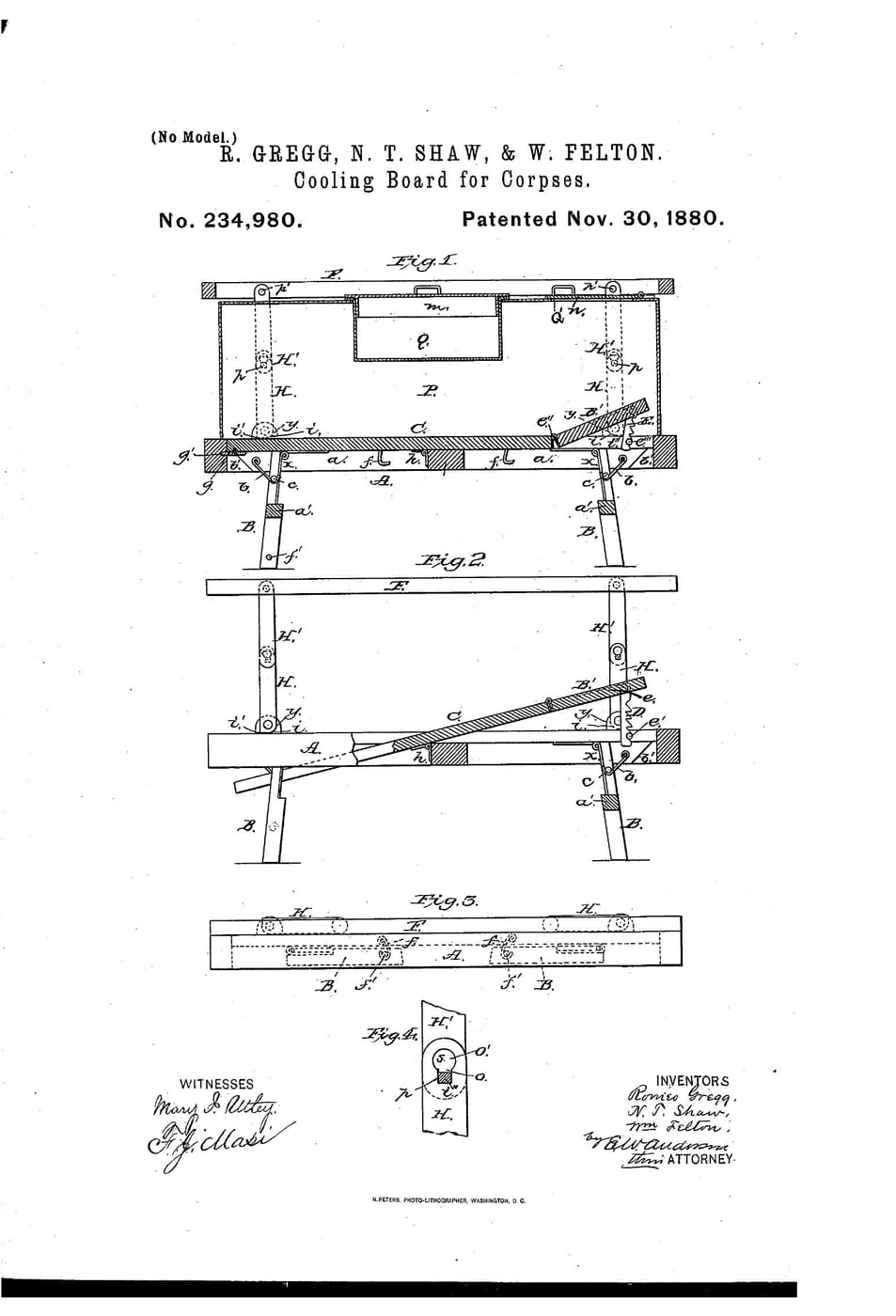
The patent record documents the type precisely. U.S. Patent 234,980, “Cooling-board for corpses,” granted to Romeo Gregg, Noah T. Shaw and William Felton of Columbus, Ohio, on 30 November 1880, describes a strong rectangular frame carried on folding legs that tuck underneath for storage and transportation, a board “of cane, perforated zinc, or wood,” an ice-box with removable pockets to “receive ice and other refrigerants,” a hinged top that could be raised to an incline on gravitating rack-bars, and an adjustable head-rest. Henry Clay Johnson of Meadville, Pennsylvania, patented a companion “Corpse Cooler and Preserver” (U.S. Patent 311,764, 3 February 1885) with the cross-laminated perforated board and metal carrying handles noted above. The type persisted into the twentieth century — Lloyd E. Fosdick’s “Undertaker’s Cooling-Board,” U.S. Patent 776,313, was granted as late as 29 November 1904.
The best-remembered maker in the collector literature is B. F. Gleason of Brockport, New York, whose folding “Gleason board,” mass-produced and sold nationally, became almost a generic name for the portable type; secondary sources cite Gleason patent dates in the 1880s, but I was not able to confirm the specific numbers or dates against the primary patent record, so treat “Gleason, 1881/1886” as trade lore pending Vol 4’s patent search. What is certain is that folding, portable cooling boards were a competitive product line by 1880, made by several firms — the makers and their catalog plates are Vol 4’s subject.
1.4 The physics of a cold plank
The cooling board is a good object to think clearly with, because its physics is honest and small. Two processes destroy a body after death: autolysis, the self-digestion of tissue by the body’s own enzymes released from dying cells, and putrefaction, the breakdown of tissue by bacteria — chiefly the gut flora — multiplying through it. Both are chemical reactions, and both are governed by temperature. As a rough rule of thumb from reaction kinetics, the rate of an enzymatic or microbial process falls by roughly half for every ~10 °C (about 18 °F) drop in temperature; lower the temperature and you slow the enzymes and suppress the bacteria together. That is the entire principle. Chilling does not preserve; it postpones. A body held near the melting point of ice, in the region of 0–4 °C (32–40 °F), decays far more slowly than one at room temperature — enough to buy the days a wake required, not enough to make it permanent.
The cooling board delivers that chill by the two most ordinary modes of heat transfer. Conduction carries heat from the body down through the perforated board and the intervening air. Convection does the larger share: air chilled by contact with the ice below is denser and settles, and the perforations let that cold air rise into contact with the underside of the body while warmer air falls away — a slow, passive circulation with no fan and no moving part. The open lattice is not decorative; it is what lets the cold reach the body at all. Ice sat in a tray or the framed ice-box beneath, and had to be replenished as it melted.
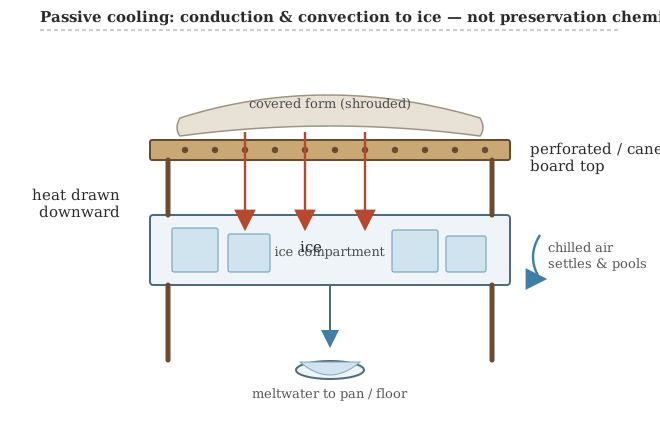
Two limits follow directly from the physics, and both matter to the rest of this dive. First, it is only as cold as the ice, and only for as long as the ice lasts — an unattended board in a warm summer room was a losing race against its own meltwater. Second, that meltwater had to go somewhere: the drainage holes that let fluids escape the body also let melting ice run off, and the whole arrangement was open to the room. Those were tolerable nuisances on an open board in a ventilated parlor. Seal the same ice-and-body arrangement inside an airtight metal box or casket, as the next generation of “corpse coolers” did, and the meltwater and hygiene problems stop being nuisances and become the central hazard — the “undertaker’s ice-box” controversy that is Vol 2’s to tell.
1.5 Documented dimensions and specimens
Surviving boards and period trade descriptions put a standard adult cooling board at roughly 75 inches (about 6 ft 3 in) long, 19 to 22 inches wide, and 16 to 25 inches tall — long enough to lay out an adult, narrow enough to carry through a doorway, and raised enough to seat an ice tray beneath. Child-sized boards were made to match, on the order of 42 inches long. These figures come from collector and trade-supply descriptions rather than a single authoritative museum measurement, so read them as a well-attested range rather than a fixed specification; the ~75 × 22 × 20-inch figure often quoted for a late-1800s example sits comfortably inside it.
Folded, a travelling board collapsed dramatically — a roughly 73-inch board reported to fold to about half its length with the legs stowed against the frame, thin enough to carry flat. Museum and collector documentation of specific specimens (the National Museum of Funeral History in Houston curates the type, and the folding “Gleason board” recurs in the sale record) is gathered in Vol 5, which reads joinery, cane-versus-plank construction, cast fittings, and folding hardware as dating and provenance cues. The point for this establishing volume is only that the object was standardized enough, by about 1880, to have a recognizable form and a settled set of dimensions.
1.6 Where the board sat in the household
The cooling board’s cultural footprint was larger than its plank. Because dying was domestic, the board was the stage on which a family’s dead were prepared and shown, and it left its trace in the language: to be “laid out on the cooling board” became a plain synonym for death. When no proper board was to hand — and for most poor and rural households there was none — families improvised the same geometry from what they owned, laying the body on a door taken off its hinges and set across two chairs, or on a dining table or bed, with ice or cold water doing the board’s job as best it could. The improvisation is the proof of the principle: what mattered was a flat, drainable surface and something cold beneath, not the furniture itself. Even a famous death fits the pattern — contemporary accounts describe Abraham Lincoln’s body being placed on a cooling board at the White House in 1865, though the detail comes from period recollection and is offered as color, not as a load-bearing fact.
This is why the cooling board is the right frame for the whole Embalming Machines wing. It represents the world before the machines — a world in which preservation meant cold, time was short, and the family did the work at home. The arterial pumps and trocars of the sibling dives, and the sealed ice caskets of Vol 2, were all, in their different ways, attempts to buy more time than a plank of cane and a block of ice could give. That contest between passive cold and active preservation is the spine of this five-part dive, and it starts here, with the simplest instrument of all. (The parlor electrotherapy fads of the same decades — the Violet Ray Wands and kindred gadgets in this site’s Quack Devices wing — belong to a different story of the era’s faith in machines; the cooling board asked for nothing but ice.)
1.7 Where this volume hands off
You now have the object: a folding, perforated, cane-or-plank platform that cooled the dead by conduction and convection to ice, bought a household a few days, and did nothing chemical whatever. The obvious next move was to close the open board into a container — to pack the ice around the body in a sealed metal trough or a casket with an icebox on top, and so carry the cold with the coffin. That is Vol 2 — Corpse Coolers and the Ice Casket, which takes up the metal “corpse cooler,” John Gravenstine’s patented “Corpse-Preserving Casket,” and the meltwater-and-hygiene hazards that made sealed ice a stopgap rather than a solution. From there the dive follows the cold into the twentieth century and its replacement by mechanical refrigeration (Vol 3), reads the makers and patents off the surviving hardware (Vol 4), and closes on collecting and display (Vol 5).
Sources
- Cooling board — Wikipedia — baseline definition (perforated wooden platform, cane latticework, ice beneath, drainage holes); replacement by metal embalming tables with refrigeration; the door-across-chairs improvisation; the Appalachian barn survival; the Lincoln cooling-board recollection (offered here as color, not verified fact).
- U.S. Patent 234,980, “Cooling-board for corpses” — Google Patents — primary source for the folding travelling board: Gregg, Shaw & Felton, Columbus, Ohio, granted 30 November 1880; folding legs, board of “cane, perforated zinc, or wood,” ice-box with removable pockets, gravitating incline, adjustable head-rest.
- U.S. Patent 311,764, “Corpse Cooler and Preserver” — Google Patents — primary source: Henry Clay Johnson, Meadville, Pennsylvania, 3 February 1885; cross-laminated perforated wood board “to permit free passage of air,” securing straps, and metal carrying handles.
- U.S. Patent 776,313, “Undertaker’s cooling-board” — Google Patents — primary source for the type’s persistence: Lloyd E. Fosdick, granted 29 November 1904.
- An Essential Guide to Identifying Antique Cooling Tables — American Mortuary Coolers (trade/collector blog) — secondary: standard adult dimensions (~73–76 in long × ~19 in wide × 16–25 in tall), oak frames with cane lattice or perforated pine, brass/iron fittings, folded-to-half-length figures, ~40 °F holding range, and the B. F. Gleason of Brockport, NY attribution and 1880s patent dates (cited but unconfirmed against the primary patent record — flagged for Vol 4).
- Antique folding traveling cooling/“Gleason” board, Undertakers’ Supply Co., Chicago — auction listing — a surviving folding travelling board on the market, for object form and maker mark (dimensions not published in the listing).
- Decomposition — Wikipedia and Factors influencing the progression of post-mortem changes (Scientific Reports) — the physiology behind the physics: autolysis (enzymatic self-digestion) and putrefaction (bacterial breakdown), both accelerated by heat and slowed by cold, establishing that chilling postpones rather than preserves.
Comments (0)