Cooling Boards and Corpse Coolers · Volume 3
From Ice to the Cold Room
How mechanical refrigeration and the metal embalming table displaced the cooling board and the ice-packed cooler in the twentieth century — and where the old ice-and-barn practice survived longest, in the frozen-ground receiving vault and the Appalachian winter hold.
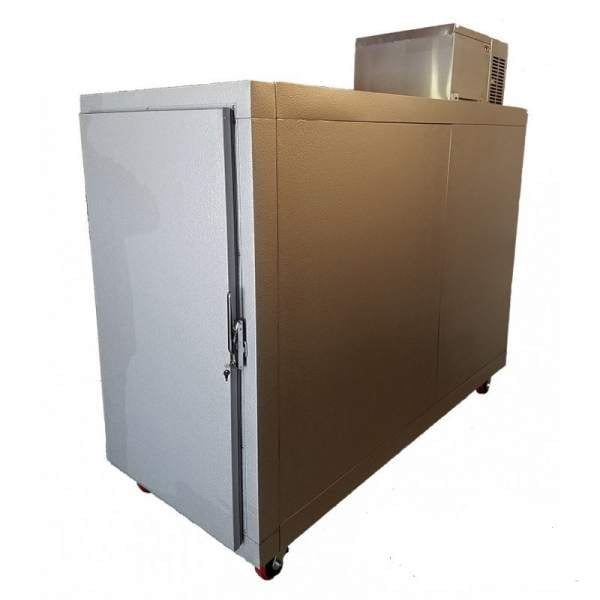
Where Vol 1 — The Cooling Board established the perforated ice-cooled board as pre-refrigeration furniture, and Vol 2 — Corpse Coolers and the Ice Casket took apart the metal ice-trough cooler and John Gravenstine’s 1871 ice-topped casket, this volume is the frame around all of them: the twentieth-century arrival of mechanical cold — the compressor, the refrigerated holding room, and the porcelain-topped metal table — and the slow retirement of the ice block. It is deliberately an object-history of the transition, and it closes the arc that the earlier volumes opened.
3.1 About this volume
The cooling board and the corpse cooler were never preservation technology in the chemical sense — they bought time by lowering temperature, nothing more. Their whole physics is the physics of a refrigerator, and so their story ends where mechanical refrigeration begins. This volume traces that ending: how vapor-compression cooling matured into a domestic and commercial commonplace between roughly the 1870s and the 1940s, how it entered the funeral home as the refrigerated holding room, and how the porcelain-enameled metal table displaced the perforated wooden board on the bench beside it.
It also resists a tidy story. Refrigeration did not arrive on a single date, did not reach every community at once, and did not abolish the old practice so much as make it optional. In the frozen-ground North the cemetery’s stone receiving vault held the winter dead into the early twentieth century; in the southern Appalachians the barn-till-spring hold outlasted the electric grid that would have replaced it. Those survivals are the point of the closing sections. The named machines of this sub-project — the gravity outfits, hand pumps, the electric Porti-Boy, the trocar — are catalogued in the four sibling dives; here the subject is the cold that surrounded them and finally outgrew the ice.
3.2 Why cold works, and where ice fell short
The mechanism a cooling board exploited is the same one a refrigerator exploits, and it is worth stating plainly because period advertising routinely blurred it. After death, tissue breaks down along two tracks: autolysis, the body’s own enzymes digesting cells from within, and putrefaction, driven by bacteria. Both are chemical reactions, and the rate of a chemical reaction falls sharply as temperature drops — as a rough rule of thumb, reaction rates roughly halve for each 10 °C of cooling. Chilling does not stop decomposition; it slows it. This is why modern mortuary holding coolers are run at a positive temperature, cited in mortuary-trade sources at around 36–39 °F (about 2–4 °C) with a holding window of roughly three to four weeks — cold enough to suppress bacterial and enzymatic activity and hold a body in acceptable condition for a matter of weeks, but above freezing, so tissue is not damaged by ice-crystal formation. (These specific figures rest on trade-vendor guidance rather than a museum or standards source, so read them as indicative.) A block of ice under a perforated board was reaching for exactly this window, by conduction and convection, with none of the control.
Ice did the job badly. It was a consumable that had to be bought, delivered, and replenished; it cooled unevenly and only from below; and — the recurring complaint of the period, treated at length in Vol 2 — it melted, producing meltwater that fouled the board, the room, and the family parlor and raised the hygiene objections that made the “undertaker’s ice-box” a minor Victorian scandal. Natural ice was also seasonal and, by the late nineteenth century, increasingly suspect as a vector for contamination where it was cut from polluted ponds. The cooling board’s limitations were, in short, the limitations of ice itself; solving them meant replacing the ice with a machine.
3.3 The machine that displaced the ice
The machine already existed, decades before it reached the funeral home. The vapor-compression cycle — the closed loop that virtually every refrigerator, cold room, and mortuary cooler still uses — was first demonstrated in a working apparatus by the American-born engineer Jacob Perkins, who was granted a British patent for it in 1834, using ethyl ether as the working fluid. Perkins’ machine was commercially stillborn, largely because cheap natural ice, harvested and shipped from North America, undercut it. The cycle turns on a simple thermodynamic trick: a refrigerant is compressed to a hot high-pressure gas, cooled and condensed to a liquid while dumping that heat outdoors, then allowed to expand through a valve, where it flashes cold and low-pressure and absorbs heat from whatever surrounds the evaporator coil. The heat is not destroyed — it is pumped from a cold place to a warm one, at the cost of the work put in by the compressor.
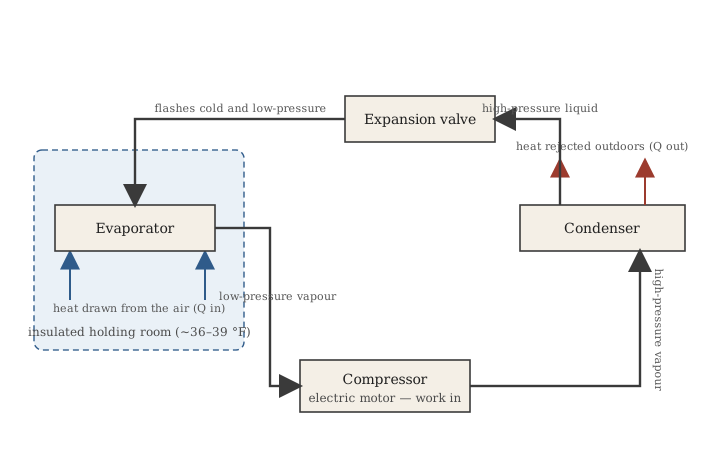
Commercial refrigeration arrived when Carl von Linde, a German engineering professor, developed an efficient ammonia vapor-compression system in 1876, which spread rapidly through breweries, meatpacking, and cold storage. What remained was to shrink it. Small electric motors after 1900 made compact units feasible, and around 1918 Kelvinator and (the company soon renamed) Frigidaire — the Guardian Frigerator Company, renamed Frigidaire in 1919 — were among the first to sell practical self-contained household refrigerators in the United States. (The “first” is genuinely contestable, with claimants such as the 1913 Domelre, so this is a rough date for the technology reaching the home, not a settled priority.) The last barrier was the refrigerant itself — ammonia and sulphur dioxide were efficient but toxic and dangerous to leak indoors — and it fell in 1928, when Thomas Midgley Jr. and Charles Kettering synthesized the first chlorofluorocarbon refrigerant, marketed as Freon: stable, non-flammable, and non-toxic in ordinary use. (Freon’s atmospheric legacy is another century’s problem; in the 1930s it was simply the thing that made refrigeration safe to put in a small room.) With a safe refrigerant and an affordable compressor, mechanical cold could go anywhere a wall outlet reached — including the back room of an undertaking establishment.
3.4 Into the funeral home: the cold room and the metal table
Two changes converged on the funeral home’s preparation room in the first half of the twentieth century, and it is easy to conflate them. One was the retirement of the ice-cooled board; the other was the retirement of ice as the cooling medium. They did not happen at the same time.
The board went first, and for reasons of sanitation as much as cold. Porous, absorbent wood — and the cane latticework of the folding traveling boards — could not be properly cleaned between uses, an intolerable liability once germ theory reshaped the trade’s self-image. The answer was a nonporous, washable metal table. Trade sources credit the Embalmers’ Supply Company (ESCO) with producing the first American-made embalming tables in 1903, with porcelain-enameled tops and a tilting mechanism for drainage following by about 1908 — a cast-iron base carrying a glass-smooth, chemically resistant, sanitizable surface. (These early-table dates come from supply-house and dealer histories rather than a museum catalog, and should be treated as indicative; the direction of travel — wood to cast iron and porcelain across the 1890s–1930s — is well attested.) The perforated draining board and the sanitary metal operating table are functionally cousins, but the metal table belongs to the embalming room and the arterial-injection trade covered in the Gravity Injection Systems, Hand Pump and Bulb Machines, and Electric Embalming Machines dives, not to the ice-and-parlor world of the board.
Cold followed a slower curve. Through the early 1900s many establishments still depended on delivered ice, because mechanical refrigeration was expensive and, early on, unreliable. Larger and more centralized funeral homes began adopting it in the 1920s–1930s as electric refrigeration matured; the period after the Second World War is generally when the mechanically refrigerated holding room became the professional standard, and compact, efficient compressors from the 1960s made individual refrigerated tables and small cold cabinets practical for even modest firms. The modern holding cooler — an insulated room or cabinet of roller shelves at that 36–39 °F positive temperature — is the direct descendant of the ice block under the board, doing the same job continuously, evenly, and without meltwater. A separate class of mortuary freezer, running well below freezing for long-term storage, occupies the far end of the same technology, but freezing is a distinct regime from the gentle chilling the cooling board ever attempted.
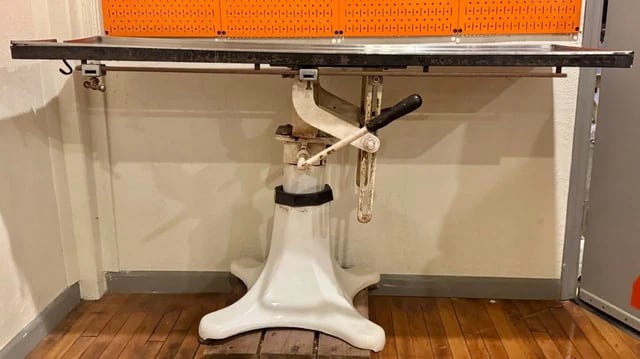
3.5 Cold is not chemistry: refrigeration versus embalming
It is worth being exact about what displaced what, because the trade’s own marketing was not. Arterial embalming — the injection of a preservative fluid that fixes and disinfects tissue, the subject of the four machine dives — is a chemical intervention that gives durable preservation, good enough to ship a body across a continent or hold an open-casket viewing days after death. Refrigeration gives only temporary preservation: it pauses decomposition while the cold holds, and the clock restarts the moment a body is removed to a warm room. The two are complementary, not equivalent. The spread of embalming after the Civil War did not abolish the need for cold; rather, refrigeration became the holding technology — the way a body is kept before and between the steps of preparation, or held for a delayed service — while embalming became the presentation technology.
This distinction quietly retires a whole genre of period claim. The Gravenstine ice casket of Vol 2, and the corpse-cooler advertisements that promised “preservation,” were selling refrigeration under a word that properly belonged to chemistry. What ice actually delivered was a slowed clock, not a stopped one — the same honest limit that a modern holding cooler carries, only far less reliably. Where the earlier volumes debunk the specific ice-casket claims, the general correction is this: no amount of cold preserves in the sense the fluid trade meant; it only waits. The machines of the sibling dives did the preserving; the cold, ice or mechanical, only ever bought the time.
3.6 Regional survivals: the receiving vault and the Appalachian hold
The ice-and-cold-room story has a long tail, and it is geographic. Two survivals outlasted the technology that should have ended them.
The first is the receiving vault (also receiving tomb or public vault) — a cemetery structure, ranging from a simple hillside chamber with coffin niches to an ornate above-ground tomb, built to hold the dead through the months when the ground was frozen too hard to dig a grave. These were a fixture of northern Europe, northern North America, and far southern South America, most common from the 1800s into the early 1900s, and they solved exactly the problem the cooling board could not: not how to chill a body in the parlor, but where to keep it, coffined, until spring burial was physically possible. Their obsolescence came less from refrigeration than from earthmoving — the steam shovel and later the backhoe made winter grave-digging feasible — with embalming and, eventually, funeral-home refrigeration finishing the job. Hundreds of these stone vaults survive, empty, in older cemeteries, and they are a legitimate collecting-and-documentation subject in their own right alongside the coolers.
The second survival is domestic and southern. In the Appalachian highlands, custom was to bury within a day or two of death — except in winter, when frozen ground forced a delay. In that case the coffined body, or the body on its cooling board, was commonly kept in the barn or another cold outbuilding, protected from animals, until the ground softened; the same folk practice used a cool room, a springhouse, or simply the winter air where refrigeration and even electricity had not reached. This was not a quaint anachronism confined to the deep past: into the 1960s, parts of the Appalachian mountains were still without reliable electricity, telephones, or nearby funeral homes, and home laying-out and the winter cold-hold persisted in living memory. Here the “cooling board” and the receiving vault effectively merged — the board itself set in a cold place until spring — and the frame of this whole dive, the pre-refrigeration furniture of death, was still doing its work in the age of the household refrigerator. That overlap, more than any clean cutoff date, is the honest shape of the transition from ice to the cold room.
3.7 Where this volume hands off
With the transition traced, the collection turns from how it worked to the objects and their record. Vol 4 — Makers, Patents, and the Trade-Catalog Record reads the patent drawings and period catalog plates — Gravenstine and his peers, the corpse-cooler engravings, the folding-board hardware — and lays out the construction and dating cues; Vol 5 — Collecting Cooling Boards, Coolers, and Ice Caskets carries those cues onto the collector’s bench, from joinery and cane-versus-plank to provenance and display. The receiving vault and the survived cold-hold documented above are, appropriately, where the object-history frame of this volume meets the collecting eye of the next.
Sources
- Cooling board — Wikipedia — definition (perforated wood or cane latticework), ice-beneath cooling, the note that metal embalming tables replaced cooling boards as refrigeration became available, and the Appalachian winter barn use.
- Receiving vault — Wikipedia — definition of receiving vault / receiving tomb / public vault, frozen-ground geography, common use “from the 1800s into the early 1900s,” and obsolescence via steam shovel/backhoe, embalming, and refrigeration.
- “Put the corpse in the barn till spring” — Appalachian History — the Appalachian winter practice of keeping a coffined body or cooling board in the barn until the ground softened; improvised boards; persistence of home laying-out.
- History of Refrigeration — Chef’s Deal and Refrigerator — Wikipedia — Jacob Perkins’ 1834 vapor-compression patent (ethyl ether), Carl von Linde’s 1876 ammonia system, Kelvinator/Frigidaire’s household refrigerators around 1918 (Frigidaire being the Guardian Frigerator Company, so renamed in 1919, and “first” being contested by earlier claimants such as the 1913 Domelre), and Midgley/Kettering’s 1928 Freon. Used for the general refrigeration timeline and the cycle description.
- Chilling Facts About Funeral Home Refrigeration and The Cold Truth About Funeral Body Storage — modern holding-cooler positive temperature (≈36–39 °F / 2–4 °C), 3–4 week holding window, refrigeration-versus-freezing distinction. Trade-vendor sources, used for present-day technical figures and hedged accordingly.
- The Complete Guide to Comparing Porcelain Embalming Tables — ESCO’s first American embalming tables (1903), porcelain-enameled tilting tops (c. 1908), and the sanitation rationale for metal over wood. Supply-house history, treated as indicative rather than museum-authoritative.
- The History and Evolution of Funeral Homes — general framing of the move from home parlors and ice to professional establishments and mechanical refrigeration across the early-to-mid twentieth century.
- Modern Embalming — William L. Clements Library, University of Michigan — the post-Civil War professionalization context that made embalming the “presentation” technology while cold remained the “holding” technology.
Comments (0)