C. M. Sorensen Pressure and Suction · Volume 6
C. M. Sorensen Co., and Dating This Machine
A firm that made pressure and suction apparatus for sixty years, moved twice, patented nothing, and ended inside Vernitron — and why, with all of that on the table, Machine No. 10010 still cannot be dated to a year.
Contents
6.1 About this volume
Vol 1 settled what this machine is. This volume asks the two questions that follow: who made it, and when.
The first has a reasonably good answer. The second does not, and the honest work of this volume is to explain exactly why — because the temptation to produce a year is strong, the material almost supports one, and almost is not good enough.
Everything in the address chronology below I re-read in the scanned originals rather than taking it from a secondary summary. Where I am inferring rather than reading, it is flagged.
6.2 The address chronology
The firm moved twice in the period that matters, and the moves are the only hard chronological pegs available.
1914 and 1915 — 177 East 87th Street, Manhattan. Both years’ New York City telephone directories carry the same line, in the same abbreviated form:
Sorensen C M Co, Elec Air Comprsrs · 177 E 87th · Lenox
The firm is already incorporated, and already classified as a maker of electric air compressors — not surgical instruments, not medical supplies. Whatever Sorensen thought it was selling, the telephone company thought it was in the compressor trade, and that classification is a fair description of the object on my bench.
1917–18 — still 177 East 87th Street. The advertisement in The American Year-Book of Anesthesia and Analgesia quoted in Vol 1 gives the same address in the same words. So Manhattan holds across at least four documented years, and the firm is by then advertising in an anaesthesia annual rather than a general directory.
1925–26 — 444 Jackson Avenue, Long Island City. The catalogue’s title page:
C. M. Sorensen Co., Inc. · 444 Jackson Avenue · Long Island City, New York (Queensboro Plaza, 15 Minutes from Times Square) · Cable Address: Tankless, New York
The parenthetical is period marketing worth keeping: Sorensen felt the need to reassure Manhattan physicians that a Queens address was not the sticks. The cable address — Tankless — is what the firm considered its brand. Everything it sold was “Tankless Apparatus,” meaning a pump that made its own pressure on demand rather than drawing from a stored reservoir.
1937 — 29-44 Northern Boulevard, Long Island City. The advertisement in volume 38 of the Medical Directory of New York, New Jersey and Connecticut reads:
Pioneers since 1908 — Chairs · Stools · Complete Combination Treatment Outfits comprising suction and spray apparatus, with accessories, Coagulator and Desiccator, Sterilizers, Sterile Water Heaters, etc. · Write for catalogue · C. M. SORENSEN CO., Inc., 29-44 NORTHERN BLVD., Long Island City, New York
The following year’s volume runs a near-identical advertisement, but with three differences worth recording precisely: it drops the street number (giving only “Long Island City New York”), it heads the block with a named product — “Portable Ear, Nose and Throat Treatment Outfit No. 65” — and it drops “Pioneers since 1908” entirely. So the heritage line appears in exactly one of the two years, which is worth remembering when it comes to be weighed.
Whether the No. 65 is the No. 60’s descendant is an inference and not a documented lineage: the advertisement gives a name and a number and no specification whatever, and Sorensen numbered liberally across its range. What the 1938 block does establish, which is enough, is that the firm was still selling a portable ENT office outfit twenty years after the Yankauer advertisement, under a number close to the old one. ⟨verify⟩
So: Manhattan through at least 1918, Jackson Avenue by 1925, Northern Boulevard by 1937. The moves are the spine of any dating attempt — and my machine’s plate, unhelpfully, carries none of them.
6.3 “Pioneers since 1908”
That phrase is the only origin date the company ever seems to have printed, and it needs handling carefully, because it is advertising copy about itself.
It is corroborated in direction if not in detail: a firm listed as an established electric-air-compressor company in the 1914 telephone book plainly did not start in 1914, so a founding in the late 1900s is entirely plausible. But — and this is the part that gives me pause — the 1925 catalogue makes no such claim. Forty-eight pages of self-promotion, and not one “established,” “founded,” or “since.” The heritage line surfaces twelve years later — and then, in the very next volume, disappears again. It appears exactly once in everything I have been able to read of this company’s own words. Firms tend to discover their own antiquity at the moment it becomes useful, and to mislay it just as easily.
I would state it this way: the company claims 1908, the claim is consistent with the record, and no independent source confirms it. ⟨verify⟩ An incorporation record in the New York State corporate filings would settle it, and I have not searched those.
The founder is a further gap. “C. M.” is presumably a real person — a Sorensen with those initials — and I have found nothing about him: no obituary, no trade-press profile, no patent (see below), nothing. Whether C. M. Sorensen was an engineer, a salesman, or a name on a door is unknown. ⟨verify⟩
6.4 The patent negative
This is a genuine finding rather than an absence of searching, and it is worth stating precisely, because negatives are easy to fake and hard to trust.
Twenty-five annual volumes of the USPTO Index of Patents, covering 1922 through 1963, were checked for “C. M. Sorensen Co.” as an assignee. There are zero hits. Not one patent, over four decades, assigned to the company. Nor does any Sorensen-surnamed patentee in those indexes hold a patent touching aspiration, surgical suction, or embalming. The Sorensens who do appear are a scatter of unrelated people: a tie-plate man in Houston, a boiler-tube-scaling device, a vibrating sieve in Norway, Charles E. Sorensen of the Ford Motor Company, a hat-blocking machine in Seattle.
Two honest limits on that finding. The 1908–1921 volumes are not digitised, so the firm’s first thirteen or fourteen years — precisely the years in which an inventive founder would have been filing — are unchecked. ⟨verify⟩ And an index search finds assignments; a patent granted to a founder personally and never assigned to the company would not surface under the company name, though it should have surfaced under the surname, and did not.
One specific error is worth killing here. US 2,252,624, “Embalming machine,” is not a Sorensen patent. It was granted to Gilmore and Junod in 1941, and is occasionally cited online as though it linked Sorensen to the funeral trade. It does not.
The inference. A manufacturer that operated for six decades and patented nothing was, in all likelihood, not inventing. It was assembling and branding conventional engineering — buying motors, casting or buying pumps, and selling the combination as a configured medical outfit with a good catalogue behind it. That reading sits comfortably with what the object shows: an orthodox eccentric-driven twin-cylinder compressor, an off-the-shelf universal motor, standard nickel canisters, cheap replaceable glassware. It sharpens Vol 3’s open question about what Sorensen actually made versus bought in — and makes finding a supplier’s name inside the motor housing a more interesting prospect than it first appeared.
6.5 Dating Machine No. 10010
Here is what can honestly be said.
There is no serial-to-year key. No Sorensen production ledger, no dated parts list, no published concordance. None has surfaced, and I would be delighted to be corrected.
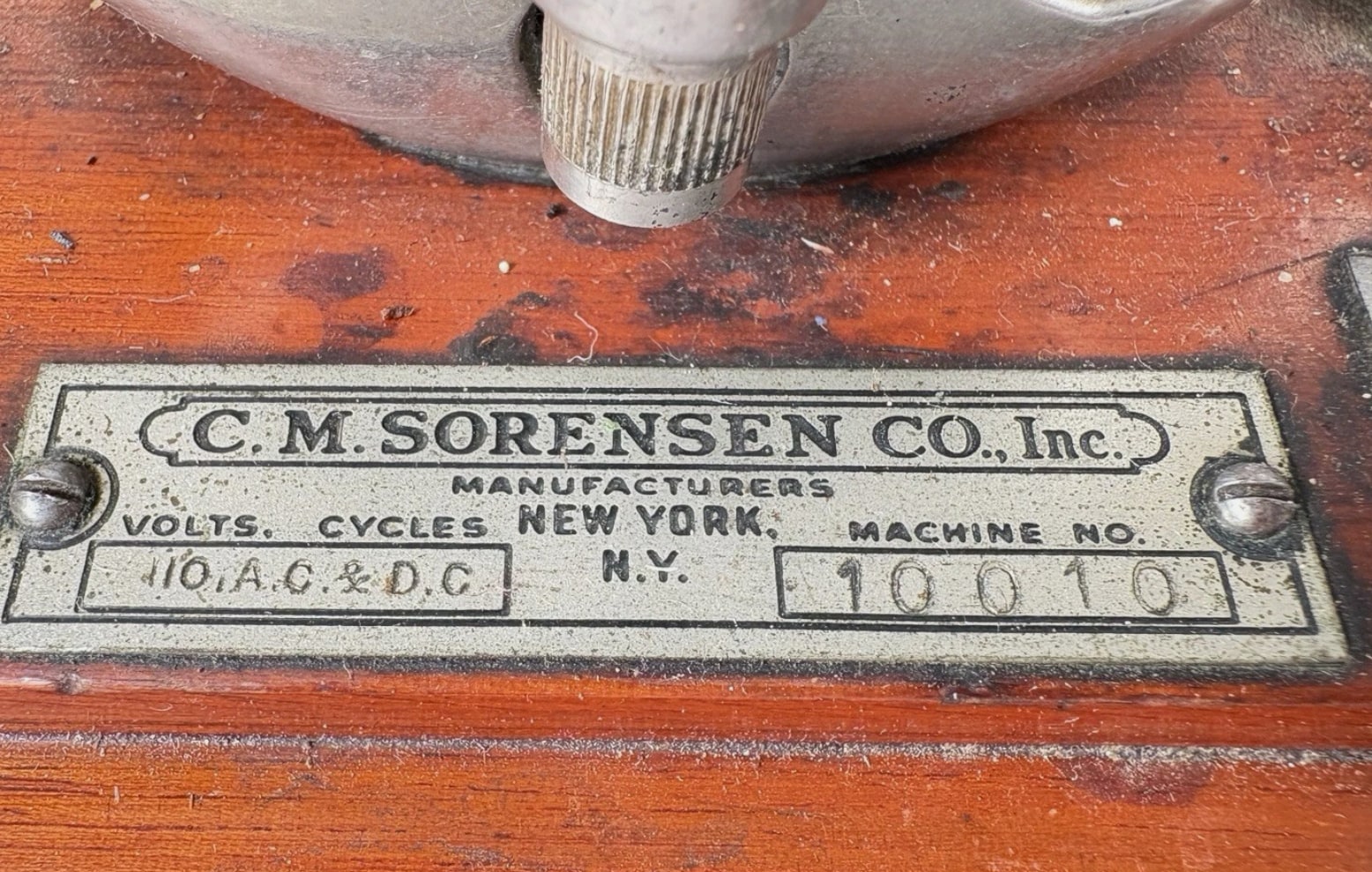
The plate gives no address. This is the single most frustrating fact in the volume. Had Sorensen stamped its street address on the base plate, as many contemporaries did, No. 10010 would be datable to a window of a few years by the address alone. It reads only NEW YORK, N.Y. — which, note, is technically true of Long Island City after the 1898 consolidation as well as of Manhattan, so the wording does not even exclude the Queens years.
What is left is a set of soft indicators, and they converge on a range rather than a year:
- The universal motor. A “110 A.C. & D.C.” rating was a real selling point while New York still ran substantial direct-current mains and alternating-current frequency was unstandardised — pressure that eased steadily through the 1930s. It points early rather than late, but it is a weak instrument: Sorensen went on offering universal motors for decades.
- The model’s catalogue life. The Yankauer outfit is advertised in 1917–18 and catalogued as the No. 60 in 1925–26 — a documented decade — with a portable ENT outfit still in the line as the No. 65 in 1938, though that continuity is inferred from a name rather than shown from a specification. Either way the model designation dates nothing on its own; a machine can have been built anywhere in that window.
- The pressure control. Vol 3 identifies this as the most useful dating evidence still available, and it is entirely internal. The 1925 catalogue describes the larger No. 460 as carrying “a new, improved type” of control which “diverts the air instead of holding it back against the pump.” If Machine No. 10010 carries the older, throttling type, it is pre-improvement — and the improvement was already in the catalogue by 1925. If it carries the diverting type, the machine is 1925 or later. This is the one determination that would materially tighten the bracket, and it requires taking the pump head apart.
- The fittings and finish. Nickel rather than chrome, mahogany rather than enamelled steel, and a push-button switch in a nickel escutcheon are all consistent with the 1910s–20s and increasingly unusual by the later 1930s, when the firm’s own advertising is showing white-enamelled chairs and stands.
My honest bracket is roughly 1917 to 1930, with the earlier half of that range better supported than the later half. I will not narrow it further, and specifically I will not put a year on it, because every route to a year runs through an assumption I cannot check.
6.6 The coincidence that is not a date
There is a very tempting piece of arithmetic here, and it needs to be disposed of explicitly, because anyone who reads the catalogue and then looks at the plate will construct it independently.
The 1925 catalogue, describing the No. 60, says:
“Perhaps we can give no better idea of its great utility than by pointing out that of this outfit alone over ten thousand are in use.”
My machine is No. 10010.
Ten thousand and ten. Written in 1925. It is a lovely coincidence and it is almost certainly nothing at all, for a plain reason: the number on the plate is a machine number spanning the whole works, not a per-model production count. Sorensen’s 1925 line ran from a $76 wall-type outfit through the Midget, the Adjusto floor stands, the No. 60, the four-cylinder No. 460 at $185 on its table, sterilisers, coagulators and water heaters. There is no evidence the firm kept a separate series per model, and every reason — repairs, parts lists, warranty — to keep one series across the shop. The catalogue points that way: “Please always mention Serial Number of Outfit” appears once, generally, in the parts-list note, not per product.
Two numbers that happen to be close, arrived at by entirely different counting methods, are not evidence. Bodnar’s sold a sister machine numbered 11260 (Vol 1); if the sequence were a No. 60 production count, that would put over eleven thousand of one specialist office outfit into the field. Treat the coincidence as a good story and not as a date.
6.7 The long tail: aspirators, the Army, and Vernitron
Sorensen outlived the machine on my bench by a long way, and the later history is thinner but real.
The firm was still in Long Island City and still making suction apparatus into the 1970s. Tanfer Emin Tunc’s Dynamis (2008) paper “Designs of devices: The vacuum aspirator and American abortion technology” — a history of vacuum aspiration in American abortion practice, which is what the source is about and there is no reason to be coy regarding it — lists “C. M. Sorensen and Co. of Long Island City, New York” alongside Battelle of Seattle and Air-Shields of Hatboro among the manufacturers who entered the aspirator market around 1970 as the technology spread. For this history the value is narrow and biographical: it puts the firm in the same borough, making suction apparatus, fifty years after the Yankauer outfit — one product category, half a century, one address book.
Somewhere in that period the name passed to Vernitron Corporation, a diversified electronics and health-care conglomerate founded in New York in 1959 by Bernard Levine. Machines survive marked “Sorensen · Vernitron Medical Products,” and Vernitron Medical Products appears later at a South Hackensack, New Jersey address ⟨verify⟩ — which would mean the Long Island City works did not survive the merger as such. A “C. M. Sorensen 1200” field surgical suction and pressure pump, in an olive-drab case and described as Vietnam-era US Army issue, turns up in the surplus market; a “Vernitron Model 1200” of the same description turns up alongside it, which is about as clear a demonstration of the same product under two badges as one could ask for.
The corporate chain is genuinely murky and I will not pretend otherwise. ⟨verify⟩ I have not found the acquisition date, the terms, or whether Sorensen was bought outright, merged, or simply licensed its name. Vernitron’s own surviving paperwork in the public record — 1990s SEC filings, a scatter of litigation — postdates the relevant transaction by decades and does not mention it. The evidence that the two names ended up on one nameplate is solid; the story of how is not yet written. ⟨verify⟩
6.8 The collecting market
These machines turn up steadily, and almost always wearing the wrong name.
What they are listed as. “Antique embalming machine,” “mortician’s vacuum pump,” and — with dispiriting frequency — “steampunk.” The mislabelling is not harmless. It moves the object into a category that carries a morbid-curiosity premium, so the wrong name inflates the price while simultaneously making the machine harder to find for the people who would actually want it: collectors of anaesthesia, ENT and early surgical apparatus. A correctly described “Sorensen Tankless No. 60, Dr. S. Yankauer Outfit for Pressure and Suction” is a genuinely interesting object with a documented place in the history of ether delivery. An “antique embalming pump” is a Halloween prop.
What they fetch. Realised prices are hard to pin down, since most of the visible listings are asking prices or sit behind paywalls, but the observable band for a complete machine with both bottles runs from roughly $150 to $400, with one asking price of $285 visible in the open. ⟨verify⟩ Incomplete machines — missing glassware, missing purifier elements, missing tubing — go for a good deal less, and rightly so.
Telling a No. 60 from a No. 460. This is the one identification a buyer can make from a photograph, and it is decisive:
Table 1 — Telling a No. 60 from a No. 460. This is the one identification a buyer can make from a photograph, and it is decisive
| No. 60 | No. 460 | |
|---|---|---|
| Cylinders | Two | Four (two pressure, two suction) |
| Air purifiers | Two | Four |
| Motor | 1/20 hp | 1/8 hp, “the most powerful ever used on such an outfit” |
| Pressure control | Bleed or relief type ⟨verify — see Vol 3⟩ | “A new, improved type… diverts the air instead of holding it back against the pump” |
| Size | 7 × 13 × 12 in | 9¼ × 12 × 16 in |
| Net weight | 16 lb | 34 lb |
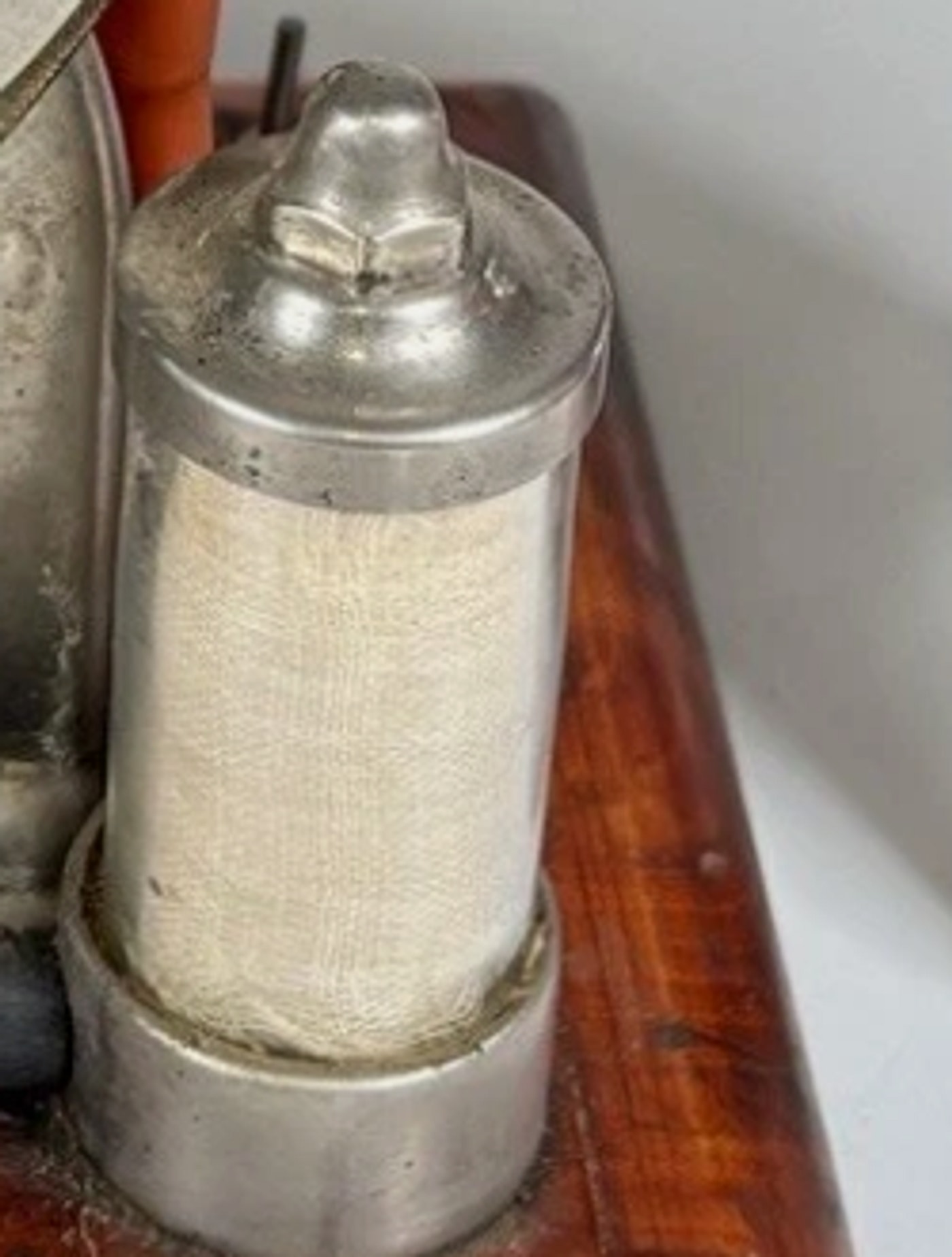
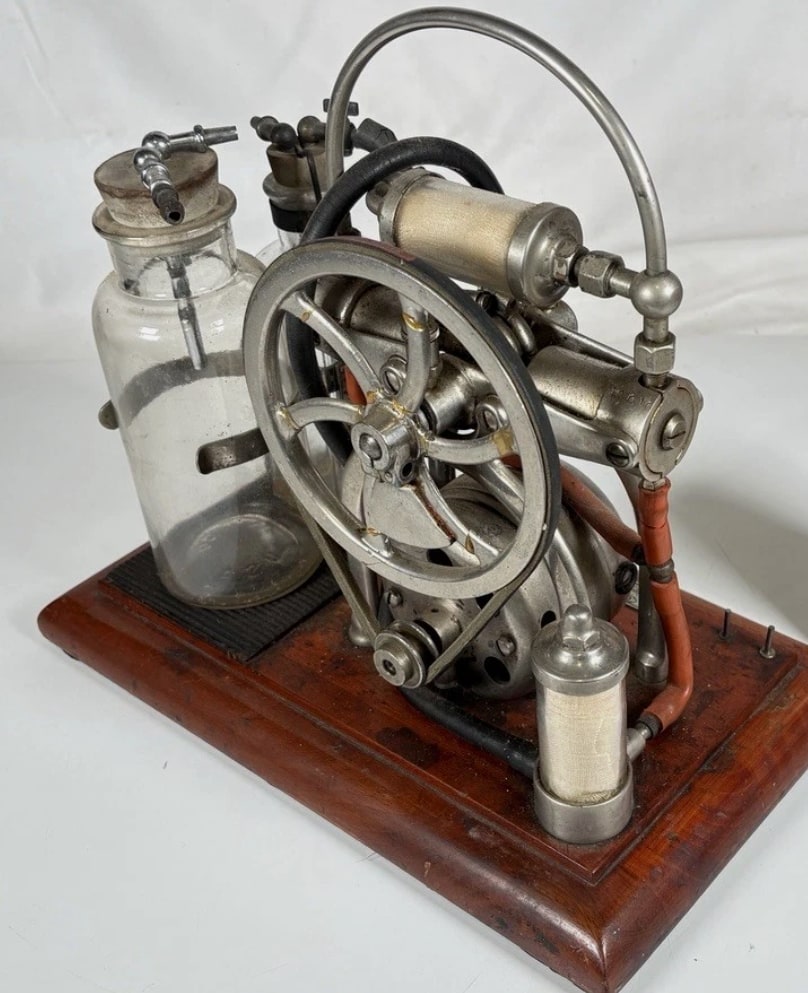
Count the nickel canisters. Two is a No. 60; four is a No. 460. That is the whole identification, and it survives a bad photograph in a way that nothing else on this list does.
Two cautions about the other rows, because both are traps I nearly fell into. The weight figures are bare-machine weights from each entry; the No. 460 was also sold mounted on a special enamelled steel table at $185.00, and that assembly weighs eighty pounds. Comparing sixteen pounds against eighty is comparing a tabletop machine against a piece of furniture — the honest comparison is 16 against 34, which is a real difference in the hand but not a dramatic one. And the No. 460 has no gauges: pressure and suction gauges belong to the larger floor-standing Adjusto outfit, whose catalogue entry introduces them explicitly as the thing that distinguishes it from the No. 460 — “The pump in the outfit here shown is very similar to that in No. 460, page 9… An important difference is that pressure and suction are indicated on gauges.” A gauge on a Sorensen is a sign you are looking at neither of these machines.
What to check before buying, in rough order of what costs most to put right:
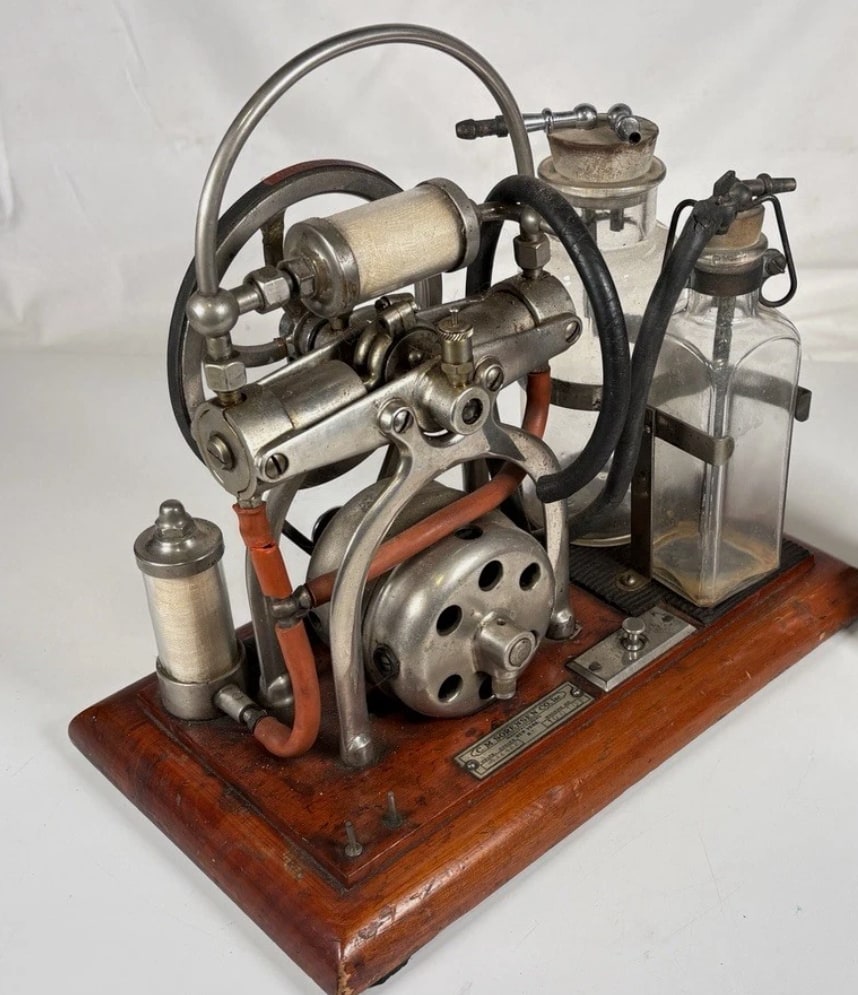
- Both bottles, and the right shapes — one square, one round. Sorensen made them dissimilar deliberately; a machine with two matching jars has lost at least one original.
- Both caps, with their valve fittings and petcocks. Small, unobtainable, and the commonest loss.
- Both purifier canisters. The elements were consumables and are usually gone; the canisters themselves are not replaceable.
- The plate number against the number stamped in the pump casting. If they disagree, the machine is a marriage of parts.
- The flywheel. A missing belt is trivial — they were shipped as spares because they broke. A cracked flywheel is not.
- The base. Mahogany, with rubber mats let into the top; splits, missing feet and replaced mats are common and visible.
- The cord. Assume it is unsafe — Vol 4 covers why a century-old ungrounded universal-motor appliance is a display object first and an electrical device second.
6.9 What is still missing
The documents that would close this volume all exist, or existed, and none of them is online.
A Sorensen Service Parts List. The catalogue promises them — “We publish lists containing every part of every apparatus we manufacture” — and a dated one would give both a parts concordance and, very likely, a chronology. Vol 3 names this as the single most valuable missing document; dating only reinforces that.
Sorensen catalogues other than 1925–26. One catalogue is a snapshot. Two, a decade apart, would let model numbers, prices and features be sequenced, and would probably date this machine outright.
The undigitised trade press. Casket & Sunnyside, Embalmers’ Monthly and The American Funeral Director are the three periodicals in which a Sorensen mortuary product, if one ever existed, would have been advertised. None is searchable online. A clean negative across them would convert Vol 1’s “no mortuary product I can find” into “no mortuary product, full stop” — and that needs HathiTrust access or the NFDA library.
New York State incorporation records, which would test “Pioneers since 1908” against a filing date and might name C. M. Sorensen himself. And whatever recorded the Vernitron transaction — a trade-press notice, a filing, a trademark assignment. It exists somewhere.
Until then, the answer to “when was this machine made” is: somewhere between 1917 and 1930, probably nearer the start of that span, and anyone who tells you a year is guessing. That is an unsatisfying place to end a dive, and it is the true one. This whole wing exists because a confident answer turned out to be wrong (Vol 1); it would be a poor tribute to that discovery to close it with another.
Sources
- New York City telephone directory, 1914 and 1915 — Internet Archive. Both carry “Sorensen C M Co, Elec Air Comprsrs, 177 E 87th, Lenox,” read directly from the scanned OCR text of each volume. The classification as an electric air compressor maker, not a medical supplier, is the firm’s earliest recorded self-description.
- The American Year-Book of Anesthesia and Analgesia, 1917–1918 — Internet Archive (Yale copy) — advertising p. 3, giving 177 East 87th St. ⚠ The “Sorensen, pH” entries elsewhere in the same volume are S. P. L. Sørensen, the Danish chemist, and are unrelated.
- 1926 Catalog of Sorensen Tankless Apparatus (copyright 1925) — Internet Archive — title page: 444 Jackson Avenue, Long Island City; “(Queensboro Plaza, 15 Minutes from Times Square)”; cable address Tankless, New York. The No. 60 entry’s “of this outfit alone over ten thousand are in use.” The No. 460’s four cylinders, four purifiers, 1/4 hp motor and 80 lb net weight, and its $185.00 price on the table. The No. 150 wall outfit at $76.00. The parts-list note “Please always mention Serial Number of Outfit.” Nowhere in forty-eight pages does the catalogue claim a founding date. Full OCR text.
- Medical Directory of New York, New Jersey and Connecticut, vol. 38 (1937) — Internet Archive — advertising p. vi: “Pioneers since 1908 … Complete Combination Treatment Outfits comprising suction and spray apparatus … C. M. SORENSEN CO., Inc., 29-44 NORTHERN BLVD., Long Island City.”
- Medical Directory of New York, New Jersey and Connecticut, vol. 39 (1938) — Internet Archive — the near-identical advertisement, headed “Portable Ear, Nose and Throat Treatment Outfit No. 65,” giving only “Long Island City New York” without a street number.
- USPTO Index of Patents issued from the United States Patent Office, annual volumes on the Internet Archive — e.g. 1926, 1935, 1950. Twenty-five volumes spanning 1922–1963 searched for “C. M. Sorensen Co.” as assignee: no hits, and no Sorensen-surnamed patent touching suction, aspiration or embalming. ⚠ The 1908–1921 volumes are not digitised and were not checked.
- US 2,252,624 — “Embalming machine,” Gilmore & Junod, 1941 — Google Patents — not a Sorensen patent, contrary to occasional online claims; cited here only to close that particular loop.
- Tanfer Emin Tunc, “Designs of devices: The vacuum aspirator and American abortion technology,” Dynamis, 2008 — lists “C. M. Sorensen and Co. of Long Island City, New York” among the aspirator manufacturers that emerged as the technology spread, placing the firm in the same city and the same product line around 1970.
- WorthPoint listings for a “Vintage Sorensen Vernitron Suction & Pressure Apparatus Surgical Pump” and a “CM Sorensen 1200 Field Surgical Suction Pressure Pump, OD Green, Vietnam Era,” alongside an eBay “VERNITRON Model 1200 Suction Vacuum Pump” — the same machine under both badges. ⟨Auction and resale listings are evidence that an object exists; they are not evidence of a corporate history. The Sorensen→Vernitron transaction itself remains undocumented here.⟩
- Antique embalming machine that’s unnerving — Auction Finds, 14 January 2015 and Bodnar’s Auction, Lot 104 — Machine No. 11260 — the mislabelled market, and the sister machine whose number bears on the serial-sequence question.
- Vernitron Corporation — SEC filings — the surviving public paper on the parent company, all of it from the 1990s and none of it touching the Sorensen acquisition.
Comments (0)