C. M. Sorensen Pressure and Suction · Volume 2
Pressure and Suction: The Circuit
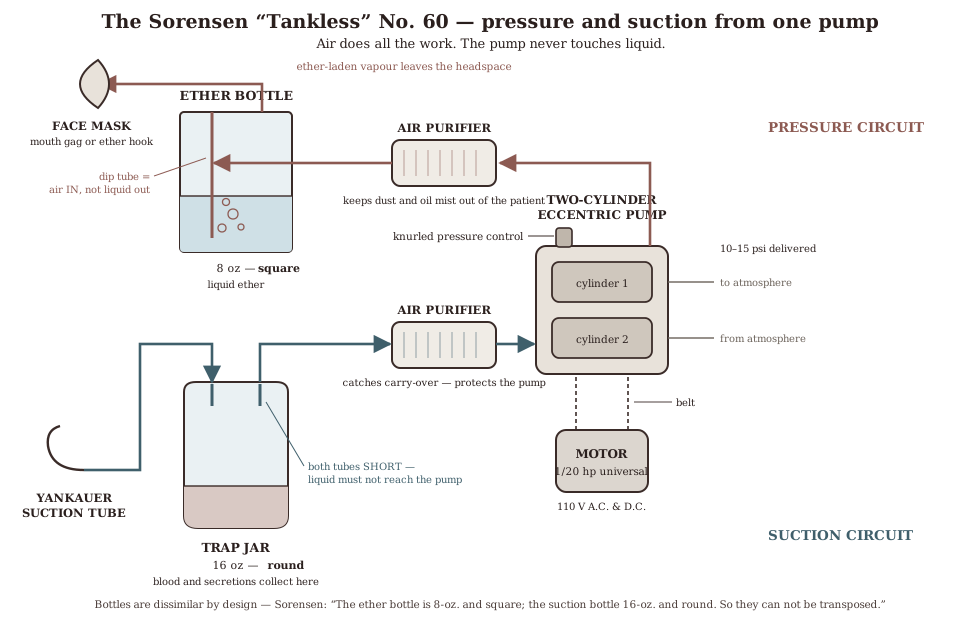
One motor, one twin-cylinder air pump, two ports and two bottles — and the reason the dip tube in the ether bottle is an inlet rather than an outlet.
Contents
2.1 About this volume
Vol 1 established what the machine is. This volume establishes what it does — how air moves through it, what happens inside each bottle, and why a machine that never touches the working liquid can nonetheless deliver ether vapour to a patient’s face and pull blood off an operating field at the same time.
The circuit is the most satisfying thing about the object. It is not complicated, but it is cleverer than it first looks, and one detail in particular tends to be misread by anyone approaching it cold: the dip tube in the ether bottle is an air inlet, not a liquid outlet. Working out why is most of the volume.
The mechanism that drives all this — the eccentric, the flywheel, the valves — belongs to Vol 3. Here we stay with the plumbing.
2.2 One pump, two duties
The machine has a single power train. A small enclosed universal motor turns a stepped pulley; a belt runs from it to a large crescent-spoked flywheel; the flywheel turns the crankshaft of a two-cylinder eccentric pump. Sorensen’s catalogue gives the motor as 1/20 horsepower. That is the whole prime mover: about 37 watts, less than a modern phone charger under load.
The trick is that a pump moving air has two useful ends, and this design exposes both of them.
Any air pump takes air in at one place and pushes it out at another. Conventionally you use one end and vent the other: a compressor uses its discharge and draws intake from the room; a vacuum pump uses its intake and dumps discharge to the room. The Sorensen uses both. One cylinder’s discharge is piped out to the work as the pressure line. The other cylinder’s intake is piped out to the work as the suction line. Each cylinder’s remaining port is open to atmosphere through a filter.
The catalogue’s language is exact about the consequence:
“Both pressure and suction are under perfect control and may be used simultaneously as well as independently.”
That is the selling point, and it is what made the machine worth buying for tonsil and adenoid work. The surgeon could keep a patient under ether vapour and keep the field clear of blood, from one appliance, driven by one motor, on one bench — at a moment when the alternative was a separate anaesthetist’s apparatus plus a hand-, foot-, or water-driven aspirator.
Two bottles hang off those two lines, and each does a completely different job.
2.3 The pressure side: blowing through a bottle
The pressure line leaves the pump, passes through its air purifier, and arrives at the cap of the square 8-ounce bottle. This is the ether bottle.
Here is the part that catches people out. The tube from the pump does not connect to the bottle’s headspace and blow across the top of the liquid. It connects to the dip tube — the tube running down to the bottom of the bottle. Pump air is forced down that tube and out beneath the surface of the liquid ether, where it bubbles up through it.
The bubbles do two things on the way. They agitate the liquid, and — far more importantly — each bubble saturates itself with ether vapour as it rises. Diethyl ether is extraordinarily volatile: it boils at 34.6 °C and has a vapour pressure above half an atmosphere at room temperature, so air in contact with liquid ether picks up a very large vapour fraction almost instantly. What arrives in the headspace above the liquid is therefore not air, but a heavily ether-laden air-vapour mixture.
That mixture is what leaves. A second port in the same cap, opening into the headspace and not reaching the liquid, carries it away down the silk-covered pressure tube to — in the catalogue’s and the advertisement’s identical phrasing — a “face mask, mouth gag or ether hook.”
So the flow is: pump → purifier → down the dip tube → bubble up through liquid ether → headspace → out to the patient. The dip tube is the way in. The short tube is the way out. Liquid ether never travels down a hose; only its vapour does, carried on the air that made it.
This arrangement is a bubble-through vaporiser, and the principle long outlived this machine — it is the direct ancestor of the bubble-through and draw-over vaporisers used in anaesthesia for the rest of the century. It also has the property, well understood at the time and worth stating plainly as a limitation, that the vapour concentration is not controlled by any calibrated mechanism. It depends on the airflow rate, the depth of liquid above the dip tube outlet, and the temperature of the ether — and the ether cools itself as it evaporates, so the concentration falls during use. The operator managed it by observation and experience. There is no dial on this machine that reads percent.
2.4 The suction side: the trap
The suction line runs the other way, and its bottle does the opposite job.
The round 16-ounce jar is a trap. Its cap carries two short tubes, neither reaching the liquid. One goes out to the patient end — in this outfit, a Yankauer suction tube, the rigid oral sucker described in Vol 5. The other goes back through a purifier to the pump’s intake.
The pump evacuates the jar’s headspace. Atmospheric pressure at the open end of the suction tube then pushes blood, mucus and saline down the hose and into the jar, where it falls out of the airstream and collects in the bottom. The air continues on to the pump; the liquid does not.
That is the entire purpose of the vessel, and it is why both its tubes must be short. A dip tube here would be a design error — it would put the pump’s intake below the liquid line and suck the collected fluid straight into the cylinders. The bottle is a separator, exploiting the fact that a liquid entrained in a moving airstream will drop out when the stream slows and turns, which is exactly what happens when a hose empties into a 16-ounce jar.
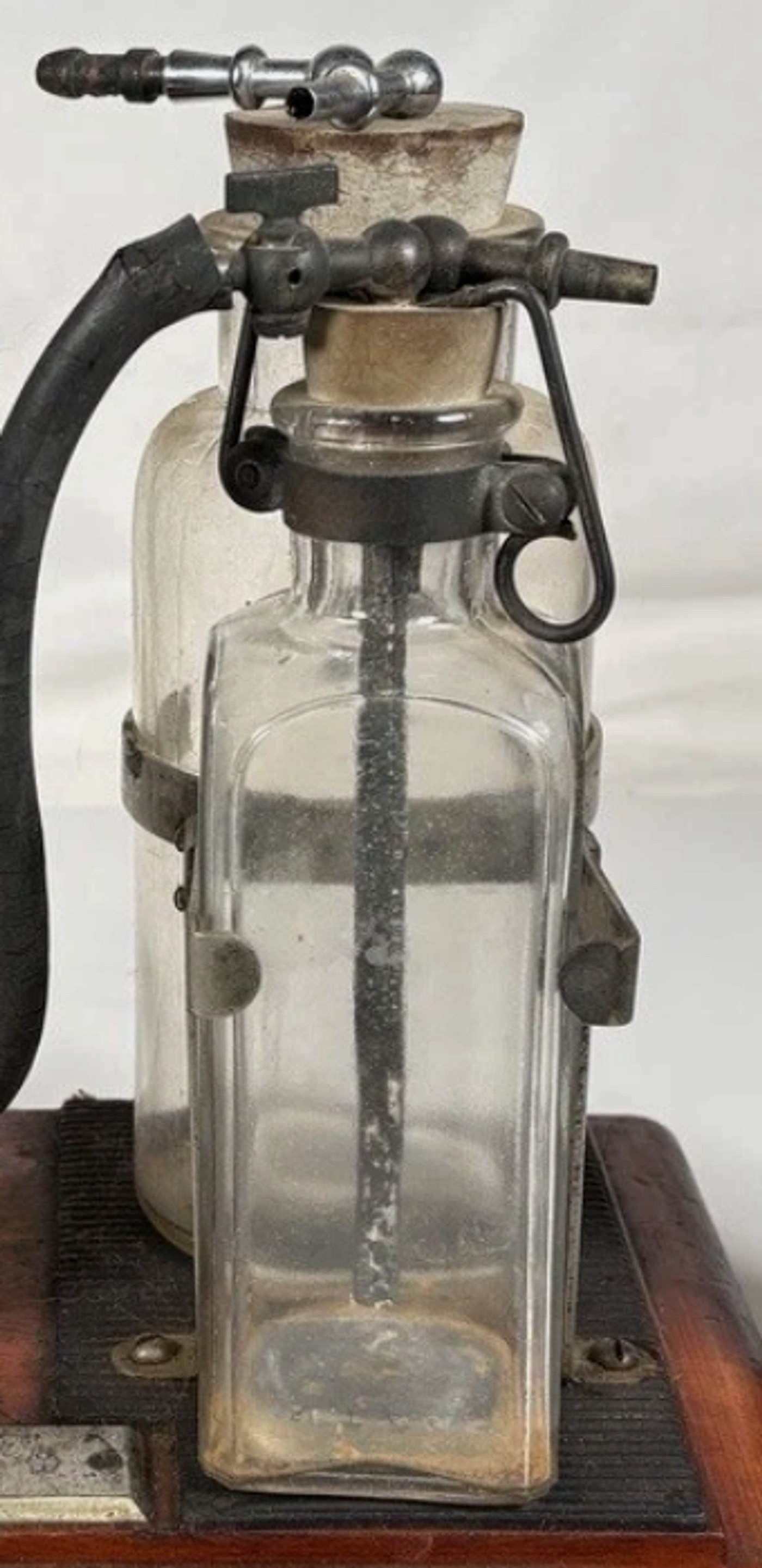
An honest caveat about my own specimen. In the photographs, a dip tube is clearly visible in the round jar. On the catalogue’s arrangement, the dip tube belongs in the square ether bottle and the round trap should have two short tubes. Three explanations are possible, and I cannot yet choose between them from photographs alone: the caps may have been swapped at some point in the machine’s life; the bottles themselves may not be the originals (Sorensen deliberately specified cheap, replaceable glassware — “a very simple form of bottle is used: inexpensive to replace in case of breakage”); or my reading of which vessel is which may simply be wrong. Establishing the cap-and-tube arrangement by direct inspection is the first item on Vol 3’s list. I would rather flag this than let a tidy diagram paper over it.
2.5 Why the purifiers are where they are
Sorensen calls them “air purifiers,” and the catalogue is characteristically brisk about them:
“AIR PURIFIERS. The air-filtering material in these is efficient, very cheap, and easily replaced.”
The No. 60 has two: one each for pressure and suction — the count that distinguishes it from the four-cylinder No. 460, which has four. On my machine one is mounted horizontally across the top of the pump and the other stands vertically at a front corner of the base.
They are not doing the same job.
The suction-side purifier sits between the trap jar and the pump intake, and it is there to protect the pump. However well a trap bottle works, some liquid carries over as aerosol, and blood and mucus drawn into a reciprocating pump’s cylinders would foul the valves, contaminate the oil, and corrode the bore. The purifier is the last line of defence — a mesh-and-fabric element catching what the jar missed. It is also, for exactly that reason, the dirtiest part of the machine and the one with real conservation and hygiene implications, which Vol 4 takes up.
The pressure-side purifier sits between the pump and the ether bottle, and its job is the reverse: to keep the machine out of the patient. Air drawn from a consulting room carries dust; a pump contributes oil mist from its own cylinders. Neither is something you want bubbled through ether and delivered to a face mask. The filter cleans the air on its way to the work.
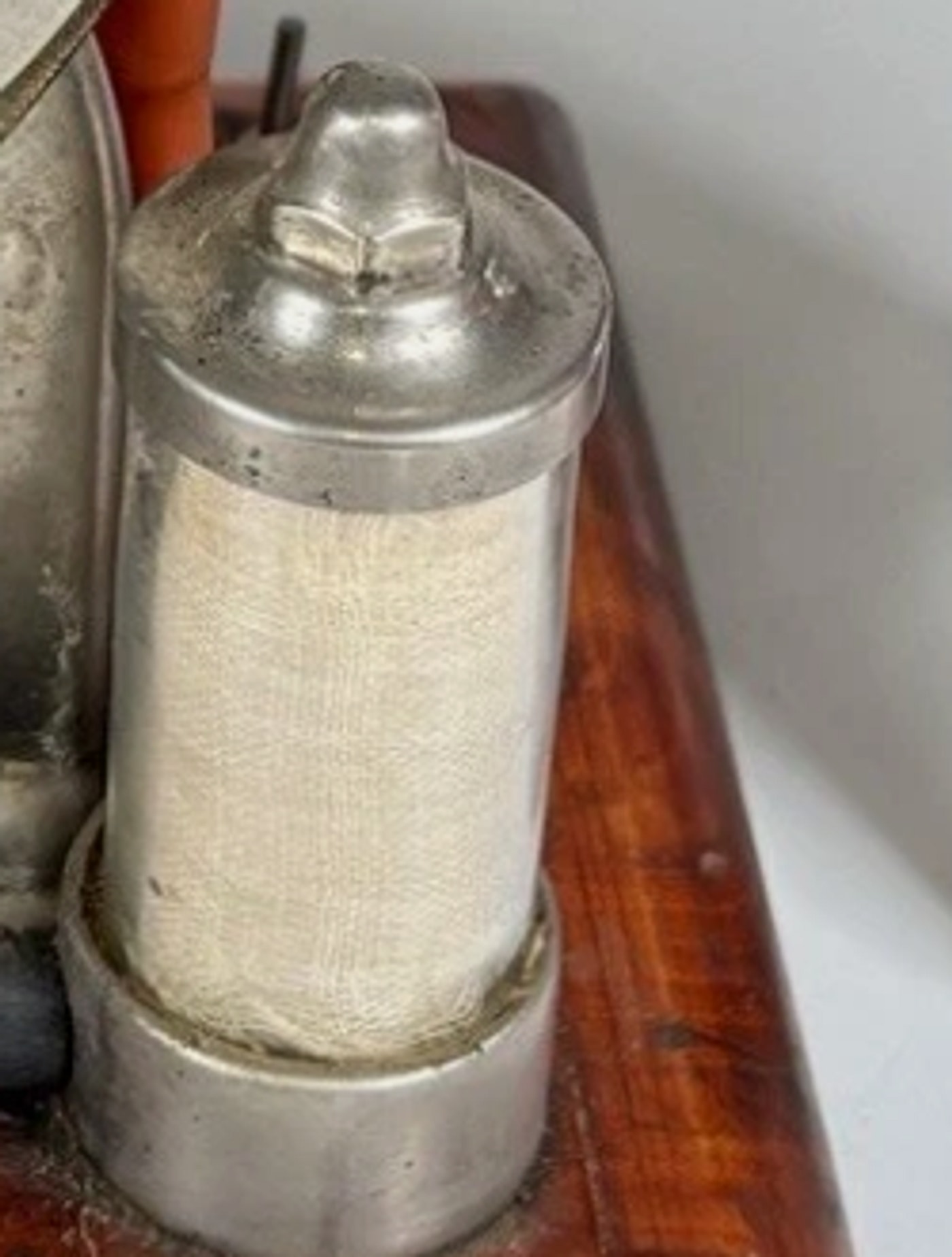
It is worth restating the inference from Vol 1 in light of all this. The purifiers are the tell. A machine that filters its own working medium through cloth is moving air. Everything else about the circuit follows from that one observation, and it is what separates this object from the embalming pumps it gets confused with — those push liquid, and their pumps get wet.
2.6 Ten to fifteen pounds, and what it buys
Sorensen quotes the pump family as maintaining “from 10 to 15 pounds of constant pressure.” That figure is worth sitting with, because it is the number that settles the embalming question and it is also the number that explains what the machine was good at.
Ten to fifteen psi is a gentle pressure. It is enough to bubble air steadily through eight ounces of ether against the small back-pressure of a hose and a face mask. It is enough to drive an atomiser or a nebuliser. It is enough for what the trade called powder blowing. It is not enough — not remotely — to perfuse a vascular system, which is why the arterial-injection machines of the same era and later ran at 45–100 psi and carried tanks measured in gallons rather than an eight-ounce bottle.
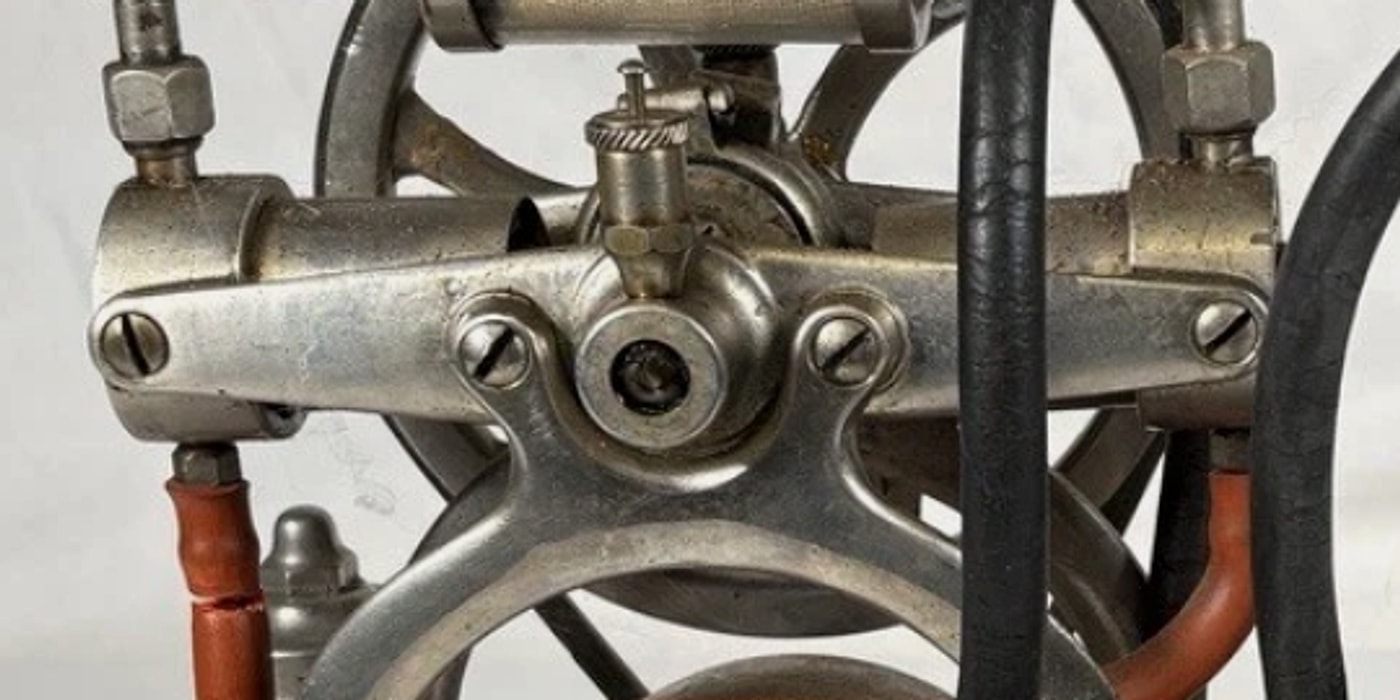
The knurled thumbscrew on the pump head is the control. On this class of Sorensen pump it works as a bleed or relief adjustment: opening it lets some of the pump’s output escape rather than reach the work, which lowers delivered pressure. The catalogue notes that the larger No. 460 later received “a new, improved type” of control that “diverts the air instead of holding it back against the pump” — a meaningful engineering distinction, since bleeding air off is easier on a small motor than throttling against it. Which type my specimen carries is not determinable from the outside, and it would tighten the dating if it were: see Vol 3.
The 1917 advertisement adds the one control detail no other source gives: switching the outfit from anaesthesia duty to office work was done “by simply adjusting ‘N’ to ‘M’.” Two lettered positions, presumably on a valve or a tube union, that reconfigured the circuit. I have not found those letters on Machine No. 10010, and I would like to.
2.7 Everything else it was sold to do
The anaesthesia application is the headline, but the catalogue is emphatic that this was a general-purpose office machine, and its list of uses is a small tour of 1920s consulting-room practice:
“It therefore serves for spraying, nebulizing, etherizing, vacuum massage, sinus work, Biers hyperemia, and aspirating blood and mucous from the operative field. In short, for all work requiring pressure or suction.”
Several of those need translating.
Spraying and nebulizing are the pressure side driving an atomiser — the same bubble-and-carry principle as the ether bottle, but with a medicated aqueous or oily solution and a spray head instead of a mask. Sorensen sold a range of atomisers and a “Birmingham Globe Nebulizer” as accessories.
Sinus work means irrigation and suction of the paranasal sinuses, a staple of the nose-and-throat specialist’s day.
Vacuum massage is the suction line fitted with a cup rather than a sucker, applied to the skin — a treatment that sat on the respectable edge of a field whose disreputable side this collection covers in the Quack Devices wing. Sorensen sold it as a straightforward physical modality alongside its surgical apparatus, which is a fair illustration of how porous that boundary was in 1925.
“Biers hyperemia” is the outlier and the most interesting entry. It refers to the method of August Bier, the German surgeon, who from the 1890s treated infections and inflammatory conditions by deliberately inducing hyperaemia — an increased blood flow to the affected part — on the theory that the body’s own defences were carried in the blood and that congesting a region would concentrate them there. Passive hyperaemia was produced with a constricting band; active hyperaemia by suction, using glass cups evacuated by exactly this kind of pump. Bier’s method was mainstream, widely taught, and is the reason a surgical suction pump of this era advertises a therapy rather than just a housekeeping function. It faded with the arrival of effective antimicrobials — first the sulphonamides in the later 1930s, then penicillin — which treated infection directly rather than by attempting to recruit the blood supply against it.
That list is also, incidentally, one more piece of evidence in the identification. It is the use-list of a doctor’s office, not a preparation room: spraying, nebulising, sinuses, cupping, and clearing an operative field. There is nothing in it that an undertaker would buy.
Sources
- 1926 Catalog of Sorensen Tankless Apparatus (copyright 1925) — Internet Archive — the No. 60 entry (two-cylinder eccentric pump, 1/20 hp universal motor, two air purifiers, the square ether and round suction bottles, simultaneous or independent operation); the Midget No. 55 entry for the “10 to 15 pounds of constant pressure” figure and the full use-list; the general notes on air purifiers, the snap-fit bottle holder and the deliberately inexpensive replaceable glassware; and the No. 460 note on the improved control that “diverts the air instead of holding it back against the pump.”
- The American Year-Book of Anesthesia and Analgesia, 1917–1918 — Internet Archive (Yale copy) — advertising p. 3: ether vapour “through one bottle to face mask, mouth gag or ether hook,” blood and secretion “into the vacuum bottle,” and the “adjusting ‘N’ to ‘M’” reconfiguration between anaesthesia and office use.
- Diethyl ether — physical properties — boiling point 34.6 °C and room-temperature vapour pressure, underlying the bubble-through vaporiser’s behaviour and the falling-concentration limitation.
- August Bier — biography and hyperaemia therapy — the origin of the “Biers hyperemia” indication in the catalogue’s use-list, and its decline with effective antimicrobial therapy. ⟨The clinical rationale is stated here as period practice, not as endorsement; verify any specific claim about Bier’s method against a history-of-medicine source before repeating it.⟩
- Wood Library-Museum of Anesthesiology — for period ether-delivery apparatus generally, including the Yankauer mask that this outfit’s pressure line was designed to feed. See Vol 5.
Comments (0)