C. M. Sorensen Pressure and Suction · Volume 5
Dr. Sidney Yankauer
The Mount Sinai laryngologist whose name is on this outfit, whose suction tip is in every operating room on earth, and whose tidiest origin story is the one the record does not support.
Contents
5.1 About this volume
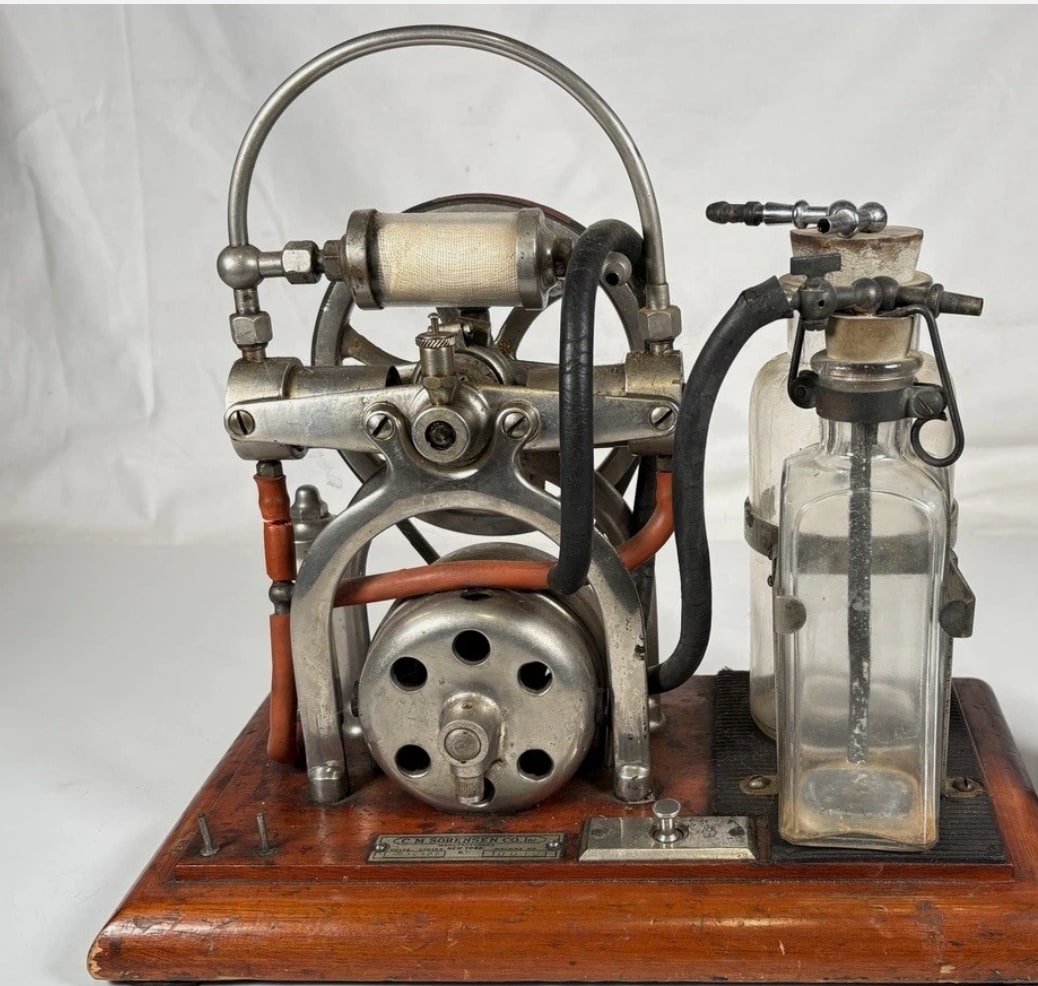
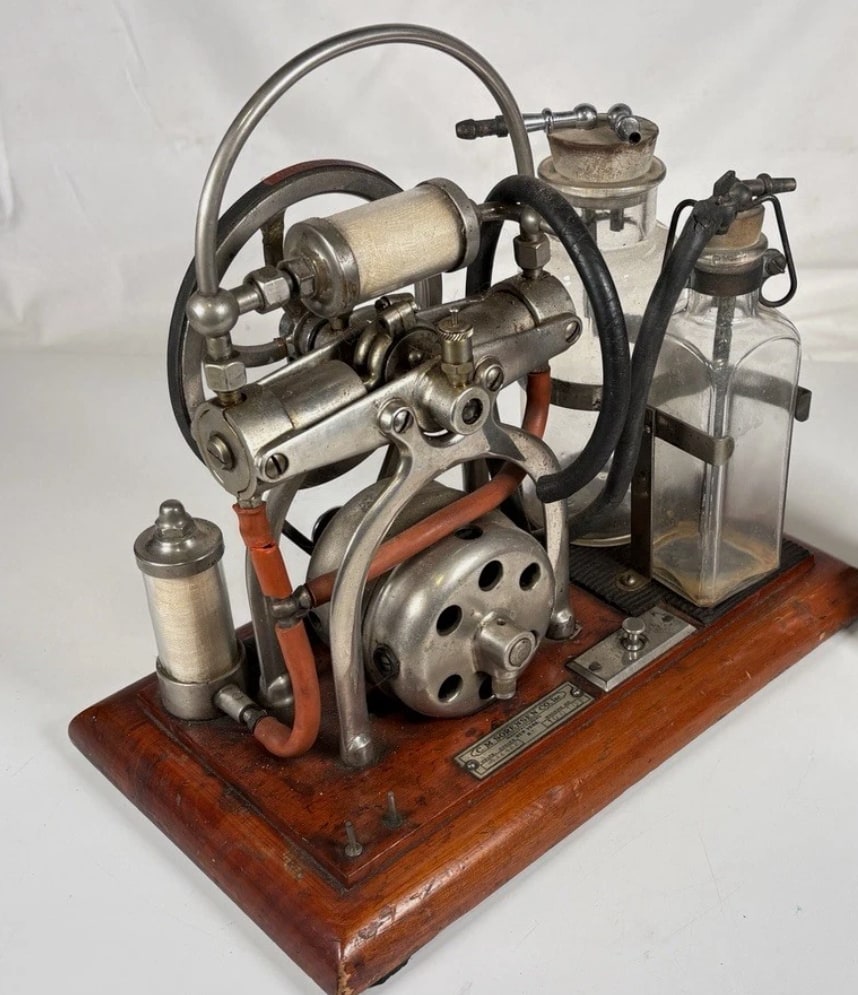
There is a name on this machine that is not on this machine.
The maker’s plate says only C. M. Sorensen Co., Inc. Vol 1 reproduced it. But in Sorensen’s own 1926 catalogue the object is No. 60, the “Dr. S. Yankauer Outfit for Pressure and Suction,” and in the firm’s 1917 advertisement it is “The Yankauer Combination Pressure & Suction Outfit.” The accessory list ships it with a “Yankauer suction tube.” The neighbouring catalogue number, No. 61, is a “Yankauer Pump Stand” at twelve dollars.
So the surgeon’s name is all over the paperwork and nowhere on the nickel. This volume is about the man it belonged to — and about a problem that turns up the moment you try to nail down what he actually invented.
Sidney Yankauer designed one of the most-used surgical instruments in the history of medicine. Disposable copies of it are manufactured by the tens of millions annually ⟨verify — the figure is repeated everywhere in the clinical literature but I could not trace it to a primary count⟩, and it is on every anaesthetic trolley, in every ambulance, and in the mouth of every dental patient who has been told to close around the little plastic hook. It is arguably the most-used object named after any physician who ever lived.
And there is no patent for it, no description of it in the early literature, and no mention of it in Yankauer’s own detailed paper on the operation it was designed for. That is not my finding; it is the finding of the 2024 Ear, Nose & Throat Journal study of his instruments, and it is the most interesting thing in this volume. This wing’s authoring discipline says that where the record is thin you say so rather than smoothing it over. The record here is thin in a specific and instructive place, and the honest version is better history than the tidy one.
5.2 The life, as the record gives it
The biography is well documented and the sources agree with each other, which is worth stating plainly because the instrument history does not.
Sidney Yankauer was born in New York City on 27 March 1872 and died at Mount Sinai Hospital, of heart disease, on 27 August 1932, aged sixty. He graduated from the City College of New York in 1890 and from Columbia’s College of Physicians and Surgeons in 1893, and interned at Mount Sinai — the hospital he then never really left.
He worked in Mount Sinai’s outpatient surgical clinic from 1893, and in 1917 was named the hospital’s first director of laryngology when the service was constituted as a department in its own right with six surgical ward beds. The following year he established a dedicated tonsil-and-adenoid ward. He was president of the Mount Sinai Alumni Association in 1916, and in 1918–19 served as a major in the U.S. Army in France, at a base hospital staffed largely from Mount Sinai. He led the national body of his specialty late in life — he was president of the American Bronchoscopic Society — the body Chevalier Jackson founded in 1917, and which was not renamed the American Broncho-Esophagological Association until 1940, so that later name is retro-applied to him by some sources. The genuine residual dispute is only the year: 1927 or 1928. ⟨verify⟩
His clinical reputation rested on the rigid bronchoscope. In 1905 he was the first physician in New York City to remove a foreign body from an airway bronchoscopically — the classic case of the era being an inhaled peanut in a child, which before endoscopy was very often fatal. By 1925 he was reporting a series of four hundred lung-abscess patients treated bronchoscopically. He was, in the phrase used by Chevalier Jackson — the founder of American bronchoesophagology and himself a formidable instrument designer — “a mechanical genius.” From Jackson, that is close to the highest available compliment.
One detail of the private life is hard to read past. His first wife, Grace Prior, was herself an otolaryngologist and shared his practice; she died in 1914 after a fall from their tenth-floor Park Avenue apartment. He remarried in 1919, to Margaret Kerrins, a Mount Sinai nursing administrator.
5.3 The mask, which he did publish
The mask is the part of the story where the paper trail is complete, and it is the part that connects directly to the machine in Vol 2.
In 1904 Yankauer published “A new chloroform mask” in The New York Medical Journal and Philadelphia Medical Journal. The article states its own case cleanly:
“The chloroform mask herewith presented has two new features which render it of special value. The body of the mask consists of a framework of wire netting, instead of the one or two wires usually arranged for the support of the gauze covering the mask.”
That is the whole idea. A tear-drop-shaped wire frame, later chrome-plated, carrying a mesh rather than a couple of bare support wires, with layers of gauze stretched over it and held by a spring clip. It sat over the nose and mouth; the anaesthetic was dripped onto the gauze; the patient breathed vapour and room air together through it. This is open-drop anaesthesia, and the Yankauer frame became one of its standard tools — surviving examples are held by the Wood Library-Museum of Anesthesiology, the Smithsonian and the University of Toronto’s instrument collection, and it reached Australian collections too.
The mesh is doing real work. Gauze sagging on two wires touches the face, and a face wet with chloroform or ether gets chemically burned; the older alternative was a towel folded into a cone, which was worse. A netted frame holds the gauze off the skin across its whole area and gives the vapour a large, even evaporating surface. A small idea, correctly executed — a fair description of most of Yankauer’s output.
Two honest notes. It was published as a chloroform mask; the ubiquitous modern label “Yankauer ether mask” is a later generalisation of a design that suited either agent. And it was subsequently modified by James Tayloe Gwathmey to admit oxygen, producing the Yankauer-Gwathmey mask — so even the well-documented instrument did not stay purely his.
The connection to Machine No. 10010 is direct but not what you would guess. The No. 60’s pressure line ends, in the catalogue’s words, at a “face mask, mouth gag or ether hook” — and the outfit as shipped included the ether hook, not a mask; the price list offers a “Glass Face Mask, with hose connection” rather than a Yankauer frame. ⟨verify⟩ These are two different techniques. The Yankauer mask is a drop mask, onto which liquid is poured; this machine blows saturated vapour down a tube (Vol 2). The same surgeon’s name sits on both, but the machine feeds the vapour method. A wire-and-gauze frame is period-correct company for this outfit in a display case; it is not its accessory.
5.4 The suction tip, which he did not
Now the hard part.
The instrument the world knows is a rigid, double-curved tube ending in a bulbous head pierced by several holes — the shape everyone calls a shower head or a rosebud. It is the standard tool for clearing an oropharynx of blood, vomit or secretions, and it has been made in nickel-plated brass, in stainless steel, in clear polystyrene since the 1950s, and with an integral light since the 1990s. Its geometry has barely changed in a century.
The geometry is not arbitrary, and it is worth explaining because the design is genuinely clever.
The bulb is a stand-off. A plain open-ended tube under vacuum seizes onto the first soft tissue it touches — tongue, tonsil bed, pharyngeal wall — and either occludes instantly or tears something. The bulb is a blunt rounded body that physically prevents mucosa from reaching the orifice, so the tip can be run over soft tissue without grabbing it. Hence “atraumatic.”
The fenestrations distribute the failure mode. With several holes around the head rather than one at the end, occluding any one leaves the others drawing — so the suction keeps working when it is pressed against tissue, which is precisely when it is needed. The same holes make it much harder to clog irrecoverably on a clot.
The double curve is anatomy, following the arc from the corner of the mouth around the tongue to the pharynx so the surgeon’s hand stays out of the line of sight. The rigidity is control: unlike a soft catheter it can be placed and held one-handed.
Every one of those is a real answer to a real problem, and the combination has resisted a century of improvement attempts. But asking who worked it out, and when, is where the trail runs out.
5.5 What the record actually supports
Here is what can be established, and here is what cannot.
What the sources actually show. The 2024 ENT Journal paper by Jalali and Isaacson — the most careful modern survey of Yankauer’s instruments, working from the surgical-instrument catalogue literature — states flatly that the suction has no patent, no description in the early literature, and is not referenced in Yankauer’s own detailed account of tonsillectomy technique. That last point is the sharp one. Yankauer did publish on tonsillectomy, at length: “Tonsillectomy,” The Laryngoscope 19(5), 1909, pp. 329–339. The suction tip is universally said to have been designed for tonsillectomy. If he had designed it and thought it mattered, his own tonsillectomy paper is exactly where it would be — and it is not there. Independently, LITFL’s eponym library records the same gap: “an original description/publication of Yankauer’s suction catheter is not found within the literature.”
The 1907 date is uncorroborated. Nearly every source that gives a date for the suction tip says 1907, and none of them cites a 1907 document for it. What Yankauer did publish in 1907 was “A laryngeal medicator for the patient’s use,” The Laryngoscope 17(8), pp. 658–659 — a different instrument, in the same anatomical neighbourhood, in the same journal, in that year. I want to be careful here: a shared date is a suggestive coincidence, not evidence of a conflation, and I have not traced the 1907 suction claim back to its origin. It is a hypothesis worth someone’s afternoon in a library, not a finding. ⟨verify⟩
What is solid is the eponym’s floor. Whatever happened at the design end, the name was firmly and commercially attached in Yankauer’s own lifetime, while he was practising a few miles from the factory. The two primary documents underpinning this whole dive prove it. The 1917 advertisement in The American Year-Book of Anesthesia and Analgesia sells “The Yankauer Combination Pressure & Suction Outfit.” The 1926 catalogue lists No. 60 as the “Dr. S. Yankauer Outfit,” supplies a “Yankauer suction tube” with it, and sells a “Yankauer Pump Stand” beside it. By 1932, the year he died, the George P. Pilling & Son Co. catalogue carried over fifty devices bearing his name. A man does not get fifty entries in a rival maker’s catalogue by accident, and he does not get his name on a competitor’s flagship product in 1917 without the profession already associating him with the thing.
So what is unresolved is narrow and specific. Not whether the instrument is genuinely connected to Yankauer — the commercial and professional record is strong and contemporaneous. What is missing is the founding document: the paper, the patent, the catalogue plate, the “I have devised” sentence that would let anyone say what he actually contributed, in what year, and how much of the final shape was his rather than a maker’s draughtsman’s. It is entirely possible that the tip evolved on a workbench in collaboration with an instrument firm and was named for the surgeon who asked for it, which was ordinary practice and is not a scandal. It is also possible the paper exists and is simply not digitised. I have not found it; neither, more importantly, did the specialists who went looking in 2024. That is where I am leaving it. There is a gap in the record, and the correct thing to do is name the gap rather than fill it.
5.6 The rest of the instruments
The suction tip’s fame flattens a much broader career. At least fifteen Yankauer instruments are described in the literature and the catalogue count runs past fifty. Among those with published descriptions attached: the nasopharyngoscope, hourglass- or wasp-waisted so it would pass the soft palate; a speculum for direct examination of the nasopharynx and Eustachian tubes and a new direct laryngoscope, both in the Transactions of the American Laryngological, Rhinological and Otological Society for 1911, with a pyramidal binocular design later; serrated tonsil scissors and a folding surgical scalpel; a radium needle for the esophagus (Archives of Surgery, 1923), from a man doing combined surgery and radiotherapy early enough to report five-year cancer cures in 1920; and the laryngeal medicator for the patient’s own use, 1907.
Tellingly, the inventing was not confined to medicine, and the patent record is where this volume’s central puzzle sharpens into something genuinely strange. Yankauer patented a clinical thermometer in 1899 (US 626,124), a resilient wheel in 1923 (US 1,459,565) — filed from Flushing, Queens — and an electric pipe lighter in 1931 (US 1,834,756), whose opening line is “My invention relates to electrical devices used for lighting tobacco.” A patent for a scalpel with a detachable blade issued under the name in 1891 (US 445,237); that would make Yankauer eighteen or nineteen and still years short of medical school, so the identity needs care before it is leaned on. ⟨verify⟩
And there is one more, which nobody writing about the suction tip seems to have noticed. In August 1908, from Manhattan, Sidney Yankauer filed a patent for a rotary valve — a plug cock with a resiliently-retained turning plug and a loop handle — granted as US 930,017 on 3 August 1909.
That is not a stray domestic gadget. It is a fluid cut-off cock, patented by this surgeon, in this city, one year after the date usually given for the suction tip and eight years before the Sorensen advertisement — and it sits in precisely the functional class of the “silk-covered pressure tube with cut-off” the No. 60 shipped with, the petcocks on its bottle caps, and the knurled control that Vol 3 and Vol 6 both treat as this machine’s key undetermined feature. Whether US 930,017 has anything to do with the Sorensen outfit is untraced, and I will not claim that it does. But it is the most promising unpulled thread in the whole dive. ⟨verify⟩
So the man plainly knew how to file a patent — repeatedly, in medicine and out of it, including on valve hardware adjacent to this very machine. Which makes the absent suction-tip patent much stranger, not less.
The 2024 survey also identifies among his devices “a portable suction/pressure pump that became a fixture in every otolaryngology office” which proved useful for anaesthesia as well. That is this machine — present in the modern scholarly literature on Yankauer in a single sentence, with no maker named. Vol 1 can supply the rest: it is a Sorensen No. 60.
5.7 Why a maker puts a doctor’s name on a catalogue number
Which leaves the commercial question, and it is the one that best explains 1910s New York.
Look at the rest of Sorensen’s catalogue. The No. 60 is not an isolated tribute. The pages carry a Dr. Frank E. Miller “Midget,” a Dr. Coffin Sinus Apparatus, apparatus associated with Dr. H. H. Forbes and Dr. J. E. MacKenty. The house style is clinician-named models, and the No. 60’s own entry is explicit about the lineage: “This is another development of Dr. Frank E. Miller’s Midget, page 6.” The machine bearing Yankauer’s name is described by its own maker as a derivative of another surgeon’s design. ⟨I have not independently verified the careers or hospital affiliations of Miller, Coffin, Forbes or MacKenty.⟩ ⟨verify⟩
That is not cynicism, and it is not straightforward endorsement advertising either. It is the visible surface of how instrument-making actually worked before industrial R&D departments existed. The manufacturer had no clinical problem to solve and no way of discovering one; the surgeon had a problem every Tuesday morning and no machine shop. So the surgeon walked into the shop — Sorensen was at 177 East 87th Street in 1914–15, a short crosstown trip from Mount Sinai — described what he needed, and argued about it over a bench until something worked. The firm then got a product and the surgeon got his name on it, which in a profession that forbade advertising was the only form of public reputation a doctor could respectably accumulate.
That arrangement explains almost everything odd about this volume. It explains the shape of the gap — not that Yankauer never patented anything, because he demonstrably did, but that he patented a thermometer, a wheel, a pipe lighter and a valve, and did not patent the instrument that made him famous. What he contributed to the instruments was specification and judgement; the shop contributed the drawing and the tooling; and neither party appears to have thought that arrangement needed a legal instrument. A thing you invent alone at your bench is a thing you patent. A thing you argue into existence over someone else’s lathe is a thing you simply use, and the name sticks or it doesn’t. It explains why a 1917 advertisement in an anaesthesia annual leads with a surgeon’s name rather than the machine’s function. It explains why the eponym is rock-solid commercially and vaporous documentarily.
And it explains the small fact this volume opened with. The nameplate on my machine says Sorensen. The catalogue says Yankauer. Both are telling the truth about a different half of the same object — one made it, the other specified it — and a century later the man who specified it has his name on a hundred million pieces of plastic a year, while the firm that actually built the thing is so thoroughly forgotten that its products get sold as embalming machines. Vol 6 is about that firm.
Sources
- Jalali S, Isaacson G. “Sidney Yankauer, the Mechanical Genius.” Ear, Nose & Throat Journal, November 2024 — doi:10.1177/01455613241301593. The key source for this volume. Chevalier Jackson’s “mechanical genius”; at least fifteen instruments in the literature and over fifty in the 1932 George P. Pilling & Son Co. catalogue; the nasopharyngoscope, pyramidal binocular laryngoscope, serrated tonsil scissors and folding scalpel; the “portable suction/pressure pump that became a fixture in every otolaryngology office”; and the decisive negative finding that the suction “has no patent, no description in the early literature, and is not referenced in Yankauer’s detailed description of the tonsillectomy technique.” PubMed 39562311.
- Sidney Yankauer — LITFL Medical Eponym Library — the fullest biography and bibliography available online: born 27 March 1872, died 27 August 1932 of heart disease at Mount Sinai; CCNY 1890, P&S 1893; outpatient surgical clinic 1893–1917, director of the laryngology service 1917, tonsil-and-adenoid ward 1918, U.S. Army major in France 1918–19; the 1905 bronchoscopy, the 1920 cancer results and the 1925 lung-abscess series. Carries the verbatim 1904 mask text and the independent statement that “an original description/publication of Yankauer’s suction catheter is not found within the literature.” Also the source for the individual paper and patent citations listed above. ⟨An eponym encyclopaedia, not a peer-reviewed journal — but it cites its primary literature, and its suction-tip caveat is corroborated by the ENT Journal paper.⟩
- Sidney Yankauer — Wikipedia — corroborates the Mount Sinai chronology, the 1905 bronchoscopy priority, the Gwathmey modification of the mask, and the biographical detail of Grace Prior’s death in 1914 and the 1919 remarriage. ⟨Used only where it agrees with LITFL or the journal literature; the society-presidency year differs between sources.⟩
- Yankauer S. “A new chloroform mask.” The New York Medical Journal and Philadelphia Medical Journal, 1904; 79(23): 1114 — the mask’s original publication and the wire-netting quotation. ⟨Cited via LITFL’s transcription; I have not read the original page.⟩ ⟨verify⟩
- Yankauer S. “Tonsillectomy.” The Laryngoscope, 1909; 19(5): 329–339 — the paper in which the suction tip is absent. The single most important negative in this volume.
- Yankauer S. “A laryngeal medicator for the patient’s use.” The Laryngoscope, 1907; 17(8): 658–659 — the instrument he actually published in 1907, offered here as a possible but unproven source of the conventional 1907 date for the suction tip.
- Wood Library-Museum of Anesthesiology — Yankauer masks — the reference collection of surviving mask specimens. ⚠ The site returned HTTP 403 to automated fetching on 20 July 2026; cited from the wing brief and corroborated by other museum holdings rather than read directly. ⟨verify⟩
- The Yankauer Mask — University of Toronto Scientific Instruments Collection — chrome-plated wire frame, tear-shaped mesh, gauze held by a spring; the open-drop technique and the folded-towel practice it replaced; introduction “around 1904.”
- Anesthesia facemask — Smithsonian National Museum of American History and Mask, Yankauer, c. 1904 — Victorian Collections — further museum specimens, establishing how widely the design travelled.
- 1926 Catalog of Sorensen Tankless Apparatus (copyright 1925) — Internet Archive — the “Dr. S. Yankauer Outfit for Pressure and Suction”; the accessory “Yankauer suction tube”; No. 61 “Yankauer Pump Stand,” $12.00; the “Glass Face Mask, with hose connection”; and the clinician-named model line — Dr. Frank E. Miller’s Midget, the Dr. Coffin Sinus Apparatus, Dr. H. H. Forbes, Dr. J. E. MacKenty — together with the statement that the No. 60 “is another development of Dr. Frank E. Miller’s Midget.”
- The American Year-Book of Anesthesia and Analgesia, 1917–1918 — Internet Archive (Yale copy) — “The Yankauer Combination Pressure & Suction Outfit,” C. M. Sorensen Co., 177 East 87th St. The earliest dated attachment of the eponym to this machine that I have located. ⚠ As Vol 1 notes, the “Sorensen, pH” entries in the same volume are S. P. L. Sørensen, the Danish chemist, and are unrelated to this firm.
- Yankauer suction tip — Wikipedia — the conventional account (1907, designed for tonsillectomy, bulbous fenestrated head, transparent plastics from the 1950s and integral lighting from the 1990s). ⟨Cited as the received version whose 1907 date this volume flags as uncorroborated, not as authority for it.⟩
Comments (0)