C. M. Sorensen Pressure and Suction · Volume 1
The Machine Everybody Mislabels
It was sold to me as an embalming machine. Its maker's own 1926 catalogue says otherwise — and so does a 1917 advertisement. What I actually own is a Sorensen 'Tankless' No. 60, the Dr. S. Yankauer Outfit for Pressure and Suction.
Contents
1.1 About this volume
I bought this machine as an antique embalming pump. That is what it was described as, that is what comparable machines are described as when they come up at auction, and that is what I expected to be writing about when I set out to add it to this collection.
It is not an embalming machine. It is a nose-and-throat surgeon’s pressure-and-suction outfit — an apparatus for blowing ether vapour to a face mask with one bottle while drawing blood and secretions into the other, built for tonsil and adenoid work in a doctor’s office. Its maker never sold a mortuary product under any name I have been able to find in print. The identification is not a guess or an inference from the shape of the thing; it rests on two independent primary documents, one of them the manufacturer’s own catalogue, and the match is close enough to be conclusive down to the shape of the bottles.
This volume is the argument. It describes the object first, without a name attached, so that the evidence can be laid against a neutral description rather than against a conclusion. Then it presents the two documents, and then it asks the more interesting question — not what is this, which is now settled, but why has an entire corner of the antique market been calling it the wrong thing for twenty years, and why is the wrong answer so plausible?
The remaining volumes follow from the answer. Vol 2 traces the pressure-and-suction circuit that makes the machine work. Vol 3 goes inside the pump. Vol 4 is conservation and the question of whether to make it run. Vol 5 is Sidney Yankauer, whose name is on the outfit and whose suction tip is in every operating room and ambulance on earth today. Vol 6 is C. M. Sorensen Co. itself, and what can and cannot be said about dating a specimen.
1.2 The object, described before it is named
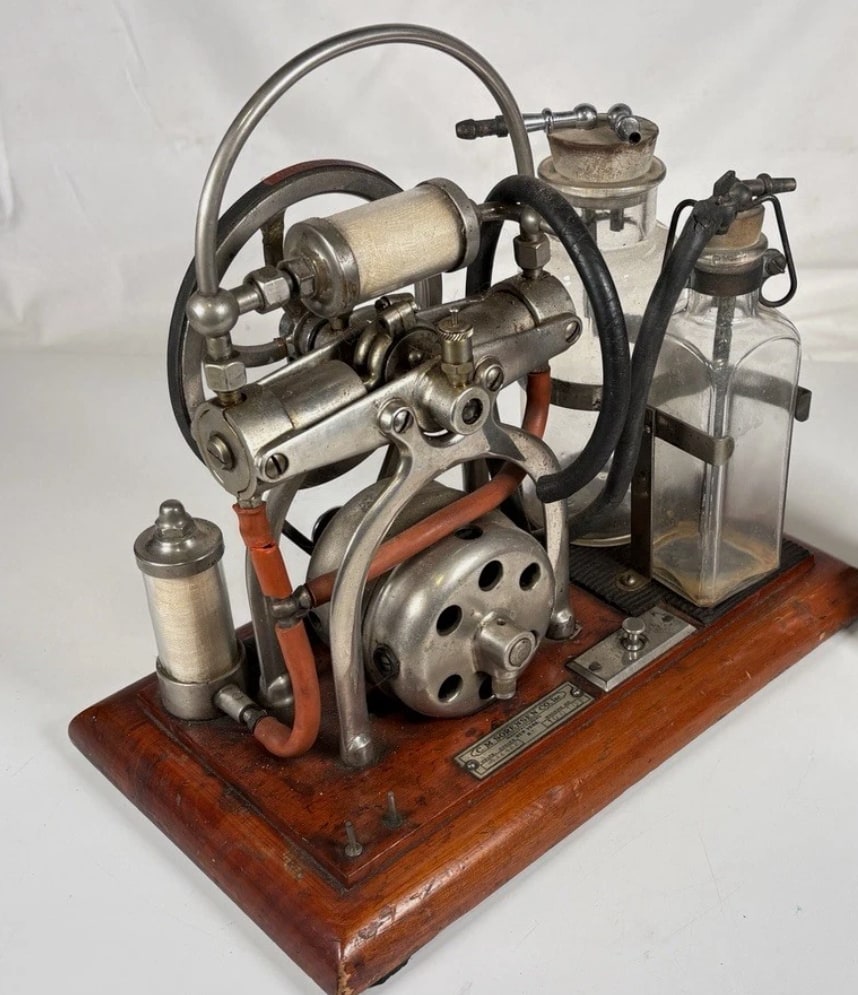
A mahogany base, varnished, measuring 12 × 12.5 × 7.5 inches, with corrugated rubber mats let into its top surface beneath the glassware. Four feet. The whole assembly is small enough to pick up in one hand and heavy enough that you use two.
Standing on the base, an enclosed electric motor — a squat drum with a ring of circular ventilation holes around its face — with a stepped pulley on its shaft. A belt runs from that pulley up to a large flywheel with five curved, crescent-shaped spokes, and the flywheel turns the crankshaft of a twin-cylinder reciprocating pump: two polished horizontal cylinders side by side in split clamps, driven through connecting rods. On top of the pump head sits a knurled thumbscrew on a spring-loaded stem — plainly an adjustment for something, and just as plainly not a gauge.
Two nickel-plated cylindrical canisters with visible woven mesh elements: one mounted horizontally across the top of the machine, one standing vertically at a front corner of the base. A large arched nickel tube spans the whole assembly as a carrying handle. Red-orange and black rubber tubing connects everything.
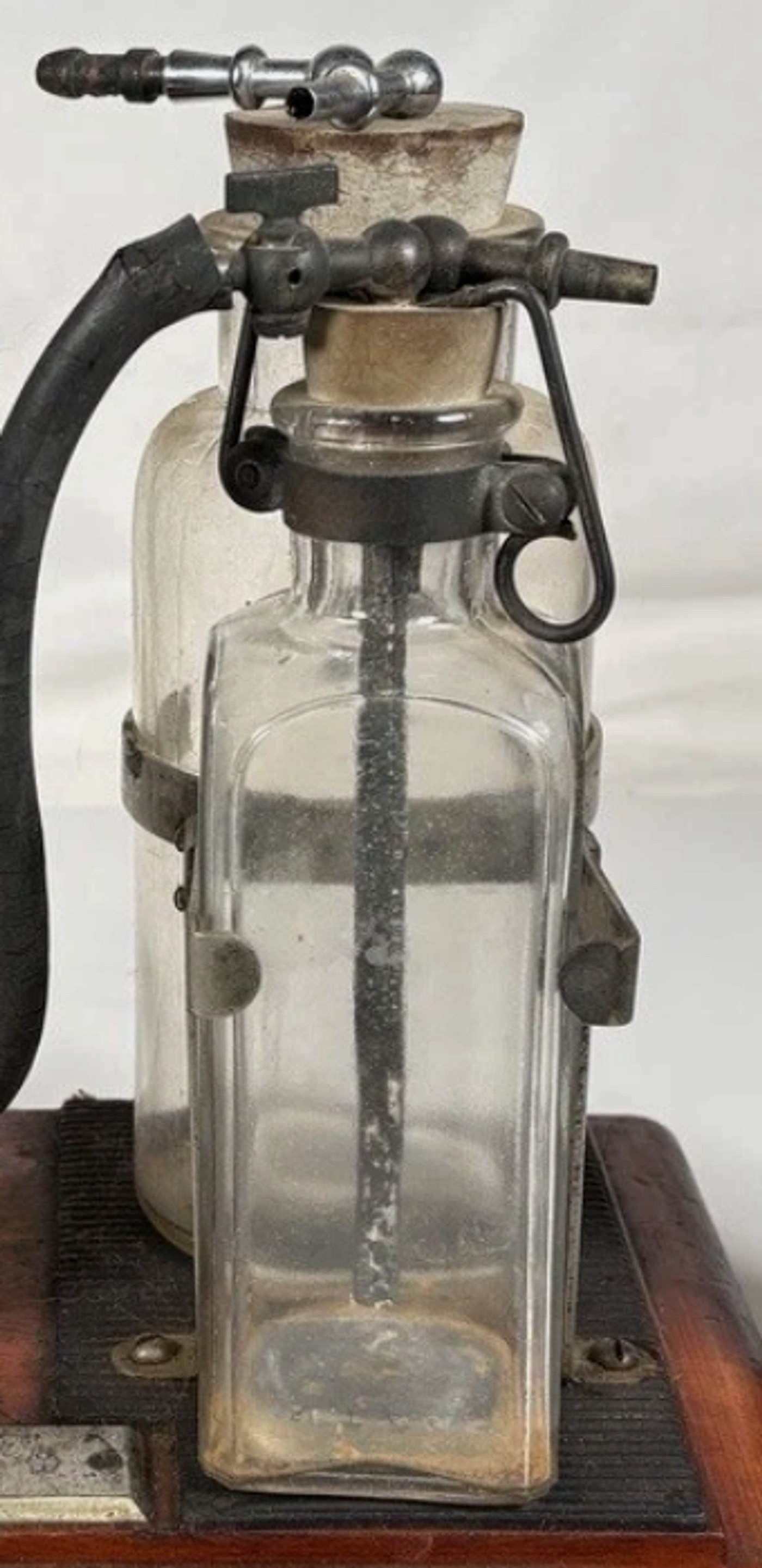
And two glass bottles, deliberately different from one another. One is a large, round, clear jar. The other is smaller and square-shouldered. Each has a metal screw cap carrying valve fittings and petcocks. At least one carries a dip tube running to the bottom of the bottle.
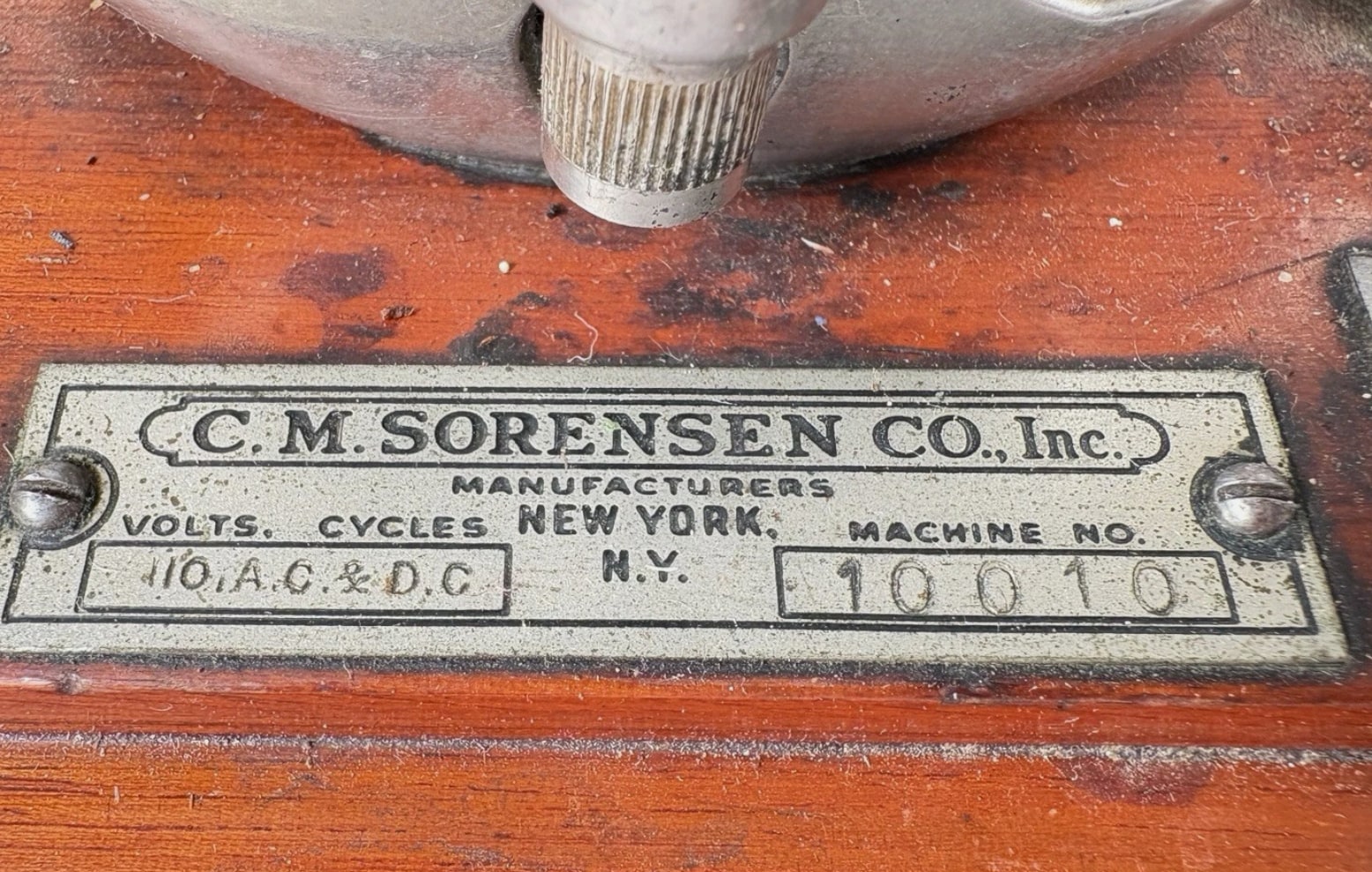
Let into the mahogany near the front edge, a small nickel escutcheon with a push-button switch. And beside it, the maker’s plate:
C. M. SORENSEN CO., Inc. MANUFACTURERS VOLTS, CYCLES 110 A.C. & D.C. · NEW YORK, N.Y. · MACHINE NO. 10010
Two details from that description do more work than the rest, and both are worth pausing on.
The first is the mesh-element canisters. A pump fitted with fabric filters on its ports is moving air, not liquid. Nobody filters embalming fluid, or ether, or blood through a woven cotton element in a nickel can; the arrangement only makes sense if what passes through it is atmosphere. This machine is an air pump — which means it does not push the working fluid at all. It pushes air, and the air does the work on the liquid, indirectly, inside the bottles.
The second is that the two bottles do not match. That is not wear or replacement or a collector’s mismatch. As the next section shows, it is a designed feature, and it is the single most diagnostic thing about the whole machine.
1.3 What it was sold as
“C. M. Sorensen embalming machine” is a well-established label in the antique trade. Bodnar’s Auction has sold one described exactly that way — Machine No. 11260, a near neighbour of mine in the serial sequence. LiveAuctioneers carries a “Vintage C.M. Sorensen Co. embalming pump.” WorthPoint indexes more. The description is consistent, confident, and repeated across a decade of listings.
It is also, as far as I can establish, entirely without documentary foundation. Not one of those listings cites a catalogue, an advertisement, a manual, or a trade reference. They cite each other, in effect — each new seller reasonably describing the object the way the last seller did.
The first person to say so in public appears to have been a commenter on the blog Auction Finds in January 2015, responding to a post about one of these machines. He identified himself as a mortician since 1973, said he had never seen this type of machine in the business, observed that the power and capacities did not equate to arterial injection, and suggested it might be a dental tool.
He was right to reject the label, and right for the right reason — the numbers do not work, as shown below. His alternative guess was in the right neighbourhood and the wrong specialty: this is a doctor’s-office bench apparatus, but an ear, nose and throat one, not a dental one. Forty years in the funeral trade told him what the machine wasn’t. Only the maker’s paperwork could tell him what it was, and that paperwork had not yet surfaced online.
1.4 The catalogue that settles it
It has now. The Internet Archive holds a scan of the 1926 Catalog of Sorensen Tankless Apparatus for the Nose and Throat Specialist and the Hospital, copyright 1925 — forty-eight pages, printed on deliberately thin paper so it would fit a coat pocket, from C. M. Sorensen Co., Inc., 444 Jackson Avenue, Long Island City, New York. Cable address: Tankless, New York.
There is not one mortuary reference in it. It is, cover to cover, a catalogue of ear-nose-throat, hospital, anaesthesia and surgical suction equipment.
On its pages is No. 60, the “Dr. S. Yankauer Outfit for Pressure and Suction.” The entry reads, in part:
“The two-cylinder eccentric pump is driven by a 1-20 horsepower universal motor. It has two air purifiers: one each for pressure and suction.”
“Both pressure and suction are under perfect control and may be used simultaneously as well as independently. Thus ether vapor may be administered through one of the bottles by face mask, mouth gag or ether hook, while blood and secretions are drawn through the suction tube into the other bottle.”
“The ether bottle is 8-oz. and square; the suction bottle 16-oz. and round. So they can not be transposed.”
“Equipment, as shown in the illustration, includes mahogany cover, pressure and suction tubes, ether hook, Yankauer suction tube, and silk-covered pressure tube with cut-off. Size 7 × 13 × 12″. Net weight 16 lbs.”
Set that against the description in the previous section, item by item.
Table 1 — The catalogue that settles it
| Catalogue, No. 60 | Machine No. 10010 |
|---|---|
| Two-cylinder eccentric pump | Two horizontal cylinders, crank-driven ✓ |
| 1/20 hp universal motor | Plate reads “110 A.C. & D.C.” — a universal motor ✓ |
| Two air purifiers, one per circuit | Two mesh canisters, one horizontal, one vertical ✓ |
| Ether bottle 8-oz square; suction bottle 16-oz round — “they can not be transposed” | One square-shouldered bottle, one large round jar ✓ |
| Mahogany base | Mahogany base ✓ |
| Size 7 × 13 × 12″ | Measured 12 × 12.5 × 7.5″ ✓ (the same three figures, differently ordered) |
| “ELECTRIC SWITCH. Is incorporated in every machine.” | Push-button switch let into the base ✓ |
Every element matches, and the bottles clinch it. Sorensen made the ether bottle square and the suction bottle round specifically so that a hurried operator could not swap them — an interlock made of glassware. That is a peculiar, deliberate, entirely non-obvious design choice, and my machine has it.
The size discrepancy is not a discrepancy. The catalogue’s 7 × 13 × 12 and my 12 × 12.5 × 7.5 are the same box measured in a different order, and the half-inch on the middle figure is the kind of variance you get between a catalogue round-number and a tape measure on a hundred-year-old piece of mahogany.
One question the catalogue also answers: the machine could have been the larger No. 460, a four-cylinder unit whose entry specifies four air purifiers and cylinders arranged “two each for pressure and suction.” Counting the canisters resolves it. Mine has two. It is a No. 60.
1.5 The advertisement that confirms it
The catalogue is decisive on its own, but it is a single document from a single year, and it would be fair to ask whether the No. 60 was a late product bolted onto an older, differently-purposed machine. It was not, and there is a second document to prove it.
The American Year-Book of Anesthesia and Analgesia for 1917–1918 — a Yale copy of which is on the Internet Archive — carries a Sorensen advertisement on its third advertising page:
THE SORENSEN Portable Anaesthesia Outfit The Yankauer Combination Pressure & Suction Outfit
“This portable outfit is small and compact, but very efficient. It enables the operator to administer ether vapor through one bottle to face mask, mouth gag or ether hook, and to draw blood and secretion through the suction tube into the vacuum bottle. Especially designed for tonsil and adenoid operations. When not in use as an anaesthetizing outfit, same can be used in the office for spraying, powder blowing or nebulizing by simply adjusting ‘N’ to ‘M’.”
C. M. SORENSEN CO., INC. — Send for Descriptive Catalogue — 177 East 87th St., NEW YORK
That is nine years before the catalogue, in an anaesthesia annual, describing the same outfit in almost the same words — ether vapour through one bottle to a face mask, mouth gag or ether hook; blood and secretion into the other — and naming Yankauer in the product title.
It is also, incidentally, a useful piece of corroboration for Vol 6’s dating work: the 177 East 87th Street address matches the Manhattan telephone directory listings of 1914 and 1915, where the firm appears as “Sorensen C M Co, Elec Air Compressor.” Sorensen was, from the beginning, in the air-pump business.
The advertisement adds one detail the catalogue does not: the machine had lettered controls, and switching it from anaesthesia duty to office spraying was a matter of “simply adjusting ‘N’ to ‘M’.” I have not identified those letters on my specimen, and finding them is on the list in Vol 3.
1.6 Why the wrong name sticks
So the identification is settled. The more interesting question is why “embalming machine” was ever plausible — because it is plausible, and dismissing the sellers as careless would be both unfair and uninteresting.
The architecture really is the same. Air-pressure embalming machines genuinely existed and genuinely worked like this: a motor-driven air pump pressurising a bottle of fluid through a dip tube, forcing the contents out to a delivery line. US Patent 2,252,624 — an “Embalming machine” granted to Gilmore and Junod in 1941, and not, despite occasional claims, to Sorensen — describes a motor-driven air pump with a suction inlet, a pressure outlet and paired equalising chambers. Someone who knows what that patent drawing looks like, and who then sees my machine, is not making a foolish mistake. They are recognising a real family resemblance. The two devices are cousins in mechanism.
The context is right too. Twin bottles, rubber tubing, nickel plate and a mahogany base read unmistakably as early-twentieth-century clinical apparatus, and the funeral trade is where the antique market expects to find early-twentieth-century clinical apparatus that isn’t obviously a doctor’s instrument. There is a ready-made category, and the object slots into it.
What breaks the resemblance is the numbers. A 1/20 horsepower motor delivering 10 to 15 pounds of constant pressure — the figure Sorensen quotes for this pump family — is nowhere near what arterial injection needs; the modern machines that do that job run to 45–60 psi on the small model and 80–100 on the large one. And the ether bottle holds eight ounces. Arterial embalming is measured in gallons. You could not do the job with this machine if you wanted to, which is precisely the objection the mortician raised in 2015 without having the catalogue in front of him.
There is a lesson in that for the rest of this collection, and it is not really about Sorensen. An object’s identity in the antique market is established by consensus among sellers, and that consensus is self-reinforcing and evidence-free by default. It takes one scanned catalogue to overturn twenty years of confident listings — and until somebody goes and finds the catalogue, the confident listings are all anyone has. The Gravity Injection Systems volume in this collection’s embalming wing flagged exactly this machine as a suspected misidentification before I owned one. It was right, and it now has its proof.
1.7 What this dive does next
The object is named. The rest of the dive takes it apart.
- Vol 2 — Pressure and Suction: The Circuit works out what the plumbing actually does: one motor, two ports, two bottles, and why the dip tube in the ether bottle is an inlet rather than an outlet.
- Vol 3 — Inside the Machine covers the eccentric pump, the flywheel and belt reduction, the valves, and the knurled control on the pump head.
- Vol 4 — Care, Repair and Bringing It Back is conservation, and the electrical question of whether a century-old ungrounded universal motor should ever be energised. It also carries a safety item about the sealed bottles that should be read before anyone opens one.
- Vol 5 — Dr. Sidney Yankauer is the man on the nameplate of the outfit: Mount Sinai’s first director of laryngology, called “a mechanical genius” by Chevalier Jackson, and the designer of an instrument still in daily use worldwide.
- Vol 6 — C. M. Sorensen Co., and Dating This Machine is the maker: a firm that spent sixty years making suction and pressure apparatus, ending up inside Vernitron, and never — on any surviving paper — selling to undertakers.
Sources
- 1926 Catalog of Sorensen Tankless Apparatus for the Nose and Throat Specialist and the Hospital (copyright 1925) — Internet Archive — the primary document. The No. 60 “Dr. S. Yankauer Outfit for Pressure and Suction” entry: two-cylinder eccentric pump, 1/20 hp universal motor, two air purifiers, the 8-oz square ether bottle and 16-oz round suction bottle that “can not be transposed,” size 7 × 13 × 12″, 16 lb, and the note that an electric switch is incorporated in every machine. Full OCR text at
Sorenson_Tankless_Apparatus_1925_djvu.txt. - The American Year-Book of Anesthesia and Analgesia, 1917–1918 — Internet Archive (Yale copy) — advertising p. 3, “THE SORENSEN Portable Anaesthesia Outfit / The Yankauer Combination Pressure & Suction Outfit,” C. M. Sorensen Co., Inc., 177 East 87th St., New York. ⚠ Note that the same volume’s index contains references to “Sorensen, pH” — that is S. P. L. Sørensen, the Danish chemist of pH fame, and nothing to do with this company.
- New York City telephone directory, 1914 and 1915 — “Sorensen C M Co, Elec Air Compressor,” 177 East 87th St., corroborating the advertisement’s address.
- Antique embalming machine that’s unnerving — Auction Finds, 14 January 2015 — the comment thread in which a mortician of forty years’ standing rejects the “embalming machine” label on capacity grounds and proposes a dental tool. The first public challenge to the attribution I have found.
- Bodnar’s Auction, Lot 104 — “Antique CM Sorensen Embalming Machine” — Machine No. 11260, sold under the mistaken label; cited as evidence of the market consensus, not of the identification.
- LiveAuctioneers — “A Sorensen Tankless Air Compressor, Model 60” — a listing that gets the model designation right, showing the correct attribution does occasionally surface in the trade.
- US 2,252,624 — “Embalming machine,” Gilmore & Junod, 1941 — Google Patents — a genuine motor-driven air-pressure embalming machine with suction inlet, pressure outlet and equalising chambers; cited for the architectural family resemblance that makes the misattribution understandable. Not a Sorensen patent, contrary to occasional online claims.
Comments (0)