C. M. Sorensen Pressure and Suction · Volume 4
Care, Repair and Bringing It Back
Conservation of a hundred-year-old ungrounded bench appliance — what to stabilise, what to leave alone, why the cord is the most dangerous thing on the machine, and the irony of an arcing motor built to sit beside an open ether bottle.
Contents
4.1 The governing decision
This machine is a display piece. It is not clinical apparatus, and nothing in this volume is instruction for using it on a person.
That needs saying at the top rather than buried in a footnote, because everything else in the volume follows from it. The Sorensen No. 60 was built to deliver ether vapour to a face mask and to draw blood off an operative field. Both of those functions are, in 2026, obsolete, unlicensed and unlawful to attempt with a hundred-year-old uncalibrated appliance, and I have no interest in either. What I own is an object of engineering and trade history, and the entire aim of its care is to keep it legible as that object for as long as possible.
Once you accept that framing, a lot of decisions that look hard become easy. You are not obliged to make the pump reach 15 psi. You are not obliged to make the motor spin. The bar is not “does it work” but “is the evidence intact, and is it stable.”
4.2 Conserve, do not restore
The distinction between conservation and restoration is the whole of the ethics here, and it is not a pedantic one.
Restoration returns an object to a chosen former state — usually as-new. Conservation stabilises what survives and prevents further loss, intervening as little as possible and preferring interventions that a later custodian can undo. The American Institute for Conservation’s Code of Ethics and Guidelines for Practice sets the professional standard of documentation and minimal intervention; the sharper test, retreatability, comes from the wider conservation literature built on it — Appelbaum’s argument in the Journal of the American Institute for Conservation that reversibility is a spectrum rather than a property, and that the operative question is whether a treatment precludes future treatment or future analysis of the object. That is a workable test for a machine, and it is the test I apply below.
What is genuinely lost by over-restoring is worth itemising, because it is not sentimental.
- Original wiring is evidence. The cord, its cloth braid, its terminations and the switch record how a 1910s–20s bench appliance was actually wired, by whom, and to what standard. Cut it off and bin it and that information is gone permanently. Preserve it — coiled, labelled, and stored with the machine — and it remains available even if you fit a replacement.
- Patina is stratigraphy. Wear on the flywheel rim tells you the belt ran. Polish on the knurled control tells you it was adjusted often. Staining around the suction purifier tells you the machine was used in earnest. A buffing wheel erases all of it in ten minutes and returns nothing.
- Original finishes are one-shot. Nickel plating of this period is thin. Abrasive polishing removes plate, not tarnish, and once you are through to the base metal there is no going back short of replating — which destroys the original surface entirely and makes the object a reproduction of itself.
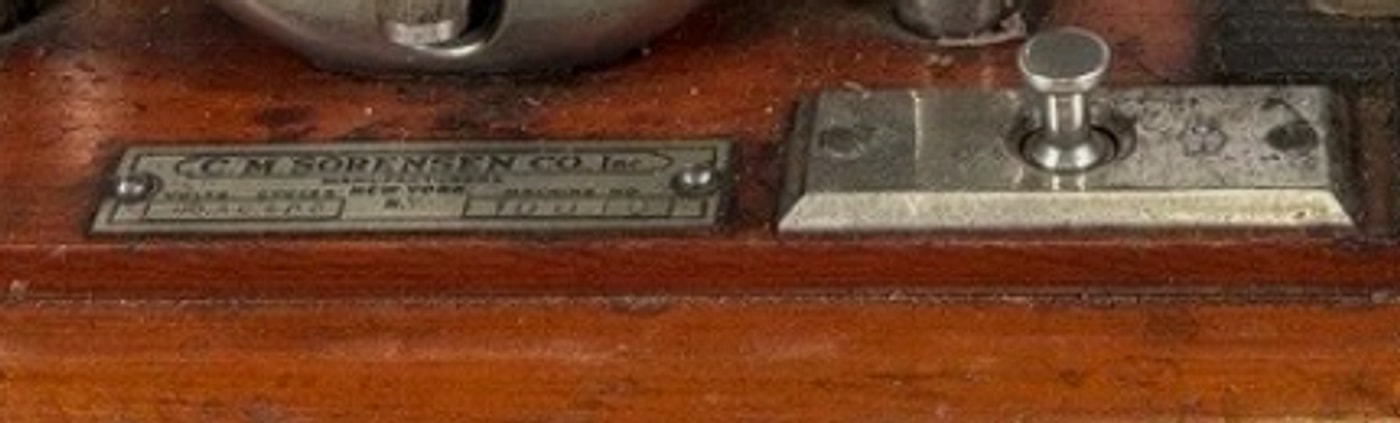
- Provenance detail hides in the dirt. Paper labels, pencilled service notes on the underside of a base, a supplier’s sticker — all of them are routinely cleaned off by people trying to be helpful.
The counter-argument deserves a hearing: a machine that can never run is a machine whose mechanism can never be demonstrated, and there is real interpretive value in seeing a flywheel turn and a purifier canister breathe. I do not dismiss that. But it is a demonstration case, met by brief, supervised, heavily-protected runs — not a case for rewiring the object to modern appliance standard and using it.
4.3 Document before you touch
This is the cheapest and most-skipped step, and it is the one that makes everything else recoverable.
Before any cleaning, disassembly or replacement: photograph everything, in place, from multiple angles, with a scale in frame. Record the routing of every tube and which port it lands on. Record the orientation of every cap, petcock and union. Record the belt’s position on the stepped pulley. Vol 2 flags an unresolved question about which bottle carries the dip tube — that question exists partly because the machine came to me already disturbed, and nobody photographed it before it was.
Write down what you did and when. A treatment record kept with the object is standard conservation practice and it costs nothing; its absence is why so many collected machines are now unreadable, having been “tidied up” by three successive owners none of whom left a note.
4.4 The electrical reality, stated plainly
Three facts about this appliance, all of them true of most bench machines of its generation, and all of them worth stating without softening.
One: the cord is perished. Flexible cords of the 1910s and 1920s used natural-rubber insulation under a cotton or silk braid. Natural rubber oxidises; it hardens, crazes and eventually crumbles off the conductor, and it does so from the inside as much as the outside, so a cord that looks sound under its braid may have bare copper inside it. Sorensen’s own equipment list confirms the machine shipped with “cord with attachment plug” as standard, and there is no reason to think that cord was anything other than typical period practice. Flexing an old rubber cord to see whether it is brittle is itself a way of breaking it.
Two: there is no earth. This is a two-wire, ungrounded appliance. There is no protective conductor tying the motor frame, the pump castings, the nickel handle or the metal canisters to earth. If insulation fails anywhere inside the motor, the entire metal superstructure — including that inviting arched carrying handle — can sit at mains potential, and nothing in the appliance will notice or trip.
Three: the motor arcs by design. As Vol 3 sets out, this is a series-wound universal motor: current reaches the armature through a commutator and carbon brushes. Brush-to-commutator contact is a continuously making-and-breaking connection, and it sparks. That is not a fault condition to be repaired away; it is how the machine works, and it was true when it left the factory.
Taken together: do not simply plug it in. A hundred-year-old cord, no earth, and an intentional spark source is not a combination that deserves an experimental flick of a switch to see what happens.
4.5 If it is ever to run
What follows is general good practice for antique mains appliances, not a procedure for this one. Mains work on a century-old machine is a job for someone competent to do it — and it should be said clearly that the safest configuration for this object is not running it at all. Every option below is worse than that one; they are ranked in the order a cautious owner would consider them.
- Replace the cord, keep the original. A new cord in period appearance — cloth-braided flex is readily available for lamp and appliance restoration — is a fully retreatable intervention provided the original is retained, labelled and stored with the machine. Fitting a modern three-core cord raises the question of what to bond the earth conductor to, which on a machine with no designed earth path is not a trivial decision. ⟨verify⟩ — whether a competent electrician would earth the frame of a machine like this, or leave it double-insulated-by-isolation, is a judgement call I am not qualified to make on someone else’s behalf.
- Protect the person, not just the machine. An RCD/GFCI at the supply is the single most useful addition, because it addresses the exact failure mode an ungrounded appliance creates: current leaving the appliance through a person. An isolation transformer serves a different purpose — it breaks the galvanic connection to the supply so that touching one conductor and earth simultaneously does not complete a circuit. The two are complementary, and note that a conventional RCD placed upstream of an isolation transformer will not see a fault on the isolated secondary at all. Understanding which protection is doing what is part of being competent to do this.
- Current-limit the first power-up. The dim-bulb tester — an ordinary incandescent lamp wired in series with the appliance — is the standard first-power-up tool in vintage electronics restoration, and it applies just as well to a small motor. If something inside is shorted, the lamp glows brightly and absorbs the energy rather than letting it flow into the fault. If the machine is healthy, the lamp glows dimly and the machine runs at reduced voltage. It must be a genuine incandescent or halogen lamp; LED and CFL lamps contain switching supplies and will not behave as the resistive element the technique depends on.
- Run briefly, and watch. Seconds, not minutes. A universal motor whose insulation is a century old is being asked to do something it has not done in decades, and the heat of a long run is exactly what will finish off marginal insulation. Never leave it energised unattended.
- Never with anything in the bottles. See the last section. This is not negotiable.
If that list reads as a procedure, read it again as a set of reasons to hand the job to someone who does this for a living. None of it is worth an injury, and none of it makes the machine a better historical document than it already is.
4.6 The ether irony
There is an irony sitting in the middle of this machine that is worth naming, because it is genuine history rather than a rhetorical flourish.
The No. 60 was designed to be used in the immediate vicinity of an open bottle of diethyl ether, whose vapour is flammable and, mixed with air, explosive. Its prime mover is an unenclosed-commutator brush motor that sparks every revolution by design, sitting on the same twelve-inch mahogany base, inches from the ether bottle it is bubbling air through. Nobody in 1917 appears to have regarded that as remarkable.
The profession subsequently spent decades engineering exactly that class of ignition source out of the operating theatre. The remedies that emerged are a coherent programme: conductive flooring to bleed static charge away rather than let it accumulate and discharge as a spark; conductive footwear and antistatic rubber on castors, mats and tubing for the same reason; cotton rather than wool or nylon in the room; and explosion-proof plugs, sockets, switches and fittings in anaesthetising locations. Sustained institutional work on flammable-anaesthetic fires and explosions ran from the late 1930s, involving the US Bureau of Mines, the National Bureau of Standards, the University of Pittsburgh’s anaesthesiology department and the NFPA’s hospital committee; the Bureau of Mines published Static Electricity in Hospital Operating Suites in 1953, and the NFPA’s requirements were eventually consolidated in the 56 series, of which 56A, Inhalation Anesthetics, is the relevant title. The predecessor document was NFPA 56, Code for the Use of Flammable Anesthetics, compiled by the NFPA’s Committee on Hospitals, with a 1960 edition later expanded as 56A in 1978 — so the 56A numbering is a renumbering of considerably older hospital standards, not the origin of the requirements. The first-edition date of NFPA 56 itself I could not confirm from NFPA’s own record. ⟨verify⟩
There is a closing irony worth recording. NFPA has since withdrawn its static-control guidance for anaesthetising locations — not because the physics changed, but because the hazard did. Once flammable agents left the operating room, the conductive floors and antistatic footwear that a half-century of engineering had produced became answers to a question nobody asks any more.
The programme worked, and then it became unnecessary: flammable agents were displaced by halothane and its successors, and NFPA has since dropped its electrostatic-control guidance from the healthcare facilities code because the hazard it was written for no longer exists in most theatres.
None of that is a warning to reproduce anything. It is the reason this volume says display piece in its first line. The machine embodies a risk that an entire profession later organised itself to eliminate, and that is one of the more interesting things about it.
4.7 Mechanical care
Cleaning, generally. Least-aggressive first, always, and test on an inconspicuous area. Dust with a soft brush. For grime, a soft cloth barely damp with warm water and a mild detergent, dried immediately. Stop when the object is clean, not when it is shiny.
What not to use on the nickel. No abrasives of any kind — not metal polish, not scouring cream, not a nylon pad, and emphatically not a buffing wheel. Period nickel plate is thin, and abrasive polishing removes plating rather than tarnish. Avoid ammonia, which attacks nickel, and avoid acidic cleaners and bleach. A microcrystalline wax such as Renaissance Wax is the conservators’ default protective coating, and it is removable; avoid silicone-based polishes, which are extremely difficult to remove and contaminate any surface you might later want to coat, glue or analyse.
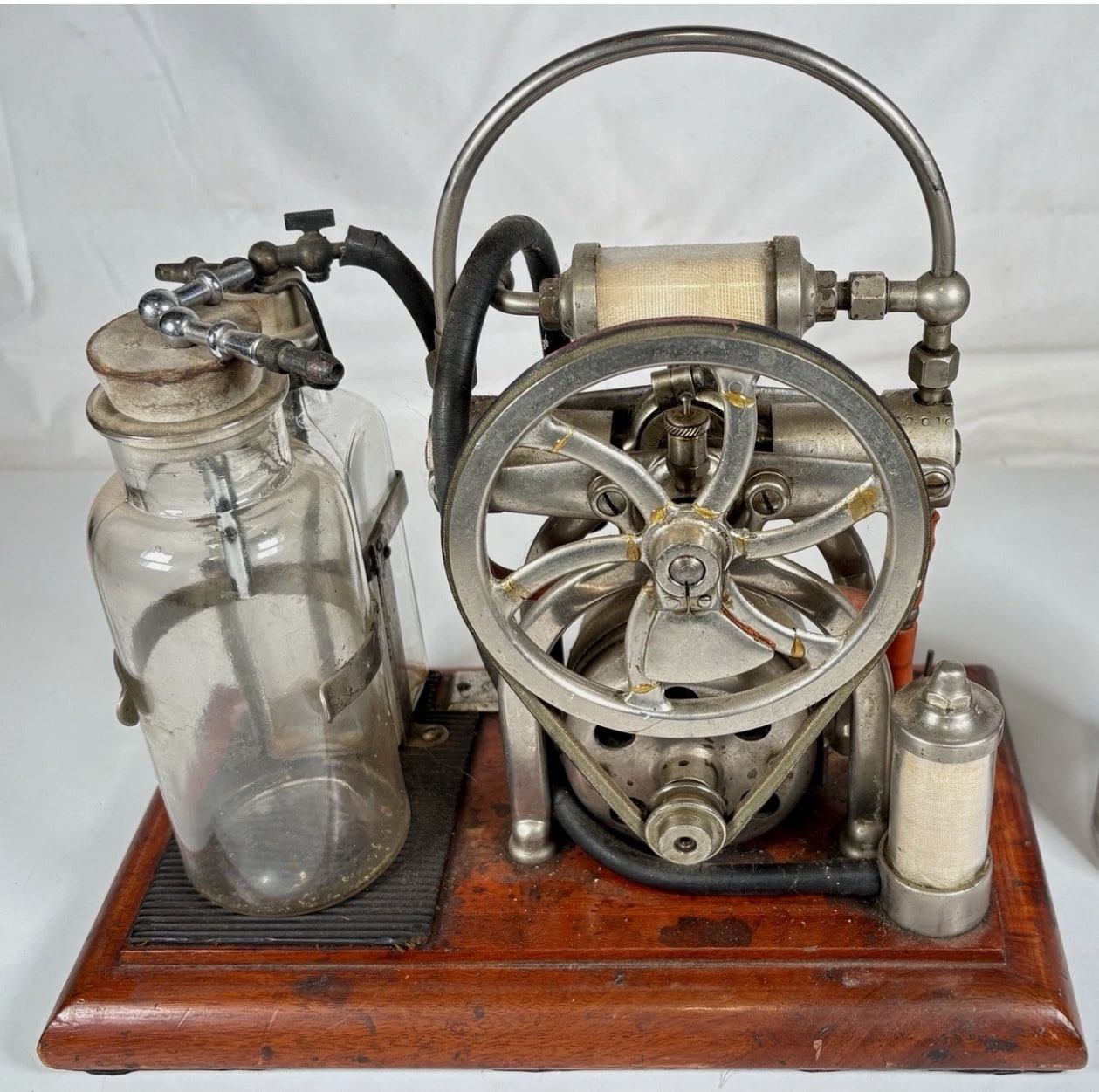
The mahogany. Warm water and a trace of mild detergent on a barely-damp cloth, dried at once; a good paste wax sparingly if the finish is sound. Do not strip and refinish — the varnish is original fabric. Do not use silicone furniture sprays, for the reasons above. The corrugated rubber mats let into the base top (Vol 1) are perishable, and appear original — though on a volume whose whole argument is that undocumented assumptions are how machines become unreadable, I should say plainly that I have not established that they are, and a replacement mat would be an entirely ordinary thing to find. ⟨verify⟩ Clean them dry, with a brush, and leave them alone otherwise.
Oiling. The catalogue’s line-wide specification page says standard equipment “always includes cord with attachment plug, extra belt, oilcan and wrench” — a general page rather than the No. 60’s own entry, which lists only the mahogany cover, tubes, ether hook, Yankauer suction tube and cut-off. (The same general page also specifies ball-bearing rubber-tyred hospital castors, which a sixteen-pound tabletop machine plainly does not have, so it is worth reading that page as line-wide boilerplate.) Still, an oilcan in the box tells you the owner was expected to lubricate it. The bearings, the eccentric strap and the crankshaft are the obvious points, though I have not identified specific oiling points on Machine No. 10010 and Sorensen’s catalogue gives no lubrication schedule. ⟨verify⟩ — the Service Parts Lists the catalogue mentions may; none has surfaced. A light machine oil, sparingly, on a machine that is going to be turned at all; nothing at all on a machine that is going to sit.
The belt. The catalogue shipped an extra belt as standard equipment, which tells you plainly that belts were a consumable and that replacement is period-correct rather than a violation. If the original is intact, keep it, even if it is too perished to run — bag and label it and fit a replacement for any demonstration.
Seized things. Do not force anything. A pump that will not turn by hand should be diagnosed, not persuaded; penetrating oil and patience, and an acceptance that some machines do not come free. And before anyone diagnoses a fault inside the pump, re-read Vol 3’s trap: in many period designs the leather cup packing is deliberately loose on the piston, because the cup is itself the intake valve. A well-meaning restorer who finds that looseness, calls it wear, and tightens it has disabled the pump.
4.8 Glass, rubber and the things that perish
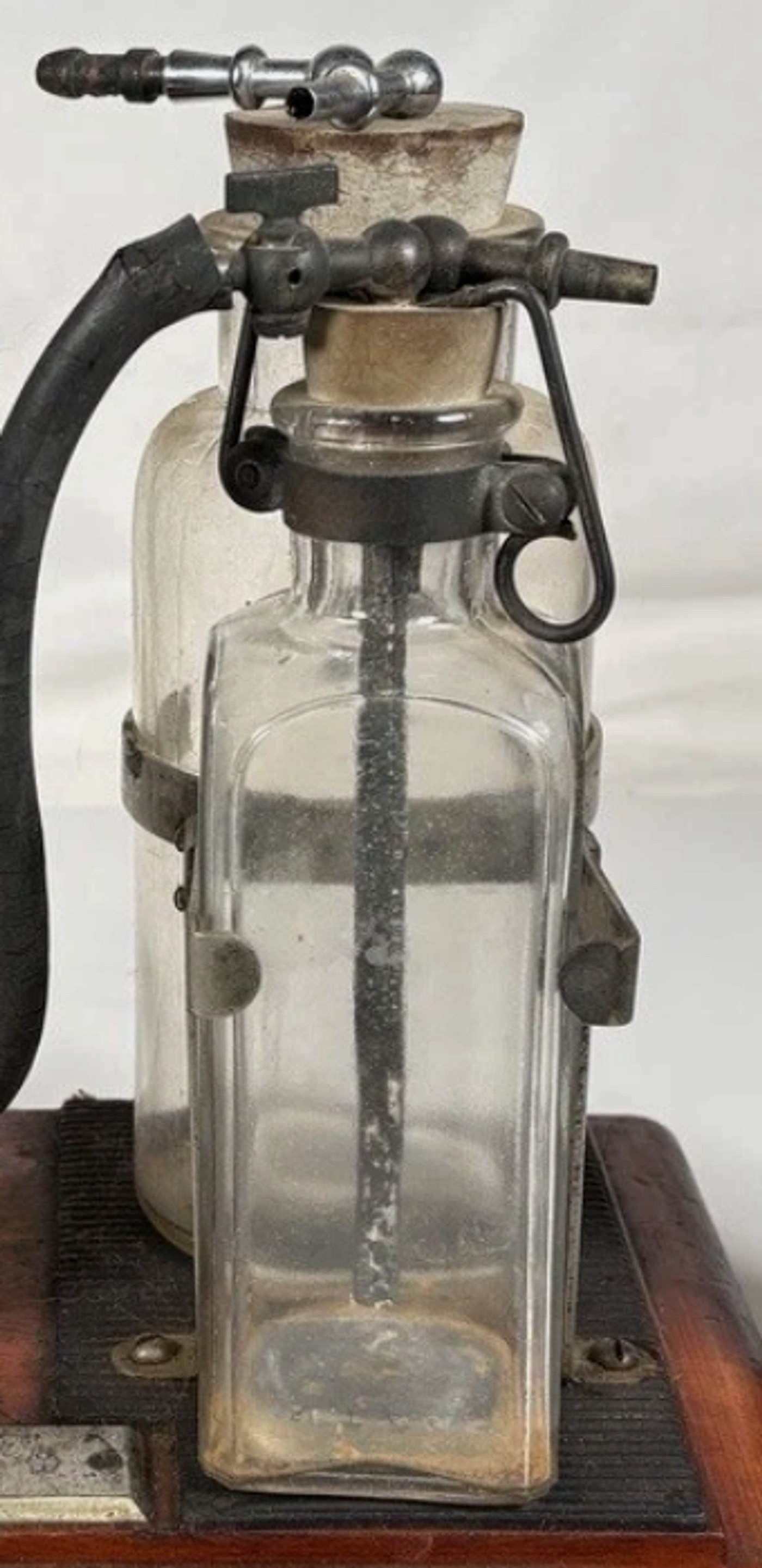
The bottles. Sorensen deliberately specified cheap replaceable glassware — “a very simple form of bottle is used: inexpensive to replace in case of breakage” — which means the pair on any given machine may or may not be original, and this specimen’s apparent cap-and-dip-tube anomaly (Vol 2) is unresolved partly for that reason. Clean them with warm water and mild detergent only, dry thoroughly, and leave them empty. Never put anything in them.
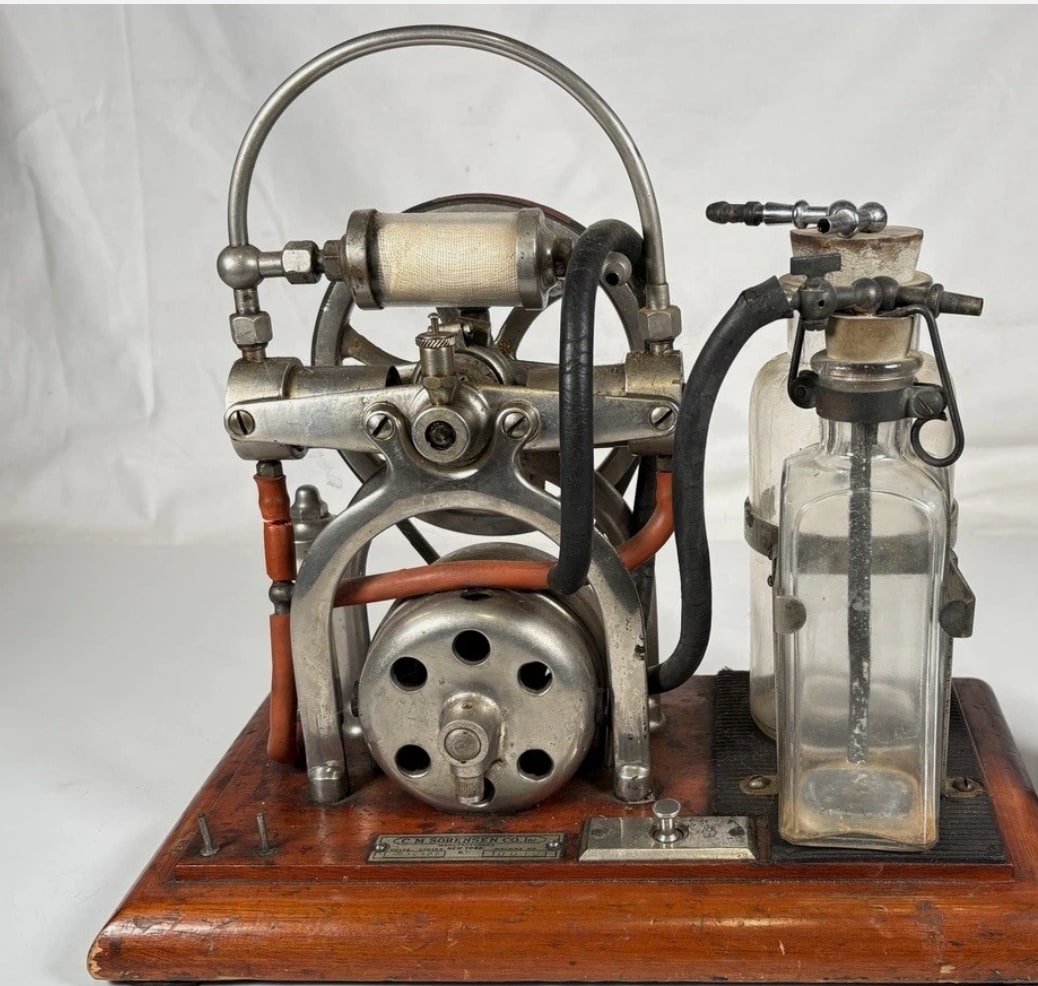
The rubber. The red-orange and black tubing linking the assembly is a century old and will be hard, cracked or sticky. Rubber of this age degrades irreversibly and there is no treatment that restores it. Two defensible positions: keep the original tubing in place, unstressed, accepting that it is display-only and will not seal; or retain the originals in labelled storage and fit modern tubing of similar colour and bore for display. The catalogue notes that pressure tubes were silk-covered and all tubes five feet long, which is useful if anyone wants to source a period-appearance replacement. What is not defensible is throwing the originals away.
The caps and fittings. Corroded metal caps on glass are a classic trap: forcing a seized cap breaks the bottle, not the cap. Penetrating oil at the thread, time, and gentle even pressure — or leave it shut.
4.9 Storage and display
Stable moderate humidity is the main requirement, and it is a compromise between materials that want different things. Mahogany and its varnish move with humidity and will check or lift if the environment swings; nickel plate corrodes at the pinholes in damp; rubber and leather harden as they dry. Somewhere around 45–55 % RH at ordinary room temperature is the usual museum compromise for a mixed-material object — the setpoint recommended by the 2010 Boston Roundtable and carried into the ASHRAE Handbook’s museum chapter by the Canadian Conservation Institute. Two caveats keep it honest: CCI’s own general guidance for mixed collections is the wider 35–55 %, with metals preferring the dry end, so 45–55 is a choice within a range rather than a threshold; and none of it is specific to this machine.
Keep it out of direct sunlight, which fades varnish and accelerates rubber degradation. Support the weight through the base, not the arched nickel handle, however much the handle invites it. Do not store it with the cord plugged in, and — if the machine is on open display where a visitor might reach a switch — consider storing the cord separately, coiled, so that plugging it in is a deliberate act rather than an available one.
And the last item, which is the whole of this volume in one line: put no chemical in this machine, ever. No ether. No solvent. No medicament, no water, no “just to see if it draws.” The bottles stay empty and dry. There is nothing to learn from filling them that is worth what could go wrong, and the object’s value now lies entirely in what it is, not in what it can still be made to do.
Sources
- 1926 Catalog of Sorensen Tankless Apparatus (copyright 1925) — Internet Archive — standard equipment “always includes cord with attachment plug, extra belt, oilcan and wrench”; the one-year guarantee against defects in material and workmanship; “the air-filtering material in these is efficient, very cheap, and easily replaced”; “pressure tubes are silk covered; all tubes are five feet long”; the deliberately inexpensive replaceable glassware; and the Service Parts Lists note (“Please always mention Serial Number of Outfit”). Full OCR at
Sorenson_Tankless_Apparatus_1925_djvu.txt. - AIC Code of Ethics and Guidelines for Practice — American Institute for Conservation — the professional standard for documentation and minimal intervention. ⟨“Retreatability” as a term of art belongs to the surrounding literature and AIC’s Commentaries rather than to the Code’s own text.⟩ See also Criteria for Treatment: Reversibility, JAIC 26(2) for the argument that reversibility is a spectrum and that the operative test is whether a treatment precludes future treatment or analysis.
- Chapter 8: Conservation Treatment — NPS Museum Handbook I — documentation-before-treatment practice and the conservation/restoration distinction, in a form written for collection custodians rather than practising conservators.
- What is Conservation? — Mechanical Curios — the same ethics applied specifically to mechanical objects, where the temptation to restore function is strongest. ⟨A specialist workshop’s statement of practice, not a standards body; cited for the framing, not as authority.⟩
- Lesson 3 §2, Explosion and Fire Hazards — Introduction to the Operating Room (Brookside Press / US Army medical training text) — the flammable agents (ethyl ether, vinyl ether, ethyl chloride), electrostatic spark as the commonest ignition source, conductive flooring that “disperses static charges but does not subject personnel to electrical shock,” conductive footwear, and the requirement that “all plugs, sockets, and switches must be explosion-proofed for use in anesthetizing locations.”
- Evaluating the Latest Strategies for Electrostatic Hazard Mitigation in Medical Environments — In Compliance — the 1953 US Bureau of Mines report Static Electricity in Hospital Operating Suites, the NFPA’s subsequent codification, and the recent removal of electrostatic-control guidance from NFPA 99 as flammable anaesthetics fell out of use.
- NFPA 56A, Standard for the Use of Inhalation Anesthetics — standards record — for the standard’s existence and scope. The predecessor is NFPA 56, Code for the Use of Flammable Anesthetics (Committee on Hospitals), 1960 edition, expanded as 56A in 1978 — so the numbering postdates the 1938-onward institutional effort it codifies. ⟨First-edition date of NFPA 56 itself unconfirmed from NFPA’s own record.⟩
- ASHRAE/CCI environmental guidelines for museums — Canadian Conservation Institute — the 45–55 % RH setpoint from the 2010 Boston Roundtable as carried into the ASHRAE Handbook museum chapter, and CCI’s wider 35–55 % band for mixed collections.
- Old Fabric-Insulated Electrical Wire & Cable Identification — InspectAPedia — the failure mode of natural-rubber conductor insulation under cloth braid: hardening, crazing and crumbling, often worse inside than out, and the absence of a grounding conductor in period cords.
- Vintage Electronics: Safer With a Dim-Bulb Tester — IEEE Spectrum and Building a Dim-Bulb Tester — the series-lamp current limiter, why the rising resistance of a hot filament makes it work, the incompatibility of LED and CFL lamps, and the complementary role of an isolation transformer.
- Nickel plating care — conservation-oriented cleaning guidance — least-aggressive cleaning, the thinness of period plate, avoidance of ammonia, acids and abrasives, and microcrystalline wax as a removable protective coating. ⟨Trade guidance rather than a conservation authority; the underlying chemistry is uncontroversial but treat specific product recommendations with caution.⟩
Comments (0)