Violet Ray Wands · Volume 5
Collecting, Restoring, and Displaying
The glass-electrode catalogue and its uses, how to identify and date a set, condition assessment, the safety case for treating every surviving unit as an unsafe antique mains appliance, and how to display one.
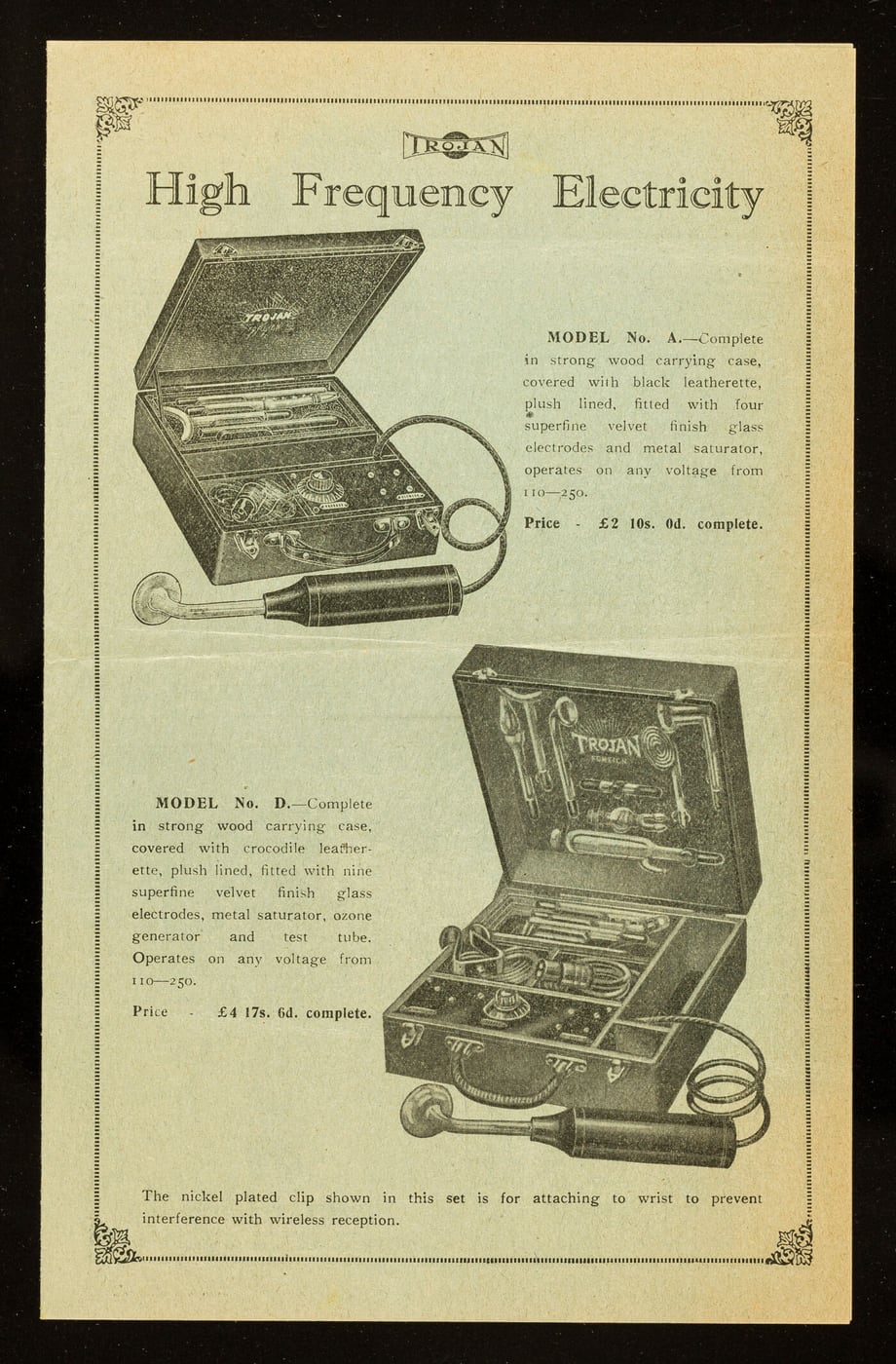
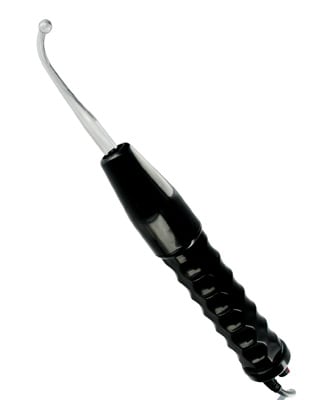
The end of this dive is the object on the shelf. Four volumes have explained what a violet-ray wand is — a mains handset whose coil drives a glowing evacuated electrode — what it actually did, who made it, and why it was pulled from sale. This volume is for the person who now owns one, or is about to: how to read the electrode fan, how to date the case, how to judge condition, and — the load-bearing part — why the safest thing to do with a working example is very often not to work it.
5.1 About this volume
A violet-ray set is one of the more collectable objects in the quack-medicine field precisely because it survives well: a wooden or bakelite handle, a compact control box, a fitted case, and a fan of glass electrodes that look like laboratory glassware crossed with stage props. They turn up constantly at estate sales and online auction, usually cheap, usually described with more romance than accuracy.
This closing volume assumes you have read the rest of the dive. It refers back rather than repeats: the cased set and its world are laid out in Vol 1 — The Handset and Its World; why the electrode glows violet — a low-pressure gas discharge inside the evacuated glass, not ultraviolet light — is the physics of Vol 2 — What It Actually Did; the makers and the case, coil, and label cues that date a set are Vol 3 — The Makers and Their Machines; and why the government eventually seized and destroyed them is Vol 4 — The Promise and the Reckoning. Here we catalogue the electrodes, assess condition, and make the safety case.
5.2 The electrode catalogue
The electrodes are the reason to collect a set, and the reason the marketing worked: a fan of specialised glass shapes made a one-trick spark generator look like a whole clinic. Period catalogues such as the Master Violet Ray list twenty-odd shapes; most home sets shipped with four to seven, and a “professional” set such as the URMC’s Renulife Model R came with a claimed 44 electrodes plus a separate ozone inhaler. The shapes fall into a few families, described here as historical catalogue objects.
Surface and facial. The workhorse. A straight tube ending in a bulb, mushroom, or spoon (“No. 1 General Electrode… for facial and body treatment, and for any surface application,” in Master’s wording), rolled over the face, neck, or a sore joint. This is the electrode most sets still have, because it saw the most use and broke the least.
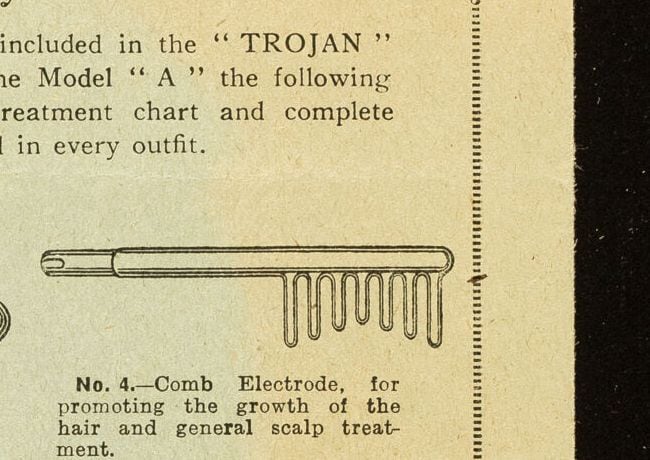
Comb and rake (scalp). A flat glass comb or a six-pronged rake drawn through the hair — sold explicitly against “Falling Hair, Dandruff, Gray Hair” and baldness. Distinctive and fragile; the prongs snap.
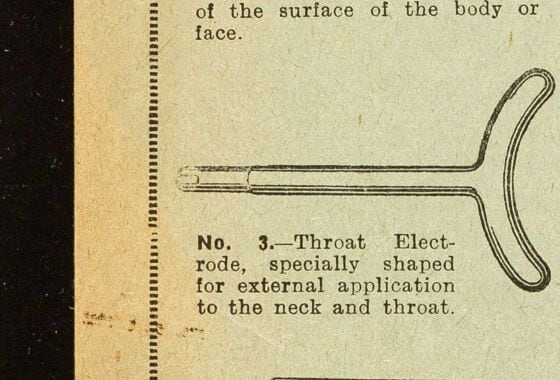
Eye, ear, throat, and nasal. A single or double eye electrode shaped to sit over the closed eyelid; an insulated ear electrode; a throat/neck electrode curved to fit the throat and sold for goitre and tonsillitis; and slim nasal tubes for “catarrh.” These narrow shapes are where a set’s completeness — and its collectability — is often decided.
Cautery and fulguration. A fine point electrode run at high output to burn off a wart or mole — the one genuinely destructive use, and the seed of the legitimate dental descendant discussed in Vol 4.
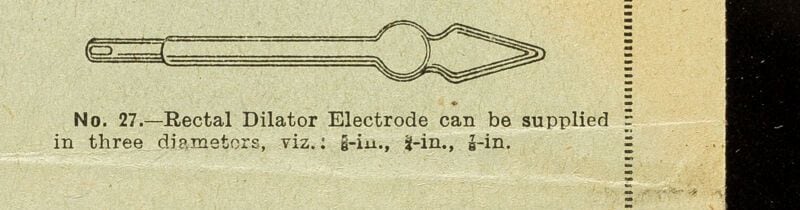
The “internal” applicators. Every full catalogue also listed long orificial electrodes — urethral, rectal, vaginal, and prostatic, offered in “plain” and “insulated” grades (Master’s Nos. 14–24, priced separately at a dollar or two each), one perforated “so that ozone may be generated.” They are described here plainly, as the historical record has them: the same partially-evacuated glass, the same harmless glow and mild spark, sold for the same imagined internal “vitality” as everything else. They are genuinely present in surviving sets and in museum catalogues; a collector should know what the long tubes are, and that they are objects of medical history, nothing more.
5.3 Identifying and dating a set
Dating is covered in detail in Vol 3; the short version for a collector holding a mystery set: read the label and the case first. A moulded or foil maker’s plate on the control box — Renulife (Detroit), Master Violet Ray, Fitzgerald, Fisher, Bleadon-Dun, or one of the countless drugstore house-brands — narrows both maker and era at a glance, and Renulife’s Model R carries an on-plate 1919 patent date. Absent a plate, the handle material (early wood giving way to moulded bakelite), the fitted velvet colour (Renulife’s signature purple), the case hardware, and the typography of any surviving instruction pamphlet (Eberhart’s Physicians’ Directions for Renulife Treatments, c. 1923–26, in the Rochester set) all place a set within the roughly 1915–1950 window. Cross-check any claimed model against Vol 3’s maker table rather than trusting the seller.
5.4 Condition assessment
Grade five things, in order of what they cost you.
The electrodes. Hold each to the light. Look for cracks, chips, and loss of the tip, and — the subtle one — loss of vacuum. A sound electrode strikes a strong violet-to-lavender glow; one that has slowly admitted air glows dim, reddish, or washed-out white, because the discharge colour tracks the internal pressure. Most period electrodes are simply air at various degrees of vacuum, not a noble-gas fill, so a leaker cannot practically be re-evacuated at home — re-pumping needs specialist glass-vacuum equipment, and a gassy electrode is effectively spent as anything but a display piece. A darkened tip is normal sputter; a completely clouded one has usually lost its seal.
The coil and interrupter. The heart of the box, and the part you should assume is degraded. Do not power it to test it (see below).
The cord and plug. Almost universally perished. Century-old rubber-and-cloth cordage goes brittle and crumbles, and early two-wire cords have no earth; contemporary restorers report insulation that has “fallen off in many places” and capacitor leads left “for the most part bare.” Treat the original cord as unusable.
The case and velvet. Cosmetic but value-determining: crushed nap, moth loss, water-staining, and missing electrode-retaining loops. A complete, un-reproduced fitted case with its full electrode fan is worth far more than the sum of loose parts.
5.5 Safety: treat every unit as an unsafe antique appliance
This is the volume’s core message, so it is stated flatly: a surviving violet-ray wand is an unsafe antique mains appliance, and the default sensible treatment is to display it, not operate it. The reasons stack up:
- Exposed high voltage. The coil steps mains up to a high-frequency output commonly characterised around 1–2 kV, discharging in the kilohertz range. That is not a trivial “tickle”: the output can bite, and — because early cords are ungrounded two-wire — a fault can put full mains potential where you don’t expect it, with the wand’s own spark “backed” by line voltage through degraded wiring.
- Perished insulation. As above: brittle, crumbling rubber; bare capacitor leads; wax-impregnated parts that must not be allowed to overheat. Even period-correct guidance warned never to run one more than about ten minutes and to let it cool for an hour — these were never continuous-duty devices, and a century of ageing has only made that worse.
- Possible asbestos. Some early bakelite and insulating-board formulations were reinforced with asbestos fibre to improve heat and electrical resistance; industry references put the content of affected mouldings as high as a few percent amosite. Whether a given handle or base contains any is not knowable by eye and should be verified, not assumed — but the correct posture is precaution: do not sand, drill, cut, or abrade an old bakelite part, since intact material is low-risk and it is damage that releases fibre.
- Ozone. The spark ozonises the surrounding air — the characteristic “electric” smell, and, as Vol 2 explains, a genuine output of the device. Ozone is a respiratory irritant; running a wand in a closed room is its own small hazard.
Because of all this, this volume gives no step-by-step electrical repair or operating instructions, and none for using an electrode on a person — the historical claims were bogus (see Vol 4) and the appliance is unsafe. If a collector genuinely intends to bring a unit to life, that is expert-only work for someone who understands high-voltage and Tesla/Oudin coils, on a bench, through current-limiting gear — the community norm is to check a coil at reduced input via a variac and a series dim-bulb tester and to sense high-frequency output without contact by seeing whether it lights a neon or fluorescent lamp held nearby, never by grabbing the wand and plugging it into the wall. Described here as principle, not procedure: the point is that a safe check is a low-power, hands-off, specialist affair, and everyone else should leave the plug in the drawer.
5.6 Display and provenance
Displayed cold, a violet-ray set is a superb object: lay the handle and electrodes in the open fitted case, cord coiled, maker’s plate forward. Keep it out of direct sun (velvet fades, bakelite yellows) and dry (to spare the coil and any iron hardware). If you want the violet glow for a photograph or a show, produce it the modern, safe way — a small modern Tesla-coil or plasma source that lights a spare electrode by proximity — rather than energising the antique.
Provenance turns a curiosity into a document. A surviving instruction pamphlet, a drugstore or utility retailer’s label (the Rochester Model R was sold through the local gas-and-electric company), a receipt, or a mail-order catalogue page ties the object to the exact moment Vol 1 describes — the drugstore “health generator” sold beside the soda fountain. Record where a set came from, photograph every electrode with its shape and any catalogue number, and note the maker’s plate: that record is the difference between “an old violet-ray thing” and a dated, attributed artefact of the golden age of medical fraud.
5.7 Where this volume hands off
This is the last volume of the Violet Ray Wands dive. From here the collection branches: the sober engineering cousin of this machine — real, physician-administered high-frequency electrotherapy and d’Arsonvalisation — is the subject of the High Frequency Currents dive (in Electrotherapy Devices), where the same coil is treated as legitimate apparatus rather than cure-all. And the other Quack Devices dives — electropathic belts, radionics boxes, radioactive tonics, Spectro-Chrome, and the vibratory cures — each end, as this one has, on the object a collector holds and how to read it.
Sources
- High frequency (violet ray) apparatus, England, before 1966 — Science Museum Group Collection — cased-set description and named electrode shapes (comb, circular/surface, six-pronged rake, sphere) with dimensions.
- Master Violet Rays catalogue (McMillin Media / EAEM) — the full period electrode catalogue and its own stated uses, including the surface, comb-rake, eye, throat, ear, and orificial (urethral/rectal/vaginal/prostatic) electrodes and their prices.
- RenuLife Violet Ray Health Generator — University of Rochester Medical Center, History of Medicine — Renulife (Detroit), Model R (patented 1919), purple velvet set, 44-electrode “professional” set + ozone inhaler, sold via Rochester Gas & Electric, 1923 Eberhart pamphlet.
- Violet ray — Wikipedia — voltage/frequency characterisation, the evacuated-glass/gas-discharge nature, ozone as an intentional output, and the recall/seizure history.
- Violet Ray Machine — Warning: Get it CHECKED before use (Extreme Electronics) — first-hand condition report: perished/fallen-off rubber insulation, bare capacitor leads, ungrounded two-wire cord, wax-insulated parts and overheating, “get it checked by someone who knows high-voltage/Tesla coils.”
- Violet Ray Machine Safety Guidelines — Steffan’s Violet Ray Shop — the ~10-minute run limit and hour cool-down, bakelite as a poor HV insulator, and hands-off power-up caution (collector, not medical, framing).
- What is asbestos Bakelite — Oracle Asbestos and Asbestos in vintage products — RWK Goodman — that some bakelite/insulating formulations contained asbestos, that intact items are low-risk, and that damage (sanding/drilling/breaking) is what releases fibre — supporting the “verify, don’t assume; don’t abrade” posture.
- What Was the Violet Ray Machine? — IEEE Spectrum — plug-into-a-lamp-socket mains appliance, AC/DC operation, and the ~1–2 kV / 4–10 kHz output figures.
- Tesla, quacks and violet rays — Wellcome Collection — that the electrodes are partially-evacuated glass whose glow is a proximity-excited gas discharge, and general framing of the object as collectable medical history.
Comments (0)