Violet Ray Wands · Volume 4
The Promise and the Reckoning
What the violet-ray wand was sold to cure, why the medicine never held up, and the long regulatory road — JAMA's 1917 dismissal, the 1938 Food, Drug, and Cosmetic Act, and the 1950–51 FDA action that ended the trade — plus the device's strange modern afterlife.
Contents
4.1 About this volume
The four volumes before and around this one describe an object: a mains-powered handset that drove a partly-evacuated glass electrode until it glowed violet and stung the skin (Vol 1 — The Handset and Its World), the real electrical physics behind that glow (Vol 2 — What It Actually Did), and the makers who built and branded it (Vol 3 — The Makers and Their Machines). This volume is about the words — the promise printed on the box and in the magazines, and the forty-year reckoning in which medicine, then the law, took that promise apart.
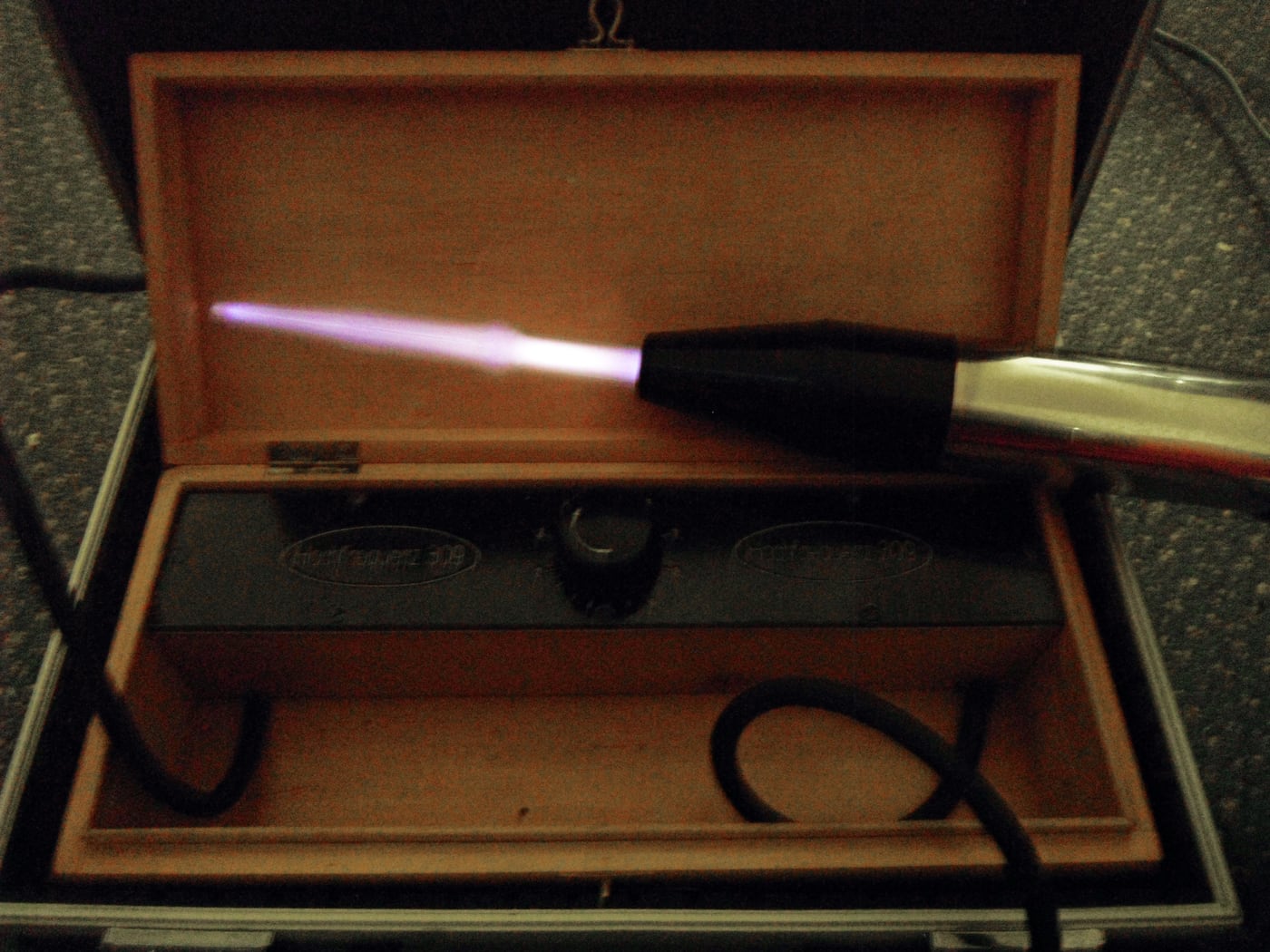
The through-line is a single deception, stated plainly in Vol 2 and never re-derived here: the violet glow is a low-pressure gas discharge inside the sealed electrode, not ultraviolet light. The whole commercial proposition depended on blurring that line — on letting a buyer hear “violet ray” and think of the genuine, respectable ultraviolet phototherapy then curing rickets and skin tuberculosis in real clinics. Once you hold those two things apart, the marketing collapses and the regulatory story writes itself.
A note on discipline, because this field is thick with repeated myths. Where a date or a quotation could be pinned to a museum or a government record it is cited as such below; where it could only be traced to secondary accounts it is flagged in the prose as reported or commonly cited. Nothing here is medical advice — it is the history of why this device stopped being sold as medicine.
4.2 The promise: a cure-all in a velvet case
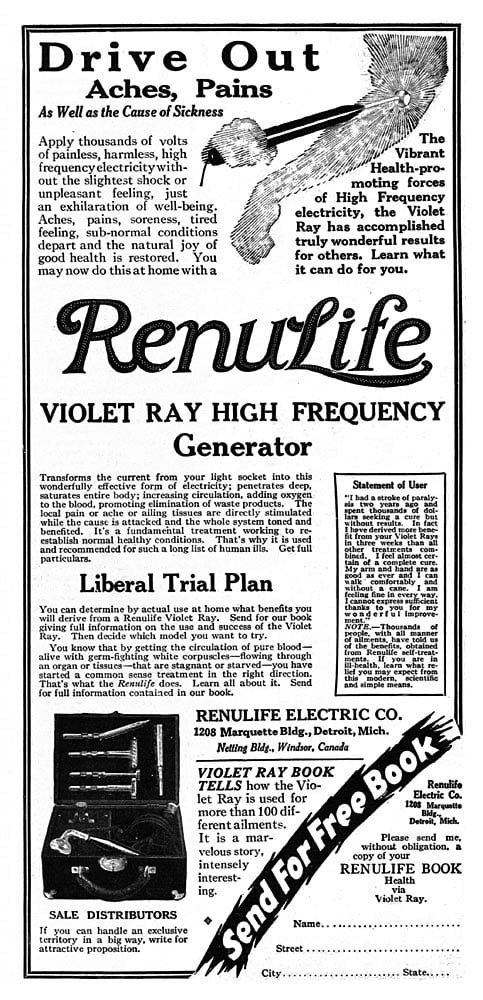
The claims were extravagant even by the standards of the era. Surviving instruction booklets and advertising for Renulife, Master, and their imitators recommended the wand for an alphabet of complaints — the University of Rochester’s history-of-medicine collection lists a range running “from asthma to deafness, infantile paralysis to dandruff, nervous affections to enlarged prostates,” with treatment guides indexing conditions “from abscesses to writer’s cramp.” The Museum of Quackery’s transcription of a Master-brand decree records claims to relieve “rheumatism, lumbago, and neuritis,” to treat “heart disease, paralysis, wry neck and writers cramp,” to address “cystitis, strictures, gonorrhea, and prostate and vaginal troubles,” and to remove “facial blemishes” for a “clear, healthful complexion.”
Behind the long lists sat a smaller set of recurring promises pitched straight at anxiety: baldness and dandruff (the comb electrode), “nervous debility” and insomnia, rheumatism and lumbago, deafness (the ear electrode), skin disease and blemishes, impotence and “lost vitality,” and — at the disreputable edge — hints of relief from cancer. The unifying sales idea was vitality: the visible violet glow and the tingling spark were offered as energy entering the body, a glow you could feel doing you good.
The name did the heavy lifting. “Violet ray” and the frequent companion word “actinic” invited the buyer to file the handset alongside ultraviolet therapy, which in the 1910s and 1920s was a legitimate and celebrated medical treatment. Advertisers rarely claimed outright to emit ultraviolet — they let the color, the vocabulary, and the borrowed prestige do the implying. That single equivocation is the hinge on which every later enforcement action turned.
4.3 The reckoning: what medicine actually found
The physics is covered in Vol 2 — What It Actually Did; the summary that matters here is that the genuine effects were real but trivial. The high-frequency, high-voltage, very-low-current output produced superficial skin stimulation, a mild counter-irritant sting, warmth, and the smell of ozone from the spark — nothing systemic, nothing that reached an organ, and no meaningful (only negligible, incidental) ultraviolet dose. For the serious, sober account of the high-frequency electrotherapy the wand imitated — d’Arsonvalization as practiced by physicians — see the High Frequency Currents dive in Electrotherapy Devices, which is where the legitimate version of this technology properly lives.
Organized medicine reached that verdict early. It is commonly cited that in 1917 the Journal of the American Medical Association dismissed the violet-ray apparatus as incapable of treating the “practically all diseases” its sellers claimed, attributing whatever benefit patients reported to suggestion — the placebo effect of an impressive, glowing, faintly painful ritual — rather than to any physical action. The American Medical Association’s Bureau of Investigation went on to file the devices in its long-running “Nostrums and Quackery” indictments of fraudulent healing apparatus. (Accuracy flag: the 1917 JAMA line is repeated consistently across secondary sources but the primary editorial could not be pinned to an exact JAMA volume, page, and wording in this pass — it should be confirmed against the digitized JAMA archive before being quoted as verbatim.)
The trouble was that a professional society’s disapproval carried no force of law. A doctor could denounce the wand in print on Monday and watch a drugstore sell a dozen of them on Tuesday. For the promise to actually end, the criticism had to acquire teeth — and that took the better part of two decades.
4.4 A law with no teeth for devices
Here the history is easy to get wrong, so it is worth stating precisely. The Pure Food and Drug Act of 1906 did not cover medical devices at all — its reach ran to foods and drugs, and even its later false-claims provisions applied to drug labeling, not to apparatus. A glowing glass wand was, in the eyes of the 1906 statute, simply not the kind of thing the government could seize for lying about what it cured.
This is why the frequently-repeated story of “FDA misbranding complaints in the late 1920s” needs careful handling. Federal and professional critics did, in that period, attack the devices — the memorable characterization that the wands “give forth a violet ray but are in no way similar to ultraviolet rays” and were useless against disease circulates widely as a period judgment. But whatever body voiced it, it could not have been an enforceable device-misbranding seizure, because no agency held statutory authority over devices until 1938. The late-1920s scrutiny is best understood as criticism and investigation without a hammer — accurate, damning, and toothless. (Accuracy flag: the exact “in no way similar to ultraviolet rays” quotation is repeated across secondary accounts, but its original speaker, agency, and date were not pinned in this pass; treat it as a characteristic period criticism rather than a dated, sourced enforcement quote.)
4.5 1938: the law grows teeth
Everything changed with the Federal Food, Drug, and Cosmetic Act of 1938. For the first time, the FDCA extended federal jurisdiction to medical devices, giving the Food and Drug Administration authority to act against apparatus that was misbranded — that is, whose labeling made therapeutic claims it could not support. In the same year the Wheeler-Lea Act handed the Federal Trade Commission clear authority over the advertising of such products. Between them, the two 1938 laws finally closed the gap the violet-ray trade had lived in: the promise on the box and the promise in the magazine were now both actionable.
The FDCA is the load-bearing statute in this volume. It did not ban the violet-ray wand — it made it illegal to sell one as a cure. That distinction shaped how the ending actually arrived: not as a dramatic prohibition of an object, but as a slow attrition of claims, seizure by seizure, until manufacturing the thing as medicine no longer made commercial sense.
4.6 1950–51: the trade ends
Through the 1940s the makers, in the words of the University of Rochester’s account, were “party to numerous lawsuits and multiple actions by the United States government including recalls, seizures, forfeitures, and orders to have them destroyed.” The decisive blow landed at the turn of the decade against Master Appliances, Inc., by then among the last U.S. producers.
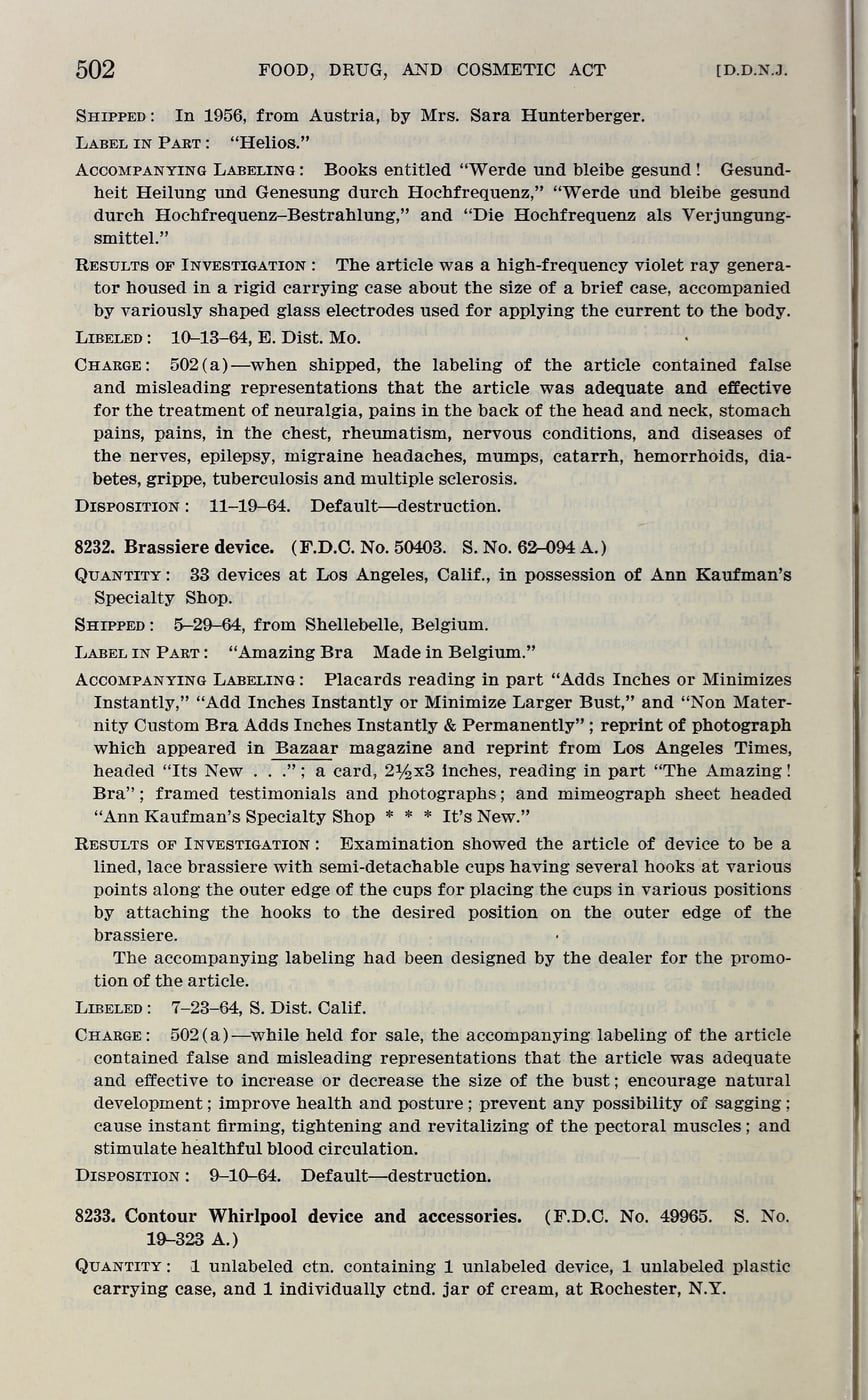
The paper trail runs through the FDA’s own published Notices of Judgment. The Museum of Quackery’s transcription records a shipment dated July 24, 1950 and a default decree of condemnation entered April 24, 1951, the government having charged that the device “was not an effective treatment for the conditions stated and implied, and it was not capable of producing the effects claimed.” A companion criminal action is cited on Wikipedia from the same Notices of Judgment series: United States v. Master Appliances, Inc. — a plea of guilty, fine of $2,000 plus costs, dated October 10, 1951. Taken together, the 1950–51 actions against Master effectively ended the manufacture and therapeutic advertising of violet-ray wands in the United States. (Accuracy note: both the April 1951 condemnation and the October 1951 criminal plea are FDA Notices of Judgment and are the strongest-verified milestones in this volume; the “1950–51” framing is firmly documented, though the two dates belong to two distinct proceedings against the same firm.)
There was a narrow dermatological carve-out. The device was never proven dangerous — only useless for its grand claims — and a stripped-down, honestly-labeled high-frequency spark had a genuine, limited place in dermatology and dentistry for superficial skin and gum work. What the law killed was the cure-all; the modest, real application survived by shedding the promises.
4.7 The afterlife: novelty wands and a real descendant
The object outlived the fraud, in two directions.
The first is novelty. Stripped of any medical claim, essentially the same handset — a small Tesla/Oudin coil driving a glowing evacuated electrode — is still manufactured and sold today as a “violet wand,” marketed since roughly the 1990s as a relatively safe erotic electrostimulation toy. It is unregulated as a medical device precisely because it no longer pretends to be one; the tingling spark that once “cured” rheumatism is now simply the point of the product. (This is noted here as social history, not endorsement or instruction.)
The second is legitimate medicine. The genuine, narrow effect the wand always had — a high-frequency spark that can superficially treat and coagulate tissue — matured into real clinical dental and dermatological electrosurgery. The RenuLife sets already shipped with dedicated dental electrodes for the gums; the modern high-frequency dental unit, used for controlled cutting, hemostasis, and soft-tissue contouring, is the honest descendant of that same physics, retaining the effect and discarding the mythology. The through-line from parlor cure-all to chairside instrument is the clearest single measure of what was ever real about the violet ray: very little, but not nothing.
4.8 Where this volume hands off
This volume closed the historical arc — from the promise printed on the velvet-lined case to the FDA judgments that ended it. The final volume, Vol 5 — Collecting, Restoring, and Displaying, returns the wand to the present as a collector’s object: how to identify and date a set, how to read its condition, the full electrode catalog described soberly as historical hardware, and — most importantly — the safety realities of a mains-driven antique with exposed high voltage, aged insulation, asbestos in some bases, and ozone. Read Vol 5 before you so much as plug one in.
Sources
- RenuLife Violet Ray Health Generator — University of Rochester Medical Center, History of Medicine blog; the claimed-conditions lists, the pattern of 1940s government actions, and the 1951 Master Appliances ruling that ended U.S. production.
- Violet Ray Generators — Museum of Quackery; transcribed Master-brand claims and the FDA decree details (July 24, 1950 shipment; April 24, 1951 default decree of condemnation; the “not capable of producing the effects claimed” finding).
- Violet ray — Wikipedia; the U.S. v. Master Appliances, Inc. Notice of Judgment (guilty plea, $2,000 fine, 1951-10-10), the pattern of recalls/seizures/forfeitures, and the modern “violet wand” erotic-electrostimulation afterlife.
- Part II: 1938, Food, Drug, Cosmetic Act and The History of Medical and Radiation-Emitting Device Regulation — FDA; that the 1906 Act did not cover devices and that the 1938 FDCA first extended FDA authority to medical devices (with the Wheeler-Lea Act covering advertising).
- Federal Food, Drug, and Cosmetic Act — Wikipedia; the 1938 statute’s scope and its device provisions.
- Shocking Dentistry — Modern Clinical Applications for an Old Dental Device — Glidewell Chairside magazine; the line from the violet-ray-type high-frequency dental unit to modern dental electrosurgery, the legitimate descendant.
- FDA Notices of Judgment Collection — U.S. National Library of Medicine; the primary published record for the FDA misbranding actions cited above (recommended for the accuracy reviewer to confirm the exact Master Appliances notices).
- High frequency (‘violet ray’) apparatus — Science Museum Group Collection; representative museum object records for the apparatus itself.
Comments (0)