Violet Ray Wands · Volume 1
The Handset and Its World
What a violet-ray wand is, its velvet-lined cased set and fan of glass electrodes, and how a mains 'health generator' was sold to American homes from the 1910s to the 1940s.
Contents
| Section |
|---|
| About this volume |
| The object in the hand |
| The cased set and its fan of electrodes |
| Sold as a household health generator |
| Why this object matters |
| Where this volume hands off |
1.1 About this volume
Open a violet-ray set from the 1920s and the first thing you notice is how considered it looks: a black leather or lacquered-wood case, a lining of purple velvet, and a fan of slender glass bulbs laid out like surgical instruments. Lift the handle, plug it into the wall, touch a bulb to your forearm, and it fills with a soft violet light while the air takes on the sharp, metallic smell of ozone and a fine crackle of sparks dances against your skin. For roughly thirty years this small theater of light and smell was sold to ordinary households as a cure for almost everything.
This is the establishing volume of a five-part deep dive. Its job is narrow and specific: to describe the object and the world it lived in — what a violet-ray wand physically is, the fitted cased set it came in, and the drugstore-and-mail-order marketplace that put one in so many American parlors between about 1915 and 1950. It deliberately stops short of the interesting arguments. The real electrical physics — why the bulb glows, what the coil actually does, and the load-bearing correction that the violet glow is a gas discharge, not ultraviolet light — is the whole subject of Vol 2 — What It Actually Did. The manufacturers and models are catalogued in Vol 3 — The Makers and Their Machines; the medical promises and the regulatory reckoning in Vol 4 — The Promise and the Reckoning; and identifying, restoring, and safely displaying a set in Vol 5 — Collecting, Restoring, and Displaying.
One caution belongs here at the front, because the name of the device is itself a small deception. “Violet ray” invites you to imagine a beam of ultraviolet therapy. It is nothing of the kind. The violet you see is a low-pressure gas glowing inside a sealed glass electrode — the same physics as a neon sign, tuned to a different color. There is no therapeutic beam — only visible light, a negligible incidental trace of ultraviolet, and a harmless surface spark. The full account of that distinction is Vol 2’s to make; this volume simply refuses to repeat the marketing.
1.2 The object in the hand
Strip away the case and the mystique and a violet-ray wand is a straightforward, if slightly alarming, piece of domestic electrical apparatus. It plugs into house mains — a surviving Renulife Model R is rated 110 volts, 30 watts — and inside its handle sits a small step-up coil of the Tesla/Oudin family driven through a vibrating interrupter. The coil converts ordinary mains into a high-voltage, high-frequency, very-low-current output. Published characterizations of a Renulife wand put the output on the order of one to two kilovolts discharging at roughly 4 to 10 kilohertz, though these figures come from museum secondary descriptions rather than a maker’s spec sheet and are best treated as indicative.
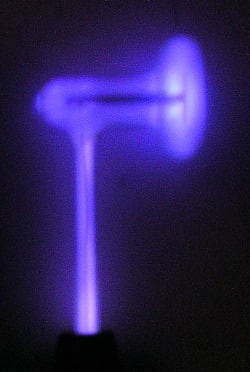
The business end is a partially evacuated glass electrode — a sealed glass bulb from which most of the air has been pumped, leaving a thin residual gas. Push that electrode into the socket of the handle and switch on, and the high-frequency field ionizes the trace gas so the bulb glows a soft violet. Bring the glowing glass near the skin and the field jumps the last small gap as a spray of tiny sparks; those sparks tear apart oxygen molecules in the air, which recombine into ozone, the source of the device’s unmistakable smell. The current that actually reaches the body is minute — enough to prickle, warm slightly, and startle, but not to shock in the way house current would. The handle is almost always sheathed in Bakelite, the era’s signature moulded insulator, because the whole point of the design is to let a person hold a high-voltage electrode safely in one hand.
That combination — glow, spark, prickle, warmth, and ozone — is the entire sensory payload of the device, and it is worth naming plainly now because the marketing spent thirty years attributing it to invisible healing energies. What the physics can honestly claim is superficial and local: a mild counter-irritant tingling of the skin and the smell of ozone. What it did to disease is the subject of Vol 4, and the answer, briefly, is nothing.
1.3 The cased set and its fan of electrodes
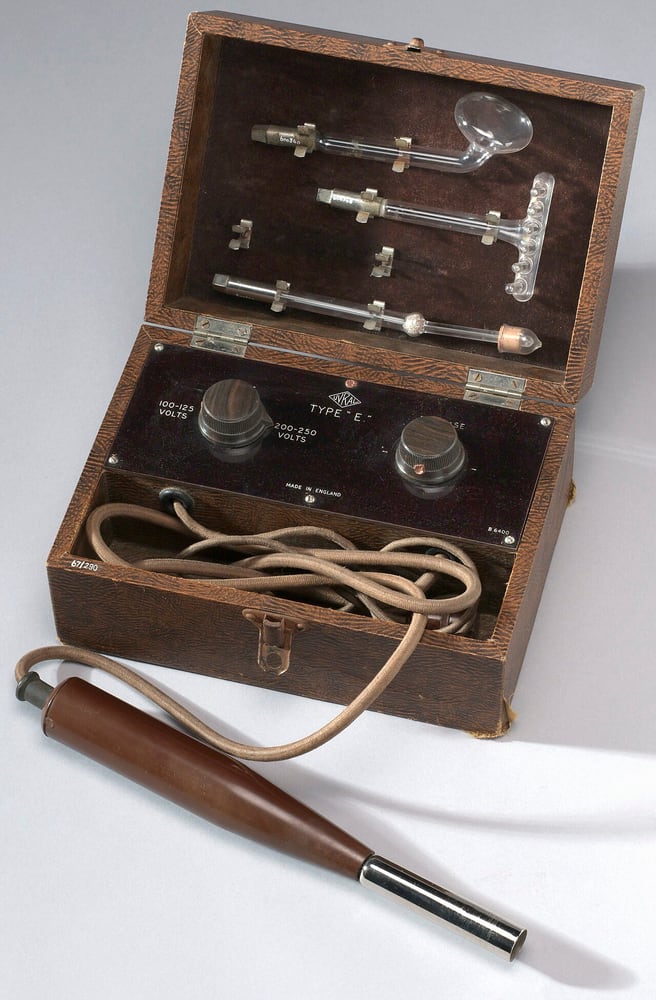
The cased set is what makes these objects so collectible and so photogenic, and it is the heart of this volume’s figure plan. A typical set is a hinged box — black leather over board, or stained wood — with a purple- or violet-velvet lining that both cushions the glass and, not coincidentally, flatters the violet theme. The base of the case holds the transformer, a control knob dialing the output from “mild” to “strong,” a cloth-wrapped mains cord, and the Bakelite handle. The lid, or a fitted tray, holds the fan of interchangeable glass electrodes, each a different shape for a different part of the body.
The number of electrodes varied enormously by grade and price. A modest household set might carry five bulbs; the Renulife Model R held in the University of Rochester’s History of Medicine collection came with a remarkable 44 electrodes for “internal and external applications,” including an ozone-inhaler attachment. The shapes recur across makers: a rounded surface or “mushroom” electrode for general application; a comb or rake for the scalp (baldness was a favorite target); a slim ear electrode; a throat or nasal applicator; specialized dental bulbs — one Renulife set advertised a dedicated “pyorrhea” electrode for the gums; and the frankly startling “internal” applicators — rectal and vaginal glass rods sold as matter-of-factly as the rest. Those internal electrodes are described here only to inventory the object; Vol 5 treats them soberly as historical catalog items, and this volume leaves them at that.
The fitted case did real persuasive work. It signaled that this was a medical instrument, not a novelty — a considered kit a person consulted like a home dispensary, choosing the right bulb for the complaint of the day from an instruction booklet that might list well over two hundred conditions. The catalog of who made these cases, how the electrodes differ between makers, and how a collector dates a set by them is Vol 3’s territory.
1.4 Sold as a household health generator
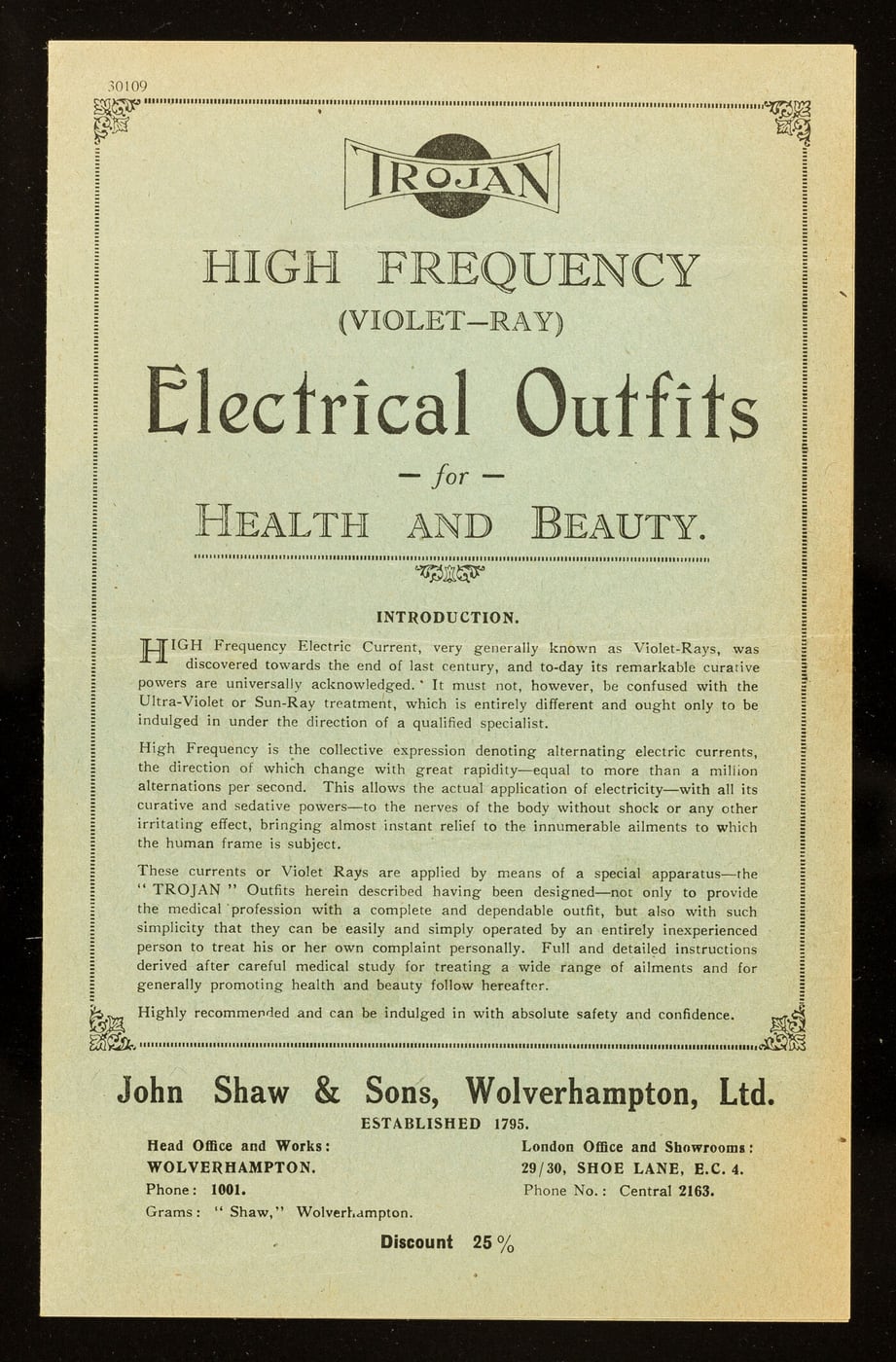
Violet-ray wands arrived at the tail end of a genuine electrical-medicine boom. By around 1900, electrical treatment apparatus of one kind or another was reportedly present in the great majority of big-city physicians’ offices, and the home version rode that credibility straight into the parlor. From roughly 1915 to 1950, tens of thousands of these handsets were sold for home use across the United States. They were marketed frankly as a household appliance — a “health generator” you owned, plugged in, and used yourself.
The sales channels were everything the era offered at once. Wands were sold across the drugstore counter as a health generator; through department stores; by mail order from the manufacturers and from the great catalog houses; and door to door by canvassers. Manufacturers pitched them for both the clinic and the home: the Turtle Bay Exploration Park’s Renulife notes that such machines were “designed to be used in medical settings and at home by the consumer.” A buyer in a mid-sized city might acquire one, as the Rochester Model R apparently was, through the local electric utility — the electricity company itself moving hardware that used its product. The device’s spread tracks the spread of household wiring: a violet-ray wand needed a wall socket, and it sold hardest exactly where and when American homes were getting them.
The maker landscape behind that marketplace was crowded. The best-documented name is Renulife, of Detroit, Michigan, whose Model R carried a patent date of September 30, 1919 (the physical maker’s label on at least one surviving Renulife reads “Beasley-Eastman Laboratories, Inc., Detroit” — a wrinkle Vol 3 untangles). Alongside Renulife stood Master Violet Ray (Master Appliances, Inc., of Marion, Indiana — with an earlier “Master Electric” identity that Vol 3 untangles), Fitzgerald, Fisher, and a long tail of drugstore house-brands. Sorting them out is Vol 3’s job; what matters here is simply that no single company defined the object — it was a whole industry of near-identical velvet-lined boxes.
1.5 Why this object matters
A violet-ray wand is a nearly perfect specimen of a certain kind of medical fraud: not a crude swindle but a designed one, engineered to be persuasive through the senses. It genuinely lights up. It genuinely sparks and smells of ozone. It genuinely tingles. Every one of those effects is real — and every one of them is trivial, superficial, and unrelated to the diseases it was sold to cure. The gap between the vivid sensation and the empty therapy is the entire story of the object, and it is why the wand rewards a full five-volume treatment.
It also sits on a genuinely porous boundary. The same high-frequency current, delivered by serious physicians as d’Arsonvalization, was a real (if limited) branch of medical electrotherapy; the sober engineering account of that lives in the High Frequency Currents dive (in Electrotherapy Devices), and Vol 2 draws the line between the two carefully. The violet-ray wand is what happens when a real physical phenomenon is stripped of its clinical modesty, put in a beautiful box, and sold to everyone for everything.
And the object outlived its own fraud. Manufacture was effectively ended in the United States around 1951 after a misbranding action, yet the handset never quite died: its lineage runs on into the genuine dental high-frequency descendant and into the unregulated modern “violet wand” sold as a novelty. Those afterlives, and the regulatory story that produced them, are Vol 4’s to tell.
1.6 Where this volume hands off
You now have the object in hand and the marketplace around it. The next question is the one the marketing worked hardest to obscure: what was actually happening when the bulb glowed and the skin prickled. That is Vol 2 — What It Actually Did, which follows the current from the wall socket through the interrupter and resonant coil to the gas-discharge glow and the ozone spark — and makes the load-bearing correction that the violet light is a low-pressure gas discharge, not ultraviolet therapy. From there the dive turns to the makers and models (Vol 3), the promises and the reckoning (Vol 4), and the collector’s practical questions of dating, restoring, and safely displaying a mains-powered antique with exposed high voltage (Vol 5).
Sources
- Renulife Violet Ray Health Generator — University of Rochester Medical Center, History of Medicine blog — Model R specifics: 110 V / 30 W, ~1–2 kV at 4–10 kHz, 44 electrodes including ozone inhaler, purple-velvet case, Detroit maker, acquired via Rochester Gas & Electric; the “glow is ionized gas, not ultraviolet” point and the ~200-condition claim.
- RenuLife “Violet Ray” Machine — Turtle Bay Exploration Park blog — high-voltage/high-frequency/low-current + ozone-inhalation operation, home-and-clinic use, 1919 patent, decline via 1940s–50s false-advertising suits, unregulated modern “beauty” afterlife.
- Storeroom Discoveries: the Renulife Violet Ray Health Generator — Sindecuse Museum of Dentistry — Renulife Electric Company, Detroit (512 Empire Building, 1925); Model R patented Sept 30, 1919; late-1920s criticism (widely repeated; agency and date unconfirmed — see Vol 4) that the devices “give forth a violet ray but are in no way similar to ultraviolet rays”; 1951 US prohibition of manufacture.
- Renu-Life Ozone Violet Ray Health Generator, object record — Sindecuse Museum (PastPerfect) — physical cased-set description: black leather box, purple-velvet-lined lid, five glass-bulb electrodes of graduated shapes, Bakelite handle, “mild–strong” control knob, “Beasley-Eastman Laboratories, Inc., Detroit” label, Model R serial 75591, 110 V / 30 W.
- Violet Ray Generators — Museum of Quackery — Geissler-tube electrodes on a transformer base; makers Masters/Elco/Renulife (Master Appliances, Marion, Indiana); “tens of thousands sold for home use between about 1915 and 1950”; 1951 FDA misbranding condemnation.
- Violet ray — Wikipedia — leads only: disruptive-discharge coil + interrupter producing high-voltage/high-frequency/low-current; Bakelite handle with interchangeable glass tubes; principal US makers Renulife, Fitzgerald, Fisher; production ceasing in WWII; 1951 Marion, Indiana action against Master and the US manufacturing ban.
Comments (0)