Violet Ray Wands · Volume 3
The Makers and Their Machines
The manufacturers and models behind the violet-ray wand — Renulife of Detroit as archetype, its rivals Master, Fitzgerald, Fisher and Bleadon-Dun, the ocean of drugstore-brand handsets, and how a collector reads a cased set to identify and roughly date it.
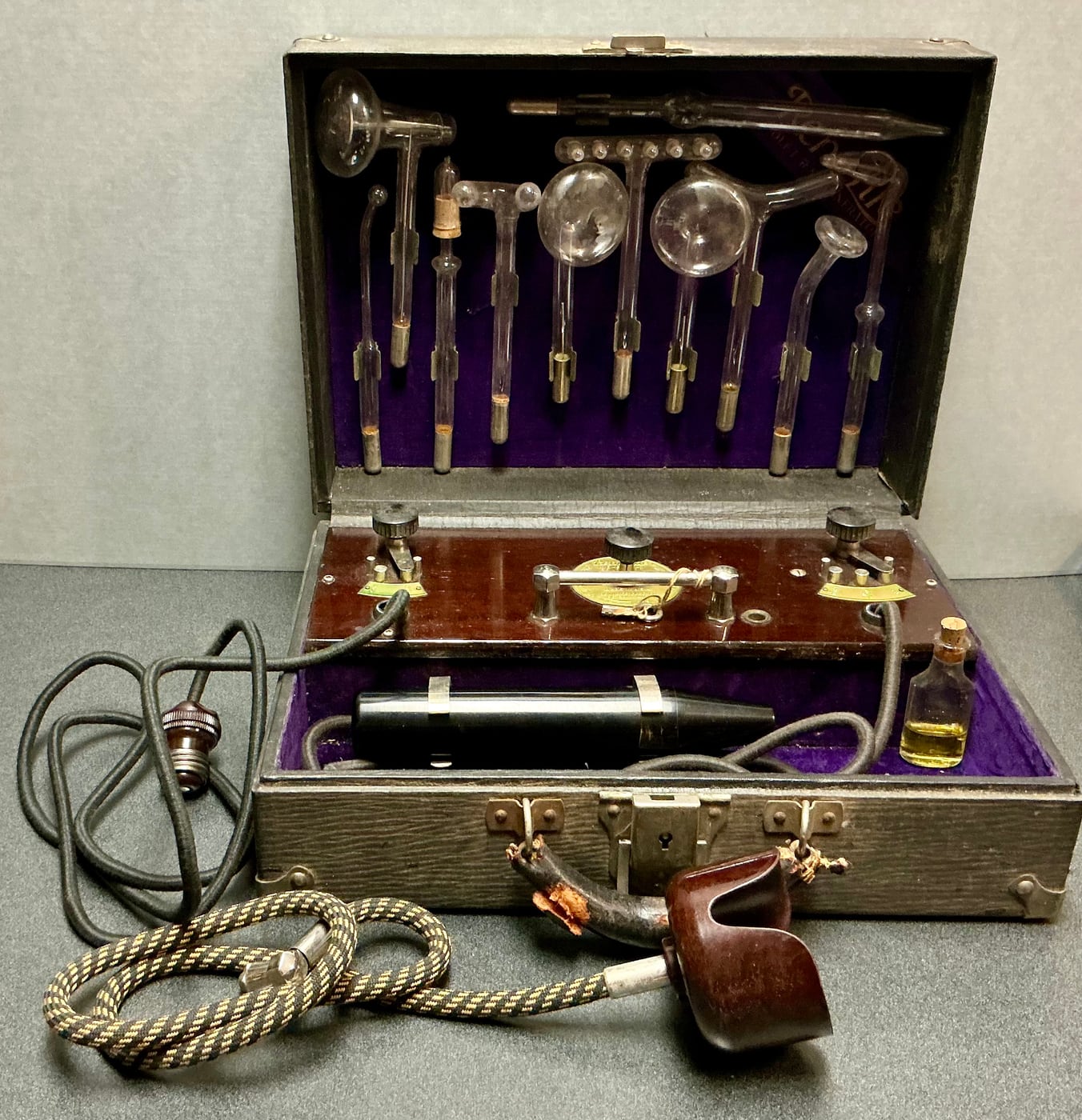
Where Vol 1 — The Handset and Its World introduced the cased violet-ray wand as an object and Vol 2 — What It Actually Did took apart its electrical physics, this volume is about the firms — who built these things, under what names, and how a collector today reads a surviving set to work out which maker made it and roughly when.
3.1 About this volume
The violet-ray trade was a crowded, short-lived American (and European) industry that ran from roughly the mid-1910s to about 1950. Dozens of firms sold what was fundamentally the same machine — a mains handset whose coil drove a glowing evacuated electrode — differentiated mostly by cabinetry, branding, and the extravagance of the accompanying booklet. Because the devices were mass-produced consumer goods rather than precision instruments, the documentary record is uneven: a few makers (Renulife, Bleadon-Dun) left rich catalogs and museum-held examples, while others survive only as a name cast into a bakelite handle or printed on a case lining.
This volume treats Renulife of Detroit as the archetype because it is the best-documented, then surveys its better-known rivals, then the anonymous private-label flood. Throughout, where the historical record is thin or contradictory — and for the smaller makers it frequently is — this volume says so rather than inventing a founding date or a model list. The deep electrical detail stays in Vol 2; the promises, the debunking, and the regulatory endgame stay in Vol 4 — The Promise and the Reckoning; the hands-on condition and safety detail stays in Vol 5 — Collecting, Restoring, and Displaying. Here the subject is simply the machines and their makers’ marks.
3.2 Renulife: the Detroit archetype
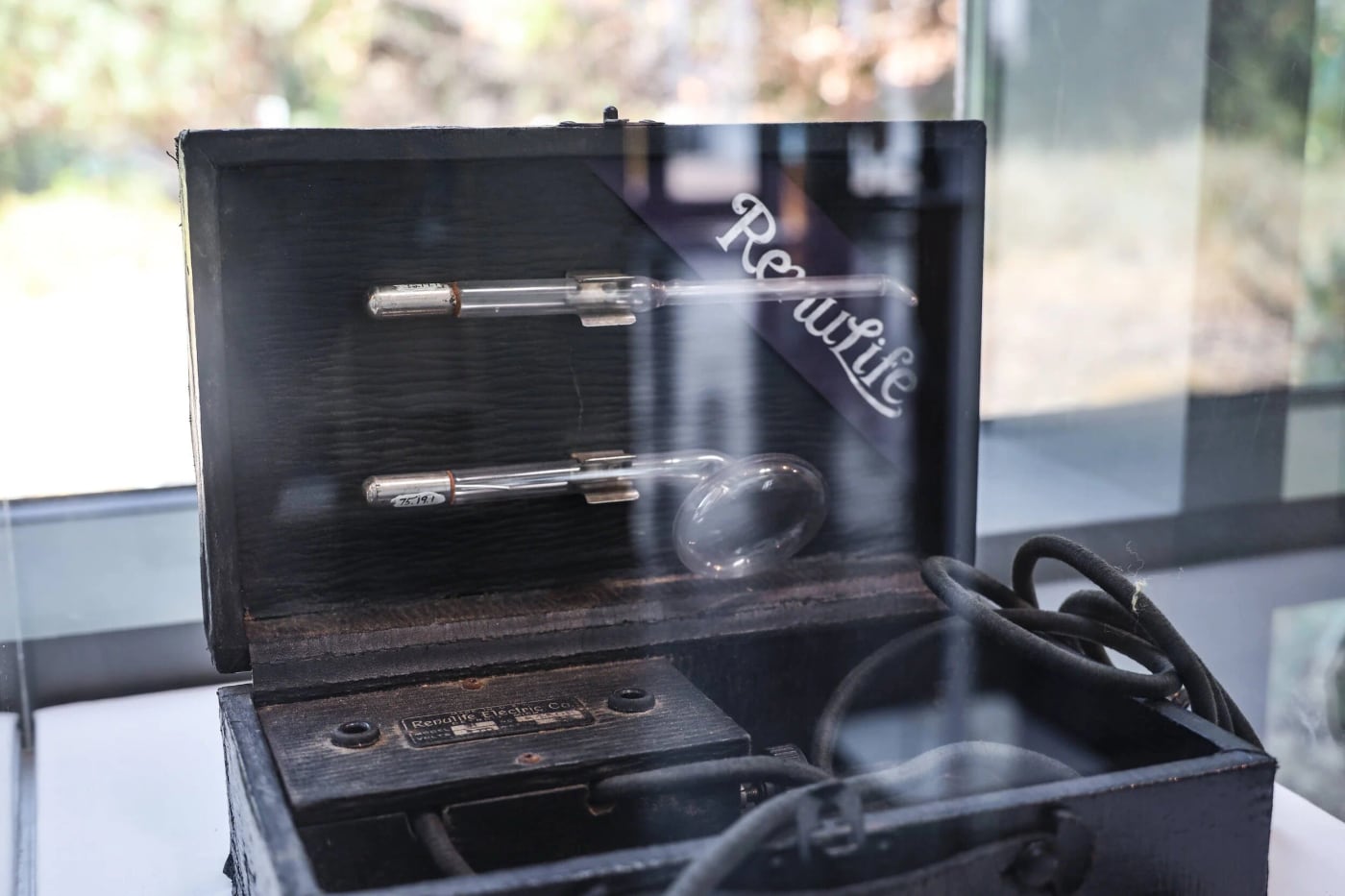
The Renulife Electric Company of Detroit, Michigan was founded in 1917 by the inventor James Henry Eastman, who held several patents on high-frequency apparatus; period correspondence places the firm at the Empire Building in Detroit by the mid-1920s. Renulife became one of the largest violet-ray makers in the United States, and its “Violet Ray Health Generator” is the set most often encountered today.
Company literature described a line of different models for different uses, and the three named designations recur across independent museum descriptions:
- Model M — the popular general-purpose home outfit.
- Model D — the dental model, sold to and through dentists.
- Model R — the deluxe unit, offering finer regulation of the current and a built-in ozone generator with an inhaling mask, promoted for “head and lung congestion.” A Model R survives in the University of Rochester’s History of Medicine collection, patent-dated 1919, lined in purple velvet.
The often-repeated claim that Renulife made seven models is supported by more than one museum source: both the University of Rochester Medical Center and the Sindecuse Museum of Dentistry state that Renulife produced seven different models, of which the Rochester example is the Model R. The claim is therefore reasonably well-founded — though a complete, authoritative list of all seven designations (beyond M, D, and R) has not turned up in the sources consulted, so a set stamped with a fourth letter should be treated as plausible rather than surprising.
Renulife leaned hard on the medical-professional angle. It is documented as offering some 44 electrodes for internal and external use, including five dental electrodes, one of them a special pyorrhea electrode the company claimed was “used by hundreds of dentists.” That dental line is the seed of the one genuinely durable descendant of this technology — a point developed in Vol 4. Sets typically shipped with a physician’s directions booklet (Renulife’s was credited to Noble M. Eberhart), an alphabetical index of ailments that is itself a useful dating and identification aid.
3.3 The rival makers
Master. The last firm standing in the American trade traded under the Master name, and its corporate identity is genuinely muddled in the record — early sets are attributed to a Master Electric Company of Chicago (the “Master Outfit No. 1,” circa 1920, in a leather-covered, satin-lined case), while the entity prosecuted in 1951 was Master Appliances, Inc., of Marion, Indiana. Whether these are the same firm relocated and renamed, or successive owners of the brand, is not clearly settled in the sources here — a collector should record exactly what the plate says rather than assume. Master’s 1930s “Master High Frequency Violet Ray” sets came in imitation-leather cases with general, rake, and throat electrodes. The 1951 misbranding case that effectively ended U.S. production was brought against Master Appliances; the legal detail belongs to Vol 4.
Fitzgerald. The Fitzgerald Manufacturing Company of Torrington, Connecticut — an established electrical-appliance maker — sold violet-ray sets (the “Star-Rite” line is associated with the firm) in the 1920s, with a representative unit rated at 110 volts and about 28 watts. Wikipedia names Fitzgerald among the three largest U.S. makers. Note that the specific model names, wattages, and the circa-1926 dating here come chiefly from auction and dealer listings rather than a museum catalog, so treat those particulars as indicative rather than authoritative.
Fisher. Fisher is routinely listed — alongside Renulife and Fitzgerald — as one of the larger U.S. violet-ray manufacturers. Beyond that repeated attribution, solid company detail is thin: a city, founding date, and model line for the Fisher violet-ray business could not be confirmed against a museum or primary source for this volume. It is named here honestly as a well-attested brand whose corporate history remains, in the sources consulted, poorly documented.
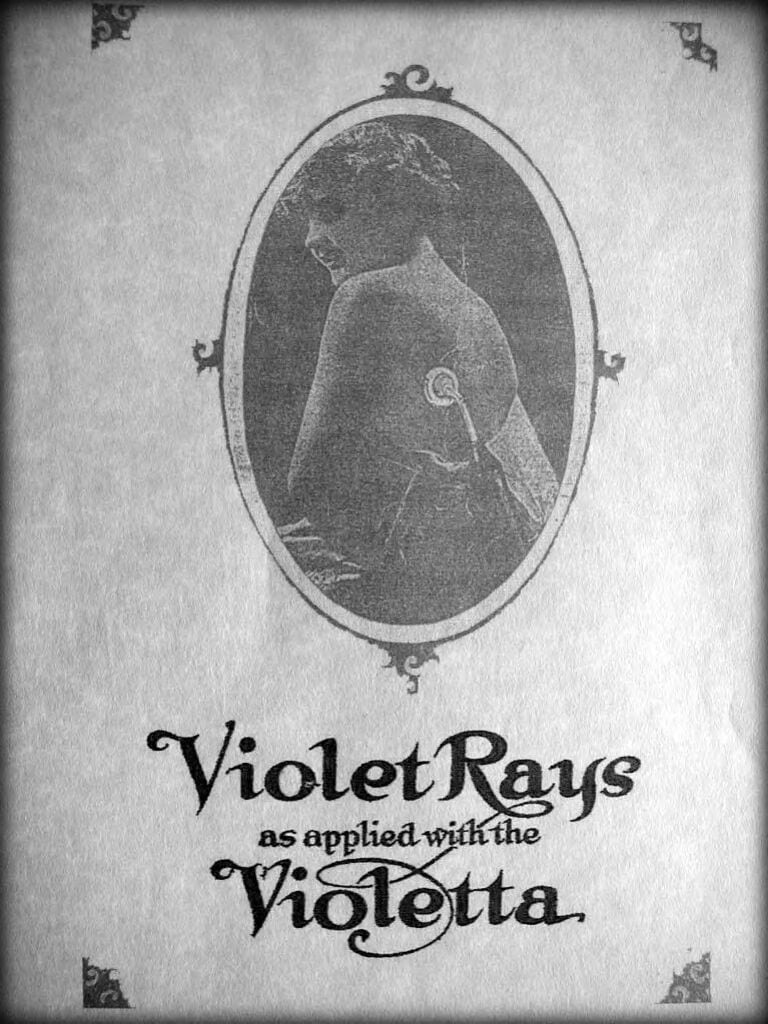
Bleadon-Dun and the Violetta. The Bleadon-Dun Company of Chicago was, by about 1919, manufacturing a family of machines all sold under the name Violetta (surviving variants include a “Baby Type A” and a “Violetta-Delux”). The firm styled itself, in the 1923 EMF Electrical Year Book, “the world’s largest exclusive manufacturers of portable, one-piece, high-frequency generators.” Its 1923 booklet Violet Rays as Applied with the Violetta survives and lists the standard electrode fan — general, comb/rake, external throat, eye, urethral and vaginal electrodes, plus an ozone attachment. “Violetta” was enough of a marketing hit that it was echoed by other sellers (e.g. a “Vi-Rex Violetta”), which is a useful caution: the model name on a case is not always the maker’s name. Other period brands that turn up include Elco and the Canadian Charles A. Branston three-mode outfits.
3.4 The drugstore ocean
Beneath the named firms lay an ocean of essentially interchangeable handsets sold as drugstore health generators, by mail order, and door to door — tens of thousands of units across the 1915–1950 span. Many were private-label: the same generic mechanism cased and badged for a regional distributor, a pharmacy chain, or a catalog house. A cheap outfit might be a single bakelite handle with one mushroom electrode selling for around $8.50 in the 1920s; a deluxe cased set with a full electrode fan and an ozone attachment ran considerably higher.
The practical consequence for identification is that many surviving sets carry no true maker’s name at all — only a model or trade name (a “Violetta,” a “Kosmosan,” a “Star-Rite,” a “Health Ray”), a distributor’s imprint, or nothing but a patent number cast in the handle. This is not a gap to be filled by guessing. When a set cannot be tied to a firm, the honest catalog entry names the trade mark, records the patent numbers, and leaves the manufacturer as unattributed.
3.5 Reading a set: how collectors identify and date
No single feature dates a violet-ray set; identification is triangulation across five things.
The case. Earlier and better sets tend toward a fitted wooden box, often leather- or leatherette-covered, with a velvet or satin lining cut to seat each electrode (Renulife’s purple velvet is characteristic). Cheaper and later sets move to imitation-leather covered board or, by the 1930s, more bakelite and molded-plastic in the fittings. Lining color and the shape of the electrode cutouts often match a specific maker’s catalog, so an intact lined lid is worth more identification-wise than the machine itself.
The coil and handle. The handle form — the “wand” that the glass electrode plugs into — evolved from turned wood and hard rubber toward molded bakelite, so a black bakelite handle points to the 1920s–30s rather than the early 1910s. The control box likewise shifts from wood cabinets to bakelite and pressed metal over the period. (The internal coil/interrupter differences that these cabinets house are covered in Vol 2.)
The electrode fan. The number and type of electrodes, and how they are cut into the lining, help fingerprint a maker — Bleadon-Dun’s standard fan and Renulife’s much larger catalog (with its dental and internal applicators) are documented, so a set’s electrode complement can be checked against a known list. The individual applicators — comb, rake, ear, and the internal types — are catalogued soberly in Vol 5.
Maker’s plates and decals. The cast-in-handle name, the box-lid decal, and the metal nameplate are the most direct evidence. Read them literally and record them verbatim, including model letters and any address — a Detroit address supports Renulife, a Marion or Chicago address points to the Master/Bleadon-Dun tangle above. Where the plate gives only a trade name, resist promoting it to a manufacturer.
Mains cordage and plug. The cord and plug are a rough era check: early cloth-braided rubber cords and period two-pin plugs are consistent with the 1910s–30s, while a modern molded cord signals a later repair — useful for dating a restoration, and a live safety concern that Vol 5 treats in full.
Taken together — a purple-velvet-lined wooden case, a bakelite handle, a large electrode fan with dental tips, and a Detroit nameplate — these read as a Renulife of roughly the 1920s. Change the address and the case covering and the same logic identifies a Bleadon-Dun or a Master. Where the clues conflict or run out, the disciplined answer is to describe what is present and stop short of a false attribution.
3.6 Where this volume hands off
With the makers and their machines in hand, the story turns to what they claimed and how those claims were finally stopped: Vol 4 — The Promise and the Reckoning covers the cure-all advertising, the JAMA and FDA record, and the 1951 Master Appliances action that closed the American trade. The physical follow-through — condition cues, the full electrode catalog, and the safety of powering up a mains antique with aged insulation — is the subject of Vol 5 — Collecting, Restoring, and Displaying.
Sources
- RenuLife Violet Ray Health Generator — University of Rochester Medical Center, History of Medicine — Renulife’s Detroit origin, the seven-models claim, Model R with built-in ozone/purple velvet, the 44 electrodes and five dental electrodes.
- Storeroom Discoveries: the Renulife Violet Ray Health Generator — Sindecuse Museum of Dentistry — Renulife as a major US maker, the five dental electrodes incl. the pyorrhea electrode, and the seven-models figure (used via search summary; page returned 404 on direct fetch).
- What Was the Violet Ray Machine? — IEEE Spectrum — James Henry Eastman founding Renulife in Detroit in 1917; Models M (general), D (dental), R (deluxe/ozone); Branston’s three-mode outfits; the 1951 Master Appliances misbranding ruling in Marion, Indiana.
- Violet Ray Generators — Museum of Quackery — Master Appliances of Marion, Indiana (imitation-leather cases; general/rake/throat electrodes); Bleadon-Dun “Violetta” (1920 ad); Elco; the ~$8.50 single-electrode outfit; the 1951 seizure/condemnation.
- Violetta High Frequency Generator — Kook Science — Bleadon-Dun Co. of Chicago making the Violetta by 1919, its electrode fan, and the 1923 EMF Electrical Year Book “world’s largest exclusive manufacturers” claim.
- Violet ray — Wikipedia — Renulife, Fitzgerald and Fisher named as the larger US makers; pre-Depression production span; the Master Electric/Master Appliances 1951 Marion, Indiana suit and FDA seizure.
- The RenuLife “Violet Ray” Machine — Turtle Bay Exploration Park — a museum-held Renulife set dated by patent to after 1919, on the home/professional dual market.
- Auction/dealer listings (Fitzgerald Mfg. Co., Torrington CT “Star-Rite,” c.1926, 110 V / 28 W) — indicative only; used to hedge, not to assert, the Fitzgerald model particulars.
Comments (0)