Violet Ray Wands · Volume 2
What It Actually Did: The Physics
The real signal path from wall socket to skin — interrupter, resonant coil, gas-discharge glow, and ozone — and why the violet light was never ultraviolet therapy.
2.1 About this volume
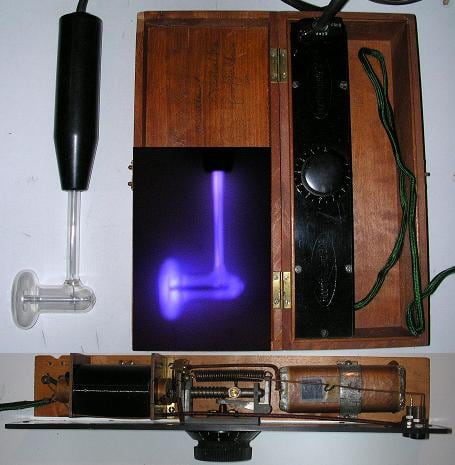
Vol 1 — The Handset and Its World established what a violet-ray wand is: a mains handset with a Tesla/Oudin coil driving a glowing glass electrode. This volume takes the lid off and traces how it worked, because almost everything the marketing said about the physics was either wrong or deliberately blurred. The good news for a museum reader is that the underlying engineering is neither mysterious nor fraudulent in itself — it is ordinary early-twentieth-century high-frequency apparatus. The fraud lived entirely in what people were told those sparks did.
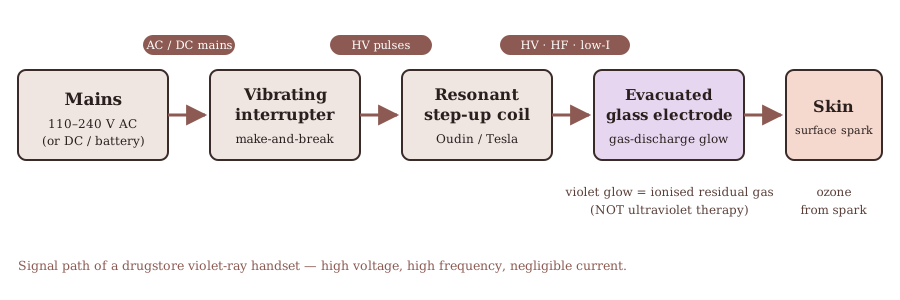
The chain is short: wall socket → a vibrating interrupter → a step-up resonant coil → a partially evacuated glass electrode pressed to the skin. The output is genuinely high-voltage, high-frequency, and very-low-current — a combination that can throw a stinging spark and light up a gas tube while being incapable of the deep, systemic effects the sellers promised.
Two facts do the heavy lifting in this volume, and every sibling repeats them: the violet light is a low-pressure gas discharge inside the electrode, not ultraviolet radiation, and the device is the retail cousin of a real hospital technology. The claims themselves — baldness, deafness, “nervous debility,” cancer — are dissected in Vol 4 — The Promise and the Reckoning; this volume establishes only the physics they were built on top of.
2.2 The signal path, stage by stage
Mains input. Because much of the 1910s–1920s world was only partly electrified, most handsets were built to run on either alternating or direct current, plugged into a lamp or wall socket, or in some models wired to a battery (IEEE Spectrum; Wellcome Collection). Nothing about the input was special; it was ordinary domestic power.
The interrupter. To get high frequency out of low-frequency (or steady) mains, the current first had to be chopped. A vibrating interrupter — a spring-loaded, make-and-break contact of the same family as an electric-bell or induction-coil interrupter, typically tungsten-tipped to survive the arcing — rapidly opened and closed the primary circuit (Wikipedia, “Violet ray”). Each break collapsed the magnetic field in the coil and produced a sharp high-voltage pulse. Wikipedia describes the standard construction plainly: “a disruptive discharge coil with an interrupter to apply a high voltage, high frequency, low current to the human body,” with the control box housing the interrupter and magneto coil and the Bakelite handle housing the high-voltage coil.
The resonant step-up coil. Those pulses drove a resonant transformer of the Oudin/Tesla type — a small air-cored coil in which a few turns of primary ring an untapped (Tesla) or tapped (Oudin) secondary at its natural frequency, stepping the voltage far up while the frequency rises into the radio range. IEEE Spectrum characterises one common design as producing roughly 1–2 kV to charge a condenser, which then discharged at about 4–10 kHz as the electrode passed over the skin, with a selector for spark intensity. (⟨verify — frequency figures vary widely between sources: the interrupter’s repetition rate, the low-kHz discharge rate cited by IEEE, and the much higher oscillation frequency of the resonant secondary are three different numbers that popular accounts routinely conflate. The output potential at the electrode is best described qualitatively as “tens of kilovolts, high frequency” rather than pinned to a single figure.⟩)
The electrode. The stepped-up output fed the glass electrode — the subject of the next two sections.
2.3 Why it glows violet
The electrode is a partially evacuated glass bulb, a direct descendant of the laboratory Geissler tube. Frederick Finch Strong is credited with adapting the Geissler tube into the medical vacuum (glass) electrode around 1896, sealing one terminal and fixing the other in an insulating handle (Cosmetics and Skin). When the high-voltage output is applied, the strong electric field ionises the thin residual gas inside the tube, and the recombining gas emits light — exactly the mechanism of a neon sign or Tesla’s wireless-lit bulbs (IEEE Spectrum; Wellcome Collection).
The colour is therefore a property of the gas fill and the degree of vacuum, not of any therapeutic “ray.” Air or argon at low pressure glows the characteristic violet-blue that named the device; period electrodes were also filled with neon (orange), mercury vapour, or simply rarefied air, and contemporary sources noted that “one of low vacuum emits a reddish glow… one of medium vacuum emits a bluish tint and one of high vacuum has a whitish appearance” (Cosmetics and Skin). Change the gas or the pressure and you change the colour, which is the clearest possible proof that the glow is a cold gas discharge inside the glass and not a medicinal emission passing through it.
2.4 Why it smells of ozone
Hold a powered electrode near the skin and a faint blue haze of tiny sparks jumps the gap, accompanied by the sharp, chlorine-swimming-pool smell of ozone. This is straightforward: the spark discharge in the air between electrode and skin carries enough energy to split ordinary oxygen molecules (O₂), whose fragments recombine into ozone (O₃) (Cosmetics and Skin). Some handsets even sold a dedicated “ozone generator” attachment and marketed the gas itself for “head and lung congestion” (IEEE Spectrum). The smell is real and the chemistry is real; the therapeutic claims built on it are not, and ozone at nose-catching concentrations is a respiratory irritant rather than a tonic.
2.5 What it genuinely did to skin
Stripped of the marketing, the honest list of effects is short. The device delivered a superficial, high-frequency spark to the skin surface. Because the current is minute and the frequency high, it does not cause the violent muscle contraction or pain of ordinary shock — the same reason high-frequency currents were of genuine clinical interest. What the user actually felt was a mild prickling, local warmth, a slight reddening from surface stimulation, and the ozone smell. In dermatological terms these amount to superficial stimulation and a mild counter-irritant effect — the transient flush and tingle that can make an area feel treated — plus whatever the placebo of an impressive glowing wand contributes. There is no mechanism by which any of it reaches, let alone cures, an internal organ. The energy simply does not penetrate, and the current is far too small to do systemic work.
2.6 The load-bearing debunk: violet is not ultraviolet
This is the single most important correction in the entire dive. The name “violet ray” invites the assumption that the device emitted therapeutic ultraviolet light — the same UV that, in the hands of Niels Finsen, had won a Nobel Prize in 1903 for treating skin tuberculosis, and that legitimate mercury-vapour “sun lamps” of the era really did produce. The violet-ray wand traded on exactly that association, and it was false.
The violet colour is visible light from the gas discharge, sitting at the blue end of the spectrum a reader can see; ultraviolet is invisible and lies beyond it. A low-pressure discharge and its skin spark do emit some incidental ultraviolet — period sources noted a high-vacuum electrode gives off “blue and violet, but also some ultra-violet rays” — but the amount is negligible, unfiltered, and nothing like the controlled therapeutic UV dose a mercury-vapour sun-lamp of the era actually delivered. IEEE Spectrum states flatly that the machines were “not in fact emitting ultraviolet light, or at least not in amounts that would be beneficial” (IEEE Spectrum); period high-frequency current was noted to have “but little, if any, ionizing power” (Cosmetics and Skin). Period critics put it in as many words — the devices “give forth a violet ray but are in no way similar to ultraviolet rays” — a characterization repeated across accounts of the era’s scrutiny, though its exact speaker and date are not firmly pinned (see Vol 4).
Why does the distinction matter? Because it was the whole trick. A buyer who conflated the pretty violet glow with real UV phototherapy imported a genuine medicine’s reputation into a device that could not do the job — the marketing let a harmless novelty borrow a Nobel Prize’s worth of credibility. Keeping “violet glow” and “ultraviolet therapy” strictly separate is how a modern reader avoids the exact confusion the sellers manufactured.
2.7 Drugstore wand versus the hospital machine
None of this makes the underlying physics quackery. The interrupter-and-resonant-coil apparatus in a violet-ray handset is the same family of hardware that serious clinicians used, and that history is told soberly in the High Frequency Currents dive (in Electrotherapy Devices). There you meet Jacques-Arsène d’Arsonval, who from 1889 showed that currents above roughly 5–10 kHz stop causing the pain and tetanus of ordinary shock; Paul Marie Oudin, who in 1893 added the resonator that reached higher potentials; and Nikola Tesla’s parallel high-frequency work — the very same resonant-coil lineage that ends in the wand on the drugstore shelf. It is even the same Frederick Finch Strong vacuum electrode.
The difference is not the physics but the marketing and the dose. The hospital version — d’Arsonvalization and its successors — used larger, better-controlled apparatus and, crucially, the one genuinely useful discovery in the whole field: that high-frequency current heats tissue safely, a finding that leads directly to diathermy. The retail version put a tiny coil in a Bakelite handle, kept the harmless surface spark and the pretty glow, threw away the careful clinical framing, and sold the light itself as the cure. Put simply: same physics, different marketing — that dive is the hospital version this wand is the retail version of.
2.8 Where this volume hands off
With the physics settled, the story turns to the objects and the people. Vol 3 — The Makers and Their Machines surveys the manufacturers — Renulife, Master Violet Ray, Fitzgerald, Fisher, Bleadon-Dun — and how a collector dates a set by its coil, case, and electrodes. Vol 4 — The Promise and the Reckoning sets the marketing claims against the physiology established here and tells the JAMA/FDA debunking and regulatory history. Vol 5 — Collecting, Restoring, and Displaying closes on identifying, safely powering (or not powering), and displaying a surviving set — where the exposed high voltage and aged insulation described in this volume become a real handling concern.
Sources
- What Was the Violet Ray Machine? — IEEE Spectrum — supported the Tesla-coil topology, the ~1–2 kV condenser / ~4–10 kHz discharge figures, the mains/battery AC-or-DC input, the gas-ionisation glow, ozone attachment, and the explicit “not emitting ultraviolet” correction.
- Tesla, quacks and violet rays — Wellcome Collection — supported the Tesla/d’Arsonval/Oudin lineage, the electrostatic-field gas-ionisation mechanism (the wireless-bulb analogy), ozone as a by-product, and AC/DC lamp-socket operation.
- Violet ray — Wikipedia — supported the “disruptive discharge coil with an interrupter,” the high-voltage/high-frequency/low-current characterisation, and the control-box/handle construction.
- High Frequency — Cosmetics and Skin — supported Frederick Finch Strong’s 1896 Geissler-tube-derived vacuum electrode, the vacuum-degree/gas dependence of glow colour, the spark-generates-ozone chemistry, and the “little, if any, ionizing power” point.
- Cross-reference (named in prose, not linked): the High Frequency Currents dive in Electrotherapy Devices — d’Arsonval (1889), Oudin (1893), Tesla, d’Arsonvalization, and the tissue-heating discovery that leads to diathermy.
Comments (0)