Trocars and Cavity Injection · Volume 5
Collecting Trocars and Aspirators
How a collector identifies and dates a cavity outfit — reading the metal and its finish, the point and button patterns, and the pump behind the tube — and why the safe thing to do with a surviving instrument is to clean it, catalogue it, and display it cold.
Contents
5.1 About this volume
This is the closing volume of the Trocars and Cavity Injection dive, and it belongs to the person holding the object. The four volumes before it explained what a trocar is — a long hollow tube, pointed at one end, that both withdraws and delivers (Vol 1 — The Instrument and Why Cavity Work Exists); how the water-powered aspirator makes suction out of the household tap by the Venturi effect (Vol 2 — The Water-Jet Aspirator); the tangled origin story and the makers (Vol 3 — Origins and Makers); and how cavity work turned arterial embalming into the transport-ready preservation the trade advertised (Vol 4 — Cavity Treatment and the Durable-Preservation Trade). Here we do the collector’s practical work: how to tell what you have, how to date it, and how to keep and show it.
It refers back rather than repeats. The physics of the Venturi jet pump stays in Vol 2; the Samuel Rodgers patent and the pen-point dispute stay in Vol 3. And it keeps the discipline of the whole sub-project: this is trade history, engineering, and collecting, described at the level of apparatus only. Every figure shows hardware, a catalog plate, or a diagram — nothing else — and nothing here is instruction to be performed on remains. In register it sits between two neighbours. The Cooling Boards and Corpse Coolers dive collects funeral furniture; the Electric Embalming Machines dive collects the arterial pump. This volume collects the small, hard, unglamorous plumbing that finished the job.
5.2 What a collector is actually buying
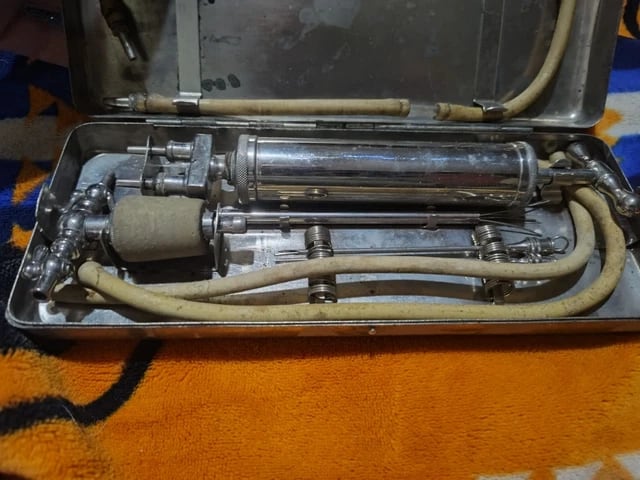
A cavity outfit is not one object but a small, related set, and the value is in how complete the set is. At its core is the hand trocar: a rigid hollow tube, sharpened to a point, with a handle or thumb-rest and a barbed fitting at the rear onto which tubing pushes. Around it cluster the pieces that made it work — a length of rubber (later clear plastic) tubing, an aspirator to provide suction, and a small screw-in trocar button with its plug key used to close the puncture afterward. Period supply houses sold these as a matched cavity outfit precisely because none of them is much use alone; a lone trocar on an auction table is a fragment of what was once a kit.
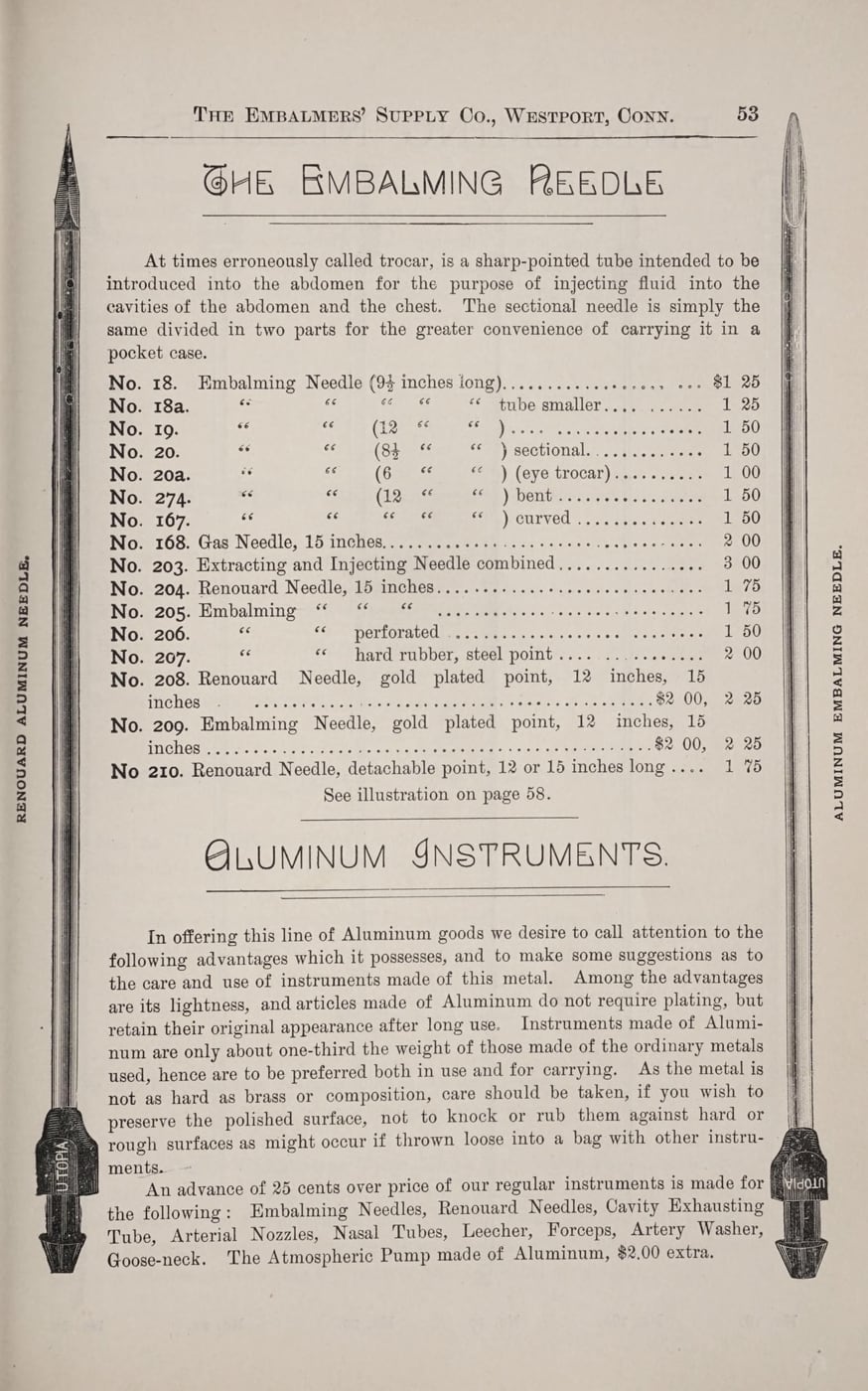
The trocar you are most likely to meet is the general adult instrument — a substantial thing, commonly around twenty-one inches overall. Alongside it the trade offered a shorter, slimmer infant trocar, cited at roughly twelve inches and a quarter-inch bore, small enough to double for hypodermic tissue injection (Vol 1 sets out these forms). A “complete” find keeps the trocar, its button and key, the tubing, and the aspirator together; far more often the rubber has perished and only the metal survives, which is the ordinary condition of these things rather than a defect.
The single most important habit for a collector is to read the maker’s mark before trusting the seller. Antique embalming instruments carry their identity in stamped or engraved lettering — a company name, a patent date, a model — on the shaft, the handle ferrule, or the aspirator body. That mark, cross-checked against the maker history in Vol 3, does more to date and attribute a piece than any amount of romance in a listing. Beware the reproduction and the theatrical prop: much of what circulates online is sold openly as “for cosplay, movie prop, oddities collection,” and those pieces are new metal dressed to look old.
5.3 Reading the metal: materials and finish as a dating cue
Because the trocar’s shape barely changed in a century, the surface is where much of the dating lives. The trade’s metals moved through a recognisable sequence, and the finish on a given instrument places it — loosely — within that arc.
The earliest instruments are brass, often nickel-plated: brass is easy to machine into the complex threads and points the work needs, and a nickel skin gave a brighter, more corrosion-resistant surface. Aged nickel-over-brass has a characteristic warm, slightly golden cast where the thin plating has worn or begun to let the brass beneath show through — a useful tell that you are looking at an early piece rather than a modern one. The trade then moved to chrome plating, which is harder, bluer-white, and more resistant to the aggressive chemistry of cavity fluid; chrome-plated brass survives today for exactly the fittings — trocar points, threaded couplings, aspirator bodies — where a machinable core and a tough skin both matter. Finally, and definitively in the modern era, came stainless steel, the present gold standard: it resists the corrosion that embalming chemicals inflict, holds an edge, and survives repeated sterilisation, which is why current makers build the whole instrument from it.
The practical reading, then: bare or nickel-plated brass leans early; bright chrome plating leans middle; solid stainless leans modern. These are overlapping tendencies, not hard dates — a good shop kept a serviceable brass trocar in use for decades, and a finish can be replated — so the metal is a cue to be weighed against the maker’s mark, the point pattern, and the tubing, never a stand-alone verdict.
The tubing deserves its own note, because it is the part that dates a set by dying. Early gum-rubber and latex hose perishes exactly as the cords do on a violet-ray set or the tubing on a gravity outfit: it goes brittle, cracks, and crumbles to sticky powder. Surviving original rubber is itself an early-set indicator (and a fragile one worth preserving as-found rather than replacing); clear, supple plastic tubing points to a later or restored outfit.
5.4 Points, buttons, and sizes: the small tells
If the finish gives the century, the details give the maker. Three of them repay close attention.
The point. The tip is the most characterful part of a trocar and the most useful for attribution. The trade named its patterns: the early pen-point — attributed in the 1912 trade text Anatomy and Embalming to Captain George Billow of Akron, Ohio, rather than to Rodgers, a credit Vol 3 unpicks — and later spiral and other cutting geometries. A collector treats the point pattern the way a philatelist treats a watermark: a small, deliberate feature that ties an unmarked instrument to a maker’s catalog line. Modern instruments favour a clean beveled point, so a distinctly patterned tip usually signals an older design.
The button. The trocar button is a small screw-in plug used to close the puncture, turned home with a matching plug key (essentially a threaded driver). A surviving button-and-key in the case is a completeness bonus and, being small and easily lost, is often the missing piece; its presence marks a kit that was kept together. Buttons appear in metal and, later, in plastic, another loose material cue.
The size. Overall length and bore separate the general adult trocar (~21 in) from the infant instrument (~12 in, ¼-in bore) and from the slimmest hypodermic-style tubes (Vol 1). Measure before you believe a listing; a “rare miniature trocar” is often just an ordinary infant trocar, which was a standard catalog item rather than a rarity.
5.5 Hand, water, or electric: identifying the suction source
The phrase “hand versus electric trocar” is worth handling carefully, because it is easy to get wrong. The trocar itself is almost always a passive hand instrument — an inert tube that does nothing until its hose is connected to something that moves fluid. What actually changed across the trade’s history, and what a collector is really dating, is the suction source behind the tube. A trocar is attached to a suction hose “usually attached to a water aspirator, but an electric aspirator can also be used”; the instrument is the constant, the pump is the variable.
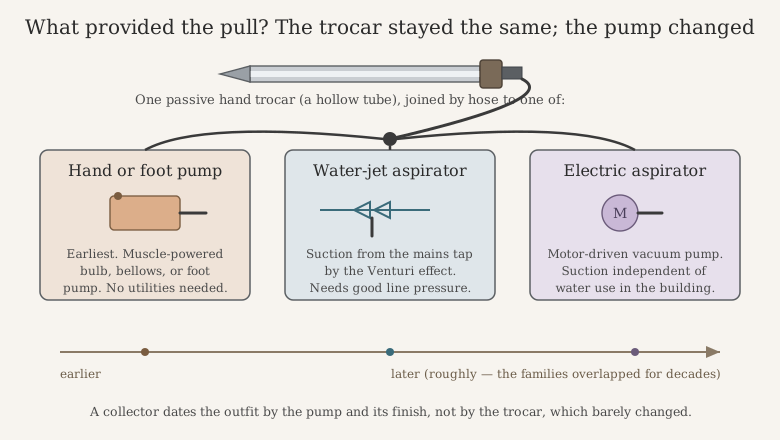
Three families cover almost everything a collector meets. The earliest is the hand or foot pump — a squeeze-bulb, bellows, or foot-operated pump that made suction from muscle, needing neither water nor wiring, and kin to the hand apparatus of the Hand Pump and Bulb Machines dive. Next is the water-jet hydro-aspirator, which draws its vacuum straight from the mains tap by the Venturi effect (Vol 2): fast water through a narrowed throat drops the pressure and pulls on a side port. It is the elegant, utility-dependent solution — a quality unit reaches around 26 inches of mercury of vacuum on a supply of about 60 psi, comfortably above the roughly 15 inches of mercury the work actually needs — and it fails when building water pressure sags. Last is the electric aspirator, a motor-driven vacuum pump whose suction is independent of the plumbing.
Which family displaced which is genuinely muddied in the sources, and this volume flags rather than settles it. One secondary trade account has water methods abandoned in the 1950s in favour of electric aspirators that held pressure more reliably; yet the water-jet hydro-aspirator remains a current, actively manufactured “workhorse of many mortuary preparation rooms,” valued for needing no electricity. The honest reading is that the three families overlapped for decades rather than replacing one another in a clean line, so a collector dates an outfit by the pump in front of them — its type, its maker’s mark, its finish — not by a tidy chronology. Named makers still trading are a useful reference point for surviving forms: Instrument Design & Mfg. Co. (whose all-stainless “Vacua” hydro-aspirator uses a chrome-plated brass backflow preventer), and the Slaughter Instrument Company of Stevensville, Michigan among them — the same catalog world, a century on.
5.6 Condition, safety, and display
A cavity outfit is a benign object to own, but it is a used medical instrument, and that governs how it is handled and shown. Grade it plainly. The metal is usually the survivor: look for pitting and corrosion from old chemistry, worn or flaking plating (an early-set cue, as above), bent points, and stripped threads on the button and couplings. The tubing is usually gone; treat perished rubber as spent and, if you want a complete display, keep the original as an artifact rather than forcing it back into service. The aspirator — hydro or electric — is graded like any small appliance: a hydro body for cracks and seized levers, an electric unit for a perished cord and a motor nobody should assume is safe to power.
The safety case is quieter than the violet-ray dive’s, but real. These instruments handled decomposition products and concentrated, formaldehyde-based cavity fluid, which is stronger than arterial fluid (Vol 1); a period instrument may carry chemical residue, and the sensible posture is to clean and neutralise a find, handle it with gloves, and never treat it as sterile or as usable equipment. The point is genuinely sharp — store and display it capped or sheathed. An electric aspirator is, like any pre-war mains appliance, an unsafe-until-proven antique: display it cold rather than plugging it in.
Displayed properly, a cavity outfit is a superb, sober artifact of the trade. Lay the trocar with its point protected, the tubing coiled, the aspirator and the button-and-key beside it, maker’s mark forward. Photograph and record everything — the mark, the point pattern, the finish, the measured length — because that record is the difference between “an old spike” and a dated, attributed instrument of the American funeral trade. Provenance seals it: a supply-house catalog page, an invoice, or a documented estate ties the metal to the professionalising shop trade the earlier volumes describe.
5.7 Where this volume hands off
This is the last volume of the Trocars and Cavity Injection dive. The instrument has been taken from first principles — the hollow tube and its dual role (Vol 1), the water-jet that pulled the vacuum (Vol 2), the contested makers (Vol 3), and the durable-preservation trade it enabled (Vol 4) — to the object a collector cleans and shelves. From here the Embalming Machines wing has one dive left to give: Cooling Boards and Corpse Coolers, the pre-refrigeration furniture that surrounded all of this hardware, where the collecting eye turns from machined metal to joinery, cane, and cast fittings. And readers arriving from the Quack Devices wing will feel the contrast one last time: where a violet-ray wand is a real spark dressed as a cure, the trocar is honest plumbing — an instrument that did exactly what its makers claimed, and asks a collector only to read it accurately and keep it safe.
Sources
- Trocar — Wikipedia — construction (obturator within a cannula vs. the one-piece embalming form), the three-sided point, and the embalming trocar’s use; general framing cross-checked against the trade sources below.
- Nunnamaker & Dhonau, Anatomy and Embalming (1912) — Project Gutenberg — attributes the “pen point trocar” to Captain George Billow of Akron, Ohio; used here for the point-pattern dating cue (the Rodgers/Billow priority dispute is developed in Vol 3).
- Embalming Tools 101 — American Mortuary Coolers (secondary) — the trocar’s aspirate-then-inject role, the trocar button/plug and its function of sealing the puncture; treated as secondary.
- A Practical Guide to Embalming Instruments and Their Uses — American Mortuary Coolers (secondary) — trocar and trocar-button description in a modern catalog context.
- Everything You Need to Know About Hydro Aspirators — American Mortuary Coolers (secondary) — the Venturi mechanism; the ~26” Hg vacuum on ~60 psi line pressure figure and the ~15” Hg actually needed; chrome-plated brass vs. stainless-steel and polymer construction; the “workhorse … no electricity” framing and the reversible water-flow lever. Materials and the ~26”/60 psi figures rest on this trade blog and want a maker-spec cross-check.
- Auction Finds — “Antique embalming machine that’s unnerving” (secondary) — collector context distinguishing an ~1910 machine from an 1870s hand-operated outfit, and the ~21-inch trocar length; a hobby/collector source, not primary.
- Instrument Design & Mfg. Co. — “Vacua” hydro-aspirator (maker, via eBay/product listings) — a current maker’s all-stainless hydro-aspirator with a chrome-plated brass backflow preventer, used only for surviving instrument forms and materials.
- Slaughter Instrument Company — hydro aspirators (maker) — a current embalming-instrument maker in Stevensville, Michigan, cited for the living catalog world of trocars and aspirators.
- Canton FSAD 121 Analytical Embalming Lab Manual (PDF, trade course) — that the trocar attaches to a suction hose “usually attached to a water aspirator, but an electric aspirator can also be used,” anchoring the hand-instrument/variable-pump distinction.
- Elite CME, “History of Embalming and Restorative Arts” (trade CE chapter, PDF) — secondary trade history for the aspiration-then-injection workflow and the materials/era arc; used as background and cross-checked against the primary patent in Vol 3.
Comments (0)