Trocars and Cavity Injection · Volume 3
Origins and Makers: Rodgers, Billow, and a Borrowed Instrument
Where the embalming trocar actually came from — a surgical drainage tool centuries older than embalming, simplified for the shop; the contested credit between Samuel Rodgers's 1880 patent and the folkloric 1868 date; and the makers, then and now, who put the instrument in the case.
Contents
3.1 About this volume
Vol 1 — The Instrument and Why Cavity Work Exists introduced the trocar as an object and flagged, rather than settled, the question of where it came from. Vol 2 — The Water-Jet Aspirator took apart the water-powered suction device that so often sits at the other end of its hose. This third volume is the one that owes the reader a straight answer to the origin question: who made the embalming trocar, when, and out of what.
The short version is that the trocar was not invented for embalming at all. It is a surgical drainage instrument centuries older than the undertaker’s trade, which the American funeral business borrowed in the 1870s–1880s and simplified for its own purposes. The credit for that borrowing is genuinely tangled — a much-repeated patent date does not match the surviving document, and the 1912 trade text that ought to name the inventor names a different man for a different part of the instrument. This volume sorts those threads out as far as the primary record allows, then turns to the makers who actually manufactured the thing, from the first American supply houses to the small firms still turning trocars today. The applied physics of the aspirator belongs to Vol 2; how cavity work became the transport-ready preservation the trade sold is Vol 4 — Cavity Treatment and the Durable-Preservation Trade; the hands-on business of dating and displaying a surviving instrument is Vol 5 — Collecting Trocars and Aspirators. The discipline is the same throughout: apparatus, patents, and makers only — never procedure on a body, and every figure a drawing, a plate, or an instrument in isolation.
3.2 The instrument that came first: surgical drainage
The word gives the game away. Trocar is an anglicisation of the French trocart, usually derived from trois-quarts (“three-quarters”) or trois carres (“three sides”) — both pointing at the triangular, three-sided point ground onto the original surgical stylet. The term is genuinely old: it is recorded by name in Thomas Corneille’s Dictionnaire des Arts et des Sciences of 1694, and the instrument’s underlying idea — puncture a swollen cavity, then leave a tube behind to let fluid run out — is older still, plausibly by centuries.
In its medical form the trocar is a two-part device: a pointed inner obturator (a stylet, metal or later plastic) carried snugly inside a hollow outer cannula, a rigid tube. The point does the piercing; then the surgeon withdraws the obturator and leaves the cannula in place as a drain. Its classic nineteenth-century job was paracentesis — tapping off the fluid that collects in ascites (abdominal dropsy) or hydrothorax (fluid on the chest) — a genuinely useful and sometimes life-prolonging procedure in an era with few other options. Patents for trocars appear early in the nineteenth century, and by mid-century the trocar-cannula had become a refined instrument: the best-known example is the Southey tube, the very fine silver drainage cannula introduced by the English physician Reginald Southey around 1877 for slow, ambulatory tapping of dropsical fluid. That surgical lineage runs on past embalming entirely — the same puncture-and-port principle became, in the twentieth century, the access port of laparoscopic surgery.
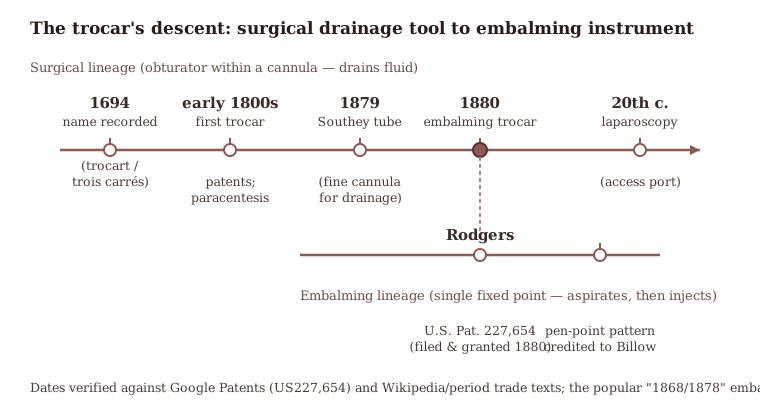
The point worth holding onto is that when the funeral trade needed a way to reach the body’s hollow interior — the engineering problem set out in Vol 1 — it did not start from a blank sheet. A mature, well-understood drainage instrument already existed, designed for exactly the task of puncturing a cavity and moving fluid through a tube. The trade simply reached for it.
3.3 What the trade borrowed, and what it changed
Borrowing is not copying, and the embalming trocar is not the surgical one. The single most important change the trade made was to discard the removable obturator and make the point part of the shaft — a one-piece, fixed-point tube rather than a stylet-within-a-sheath.
The logic is straightforward once the two jobs are compared. The surgeon wants a temporary channel: pierce, remove the stylet, leave the soft cannula behind, drain, then withdraw everything. The embalmer wants a permanent working channel that can carry flow in both directions — suction out, then fluid in — without ever being disassembled mid-task. A fixed point welded to a hollow, side-ported shaft delivers exactly that; a two-part obturator-and-cannula would only get in the way. So the embalming trocar is best understood as the surgical trocar’s simplified, ruggedised cousin: same ancestry, same three-syllable name, but a single rigid instrument built for repeated aspirate-then-inject cycles rather than one careful tap. The side ports set back from the tip, described in Vol 1, are the other trade-specific refinement — a surgeon draining a fluid pocket needs one opening; an embalmer working several directions from a single puncture needs many.
3.4 Samuel Rodgers and the contested date
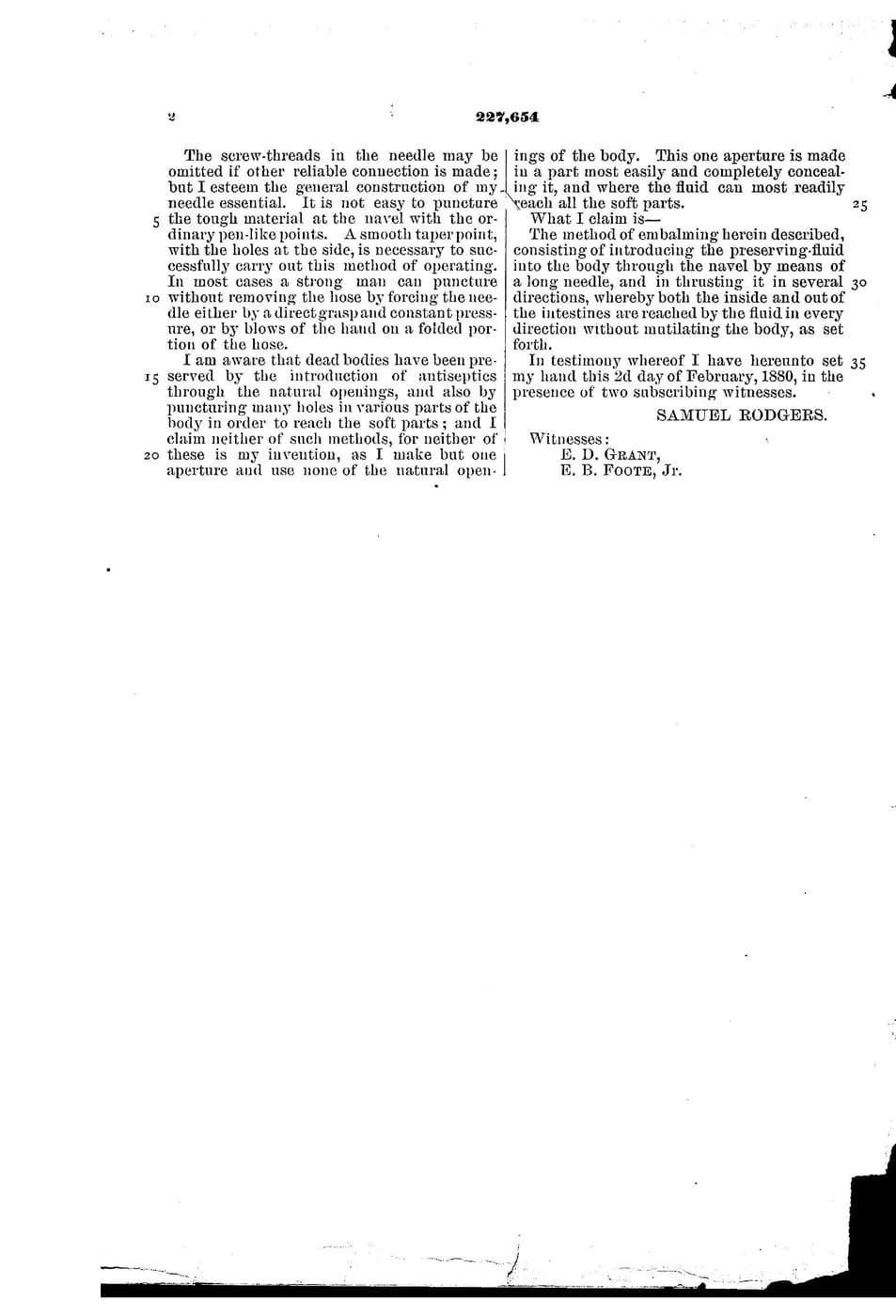
Credit for the embalming trocar is popularly given to Samuel Rodgers, and here the record and the folklore part company. Trade histories and study guides variously date his trocar to 1868, to 1878, or vaguely to “the mid-1870s,” and repeat that “the trocar was patented in two forms, with the latter issued specifically for a system of embalming.” Those dates are worth treating with suspicion, because the one document that can actually be produced tells a tidier — and later — story.
Rodgers’s surviving United States patent is No. 227,654, “Embalming” (an improvement in the means or methods of preserving dead bodies), granted to Samuel Rodgers of New York, N.Y.. It was filed 9 February 1880 and granted 18 May 1880 — not 1868, not 1878. The patent does not describe an instrument catalog-listed as a “trocar”; it describes a method: introducing preserving fluid “through the navel by means of a long needle,” a nickel-plated instrument “about seventeen inches long and one-fifth inch in diameter,” with “a smooth taper point, with the holes at the side,” thrust “in several directions” — “from two to ten thrusts” — so the fluid reaches the viscera “without mutilating the body.” That is unmistakably the cavity trocar’s working principle, laid down in a primary source with a firm 1880 date.
The 1868 date, in particular, should be read as folklore until a patent number is produced to support it — and repeated searching turns up none. The “two patents / two forms” claim is similarly unverified: no earlier Rodgers embalming patent surfaces in the public record to be the “former” of the pair, so the phrase is best treated as trade lore rather than fact. The honest position is that Rodgers’s documented contribution is the 1880 method patent, and any earlier date is unconfirmed. This is the tidying-up Vol 1 promised this volume would do.
3.5 Billow’s pen point and the divided credit
The credit muddle deepens when one consults the trade’s own near-contemporary account. Nunnamaker and Dhonau’s Anatomy and Embalming (1912) — the standard early textbook — does not name Rodgers in connection with the trocar at all. Where it explains the instrument’s origin, it credits a different man entirely: “Captain George Billow, of Akron, Ohio, a civil war veteran, and at present a member of the Ohio State Board of Embalming examiners, contrived the pen point trocar, which is still in use among the profession.” Before Billow’s point, the text says, “all kinds of instruments were used with which to introduce the fluid into the body cavities” — a picture of improvisation, not of a single 1868 invention.
Billow is a real and datable figure. He was a Union veteran who, after the war, “learned the embalming trade” and founded Akron’s first funeral home — the Billow undertaking business, established 1875 (the firm survives today). So the two claims need not contradict each other: they may simply describe different things. Rodgers’s 1880 patent covers a method — reaching the viscera through the navel with a long side-ported needle. Billow is credited with a specific, enduring point pattern — the pen-point geometry, named for its resemblance to a writing nib, that made the instrument cut and enter cleanly. A method contrived by one man and a point perfected by another can both be true, and both can be “the trocar” depending on which feature a given writer has in mind. The lesson for a careful history is to state exactly which claim rests on which source, and to resist the flattening urge to crown a single “inventor of the trocar.” The instrument is a composite of a borrowed surgical tool, a patented method, and a refined point — not one man’s flash of insight.
3.6 The makers, then and now
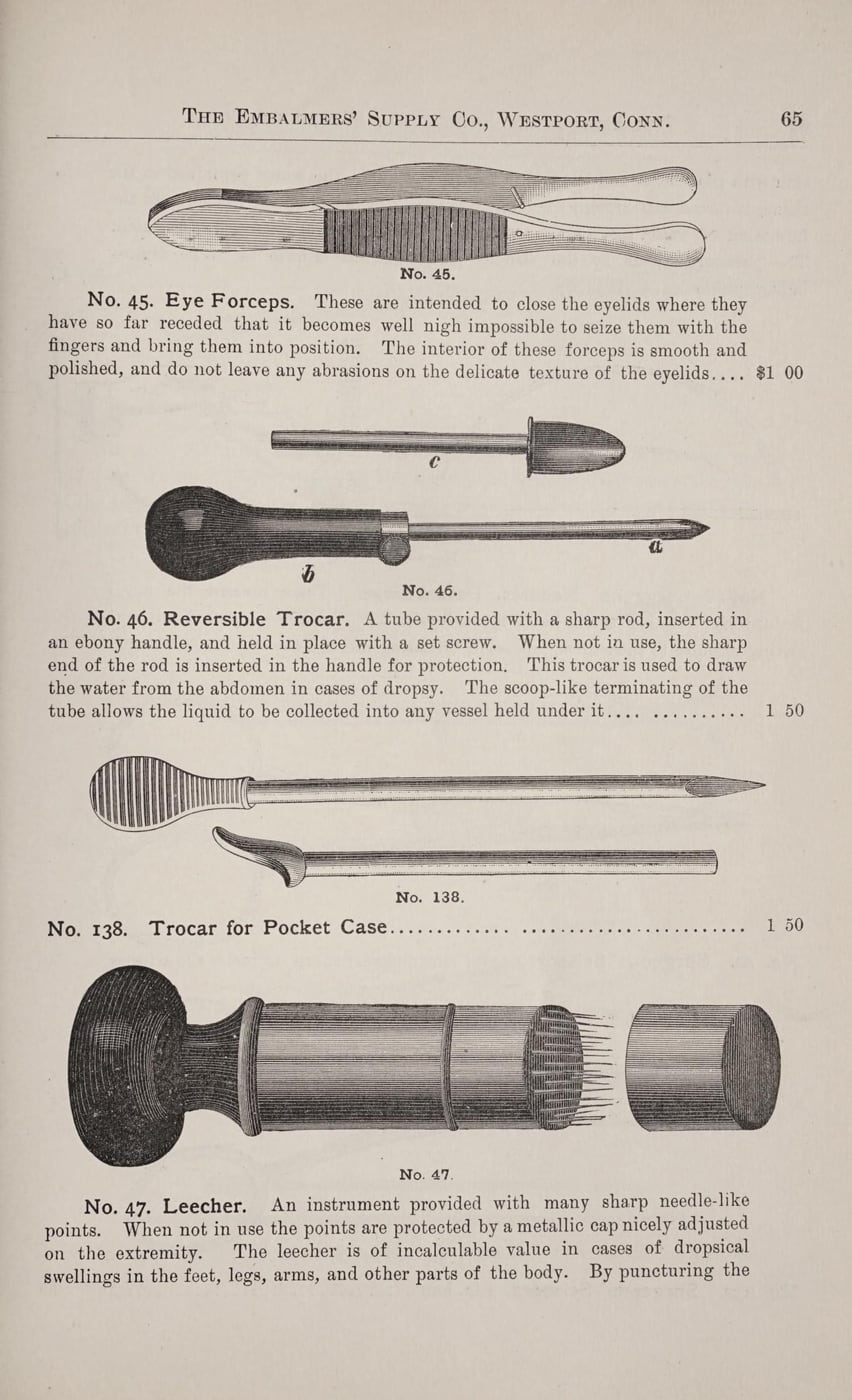
Origins are one thing; who actually manufactured the instrument is another, and here the trade’s supply houses matter more than any single inventor. As the Hand Pump and Bulb Machines dive in this wing records, American embalming instruments were largely imported from Germany or made by the user until the Embalmers’ Supply Company (ESCO) and its peers began domestic manufacture in the late 1880s. Trocars, points, buttons, and aspirators were sold from the same catalogs as arterial pumps — the matched trocar-and-aspirator outfit was a supply-house product, not a bespoke one. On the suction side, firms such as Dodge later became closely associated with the water-powered aspirator that so often partnered the trocar (its mechanism is Vol 2’s subject).
The instrument never went obsolete, so the maker record is unusually continuous — a collector can hold a modern trocar essentially identical in principle to an 1890s one. Present-day American manufacturers include the Slaughter Instrument Company of Stevensville, Michigan, which still machines trocars in a range of outer diameters and lengths; supply houses such as Lynch Supply carry stainless trocars with matching buttons, tubing, and handles; and specialist firms like the Instrument Design & Manufacturing Company produce trocars and aspirators for the trade. This continuity is a gift to the collector and a small trap: because the basic form barely changed, age cannot be read from shape alone — a point Vol 5 develops into proper dating guidance (materials, plating, maker’s marks, and case fittings do more work than the silhouette).
3.7 Hand versus powered: what “electric” really means
Collectors and catalogs both speak loosely of “hand trocars” versus “electric trocars,” and the phrase deserves a precise correction, because the engineering does not sit where the words imply. The trocar itself is inert. It is a hollow tube with a point; it has no motor and no moving parts, and it never did. Nothing about the instrument is “electric.”
What is — or is not — powered is the suction source at the other end of the hose, and that is where the real hand-versus-powered distinction lives. Three families supplied the pull over the trade’s history: early hand- and foot-operated pumps and bulb syringes, which the operator worked by muscle; electric aspirators, motor-driven vacuum pumps that made suction from mains electricity; and the hydro-aspirator, which makes suction from mains water by the Venturi effect and needs no motor at all. So when a listing offers an “electric trocar outfit,” what is electric is the aspirator; the trocar in the case is the same passive tube it would be beside a water aspirator. (True motorised trocars — a driven point advanced by a small motor — do exist in the modern surgical patent literature, but they are not the classic embalming instrument and should not be conflated with it.)
For the collector, then, the outfit is best classified by its suction unit, not its needle: a brass or chromed hydro-aspirator with faucet fittings, a corded electric aspirator with a motor and vacuum pump, or the earlier hand/foot/bulb apparatus — each a different era and a different price point. The trocar itself is the constant. Sorting those units, reading their maker’s marks, and judging their condition is the practical craft Vol 5 takes up in full; this volume’s job was only to establish that the “electric” in “electric trocar” was always a property of the pump, never of the tube.
3.8 Where this volume hands off
The origin question now has an honest answer. The trocar is a borrowed surgical drainage instrument — obturator-in-cannula, recorded by name in 1694, refined through the nineteenth century — which the funeral trade simplified into a one-piece, fixed-point tube. Its embalming credit is a genuine composite: a method documented in Samuel Rodgers’s 1880 patent (No. 227,654, not the folkloric 1868), a pen-point pattern the 1912 trade text assigns to George Billow of Akron, and a manufacturing tradition carried by supply houses from ESCO to today’s Slaughter and Lynch. And “electric,” it turns out, was never a property of the trocar at all — only of the aspirator behind it.
That last point sets up the two volumes still to come. Vol 4 — Cavity Treatment and the Durable-Preservation Trade shows how joining this instrument to arterial injection turned embalming into the transport-ready, professionalised preservation the trade advertised — the social and commercial payoff of the hardware assembled across the first three volumes. Vol 5 — Collecting Trocars and Aspirators then puts the instrument in the collector’s hand: how to date one when its shape barely changed in a century, how to tell a hydro-aspirator outfit from an electric one on a dealer’s table, and how to display the pair the catalogs always sold together. Readers arriving from the Quack Devices wing will again feel the difference in register — where a Radionics and Abrams Boxes device was an empty box sold as a diagnosis, the trocar is the honest opposite: a plain borrowed tube that did exactly, and only, the unglamorous job its makers described.
Sources
- Samuel Rodgers, U.S. Patent No. 227,654 — Google Patents — the primary document and the spine of this volume: Samuel Rodgers of New York, N.Y.; “Embalming”; filed 9 February 1880, granted 18 May 1880; the ~17 in × ⅕ in nickel-plated needle with “a smooth taper point, with the holes at the side,” introduced “through the navel,” “from two to ten thrusts,” reaching the viscera “without mutilating the body.” Used to correct the folkloric 1868/1878 dates.
- Trocar — Wikipedia — surgical lineage predating embalming: etymology (French trocart, trois-quarts / trois carres, three-sided point); the term recorded in the Dictionnaire des Arts et des Sciences, 1694; early-nineteenth-century trocar patents; obturator-within-a-cannula construction; paracentesis for ascites/hydrothorax; the Southey tube (Reginald Southey, ~1877); the modern laparoscopic descendant.
- Nunnamaker & Dhonau, Anatomy and Embalming (1912) — Project Gutenberg — the near-contemporary trade text that credits the “pen point trocar” to “Captain George Billow, of Akron, Ohio,” a Civil War veteran and Ohio State Board of Embalming examiner, and does not name Rodgers; notes that before Billow’s point “all kinds of instruments were used” to introduce cavity fluid. The basis for the divided-credit argument.
- Elite CME, “History of Embalming and Restorative Arts” (trade CE chapter, PDF) — secondary trade history stating the trocar was invented by Samuel Rodgers “in the mid-1870s” and “patented in two forms, with the latter issued specifically for a system of embalming”; treated here as the source of the conflicting dates and the unverified “two patents” claim, cross-checked against the patent above.
- Billow Funeral Homes — company history — corroborates Captain George Billow as a Union Civil War veteran who “learned the embalming trade” and founded Akron’s first funeral home, the Billow business, in 1875; used only to date and place Billow, not for the trocar attribution itself.
- The Slaughter Instrument Company — trocars and Lynch Supply — Trocars & Accessories — modern American makers/suppliers, used to establish the continuous manufacturing tradition and the trocar/aspirator/button/handle product family; Slaughter located in Stevensville, Michigan.
- Everything You Need to Know About Hydro Aspirators — American Mortuary Coolers (secondary) — used only for the hand vs. water vs. electric aspirator distinction that anchors the “what ‘electric’ really means” section; the Venturi mechanism itself is verified in Vol 2.
Comments (0)